
Tuesday, September 3, 2019

The Last Farmhouse in Manhattan


From Vintage News:
New York and Manhattan Island were originally settled by the Dutch and named “New Amsterdam”. The area included all of New York City and part of Long Island, New Jersey and Connecticut. Allegedly in 1626, Dutch governor Peter Minuit purchased the island from the local Native Americans, the Manhattans (an offshoot of the Algonquian tribe) for $26 of trinkets expecting the Indians to relinquish the land. 
By 1664 the English and taken over New Amsterdam and in 1686 it was the first city to be awarded a charter from the Crown. According to website myinwood, Jan Dyckman arrived in the New World sometime in the 1660s and began buying land. He acquired two hundred and fifty acres and set up a working farm with a farmhouse, barns, apple and cherry orchards, a cider mill, outbuildings and livestock. 
By the time of the American Revolution, his grandson William was in charge of the farm. When the British occupied Manhattan the Dyckman family was forced to flee to upstate New York. Afterwards the family returned to find their property destroyed. William immediately started building a new house for his family. 
When he died in 1787 the family offered the property for sale but his son, Jacobus, took over and increased the size of the farm. He stayed until his end in 1832 when his sons Michael and Isaac inherited the farm. Isaac left a will leaving the homestead to a cousin who was required to change his name from James Frederick Smith to Isaac Michael Dyckman in order to keep the property in the Dyckman name. (Read more.)
Share

Boys: Growing Frustrated by Living in a Feminized Society

From Intellectual Takeout:
Rules are great and necessary, but the fact is, we’re disallowing boys to be boys. We’ve taken away toys like guns and swords because they’re “dangerous.” We’ve medicated little boys because their movements and noise are too much for us to take. We’ve tried to make sure girls are equal and included, and thus removed the institutions where boys don’t have to compete against those of the opposite sex. 
Let’s face it: Little boys are different from little girls and adults. And unless we allow them to have outlets for natural boy play and ideas, we should not be surprised when they seem frustrated and can’t succeed in modern society. Is it time to stop treating the traditional, rough-and-tumble boy like a dangerous creature who must be toned down to suit feminized society? (Read more.)
Share

The Role of Islam in African Slavery

From Thought.com:
The Qur'an prescribes a humanitarian approach to slavery: free men could not be enslaved, and those faithful to foreign religions could live as protected persons, dhimmis, under Muslim rule (as long as they maintained payment of taxes called Kharaj and Jizya). However, the spread of the Islamic Empire resulted in a much harsher interpretation of the law. For example, if a dhimmi was unable to pay the taxes they could be enslaved, and people from outside the borders of the Islamic Empire were considered an acceptable source of slaves. 
Although the law required owners to treat slaves well and provide medical treatment, a slave had no right to be heard in court (testimony was forbidden by slaves), had no right to property, could marry only with permission of their owner, and was considered to be a chattel, that is the (moveable) property, of the slave owner. Conversion to Islam did not automatically give a slave freedom nor did it confer freedom to their children. Whilst highly educated slaves and those in the military did win their freedom, those used for basic duties rarely achieved freedom. In addition, the recorded mortality rate was high -- this was still significant even as late as the nineteenth century and was remarked upon by western travelers in North Africa and Egypt. 
Slaves were obtained through conquest, tribute from vassal states, offspring (children of slaves were also slaves, but since many slaves were castrated this was not as common as it had been in the Roman empire), and purchase. The latter method provided the majority of slaves, and at the borders of the Islamic Empire vast number of new slaves were castrated ready for sale. The majority of these slaves came from Europe and Africa -- there were always enterprising locals ready to kidnap or capture their fellow countrymen. (Read more.)
Share

Monday, September 2, 2019

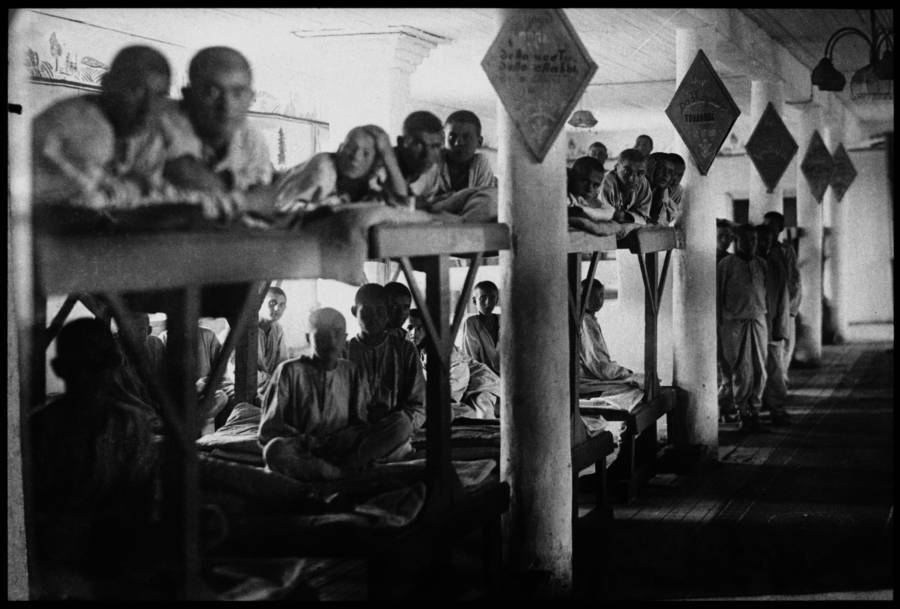
Photos from the Gulag

From All That's Interesting:
The history of forced labor camps in Russia is a long one. Early examples of a labor-based penal system date back to the Russian empire, when the tsar instituted the first "katorga" camps in the 17th century. Katorga was the term for a judicial ruling that exiled the convicted to Siberia or the Russian Far East, where there were few people and fewer towns. There, prisoners would be forced to labor on the region's deeply underdeveloped infrastructure — a job no one would voluntarily undertake. 
But it was the government of Vladimir Lenin that transformed the Soviet gulag system and implemented it on a massive scale. In the aftermath of the 1917 October revolution, Communist leaders found that there were a number of dangerous ideologies and people floating around Russia — and nobody knew how fatal an inspiring new ideology could be better than the leaders of the Russian Revolution. 
They decided that it would be best if those who disagreed with the new order found somewhere else to be — and if the state could profit from free labor at the same time, all the better. Publicly, they would refer to the updated katorga system as a "re-education" campaign; through hard labor, society's uncooperative elements would learn to respect the common people and love the new dictatorship of the proletariat. 
While Lenin ruled, there were some questions about both the morality and the efficacy of using forced labor to bring exiled workers into the Communist fold. These doubts didn't stop the proliferation of new labor camps — but they did make progress relatively slow. That all changed when Joseph Stalin took over after Lenin's death in 1924. Under Stalin's rule, the Soviet gulag prisons became a nightmare of historic proportions. (Read more.)

From Russia Beyond:
"For Russia," said Yarovskaya, "massive repressions are a more vital part of history than the Holocaust. And yet, in the center of Moscow there is still no major museum or monument in honor of the victims. I'm astounded by the absence of a global repentance." 
Gregory, Yarovskaya’s partner in the project, played an important role in focusing the subject matter of the film to female victims of the GULAG. A professor of economics at the University of Houston as well the director of the Hoover Archives Workshop on Totalitarian Regimes, Gregory is the author of the book Women of the GULAG, which tells the stories of some of the same women as the film. (Read more.) 
Share

Democratic Party Passes Resolution Against Christianity

From The Stream:
The Democratic National Committee has taken its stand, and it’s against orthodox Christianity. It passed a resolution last Saturday calling for the Party to be more inclusive toward non-believers. On its own that’s not remarkable. But the document also strongly denounces Christian belief and action. The key paragraph:
Those most loudly claiming that morals, values, and patriotism must be defined by their particular religious views have used those religious views, with misplaced claims of “religious liberty,” to justify public policy that has threatened the civil rights and liberties of many Americans, including but not limited to the LGBT community, women, and ethnic and religious/nonreligious minorities …
The party’s hostility toward Christian beliefs and values was clear enough before. Putting it on paper this way, however, raises the message to another level. The Democrats want to see Christians on the defense. And they’re good at putting us there. They have special skill with scare words. Even the simple word “particular” makes us look small, small-minded, and off in an intellectual corner somewhere. Of course none of that is true. (Read more.)
Share

Dead Planets

From Archaeology News Network:
In new research led by the University of Warwick, scientists have determined the best candidate white dwarfs to start their search, based upon their likelihood of hosting surviving planetary cores and the strength of the radio signal that we can 'tune in' to.

Published in the Monthly Notices of the Royal Astronomical Society, the research led by Dr Dimitri Veras from the Department of Physics assesses the survivability of planets that orbit stars which have burnt all of their fuel and shed their outer layers, destroying nearby objects and removing the outer layers of planets. They have determined that the cores which result from this destruction may be detectable and could survive for long enough to be found from Earth. (Read more.)
Share

Sunday, September 1, 2019

Why Sunday Family Dinners Need To Make A Comeback

From Do You Remember?:
One of the most important parts of my upbringing is centered around my family. At the end of the day, after school and work had settled, we all congregated to the dinner table and talked with one another about the day’s events. Not just on Sunday, but every day. However, Sunday is known as a pretty common family day, so where have our Sunday family dinners disappeared to?  (Read more.)
Share

Hope in a Small Town

From Human Events:
Now, I am a 55-year-old man, but my wife says my best qualities are my ability to re-examine my priorities and start fresh if I need to. I began to read: I read people like Mollie Hemingway, Sean Davis—even Ben Shapiro. I began to see that they understood what I didn’t: America was still great, and could get even greater under Trump and these new conservative ideas. 
One thing that happens when you approach death is that you think about your legacy. You think about children and what kind of nation you want to leave behind for them. After eight years of hearing how America and Americans were deplorable, colonialists, and inherently unjust, I had become downtrodden. I had lost my pride. 
Now, I began to remember that America was always great. And like all great men, this nation had its flaws, sure, but it maintained a tried and true method to correct and better itself. These young warriors forced me to reflect, remember, and not be ashamed of being American. (Read more.)
Share

Viking Drinking Hall

From Archaeology News Network:
Although only partly uncovered at this stage, the Skaill hall has parallels with other Norse halls excavated in Orkney, such as Snusgar, and elsewhere in Scotland. The find provides tantalising evidence for the earliest phases of habitation on this farm and settlement mound which may well have been inhabited for over 1000 years. It provides another piece to the 5000 year jigsaw along this archaeology rich stretch of coast at Westness on Rousay – the ‘Egypt of the north’. (Read more.)
Share