Wednesday, July 3, 2019

A Century of Disorder

From Chronicles:
A hundred years ago, on June 28, 1919, the Treaty of Versailles was signed in the illustrious Hall of Mirrors, the same spot where the German Empire was proclaimed in January 1871. It was the most ambitious gathering of its kind in history. Leaders and diplomats of 27 nations convened to establish a new order and make the world “safe for democracy,” as President Woodrow Wilson had summarized America’s war aims in his message to Congress two years earlier.

Far from reestablishing a solid new order after over four years of carnage and destruction, the Treaty was deeply flawed from the outset. It produced an unstable system which lacked legitimacy in the eyes of the vanquished states, especially Germany. This hindered their prospects of eventual integration into the new order, or even their willingness to try doing so in good faith. Perhaps it could not have been otherwise:
The war had been of such magnitude – affecting so many lives directly, creating both domestic and international divisions, and engendering insatiable expectations of the peace – that the peacemakers were all but impotent to deal sensibly with its consequences. This was not a settlement in which the peacemakers carelessly let the opportunity for consensus–building slip through their fingers: the basic problem of Versailles was that no such consensus could possibly be found.
“Versailles” contained the seeds of another, even more destructive war a generation later. On the centennial of the convening of the conference I wrote an article for the print edition of Chronicles (“A Century of Disorder,” January 2019) dealing with the Treaty’s shortcomings and their consequences. Today’s anniversary calls for a rewrite and more detailed treatment of some key themes. The subject is relevant in our own time: since the end of the Cold War, the bipartisan “foreign policy community” in Washington has been trying to create and uphold an international system based on America’s self-proclaimed authority to impose the universal regime of “benevolent global hegemony.”

The misnamed “international community” of our more or less reliable allies and partners excludes over two-thirds of humanity (China, India, Russia, Iran, subsaharan Africa, most of the Muslim world, much of Latin America). Outside its domain, the “rules-based liberal international order” is regarded as illegitimate ab initio and tainted by wanton illegality (as illustrated by the hegemon’s regime-change mania, promiscuous sanctioning of friend and foe, and undeclared wars against optional enemies).

A major weakness of the Versailles system was that two major European powers were not present. Germany and her allies were excluded until after the details of all the peace treaties had been agreed upon by the Big Four – France, Britain, the United States and Italy – and presented as faits accomplis to each of them separately. This was in marked contrast to the Congress of Vienna (November 1814-June 1815), which secured almost a century of relative stability and unprecedented prosperity to Europe. (Read more.)

Share

Obama Built The ‘Cages’ for Illegals

From PJ Media:
It was only a few months ago that Democrats were dismissing the crisis at the border as manufactured by Trump, and now they’re comparing migrant detention centers to concentration camps and blaming Trump for “putting kids in cages.” But for those still trying to blame President Trump, Barack Obama’s former ICE chief, Thomas Homan, has a reality check for them. Speaking at a conference hosted by the Center for Immigration Studies, Homan explained that the “cages” Democrats are blaming on Trump were the product of the Obama administration:
“I’ve been to that facility, where they talk about cages. That facility was built under President Obama under (Homeland Security) Secretary Jeh Johnson. I was there because I was there when it was built,” said Thomas Homan, who was Obama’s executive associate director of Immigration and Customs Enforcement for nearly four years. At an immigration conference today, Homan, under consideration for a new position of “border czar” in the Trump administration, grew visibly angry answering a question about “cages” often cited by Democratic critics of the president. Homan, who ran Obama’s successful deportation operation, ripped Democrats who question Trump immigration officials on the Obama-era idea. He cited one Democratic chairman who asked a Trump official, “You still keeping kids in cages?” Homan, at the conference hosted by the Center for Immigration Studies, said, “I would answer the question, ‘The kids are being housed  in the same facility built under the Obama administration.’ If you want to call them cages, call them cages. But if the left wants to call them cages and the Democrats want to call them cages then they have to accept the fact that they were built and funded in FY 2015.”
Homan explained that the fencing that separates kids from adults is done for safety reasons. “It’s chain link dividers that keep children separate from unrelated adults. It’s about protecting children,” he said. He also added it’s only temporary accommodations until they are moved elsewhere by the Department of Health and Human Services. According to a Google News search, only conservative media seems to be talking about Homan's comments. Gee, I wonder why. (Read more.)

This has to stop. We need that wall. From Breitbart:
 Women and young girls from Central America are routinely given birth control or morning-after pills by their mothers in anticipation of the likely sexual assaults that will occur on their illicit journey to the United States. These females are often raped immediately upon making it to their first stop once they arrive in a Mexican stash house from Guatemala. They then are shipped to the U.S.-Mexico border, usually to Reynosa, Mexico, immediately south of McAllen, Texas. In the process of making it from the first stash house to the second, the women and young girls are often sexually assaulted or raped again by the smuggler–or group of smugglers–taking them between the two locations. The sexual assaults and rapes then often happen again in the second Mexican stash house of their journey. They are then trickled into the U.S. across the porous border and brought to a third stash house in a U.S. border town, usually in or near McAllen, Texas. They are often sexually assaulted or raped again by the operator of the stash house if they are deemed attractive by the criminals operating the clandestine facility. They are stockpiled until the cartel wants to send a large load of narcotics across the Rio Grande. The cartel then sends a large load of humans across in one area and then a drug load across in another. (Read more.)

From The Miami Herald:
The wave of minors crossing the border without family was the first group of many expected to arrive at the site as they continue to flee Central America.
It’s the first time South Florida houses unaccompanied minors. More than 200 are currently residing at the shelter, which has the capacity for 600 more. The children are ages 13 to 17 and are from Honduras, Guatemala and El Salvador. All kids under 13 are placed in a permanent shelter.
The federal government operates about 100 permanent shelters across the country, but the Homestead site is the only temporary shelter currently active and was opened to handle the overflow of youths awaiting an immigration hearing. “Let’s go back in time. In 2014, the surge of unaccompanied minors crossing the borders left pictures of kids piled up at border patrol. There was not enough capacity for the 58,000 referred to our care the highest ever in the program’s history,” HHS spokeswoman Stephanie Acker Housman said. “That’s when [the U.S. Department of Health and Human Services] started to work with Homeland Security to make improvements and increase preparedness by setting up additional temporary shelters.”
In 2015, about 33,000 minors came through the system — the nation’s second highest in history, Housman said. However, a temporary shelter wasn’t needed. “In the fall of 2016 we saw an uptick in referrals and that’s why we’re in Homestead right now,” Housman said, adding that at the previous temporary shelters used in the summer of 2014, it cost about $500 a day to care for each minor. She said HHS “does not yet know” what it will cost to house the children at the Homestead location until “some time passes.”
The Job Corps site was a good shelter candidate because it is federal land, and already had a facility with ample space, cafeterias and dormitories. The complex includes the former Job Corps building, which can sleep 800 children, plus newly erected tents that house bathroom, laundry and other facilities. (Read more.)

Read more here: https://www.miamiherald.com/news/local/immigration/article86137097.html#storylink=cpy

More help. From the Catholic News Agency:
On Thursday, a group of attorneys who interviewed migrant children about the detention center conditions asked a federal judge to issue an emergency order that the centers be inspected immediately and that the conditions be improved, the Washington Post reported. Late Thursday, the House passed a Senate-approved emergency relief bill that would give $4.6 billion in aid for the humanitarian crisis on the border. The bill now goes to President Donald Trump. One of the biggest needs on the border is legal aid to help children reunite with their families, Herndon-De La Rosa said. That is why part of the donations from the drive will go to Immigrant Families Together, a legal group dedicated to reuniting families.

One of the challenges for pro-life people who want to help with the border crisis, Herndon-De La Rosa added, is that some of the larger corporations doing good work at the border also have ties to abortion funding. The groups that New Wave Feminists chose for their donations, including the legal group as well as two humanitarian respite centers, were vetted accordingly. One of the chosen respite centers - which is where families are reunited after detainment - is run by Sister Norma Pimentel, executive director of Catholic Charities of the Rio Grande Valley. “We should be able to stand with the vulnerable wherever they are,” Herndon-De La Rosa said, “and that extends beyond the womb.” (Read more.)

More HERE and HERE. Share

The Great Famine of the Ukraine

From The Atlantic:
In the years 1932 and 1933, a catastrophic famine swept across the Soviet Union. It began in the chaos of collectivization, when millions of peasants were forced off their land and made to join state farms. It was then exacerbated, in the autumn of 1932, when the Soviet Politburo, the elite leadership of the Soviet Communist Party, took a series of decisions that deepened the famine in the Ukrainian countryside. Despite the shortages, the state demanded not just grain, but all available food. At the height of the crisis, organized teams of policemen and local Party activists, motivated by hunger, fear, and a decade of hateful propaganda, entered peasant households and took everything edible: potatoes, beets, squash, beans, peas, and farm animals. At the same time, a cordon was drawn around the Ukrainian republic to prevent escape. The result was a catastrophe: At least 5 million people perished of hunger all across the Soviet Union. Among them were nearly 4 million Ukrainians who died not because of neglect or crop failure, but because they had been deliberately deprived of food.

Neither the Ukrainian famine nor the broader Soviet famine were ever officially recognized by the USSR. Inside the country the famine was never mentioned. All discussion was actively repressed; statistics were altered to hide it. The terror was so overwhelming that the silence was complete. Outside the country, however, the cover-up required different, subtler tactics. These are beautifully illustrated by the parallel stories of Walter Duranty and Gareth Jones. (Read more.)
Share

Tuesday, July 2, 2019

Decree on the Dissolution of Religious Orders of 1782

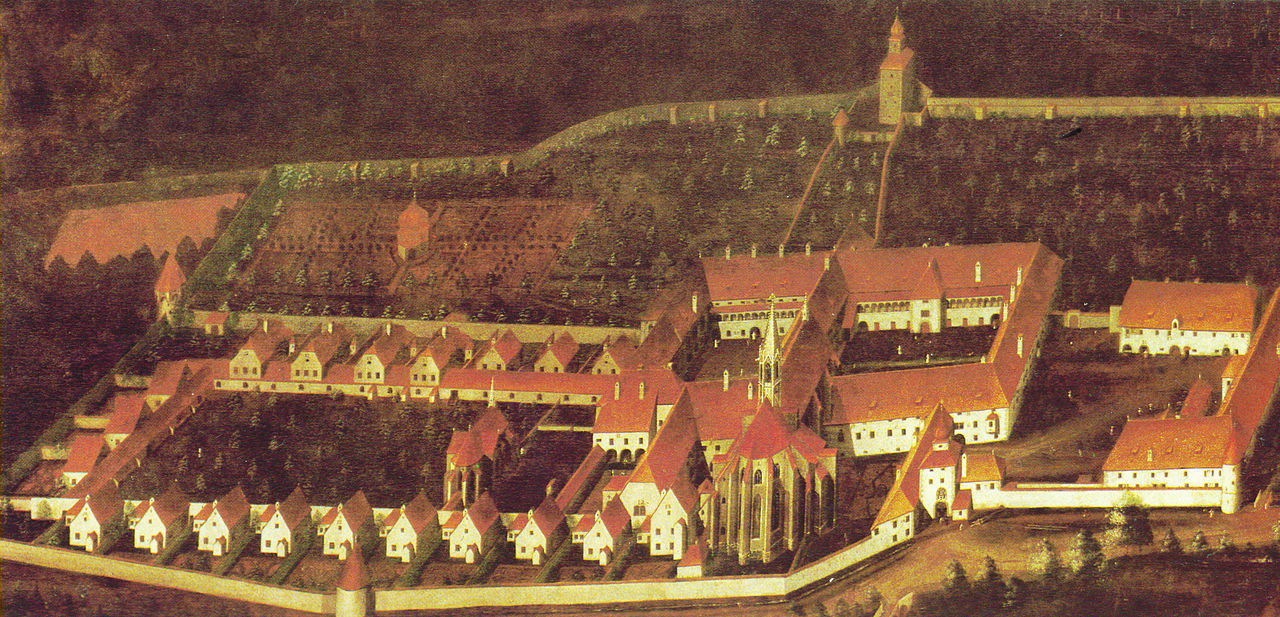
The Gaming Kartause today
The following is an article about the closing of monasteries under the liberal Joseph II. In the 1990's I was blessed to visit the beautiful former Carthusian Monastery in Gaming, Austria, closed by the imperial decree in the 1790's. From Eduard Habsburg at First Things:
Some readers may have never been guests in a contemplative monastery or convent. Today, genuine contemplation can be hard to find. Several times in recent months I have had the privilege of being a guest in such a place. This enclosed and protected environment, with its total concentration on prayer, sacrifice, spirituality, great simplicity, purity, and the contagious cheerfulness of the sisters behind their grilles—all this is infinitely valuable and easily damaged. It is something that every town, every country should thank God for; the contemplative life bears the most precious spiritual fruit. It is something for which, if it were threatened, one would give life and limb.

We must imagine this kind of life and world—innocent, vulnerable, full of the most profound trust in state and Church, where everything is ordered for the sake of prayer and community life—that suddenly was overtaken by an unprovoked and undeserved apocalypse of destruction, simply because an emperor decided that it was “useless.”

The storm began to wreak havoc at the beginning of 1782, although it was brewing in the time of the Empress Maria Theresia, and that of her father, Charles VI. For decades there had been talk of reforming the religious houses. At the end of 1781, however, problems had arisen at the Carthusian house of Mauerbach, and Emperor Joseph II's anger grew. This is what he wrote on December 6, 1781:
There is longstanding evidence that those Orders that are of no practical use to their neighbors are not pleasing to God: accordingly I have commanded the Chancellery to send Commissioners to list those Orders (of men and of women) in all crown lands that neither maintain schools nor care for the sick, nor are prominent in other useful activities: their inmates shall be ejected and given their liberty. Those who are not so numerous may leave our lands without a pension, or else they may apply to the local authorities to be dispensed from their vows... These Orders I understand to include all the Carthusians, Camaldolese and Hermits, and also all the women Carmelites, Poor Clares, Capuchin Sisters, and the like, who neither educate the young nor maintain schools, nor take care of the sick, but, whether men or women, merely lead a contemplative life.
On January 12, 1782, judgment was served on places of “uselessness.” One hundred and forty contemplative houses were closed in the first wave: This meant that around 1,500 religious sisters and brothers had to leave. Just imagine: All the contemplative monasteries and convents that could not be turned into schools and hospitals were shut—thereby putting a definitive end to their “enclosure.” In certain cases, members of the Orders were settled in other, non-contemplative houses, but in most cases they were simply “sent home.” Only a small number managed to make the change into a “life of usefulness.” Joseph II did not stop here, however. He began closing non-contemplative monasteries and convents also, with the result that in this first wave (1782–83), 400 religious houses were closed.

In 1782, Pope Pius VI made a fruitless journey to Vienna to discuss the matter with the emperor. This visit achieved nothing. Dissolutions continued and even increased. A second wave, beginning in 1783, engulfed another 800 houses in Austria and the crown lands. In 1791 Emperor Joseph II had envisaged a third wave of 450 closures; only his death prevented them from being carried out. In the end, two-thirds of all religious houses were closed, and not a single contemplative Order was left. (Read more.)
The Gaming Charterhouse before its closing

Share

The Real Fascists

From The Spectator:
The reason Andy was targeted is because the outlets he writes for, including Quillette where we both work as editors, frequently challenge hard-left dogma. Andy is best known for the investigative work he has done exposing hate crimes hoaxes, such as the Jussie Smollett incident, but he’s also filmed criminal acts by Antifa activists in Portland, including violent assaults, and posted them on Twitter, thereby earning the group’s lifelong enmity. He and his family have been doxxed numerous times, with activists publicizing his home address on social media.

In the attack, Andy received cuts and bruises to his face and head, including a torn earlobe, and had thousands of dollars worth of camera equipment smashed or stolen. He was taken to the local hospital, where it was discovered he had a small bleed to his brain and, as a result, he was kept in overnight. His friend Michelle Malkin has set up a Gofundme page where well-wishers can make donations to pay for additional security, his medical needs and to replace his camera equipment. (Read more.)

From Byron York at The Washington Examiner:
The toxicity of the resistance to President Trump has risen in recent days, with the nation's most respected newspapers publishing rationalizations for denying Trump supporters public accommodation and for doxxing career federal employees, while a journalist found himself under physical attack from the so-called anti-fascist group Antifa, which has stepped up its violent activities since Trump's election.

The justification for denying public accommodation came from the Washington Post in an op-ed by Stephanie Wilkinson, the owner of a farm-to-table restaurant in Lexington, Virginia. Wilkinson became famous in June of last year, when she refused to serve White House spokeswoman Sarah Sanders and and told Sanders and her family to leave the restaurant. Wilkinson's staff then followed the Sanders group in protest as they tried to find another place to eat. Wilkinson later told the press she ejected Sanders because the Trump administration is "inhumane and unethical" and because the Red Hen "has certain standards that I feel it has to uphold, such as honesty, and compassion, and cooperation." (Read more.)

From David J. Harris:
Senator Ted Cruz has called on federal law enforcement to investigate and prosecute Portland Mayor Ted Wheeler for ordering the police to stand down and allow Antifa fascists to attack journalist Andy Ngo, sending him to the hospital after blood was found leaking from his brain.  Wheeler must have ordered the police to stand down even though Antifa announced their intention to target Ngo, who is a gay Asian…hardly what you would call a fascist. Wheeler has a long history of ordering the police to stand down and allowing Antifa to attack people. It’s time to lock him up, perhaps. (Read more.)

From The American Thinker:
The Washington Post is all-in on stoking the fire of public harassment of Trump supporters, denying them public accommodations. So much for civility and mutual respect. That’s the only conclusion to draw from this op-ed (non-paywall version here) published by the largest newspaper in our nation’s capital, written by Stephanie Wilkinson, the owner of the Red Hen Restaurant that kicked out Sarah Sanders and her family while dining there. The paper proudly tweeted out its contribution to the loss of civility. (Read more.)
Share

Manners in Genesis

From Aleteia:
The beauty of this story is that Abraham and Sarah didn’t question the importance of offering comfort and sustenance to their guests — three total strangers. No doubt they were busy, with a lot to do that day. But hospitality for the ancient peoples of the Middle East was considered a mitzvah, a commandment from God. If a stranger was in need of food or drink, or a place to rest or sleep, it was a sacred duty to see to those needs. Never mind your to-do list, there were people in your midst who needed to be welcomed and cared for. 
What can Abraham and Sarah teach us today? For one thing, that hospitality isn’t about throwing parties with impressive cocktails, but treating anyone who comes into our home with respect. Today, when so many people are busy and lonely, anxious and depressed, something as simple as a warm welcome can be a life-changing balm. And Abraham and Sarah can also teach us that hospitality changes us. Not only does it teach us to set aside our own needs for someone else, but shows us that we never know what God wants to do for us through others. In Abraham’s and Sarah’s case, their three guests told them of a great promise: that the following year, the old couple would finally have a child. And so they did. (Read more.)
Share

Monday, July 1, 2019

Restoration of the Doddington Hall Tapestries


From The Lincolnite:
The tapestries are important for two reasons. Firstly, the way they were chopped up and nailed to the walls like wallpaper, is very unusual. Normally tapestries were woven to fit panels and treated like a painting within a decorative scheme.

Secondly, the Doddington tapestries are very rare examples of the coarser, every day tapestries which were made in large quantities but not cherished and looked after like their more finely stitched and expensive counterparts. While more of the expensive, fine tapestries survived, there are few examples like those at Doddington.

Claire said: “We’re so excited to be able to unveil the newly conserved tapestries. We took an unusual approach in doing the work in full view of our visitors, but it was worth it; visitors have been fascinated and they, along with us, the conservators, funders, volunteers are all thrilled to see the result.

“As owners and guardians of the Hall our focus is always on the upkeep, maintenance and preservation of the house and estate for the future and this project has helped show visitors just what this involves.” (Read more.)

More HERE. Share

More on Reparations

From Larry Elder:
Just 26% of Americans support reparations. In fact, according to conservative Michael Medved, since so many of today's non-black Americans are descendants of post-Civil War immigrants, as few as 5% of today's whites have a "generational" connection to slavery. University of North Carolina historian Joseph T. Glatthaar, author of "Soldiering in the Army of Northern Virginia: A Statistical Portrait of the Troops Who Served under Robert E. Lee," estimates that 4.9% of the population, or 24.9% of households in slave states, owned slaves. Of the free blacks living in the South, some were slave owners. Famed historian Carter G. Woodson found that in 1830, 3,776 free Negroes owned 12,907 slaves. Historian Roger McGrath notes: "Every one of the 13 states and most of the major cities that would become part of the Confederacy had substantial numbers of black slaveowners. New Orleans by both numbers and by proportion had the most. A staggering 28 percent of free blacks in the Crescent City owned slaves."
Those we call "Native Americans" also owned black slaves. McGrath writes: "Accompanying the Cherokee on their 'Trail of Tears' were some 2,000 black slaves. They were put to work on Cherokee farms in the new tribal home, raising cotton, corn, and garden crops, and tending hogs and cattle. ... During the antebellum decade, slavery reached its peak among the Five Civilized Tribes. The Cherokee, numbering only about 20,000 themselves, owned nearly 5,000 black slaves; the Choctaw 2,500; the Creeks 2,000; and the Chickasaw and Seminole about a thousand each. To protect their slave property, the Five Civilized Tribes, except for a few dissident factions, sided with the Confederacy when the Civil War erupted."

The government did not own slaves; people did. Conservative Dinesh D'Souza estimates that no more than 10 Republicans, out of tens of thousands of slave owners, owned slaves. The Ku Klux Klan was founded by Democrats. Congressional Democrats were overwhelmingly opposed to the 13th, 14th and 15th amendments. As a percentage of their party, more Republicans voted for the Civil Rights Act of 1964 than did Democrats. Maybe the Democrats should sue themselves to pay for reparations.
Reparation proponents often say things like "slavery built America" or "America was built on the backs of slaves." Ta-Nehisi Coates, testifying at a recent congressional hearing on reparations, made the following claim about slave-produced products: "As historian Ed Baptist has written, enslavement — quote — 'shaped every crucial aspect of the economy and politics of America, so that, by 1836, more than $600 million, almost half of the economic activity in the United States, derived directly or indirectly from the cotton produced by the million-odd slaves.'" (Read more.)
Share

12 Lesser-known Facts about the Wars of the Roses

From History Extra:
In 1460 Richard, Duke of York would trace his lineage from Edward III’s second surviving son, Lionel, Duke of Clarence, whose only daughter had married Edmund Mortimer. The House of Lancaster was descended from John of Gaunt, Edward III’s third son. The Mortimer Earls of March had been considered the lawful heirs of the childless Richard II before he was deposed, and the Lancastrian kings eyed them with suspicion. Was Jack Cade a son of this deposed line seeking restitution? 
Many would later claim that Richard, Duke of York had arranged for Cade to use the name ‘Mortimer’ to measure the response to it. Stow’s Chronicle, a Tudor source, claimed that the object of the uprising was to place York upon the throne, and Baker’s later A Chronicle of the Kings of England called Cade “an instrument of the Duke of York”. Cade – who was captured and fatally wounded following the failure of his rebellion – is a fascinating, elusive figure. Was he a genuine claimant to the throne, a social campaigner, or a puppet? (Read more.)

What happened to the Duchy of Lancaster?  From CheatSheet:
In the royal family, a dukedom is one of the highest ranking titles and usually belongs to the sons and grandsons of a monarch. The status is bestowed upon them at the time of marriage or majority. However, royal women cannot hold dukedoms — they can only carry on their husband’s title as duchesses. But, as with many things, the queen is exempt.

As the sovereign and head of the Duchy of Lancaster, a portfolio of land responsible for much of Queen Elizabeth’s income, Her Majesty is unofficially known as the Duke of Lancaster. According to the Duchy of Lancaster’s website, the title has been held by the reigning monarch since 1399 and “the title Duke of Lancaster continues to be used, even for a female monarch.” (Read more.) 
Share