| ||||
| Young Anne d'Autriche |
 |
| Young Louis XIII |
 |
| Anne and Louis adoring the Christ Child |
 | |||
| Anne and sons Louis XIV and Philippe with Benedictine saints |


| ||||
| Young Anne d'Autriche |
|
| Young Louis XIII |
|
| Anne and Louis adoring the Christ Child |
| |||
| Anne and sons Louis XIV and Philippe with Benedictine saints |
January 1st did not always signal the beginning of a new calendar year. Until 1752, the two were separate things in England and its colonies. Until that point, people began each calendar year on March 25, which was Annunciation Day—or Lady Day. This was the day the Angel Gabriel appeared to the Virgin Mary to deliver the news that she had conceived and would give birth to Jesus in nine months.Share
It took an 18th century act of Parliament for England to officially begin each new calendar year on January 1st. The centuries of discrepancy cause lots of headaches for historians and genealogists. There’s no question that it’s strange, not least because England lagged behind much of the rest of Western Europe. Why did this Protestant nation cling to Annunciation Day—by its very definition a day revolving around the Virgin—as the time to change the calendar when most Catholic countries had already shifted to January 1st in the 16th century or 17th century? (Read more.)
Of all the major illnesses, mental or physical, depression has been one of the toughest to subdue. Despite the ubiquity of antidepressant drugs — there are now 26 to choose from — only a third of patients with major depression will experience a full remission after the first round of treatment, and successive treatments with different drugs will give some relief to just 20 to 25 percent more.Share
About 30 percent of people with depression have some degree of treatment resistance. And the greater the degree of resistance, the more likely a future relapse, even if the patient continues taking the drug.
Although we have learned much about depression — for example, the recent research showing that the successful treatment of insomnia in depressed patients essentially doubles their response to a drug like Prozac — we still don’t understand its fundamental cause. The old idea that the disease results from a deficiency of a single neurotransmitter like serotonin or dopamine is clearly simplistic and wrong. (Read more.)
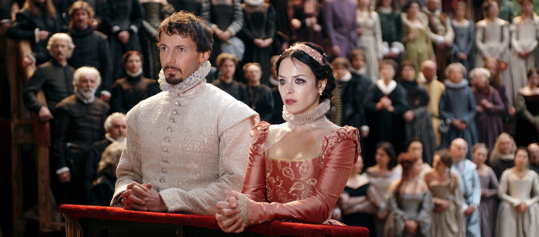 |
| Henry of Navarre (Julien Boisselier) marries Princess Margot (Armelle Deutsch) |
 |
| Queen Catherine de Medici (Hannelore Hoger) plots with Margot |
 |
| Henri IV leads his troops to victory |
Henri IV: Ever since I was the little King of Navarre, uncertain of my future, a long way from France’s throne, I’ve longed for this great hour. Now I am strong enough to declare that you shall be free. Free in your beliefs and free in your thoughts...Nobody will be persecuted for different beliefs than the majority. Catholics and Huguenots, all of you are my people. I love you equally. ~from Henry of Navarre (2010)Jo Baier directs the German production of Henry of Navarre, also known as Henri 4, a biopic about France's most beloved King, the first monarch of the Bourbon dynasty. The film captures Henri IV's simplicity, common touch, and fearless unconcern about personal safety, qualities admired by the later Bourbons but ultimately embodied by Henri's descendant Louis XVI. He is also shown as a savvy politician, able to outwit the Guises and the Valois, as well as a warrior-king, who leads his men into battle. Henri's womanizing proclivities, imitated by his future progeny, are also depicted, especially his tragic love affair with the loyal Gabrielle d'Estrées.
Based on the popular novel by Heinrich Mann, the film covers the same ground as Patrice Chereau's more accomplished 1994 drama "La Reine Margot," in which Isabelle Adjani was the queen and Daniel Auteuil her tormented but determined spouse.Henry of Navarre helped me as never before understand the devastation caused by France's Wars of Religion, which in some ways were akin to England's Wars of the Roses except with religious differences were thrown into the mix. None of the chief characters involved seem to be particularly religious, except for the Guises, in a weird, angry sort of way. In the film, most of the Catholics do not come off too well, especially after the atrocious St. Bartholomew's Day Massacre. Henri, in the movie, is psychologically scarred for life by the massacre, as are most of the other characters, not surprisingly. By that point in the film, Catholics are something from the pit of hell. In every scene which involves a Catholic ceremony the same three "cardinals" are shown, always in their red robes and never in vestments, not even at Henri's first wedding or Marie's coronation. At Henri's profession of Faith, when he becomes a Catholic for the third time, the three cardinals are surrounded by bishops in eerie black robes and black miters; I wonder if they were the same black bishop costumes used in the 1998 film Elizabeth. It is not that difficult to research historical vestments on the internet so I do not know why otherwise authentic productions fail so completely to accurately represent Roman Catholic liturgical ceremonies.
The time is 1563, with Catholics and Protestants -- in the form of Huguenots from Navarre in the southwestern part of France -- at fearful odds. Catherine de Medici (Hannelore Hoger) is a bringer of death who rules everyone and everything with brutal guile as she plots to keep one or other of her sons on the throne.
Current occupant Charles IX (Ulrich Noethen) is batty as a flock of gargoyles and so fearful that he sweats blood and gives in to whatever horrible things his mother makes him do. That includes permitting the massacre of the Huguenots who gather in Paris peacefully on St. Bartholemew's Day for the marriage of his firebrand sister Margot (Armelle Deutsch) to Huguenot leader Henry of Navarre (Julien Boisselier).
The film begins with the story of Henry's childhood with a narration that casts the boy and future king as a savior of France and the fear is that the film will be all about a saintly fellow who simply follows his destiny.
But the individual described by author Mann and screenwriters Baier and Cooky Ziesche, and portrayed by Boisselier, is far from squeaky clean. With his eye firmly on the prize, which is to say the crown, Henry matches wits with the matriarch of the de Medicis, legates from the Papacy, villains dispatched by the king's cohorts and the bewitching but soul-destroying Margot.
With serious features that suddenly break out in a winning smile, Boisselier captures Henry's chameleon ability to roll with the punches and be peasant or king, warrior or diplomat, and lover or chaste as the situation requires. Deutsch plays Margot enjoyably as all sex and little mischief while Chloe Stefani brings wit and insolence to temper the devotion of Gabrielle, the love of Henry's life. Hoger is a fairly conventional Catherine but Ulrich Noethen sees what a rich role he has in Charles and enjoys every minute of it. (Read more.)
| Chloe Stefani as Gabrielle d'Estrées |
 |
| Marie de Medici (Gabriela Maria Schmeide) and her dwarf |


The earliest extant portrayal (see photo of fresco from the Catacomb of Priscilla) of the magi, dated to the mid-third century, appears above an arch in the Catacomb of Priscilla, in Rome.1 As in almost all the early images of the magi, they are shown as three men, identical in size, dress (although the color of their clothing varies in the catacomb painting) and race. Each carries a gift. It is difficult to discern the presents in the faded catacomb painting, but usually in art one of them carries a wreath and the others a bowl, jug or box-shaped object. The magi advance in a line toward the child seated on his mother’s lap.Who were the Magi? Read HERE.
In many early images, they appear to point or gaze at a star overhead. Sometimes their camels appear behind them, as in a fourth-century sarcophagus relief in the Vatican Museums (see photo of fourth-century sarcophagus). The early images almost always appear in funerary settings—on catacomb walls and sarcophagi. The magi scene is among the first narrative images to appear in Christian art, and predates most other New Testament scenes as well as any other representation of Jesus’ nativity (a unique fresco [not shown] of Balaam and the Virgin with child in the Catacomb of Priscilla may be the exception). The complex composition and emphasis on narrative detail provide further evidence of the import the story held.
Angels flank the enthroned Mary and Jesus in this sixth-century mosaic from Sant’Apollinare Nuovo in Ravenna, Italy. The magi, followed by wreath-carrying female martyrs, press toward them. The names of the magi do not appear in the New Testament, nor does the number. The Gospel of Matthew speaks simply of “magi from the East.” By the second century, they were identified as three; by the fifth, they were identified as kings and, in the West, given the names Balthassar, Melchior and Gaspar, which appear above the magi (perhaps as a late addition) in this mosaic. Here, Balthassar is shown with a long brown beard. Melchior is a clean-shaven youth. Gaspar has long gray hair; over time, he would become the balding man who kneels before the babe in countless Renaissance images.
By the fifth century, Christian art had spread from catacombs and sarcophagi to vast public spaces, and the magi began to appear in the mosaic decorations of the first great basilicas. These mosaics share the same basic composition seen in earlier funerary art. In a sixth-century mosaic (above) from the church of Sant’Apollinare Nuovo, in Ravenna, Italy, for example, the magi appear as extravagantly dressed triplets, bearing their gifts in fluted vessels as they press forward, gazing up at the star.b Before them, the baby Jesus is seated on Mary’s lap, flanked by angels.
The magi of the Ravenna mosaic may be distinguished only by their hair (one has long brown hair and a beard; one is a clean-shaven youth; the third is an elderly man, his hair greying) and their names (most likely a later addition), which are inscribed above them: Balthassar, Melchior and Gaspar (often spelled Caspar).
Neither their names, their number (three), their physical descriptions nor the date of the magi’s arrival appears in the Bible. Over time these cherished traditions were added to the brief gospel narrative, probably first through oral tradition. By the fourth century, the magi’s arrival was celebrated as the Feast of Epiphany on January 6 (12 days after Jesus’ birth on December 25).2 (Even today, in some parts of the Christian world, January 6, rather than December 25, is a time for exchanging presents, in commemoration of the gifts of the magi.)
Their assumed number was undoubtedly derived from the three gifts presented to Jesus in Matthew. The number wasn’t always taken for granted, however. A wall painting in the Roman catacomb of Domitilla shows four magi; one in the catacomb of Peter and Marcellinus depicts two. A variety of Syrian documents name twelve.3
The names and nationalities of the magi also varied throughout the world, especially in the East.4 An Armenian infancy gospelc from about 500 lists them as Melkon, King of Persia; Gaspar, King of India; and Baldassar, King of Arabia—and is thus closest to the Melchior, Caspar (or Gaspar) and Balthassar of the medieval Latin church.
As this Armenian infancy gospel indicates, the “magi,” a Greek term that might be taken as “sages” or “astrologers” (perhaps even “priests”), had come to be identified with royalty. In 490, the Byzantine emperor Zeno claimed to discover the remains of these “kings” somewhere in Persia and brought them to Constantinople. The relics eventually reached the West during the Crusades—first traveling to Milan and then subsequently to Cologne by Frederick Barbarossa in 1164. Today, they reside in Cologne, in a magnificent reliquary shrine built for them in the late 12th century. There they are known to pilgrims and tourists as the “Three Kings of Cologne.”5 (Read more.)

ShareThe houppelande was a sumptuously weighty gown, lined with fur, worn over a slim fitting cotehardie and chemise. By the early fifteenth century it had developed a long train, large turned-back collar and lavishly long sleeves. In the 1440s the sleeves started to become tighter again and, as the century moved on, they became the slim-fitted sleeves of the burgundian gown, with fur or fabric bell-shaped cuffs that could be turned back. The collar of the houppelande similarly evolved, dropping down further and wider, until it became the V-neck shape of the burgundian gown. Other changes included the gradual introduction of a deeper belt, or girdle, to draw in the loose-fitting skirt, creating a more slender waist line. By the end of the century the top of the dress had become so fitted that such a large belt was no longer needed and ladies (by this time Tudor ladies) wore thinner, decorative belts.For late fifteenth-century inspiration, I turned to my favourite images of the gowns from medieval art and manuscripts: a depiction of Saint Ursula in the Master of Lucy Legend’s painting of the Virgin surrounded by female saints (circa 1488); two images of Mary of Burgundy in Mary of Burgundy’s Book of Hours (circa 1477); a painted panel circa 1480 depicting Saint Catherine converting the scholars (Walters Art Museum 37.2487); and The Whore of Babylon in Pierpont Morgan MS M. 68. (Read more.)
Only 12 percent of moms believe that working full time is an ideal situation for children, and 74 percent of adults say that mothers working outside the home makes it harder to raise children. About half of adults surveyed believe that children are better off if the mother does not work.Share
Yet today, only three in ten mothers do not work outside the home. The reason the feminists have won is because it is now difficult for men - as well as women - to make enough money from one job to support the entire family. (Read more.)

Catherine Mectilde de Bar lived in a time marked by superstition, sorcery, dalliance with the powers of darkness, blasphemy and sacrilege. Recent distressing events in churches on every continent have demonstrated that global society today has more in common with war–torn 17th century France than one might think. Mother Mectilde bound herself in self–sacrificing love to the perpetrators of such horrible crimes, offering herself as a victim of reparation, that is, as an offering irrevocably made over to God with the intention of supplying for the love and adoration denied Him by those who hate Him and outrage His holiness while, at the same time, praying God to show them mercy and grace them with repentance....Share
Catherine Mectilde de Bar is an icon of the kind of spiritual motherhood needed in the Church today, not only in monastic and religious communities, but in every context where the Church is being born, and born again, of the Eucharist. Ecclesia de Eucharistia. Mother Mectilde demonstrates that the altar itself — the place set apart for the immolation of the Divine Victim — becomes a wellspring of supernatural fecundity in the life of every woman who adhering to the Holy Sacrifice, enters into the victimhood of Christ and, with Him, adores the Father in the Holy Spirit. (Read more.)