


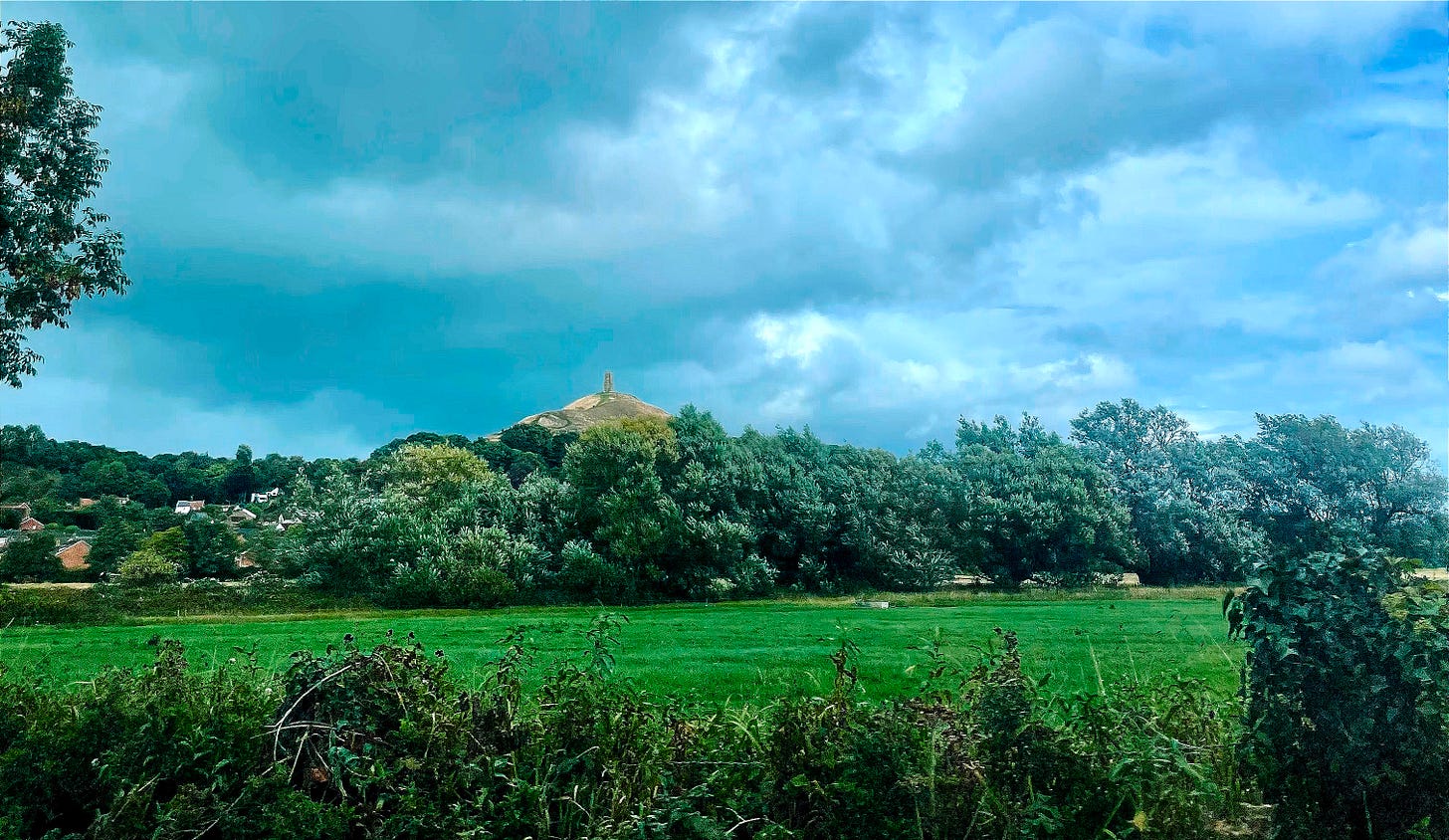

Some young knights on a quest. From The Saxon Cross:
ShareGlastonbury is a weird town. For two thousand years it has been the spiritual center of England. For a long time this was because Glastonbury Abbey was the largest and most powerful monastery on the island. But while the monastery has long lain in ruin, the town is still very much a spiritual center. The town is chockfull of New Age shops, druids, neo-pagans, witches and occultists. Something very real draws this sort of person to the town, and I think some of them are genuine seekers. Of course, they’re looking in all the wrong places, but the power they feel is real. Glastonbury is a Christian holy place and that power still pervades the ground.
First we walked the ruins of the great abbey. This island is littered with the ruin of the work of the Protestant Reformation and King Henry VIII. During King Henry’s dissolution of the monasteries the abbey fell into disrepair, and its last abbot was draw, quartered, and hanged on Glastonbury Tor in 1539. Glastonbury then ceased to be the center of Christianity in the isle, and the blood soaked into the ground has been crying out ever since. The ruins of the monastery are hauntingly beautiful. It is also the purported site of Arthur and Guinevere’s graves, although this is one legend that I think may have been fabricated in the Middle Ages. On the abbey grounds still live the last of the Holy Thorns, the sacred trees that bloom on Christmas Day, that are said to have been brought to the isle of Avalon by St. Joseph of Arimathea.
On our way up to the Tor we stopped to drink from the Chalice Well, also known as the Red Spring. There are two versions of the legend of this holy well. One claims that St. Joseph buried the Holy Grail inside the Tor, and from it sprang the well. The other claims that he buried two vials, one filled with Christ’s blood and the other with His tears, and from these sprang the Red and White Springs respectively, the White Spring being another holy well just across the street from the Chalice Well garden. Whatever the truth is, the water is full of iron and indeed tastes like blood. Inside the chalice well garden at the foot of the Tor we were met by another one of our companions, Jake, which seemed like a fitting and symbolic place to meet on a spiritual quest. Together we prayed and drank from the well, and then ascended the Tor together. As we began our ascent a rainbow broke out across the sky, crowning St. Michael’s Tower. (Read more.)








7 comments:
Mrs. Vidal,
Having long observed your remarkable talent as a historical novelist, especially in crafting works that not only entertain but also present history in a way both accurate and elaborate, I must confess that your take on figures such as Marie Antoinette and Henrietta Maria has proved refreshingly resonant compared to the usual vilification or stereotyping of their characters. Indeed, your portrayal of their own perspectives and, more importantly, their deep faith is rare among novelists.
In this regard, with the Henrietta Maria trilogy nearing conclusion and upon the supposition that a new subject is being sought, I would like to suggest a new theme.
Catherine of Braganza and Mary of Modena, who as "sister-queens" (sisters-in-law) faced similar tribulations in the Restoration court, may pose a promising subject for a subsequent novel or trilogy. Their Catholic faith and morals, not always allied with the "flamboyance" of the court, make for a compelling narrative. Both women led remarkable lives: the only Portuguese and the only Italian queens of England.
Catherine was an eyewitness to the restoration of an independent Portugal under her father, the musically gifted John IV. Equally, she was the daughter of a 'decisive' Queen, Luísa de Guzmán, whose political acumen was much in the vein of Marie de Médici. She also managed to overcome immense cultural differences upon her arrival in England, gave the English a strategic dowry, and remained loyal to her husband despite his innumerable infidelities. She accepted the cross of childlessness in a dignified manner, was a patron of Baroque art, and, once back in her homeland, served twice as Regent with remarkable success.
Meanwhile, Mary Beatrice of Modena had to abdicate her deep desire to be a nun to marry the future James II—a resignation only possible after a recommendation from the Pope. She was also a great patron of the arts, used her influence to try to protect her ladies from the 'excesses' of the court through art and culture, suffered the loss of the majority of her children, and shared her husband's fate through the turmoil of the Exclusion Crisis and the "Glorious Revolution." She spent the last years of her life in exile fighting for her son’s cause, much like your "Generalissima."
A trilogy would allow for a "clearer" view of the Restoration court and a deeper examination of the husbands' evolving characters, which have been so beautifully drawn in your current work. If my proposition is helpful, I would be delighted to recommend some works that might serve as a grounding introduction to these two characters.
- The graces and the extraordinary untold lives of woman at the restoration court by Breeze Barrigton
- The privite life of James II by Justine Ruth Brown
- Charles II's Portuguese Queen - The Legacy of Catherine of Braganza by Susan Abernethy
- Hoax: The Popish Plot That Never Was by Victor Stater
- Queen Mary of Modena, her life and letters by Haile, Martin (available for free in the Internet archive)
- Mary of Modena: James II’s Dazzling Queen by Justine Brown
- Espionage in the Divided Stuart Dynasty 1685-1715 by Julian Whitehead
- The Lost Queen; The Surprising Life of Catherine of Braganza—the Forgotten Queen Who Bridged Two Worlds By Sophie Shorland
N.B. While evaluating these two promising characters, I also came across three other ladies who may be of interest to you: Louise Hollandine of the Palatinate (the princess-painter turned nun), Teresa Sampsonia Shirley (the "Carmelite Amazon"), and St Joan of Valois.
Louise Hollandine was one of the children of Elizabeth Stuart, sister of Charles I. She became a talented painter under Gerard van Honthorst; so skilled was she that some of her works were attributed to her master.Curiously, one of her works is a portrait of Prince Rupert's Boye. In December 1657, Louise fled to France with the aid of Henrietta Maria and her brother Edward. There, she converted to Catholicism and became a novice, eventually serving as the Abbess of the Cistercian Maubuisson Abbey with the support of Louis XIV. She lived there until the remarkable age of 86, continuing her artistic endeavours by crafting a beautiful Madonna and Child (1691). She also made charitable donations to English Benedictine nuns.
Unfortunately, her conversion caused a lifelong animosity with her mother, making her the only child excluded from Elizabeth Stuart’s will. A novel was written about her by Margaret Irwin in the 1930s by the name The bride (1939) (it is available for free in the Internet archive)
A possible grounding introduction to her life may be found in :
- Converted Relationships: Re-negotiating family status after religious conversion in the Nassau-chalon and Palatinate Dynasties, available through The University of Western Australia
- A Princely Painter: Princess Louise Hollandine of the PAlatinate, Abbess of Maubuisson by Christopher A. Kerstjens, access options on Taylor & Francis Online.
- Daughters of the Winter Queen: Four Remarkable Sisters, the Crown of Bohemia, and the Enduring Legacy of Mary, Queen of Scots by Nancy Bazelon Goldstone
Teresa Sampsonia Shirley an influential Iranian-Circassian noblewoman and cultural diplomat who traveled extensively across Europe with her husband, the English adventurer Sir Robert Shirley, acting as an ambassadress for the Safavid Shah Abbas the Great. Known for her "undaunted" spirit, even saving her husband's life on at least two occasions from assassination attempts by his Persian enemies and hostile Portuguese traders, Teresa became known as a amazon. During her youth she was converted by the Discalced Carmelite missionaries in Persia, adopting the name Teresa after the great reformer saint, whose relic she was later gifted by the saint's niece herself during her time in Spain. Indeed, once a widow, courtiers and grandees who were jealous of the Shirleys' high standing with the Shah spread rumors that Teresa had been born a Muslim and later converted to Christianity. Converting from Islam was a capital offense. She was eventually captured and interrogated. During this dangerous questioning, she was reportedly threatened with being "burnt alive" or "thrown from a tower" if she did not renounce her Christian faith. Such events lead to she fleeting to Istanbul and later to Rome where she settled in a house next to the Carmelite Santa Maria della Scala church. She lived a pious life there for over three decades, devoting her time to charity and religion under the protection and guidance of the Carmelite Fathers. Today, in the church of Santa Maria della Scala, her and her husband’s tomb can still be seen—the translation of Robert’s body from Persia to Rome serving as a final, poignant love token. Throughout her life, she navigated a staggering array of cultural worlds, meeting the father of the emperor who commissioned the Taj Mahal, as well as Anthony van Dyck, whose iconic portrait of her remains a symbol of East-West relations in the early modern age. A possible grounding introduction to her life may be found in :
- Chapter Title: Teresia Sampsonia Shirley (c.1589–1668).
Chapter Author(s): Emily Stevenson
Book Title: Lives in Transit in Early Modern England
Book Subtitle: Identity and Belonging
Book Editor(s): Nandini Das
Published by: Amsterdam University Press. (2022)
Stable URL: https://www.jstor.org/stable/j.ctv2fzkpnj.31
- Other Renaissances, Multiple Easts, and Eurasian Borderlands: Teresa
Sampsonia Sherley’s Journey from Persia to Poland, 1608–1611 115
Bernadette Andrea ( Pg.115 of "A companion to the global renaissance; literature and culture in the era of expansion, 1500-1700; second edition; edited by Jyotsna G.Sinh)
- Elizabethans errant; the strange fortunes of Sir Thomas Sherley and his three sons, as well in the Dutch Wars as in Muscovy, Morocco, Persia, Spain, and the Indies by Davies, David William ( available for free in the Internet archive)
St. Joan of Valois was a French princess, the unloved daughter of Louis XI, who was briefly the Queen of France as the wife of King Louis XII, before their marriage was annulled. Her birth was a great deception as she was a second daughter when the realm wanted a son. Such animosity on the part of her father was only exacerbated by the fact that she had physical "deformities", including a curved spine and a limp. At the age of , her away from the court to be raised by a noble couple in the Duchy of Berry and never saw her mother again. During her time in Berry, she was taught the basis of noblewomans education and piety. Indeed , the couple which had no children treated her with great love. It was during her time in Berry that she received a divine intimation: a holy message foretelling that, before her death, she would found a religious order dedicated to Our Lady. At age 12, despite her religious calling, she was forced into a political marriage with her cousin, Louis, Duke of Orléans, who openly despised and humiliated her.Despite his treatment, she prayed for him and even interceded with her brother, King Charles VIII, to secure her husband's release from prison.When her brother died without an heir in 1498, her husband succeeded to the throne as King Louis XII, making Joan briefly the Queen of France. Immediately, Louis sought and obtained an annulment from Pope Alexander VI, claiming the marriage was forced and unconsummated. Joan accepted the public humiliation, stating she was grateful to be freed from the "slavery of the world" to serve God better.Granted the title Duchess of Berry, she retired to Bourges and, with the guidance of her confessor, founded the enclosed contemplative Order of the Annunciation of the Blessed Virgin Mary in 1501. The order's primary rule was to imitate the ten evangelical virtues of the Virgin Mary. She took her solemn vows in 1503, taking the name Sister Gabriela Maria.She died on February 4, 1505, at the age of 40. Miracles and healings were reported at her tomb soon after her death. Her body was found to be incorrupt decades later but was destroyed during the sack of Bourges in 1562. She was beatified in 1742 and canonized as a saint by Pope Pius XII in 1950. Her feast day is celebrated on February 4.
A good book regarding her life is The good duchess : Joan of France (1464-1505) by Forster, Ann M. C. (It is available for free in the Internet archive)
Whether it be the "Sister Queens" or these other remarkable women, each embodies the complex interplay of faith and nobility that you portray so masterfully. I hope these suggestions might serve as a spark for your future endeavours.
With profound admiration,
An anonymous admire of your literary work.
Very interesting, thanks!
Your welcome!
You’re very welcome! I hope that was helpful. Once again, congratulations on your writing—it really is excellent. Sorry for splitting the message up; it was a bit too long to send in one go, so the rest (St. Joan of Valois) is likely still loading.
Post a Comment