Monday, October 5, 2026

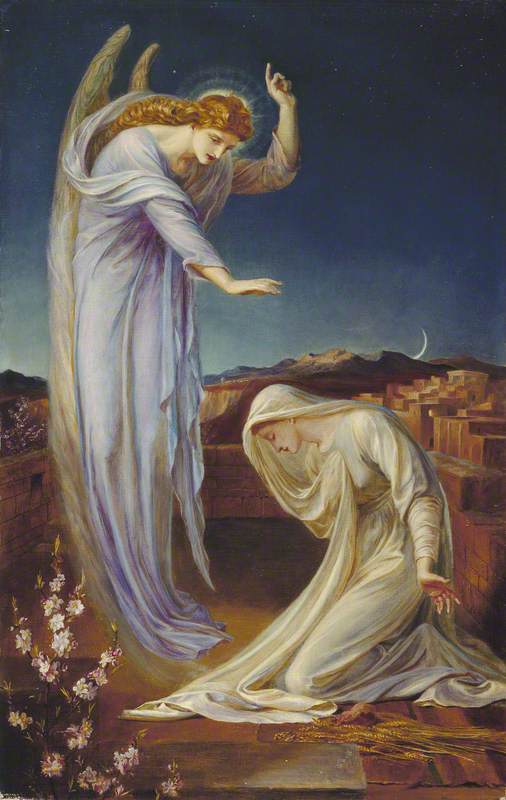
The Angelic Salutation And The Black Death

The Annunciation ~ Frederic James Shields
From Aleteia:
This second part (“Holy Mary, Mother of God, pray for us sinners now, and at the hour of our death”) is believed by many to have been added during the plague to ask for the Blessed Mother’s protection from the fatal disease. Venerable Fulton J. Sheen explains this origin in his book The World’s First Love.
Since it seizes upon the two decisive moments of life: “now” and “at the hour of our death,” it suggests the spontaneous outcry of people in a great calamity. The Black Death, which ravaged all Europe and wiped out one-third of its population, prompted the faithful to cry out to the Mother of Our Lord to protect them at a time when the present moment and death were almost one.
An expert in Marian devotion, Fr. Donald H. Calloway, confirms this conclusion in his book Champions of the Rosary and explains how, “After the Black Death, the second half of the Hail Mary began to appear in the breviaries of religious communities, especially those of the Mercedarians, Camaldolese, and Franciscans … the people of the 14th century greatly needed the ‘hope-filled’ dimension of the second half of the Hail Mary prayer.” (Read more.)
Share

Foreign Policy and the Oil Clock

 From AND Magazine:

Gulf exports excluding Iran were back at the pre-war average in September, about 16.5 million barrels a day, Kpler tracking cited by Just the News. Iranian loadings have been near zero since the July blockade. Bessent said about 15 million barrels remain on the water, nearly all for China, and that Tehran runs out of oil to trade in about two weeks. That is his clock, not a confirmed cutoff. Just the News

Brent settled Friday at $102.25, down 6 cents. WTI finished at $91.11, down $1.76. For the week, Brent was up 0.11 percent, and WTI was down 1.6 percent. Saturday quotes were still about $102 for Brent and $91 for WTI, roughly 42 percent above the February baseline near $72. The Brent–WTI gap, about $11, is the Hormuz signature: waterborne crude is repriced, U.S. inland crude less so. Business Recorder, citing Reuters and Hormuz Monitor

The Friday dip was the diesel story, not a peace story. French President Macron chaired a G7 call. EU countries agreed to a French proposal to release part of their diesel stocks over about 20 days. It was not clear the G7 had agreed on volumes. A stock release can loosen diesel for a few weeks. It does not replace barrels that are not loading in Iran, and it does not reopen the strait. Capital Economics said another release could tip the market into a slight surplus only if the recent pickup in non-Iranian Gulf flows holds. Business Recorder (Read more.)

Share

Elites Keep Saying It's Not True

 From David Strom at Hot Air:

Most religions have some version of an evangelical streak, and rightly so. If you believe that you are following the one true path, it is your duty (in most religions) to spread the word. There are exceptions, like Judaism, but the principle mostly holds. 

What makes Islam particularly aggressive is that it is not just a religious tradition or set of beliefs; it is a totalitarian ideology that doesn't allow for a separation of politics and religion, and that is based on the belief that civil law and religious duty are the same thing, and that its mission is to spread Islam to the entire world through all necessary means. Islam has always spread through conquest and, ironically, colonialism. In many ways, it is the opposite of Judaism in that regard, despite the fact that Jews are accused of being the ultimate colonialists. Jews are almost uniquely particularist, with no impulse to spread the word and little interest in territorial expansion beyond their historical borders. (Read more.)

Share

Sunday, October 4, 2026

Queen Anna (Stuart Queens Trilogy Book 1)

 Amazon.com: Queen Anna (Stuart Queens Trilogy Book 1) eBook : Riches, Tony: Kindle Store

 From Amazon:

A crown won in the eye of a storm. A queen who refuses to be broken...

Princess Anna of Denmark sails for Scotland to marry King James VI, but storms ravage her fleet, igniting a deadly obsession with witchcraft in her new home. Arriving in a strange and paranoid court, Anna finds her new husband’s bed is a treacherous place.

Surrounded by whispering courtiers and shifting alliances, Anna refuses to remain a passive pawn. When the court takes her children to raise them away from her, the young queen draws her line in the sand. From the windswept castles of Scotland to the glittering, dangerous English court, Anna is restored to her rightful place in history.

 Once again, historical novelist Tony Riches proves that true events make the best stories, especially when based upon solid research, as well as loyalty to the original personalities of the actual characters. Anna of Denmark has been largely overlooked by novelists as dull and dutiful, a quiet presence in the background of the rollicking Jacobean court. Tony paints a vibrant portrait of a great Queen who left an indelible imprint on the art and culture of the era, in addition to mothering the Stuart dynasty. While not caving to anachronisms of the feminist interpretations of history, Tony's depiction of the Danish princess, who became the bride of the son of Mary Queen of Scots and Lord Darnley, respects the framework in which Anna found herself as a very young girl. She had no concept of the type of man she had married nor of the demons which tormented him. Nevertheless, she was expected to provide heirs along with the veneer of an amicable family life, all while her husband chased handsome young men, growing more obsessed with each passing lover. Realizing, after much disappointment, that she had to cultivate a life for herself, Anna remodeled the palace she renamed "Denmark House" as a refuge of order and beauty.

As an author of Stuart-themed novels myself, I would recommend Tony's Queen Anna as an introduction to seventeenth-century England for those who wish to explore it in either novels or biographies. The seeds for the calamitous Wars of the Three Kingdoms are sown in the reign of James I who, on one hand, was a scripture scholar and theologian, deeply conscious of his duties as the Lord's Anointed. On the other hand he could be highly intemperate, whether in his love of drink, in his overzealous hunting of witches or in his passion for his own sex. Anna brought dignity, glamor, and continental sophistication to the court, be it in Scotland or in England, as well as bearing the first royal princes and princesses seen in England since the days of Henry VIII. She could not save either her family or her kingdoms from James, though, and the repercussions of his behavior upon their youngest son Charles. All this and much more is shown, not told, in the novel, as the reader is invited to draw their own conclusions from such a lively yet heartbreaking rendition of the past.

This painting by Paul van Somer has an interesting role in the novel


Queen Anna by Tony Riches is available HERE.

Share

The Ancient Parable

 From James Howard Kunstler:

Translation: Chuck Schumer knows that the Democrats have already been thwarted from rigging the election, from flooding the polls with illegal immigrant voters, with dead voters, with voters who moved out of state but still got mail-in ballots sent to their old addresses, with voters registered as living in Walmart parking lots, and so on. Chuck Schumer knows that the Civil Rights Division of DOJ is sending hundreds of lawyers to observe the action in swing state polling places. ICE might even be on hand to see who turns up.

So, Chuck Schumer is pretending that the Republicans will try to do what the Democrats actually did in several previous elections (including the last midterm, 2022, viz., AZ, GA, NV), and would have liked to do in this midterm, but can’t. The Democrats will holler like crazy about it before the election to plant this idea in credulous minds. They will jump up and down going woo-woo-woo on Election Day itself to water the idea. And after the election they will blitz every critical precinct with lawsuits to prevent the vote from being certified, using select “activist” judges to issue TROs and writs to delay election results and de-legitimize the vote.

And if none of that avails — which it won’t — they’ll call out their ground troops, Antifa, BLM, Free Palestine, LGBTQ2S+, the furious transsexuals, the hysterical cat ladies, and suchlike to make a giant ruckus so as to provoke the president to invoke emergency powers to quell the mayhem. And then they’ll point at Mr. Trump shrieking, “See! Tyrant!” (Read more.)


Share

The Need for ‘Sprezzatura’

 From The Habsburg Way:

At the turn of the 16th century, there were few places more esteemed than the Italian city of Urbino. Thanks to the inspired rule of the Montefeltro Dukes of Urbino, the city hosted one of the most illustrious courts in all of Europe, with a cultural output that rivalled Florence and Rome at their Renaissance heights. Castiglione had fond memories of his own time there, and indeed wrote Il Cortegiano as a debate taking place at the court of Urbino. The topic of the debate was simple: what makes the ideal courtier?

Initially, the courtiers ask whether noble birth is an essential prerequisite. While agreeing that it gives a powerful stage to a man, they also largely agree that it merely projects the reality of who that man is, enhancing his vices as much as his virtues. Very quickly, the courtiers observe that there is something far deeper at play than status alone:

“Besides his noble birth, then, I would have the Courtier… endowed by nature not only with talent and beauty of person and feature, but with a certain grace and (as we say) air that shall make him at first sight pleasing and agreeable to all who see him; and I would have this an ornament that should dispose and unite all his actions, and in his outward aspect give promise of whatever is worthy the society and favour of every great lord.”

Baldassarre Castiglione, The Book of the Courtier, I.14

Grace is a word that appears again and again in the texts of Renaissance Italy. It was used to describe honorable conduct, and to describe the works of Raphael, arguably the greatest painter of the Renaissance, whose hometown also happened to be Urbino. One of the courtiers present, Cesare Gonzaga, underlines this apparent importance of Grace by agreeing that it is “universal seasoning, without which all other properties and good qualities are of little worth”. But what actually is it?

To answer the question, Castiglione coins a new word, Sprezzatura. There is no direct English translation of Sprezzatura, but Castiglione helpfully defines it for us:

“To practise in everything a certain nonchalance that shall conceal design and show that what is done and said is done without effort and almost without thought”

Baldassarre Castiglione, The Book of the Courtier I.26

In other words, no matter the context it is applied to, a graceful man is one who is able to make the difficult appear natural. Appear, however, is the crucial word. It may well have taken arduous study and years of practice to reach this level of confidence, but the secret to charisma lies in downplaying the preparation. (Read more.)

Share

Saturday, October 3, 2026

The "Hail Mary" Over the Centuries

From English Historical Fiction Authors:
From Christianity’s earliest days, the Virgin Mary was an advocate for the faithful, an intercessor who would plead their case to God. Devotional images of her go back to the second century, and more Christians started to name their daughters Mary toward the end of the fourth century.

A novelist studying early medieval times can easily see her importance. Charlemagne dedicated a newly built basilica at Aachen to her. On a smaller scale, a scribe wrote, “The book was given to God and His Mother by Dido [of Laon]. Anyone who harms it will incur God’s wrath and offend His Mother.”

No surprise, then, that Christians wanted a prayer just for her. When I first wrote The Cross and the Dragon, I assumed the Ave Maria always had its current form. I just needed the Latin translation for my characters.

Imagine my surprise when my editor informed me that Ave Maria was a lot shorter in the eighth century. “Hail, Mary, full of grace,” or words to that effect go back to the sixth century, so I could have my characters praying “Ave Maria, gratia plena.”

But it apparently took a few more centuries for the prayer to get longer. Two Anglo-Saxon manuscripts from around 1030 include “benedicta tu in mulieribus et benedictus fructus ventris tui” (“blessed are you among women and blessed is the fruit of your womb”). In the 12th century, churchmen accept the greeting to Mary as a form of devotion, as familiar as the Apostle’s Creed and the Lord’s Prayer.

And so the salutation persisted, accompanied by a gesture of homage such as genuflecting, kneeling, or bowing the head. Some saints said the Ave Maria 50 to 150 times a day. (Read more.)
Share

Tariffs Work For America

 From Tierney's Real News:

Today, President Trump announced a major expansion of the Korea Strategic Trade and Investment Deal, unlocking $200 billion in new Korean investments in the United States as part of the broader $350 billion partnership reached last year.

Tariffs served as the primary leverage that secured this deal. For those who still question how tariffs help Make America Great Again, this is a clear example.

In 2025, the Trump administration imposed or threatened reciprocal tariffs on South Korean goods at around 25 percent. To avoid or reduce those rates, South Korea committed $350 billion in U.S. investments—$150 billion for shipbuilding and $200 billion for strategic projects in energy—in exchange for lowering tariffs on most Korean goods to 15 percent.

This investment pledge was the explicit quid pro quo for tariff relief. Trump has directly linked the funding to the negotiations, noting that South Korea “paid to get tariffs reduced and part of that money is going to this project,” and that investments of this scale might not otherwise have been available. Throughout 2026, the threat of higher tariffs continued to ensure progress on delivering the commitments.

As a result, these commitments are now being converted into concrete, large-scale energy and infrastructure projects that will yield tens of thousands of American jobs, expand reliable power capacity, strengthen national energy security, and support the trillions of dollars already flowing into advanced manufacturing and semiconductors. (Read more.)

Share

Education and the Moral Life

 From Mater et Magistra:

Practical Steps for Forming a Sound Conscience

  1. Seek Wisdom, Not Just Knowledge – The study of theology, philosophy, and the lives of the saints provides a framework for understanding moral truth. Reading Scripture and the Catechism with a heart open to God’s love helps ground our moral reasoning in faith, not fear.

  2. Cultivate a Relationship with God – Moral decisions should flow from love, not dread. Regular prayer, particularly the Rosary and mental prayer, fosters a deeper trust in God's mercy and guidance.

  3. Practice the Virtue of Prudence – Not every decision is a moral crisis. Learning to distinguish between mortal and venial sin, and recognizing when a choice is simply a matter of prudential judgment, brings clarity and peace.

  4. Confess Regularly, But Not Excessively – Frequent Confession is a gift, but for those struggling with scrupulosity, it can become a source of unnecessary distress. A regular confessor who understands this struggle can provide reassurance and help in forming a balanced conscience.

  5. Trust in Divine Mercy – St. Thérèse of Lisieux reminds us that God’s mercy is greater than our weaknesses. Trusting in His love frees us from the crippling burden of perfectionism and allows us to live joyfully in His grace.

  6. Avoid Unnecessary Doubt – If a person has made an honest effort to discern a moral decision and still experiences doubt, they should trust that God does not demand absolute certainty but a sincere heart. Seeking spiritual direction can also provide clarity.

  7. Remember: God Calls Us to Peace – Christ repeatedly tells us, “Be not afraid.” A moral life lived in love brings peace, not endless anxiety. The more we grow in virtue, the more we can rest in the knowledge that God is guiding us.

(Read more.)


Share