Monday, July 18, 2022

Our Favorite Pies for Summertime


 From Victoria:

The balmy summer months usher in golden afternoons spent strolling barefoot through lush fields and evenings illuminated by dancing fireflies. Enveloped in the warm radiance of the season, indulge the taste buds’ craving for sweetness by gathering around the table with loved ones to share one of our cherished pie recipes.Any way you slice it, our easy-to-assemble pastry offers the perfect conveyance for an assortment of fillings. Beneath golden-brown lattice adorned with shapely buds, discover a scrumptious pairing of stone fruit and berry in Peach-Blackberry Pie. (Read more.)

Share

Betsy DeVos on Education Freedom

 From City Journal:

We won't know the extent of the learning loss for the most vulnerable of the kids that could least afford to be locked out of their schools for months on end. The solution to this is not for them to go back into the same environment and miraculously to catch up or surpass where they were, because that's just not going to happen, absent something entirely different. That makes the case for moving to an education freedom model as quickly and as extensively as possible, and putting that power and that direction in the hands of families, many of whom have already decided. Over 1.2 million students nationally have dropped out of the traditional system. Homeschooling numbers have skyrocketed. Those kinds of opportunities need to continue to be supported and allow for other families to access those, if that's the right thing. Extra tutoring, summer school, a whole variety of ways for students to change it up and make up for that time in ways that the system is not and cannot do. (Read more.)

Share

Forty Jesuit Martyrs

 From Aleteia:

It was the year 1570 and two priests, 23 novices, 7 students and 8 collaborators, were part of an expedition of nearly 100 people on seven vessels, three carrying the Jesuits, all headed from Lisbon to Brazil. The soon-to-be martyrs were just youths – all between the ages of 15 and 30, the majority from Portugal (32) and eight Spaniards. One was a nephew of St. Teresa of Avila.

They were led by Father Ignacio de Azevedo, the Portuguese-born Jesuit provincial of the Portuguese mission in Brazil, who had returned to Portugal to recruit missionaries. From Madeira Island, father north and closer to Lisbon, one ship of the expedition needed to bring cargo toward the North Africa shore, making a stop at the Canary Islands.

The area was known to be occupied by French Huguenot Calvinist corsairs and Father Ignacio knew that they might be sailing into martyrdom. He asked his shipmates if they were prepared; four asked to leave the vessel and were replaced with four others. Landing at Tazacorte, they were able to celebrate the Eucharist at the hermitage of Our Lady of Sorrows.

According to legend, when celebrating what would be his last Mass on the island, as Father Ignacio consumed the Precious Blood he had a vision of his glorious martyrdom. He was so affected by the vision that he bit the chalice, leaving the mark of his teeth in it. (The chalice is still at the Parish of St. Michael the Archangel in Tazacorte). Given their impending death, Fr. Ignacio left in Tazacorte the relics he had been entrusted by the pope to take to Brazil. He took with him, though, a small image of Our Lady the pope had given him.

As the missionaries continued their journey, the ship with the Jesuits was attacked by the corsairs. Father Ignacio took the image of Our Lady in his hands, and encouraged his young companions to give their lives for Christ. The missionaries were stabbed and tossed into the sea, some still alive. Father Ignacio, clutching the image of Our Lady, was pierced by a sword and stabbed twice more.

Before dying, Father Ignacio said, “I die for the holy Catholic Church and what She teaches.” And he told his companions: “Don’t be afraid. Give thanks for this mercy of the Lord. I’m going on ahead and I’ll wait for you in heaven.” The day was July 15. They are known as the Martyrs of Brazil, since they were headed to the missions there, or as the Martyrs of Tazacorte. (Read more.)

Share

Sunday, July 17, 2022

Anniversary of the Murder of the Romanovs


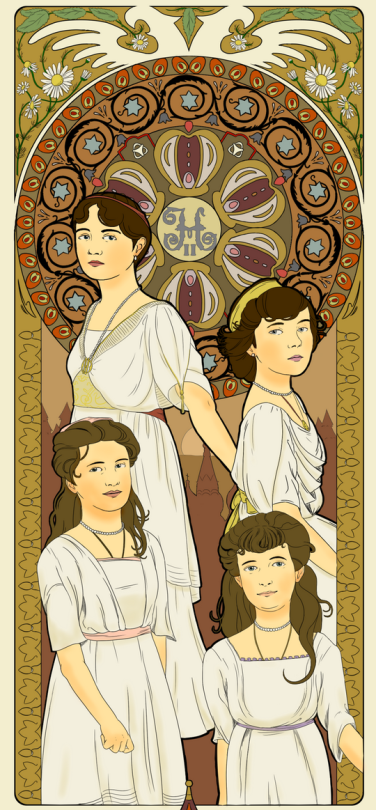
 It is 104 years since the night of July 16-17, 1918 when Tsar Nicholas II, Empress Alexandra Feodorovna, Tsarevitch Alexis, Grand Duchesses Olga, Tatiana, Maria, Anastasia and three of their retainers were shot by the Bolsheviks in a cellar in Ekaterinburg. More HERE.

From historian Gareth Russell at History Lair:
Nicholas II’s daughters, all slaughtered together in a cellar on one dreadful morning in 1918, have acquired a totemic significance in the century since their murder. For many conservatives and monarchists, the posthumous importance of the grand duchesses is obvious and inescapable as proof both of the unhinged viciousness of Communism and of the nostalgic appeal of the monarchy itself. For many others, the four girls are divorced from politics to stand in for the victims of totalitarianism everywhere. Their deaths in 1918 were part of a policy of terror, in which violence was, in and of itself, the goal. There was, after all, no firm political justification for executing the girls alongside their parents and little brother. None of the four sisters had ever held political office nor, under the rules of the Russian monarchy itself as instituted by the Emperor Paul in 1797, could they ever have done so. Keen to prevent a coup the likes of which had brought his mother to power and the expense of his father, Tsar Paul had instituted Salic Law in Russia whereby the throne could never again be held by a female Romanov nor by her direct descendants.[1] It could only, so he decreed, pass through the male line, which meant that even if the monarchy had been restored after 1917, as the Communists feared, by its own rules Nicholas II’s daughters, or any children they might have had, would be ineligible to wear the restored crown. As Trotsky himself later admitted, killing the last Tsar’s daughters was not because of any tangible political goal, but rather to shock Communism’s supporters and enemies into knowing that there was no going back.[2] This Rubicon would in part be flooded by the blood of the butchered princesses – who had once gazed out as icons of curated perfection in the family photographs printed by the monarchy for its subjects.
I often think that the Romanov grand duchesses are caught somewhere between those photographs and the horror of that cellar, where they huddled together in a terror which still brings a lump to my throat when I think of it. Yet, that tragedy has somewhat frozen the girls, trapping them like flies in amber, because we tend to think of them as homogenous girls in white dresses, bound by tragedy and almost indistinguishable from one another. However, by the time of their deaths, the three eldest sisters were no longer children and the eldest two had come-out as debutantes into Russian high society in the years before the Great War. They had adult lives, briefly, and they had even helped serve the Russian war effort between 1914 and 1916, which I would like to discuss here in the hope of shining a light on their personalities and achievements. (Read more.)
Share

Persuasion (2022)


From The New York Times:

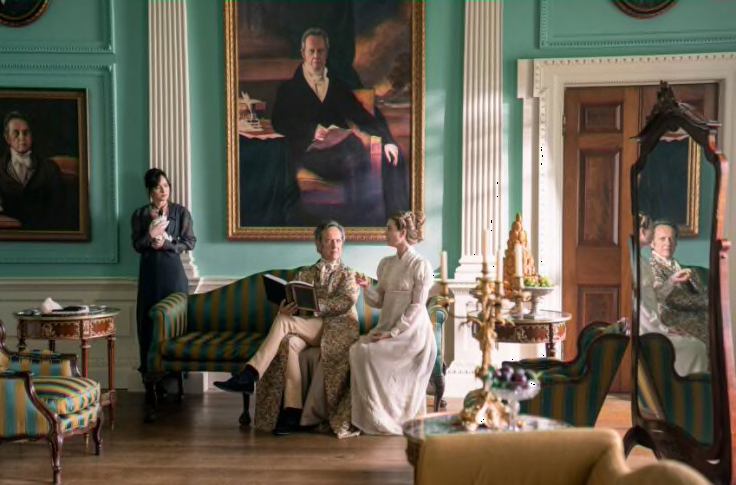
The great irony of this new, not-quite-modernized adaptation of Jane Austen’s final novel, “Persuasion,” is that it communicates its tense relationship to its 19th-century source material in a repressed, passive-aggressive manner — an approach oddly suited to Austen’s trenchant view of society. The film doesn’t take the creative leap to transpose the beloved story in the present day. Instead, in curiously excruciating fashion, the director, screenwriters, and star imply their discomfort with Georgian-era social norms from within the novel’s period setting.

Both the film and the novel begin in the early 1800s, as the story’s heroine, Anne Elliot (Dakota Johnson), visits her sister Mary (Mia McKenna-Bruce) in the English countryside, after their father squandered the family savings. Anne is an unmarried woman who is fortunate to be respected — or, at least, perceived as useful — by her blue-blooded relations. But in direct addresses to the camera, Anne admits that she is haunted by the memory of a love affair she was persuaded to end with an enterprising but fortuneless sailor, Frederick Wentworth (Cosmo Jarvis).

Now Anne is alone, and her regrets only grow when Wentworth returns to the country as a wealthy naval captain. He’s eager to find a wife, and if his sights are first set on Anne’s lively sister-in-law Louisa (Nia Towle), his attention always seems to wander back to Anne.

For this story of rekindled romance, the film summons the handsome appointments expected for a big-budget period drama. There are extravagant mansions, brocaded costumes and magnificent vistas. But there is a crisis of contemporaneity at the heart of this pretty adaptation, and the trouble begins with its presentation of its heroine.

Johnson, wearing smoky eye shadow and pink lipstick, displays the confident appeal of a celebrity sharing her secrets with the audience. Her smile reads as a smirk. The incongruous bravado of her performance is mirrored by the film’s script, written by Ron Bass and Alice Victoria Winslow, which peppers lines from the novel with meme-ish truisms like, “Now we are worse than exes. We’re friends.” (Read more.)


From Literary Hub:

A single woman is drinking alone, crying over a man. She’s probably pining for her lost girlhood, the spotlight glow of youth and the gazes that gravitate to a girl bathing in it. These days, she’s sobbing in a bathtub, wallowing in her romantic regrets. Luckily, she still has her incisive eye and sarcastic tongue. Narrating in voiceover, our heroine begins telling us her romantic history, why she’s crying, and we’re meant to laugh.

This description could apply equally to the opening sequences of 2001’s Bridget Jones’ Diary and Netflix’s Persuasion, the latest film adaptation of Jane Austen’s novel by the same name. Like Bridget Jones, Persuasion’s protagonist Anne Elliot is as witty as she is weepy, and just as rife with romantic yearning. But where Bridget Jones’ narration mixes self-loathing with earnest expressions of hope, this iteration of Anne Elliot cuts her self-recriminations with eyerolls, winks, and witticisms, alongside harsh judgments of everyone around her, save the object of her affection—and instead of limiting her audience interactions to voiceover, Anne Elliot makes direct eye contact with us throughout the film, hitting us with saucy stares and raised eyebrows. This artistic approach to telling a woman’s story is more aligned with the ethos of Fleabag than Bridget Jones, a fact the internet picked up on and began picking apart as soon as the film’s trailer was released.

Tweets like “Persuasion is in its Fleabag era and I do not like it” and “did they just…Fleabaged Persuasion?” quickly racked up likes and retweets. Early reviewers concurred, with Mashable’s Kristy Pushko calling Johnson’s Anne Elliot “a fleabagged haughty hottie.” The initial backlash centered on the fact that of all the Austen novels ripe for the Fleabag treatment, Persuasion perhaps makes the least sense. Austen’s final completed novel, published after her death, Persuasion follows its single 28-year-old protagonist as she faces her sorrow and loneliness head on, while exhibiting forbearance, grace, and dignity in front of family, friends, acquaintances, and even her ex-lover.

For the bulk of the book, Anne is a woman in yearning, prone to solitary walks and pessimistic ruminations about her future, but she is also a woman confident in her intelligence and competence, a woman who treats those around her with an almost astonishing level of care and kindness, especially in the face of her own family’s dismissiveness in light of her impending spinster status. What she is not is a judgmental jokester, or a self-hating sarcasm machine. (Read more.)


Share

'It Defies All Belief'

From The Wildfire Newsletter:

 House Democrats appear to be unconcerned about the optics of shutting down an effort to increase penalties for child sex traffickers in an election year. On Wednesday, Democrats on the House Judiciary Committee unanimously shot down such a measure.

"A question about his amendment first," Congressman Ken Buck (R-CO) said.  "I want to thank Mr. Roy for this common sense amendment that deals with the overall issue, as opposed to trying to piecemeal this out. And I suspect we won't deal with the overall issue if we continue to piecemeal this out."

"But Mr. Roy, can you think of any circumstance in which an individual induces, coerces, controls a child and forces that child into the sex trade, where that individual, that defendant, that criminal doesn't deserve 15 years in prison?" Buck asked.

"I cannot, no," Congressman Chip Roy (R-NC) answered. "I can appreciate the question from the gentleman. He is, too, a former prosecutor who prosecuted for a lot longer than I did. And I appreciate his recognition of that truth."

"I mean, as a father of two, as a former prosecutor, it defies all belief, all common sense that you would say that someone who traffics a child in the sex industry — actually puts a child into that environment for that child to be sexually abused — that that individual should not have a minimum sentence or 15 years," he added.

"I don't think there is a prison, a hole underneath a prison, deep enough to throw that individual in," Buck commented. (Read more.)


Share

How the Little Ice Age Changed History

From The New Yorker:

In the roughly five thousand years of recorded human history, there has been one period in which we have had a real taste of our climate’s potential for moodiness, beginning around the start of the fourteenth century and lasting for hundreds of years. During this epoch, often known as the Little Ice Age, temperatures dropped by as much as two degrees Celsius, or 3.6 degrees Fahrenheit. Compared with the extremes of snowball earth, that might not sound like much, but for people who lived through it the change was intensely dramatic. This was also the period between the end of the Middle Ages and the birth of the modern world. In a new book, “Nature’s Mutiny: How the Little Ice Age of the Long Seventeenth Century Transformed the West and Shaped the Present” (Liveright), the German-born, Vienna-based historian Philipp Blom argues that this is no coincidence—that there is a complex relationship between the social, economic, and intellectual disruption caused by the changed climate and the emerging era of markets, exploration, and intellectual freedom which constituted the beginning of the Enlightenment.

The Little Ice Age is an example of how we so often find complete consensus around every aspect of climate change. Just kidding. We know for sure that the earth became cooler: the evidence can be found through a variety of techniques for assessing historical temperatures, such as the study of ice cores and tree rings. There are also extensive written accounts of the cold in the form of letters and diaries, sermons, the records of wine growers, and so on. The cooling happened in phases, with an initial drop beginning around 1300, and a sharper and more abrupt onset of cold starting in 1570 and lasting for about a hundred and ten years. It is the latter period that provides the focus for Blom’s book. Agreement about the fact that the cooling occurred, however, is not matched by an equivalent consensus about why. (Read more.)


Share

Saturday, July 16, 2022

Will We Allow Cancel Culture to Win War on History?

 From Newsmax:

A biology professor who visits the library often was surprised to notice the display was missing. Kabbany writes, "He asked the librarians about it, and they had no details to provide, except to say it was removed after some sort of complaint, he said. It's been replaced with, 'well, nothing,' Wayne [a frequent library visitor] said. The walls are white, according to photos Wayne took for The Fix. The bust and plaque had been on display in the library since at least 2013."

With the rise of cancel culture, this is becoming a pattern. There is a war on American history, a war on America as founded. A few years ago, Jarrett Stepman of The Heritage Foundation wrote a book about this ongoing phenomenon. It's called, "The War on History." I have often interviewed Jarrett on the radio about this ongoing quest to purge our heroes or historical figures.

He told me: "Unfortunately, it should come as no surprise to see an Ivy League school remove a bust of Abraham Lincoln after receiving a complaint." And he added, "It's hardly just Confederates who are in the crosshairs of woke social justice warriors. It's Lincoln's legacy — and the whole history of the United States — that's on trial, too.

"Our country's greatest heroes and achievements have been judged and deemed wholly insufficient by the nation's institutional pseudo elite. Of course, this new 'elite' has accomplished little other than leading the country into a cultural morass while kicking countless great Americans off their pedestals."

Karl Marx is reported to have said, "Take away a people's roots, and they can easily be moved." (Read more)

Share

Will The U.S. Fall Just As Rome Did?

 From Spencer Klavan at The Federalist:

By the time Julius Caesar rose to prominence in Rome, the republic was so warped that few informed observers expected it to last the century. Rome’s borders had exploded outward during the 200s and 100s B.C. Legislators had devised a plan to distribute newly acquired land more or less equally among the citizenry, making room for an expanding population and a healthy middle class. But wealthy patricians, exploiting loopholes in the system, sucked up vast tracts and cultivated them with imported slave labor. Soldiers who fought to capture new territory found themselves dispossessed of it upon their return home.

 Eventually a charismatic nobleman, Tiberius Gracchus, gave eloquent voice to the common people’s discontent, earning election as their official representative — a tribune of the plebs. In “Life of Gracchus,” the biographer Plutarch attributes to Tiberius a memorable policy speech in which he lamented that “men who fight and die for Italy enjoy shared access to air and sunlight—but nothing else.” His proposed solution was a land redistribution scheme, which met with furious opposition from those who stood to lose property. (Read more.)


Share