Tuesday, April 14, 2015

Kensington Palace

From Andrea Zuvich at English Historical Fiction Authors:
A Jacobean house was built in 1605 for Sir George Coppin three years after the Neyt Manor structure was razed. Following Coppin’s death in 1619, it was purchased by the Finch family. Much later on, the house was named “Nottingham House” because Sir Heneage Finch was the Earl of Nottingham (since 1681).

In 1688, what is known as the “Glorious Revolution” occurred in which James II was ousted from power by his nephew/son-in-law William of Orange and James’s daughter/William’s wife and cousin, Mary. In 1689, William and Mary were crowned King and Queen, and they soon set out to find where to live. Why? You may well wonder, considering that they already had St. James’s Palace and Whitehall Palace. But Whitehall rested in an area by the River Thames that was full of fog, smoke, and generally unpleasant air. This wreaked havoc with King William’s chronic asthma and so more verdant climes were sought. They soon purchased Nottingham House from Daniel Finch, the 2nd Earl of Nottingham (who happened to be his Secretary of State), for a whopping £14,000-18,000.

After this, they hired Sir Christopher Wren to expand and modernise the Jacobean building into something bigger and more fashionable. Construction work went on between 1689-1690. Unfortunately, Mary was a bit impatient with what she perceived to be the slow progress of the building. This can probably be attributed to her desire to make a comfortable home for William. She wrote to her beloved:

“the schafolds are up, the windows must be boarded up, but as soon as it is done, your own apartment may be furnished.”

Her over-eagerness to get the building works completed meant that the workman built too quickly, and so the quality of their work became a secondary consideration. Mary wrote (original spelling maintained): “This made me go often to Kinsington to hasten the worckmen, and I was so impatient to beat that place, imagining to find more ease there.”

As a result of this, sadly, November 1689 saw part of the newly-built building fall down ‘killing seven or eight workman’ – and this tragedy also occurred during renovation work to Hampton Court Palace. Mary characteristically blamed herself for these deaths.

Her diary continues: “This I often reproved my self for and at last it pleased God to shew me the uncertainty of all things…All this much as it was the fault of the worckmen, humanly speacking, yet shewed me the hand of God plainly in it, and I was truly humbled.”

The gardens were redone at this time as well, with heavily manicured box hedging – elaborately formed in the formal Baroque (modern) style which was then so popular. William and Mary spent nearly the same amount on these magnificent gardens as they did on the house! They both loved gardening and their previous homes in the Dutch Republic (The Netherlands), especially Paleis Het Loo, also had wonderfully symmetrical parterres in this elegant style. Sadly, none of their Kensington gardens exist to this day! (Read more.)
Share

Monday, April 13, 2015

Icons of the Daughters of Nicholas II

Grand Duchess Maria
More from Tiny-Librarian. Share

The Ugly Reality of Pretty Woman

There is nothing pretty about prostitution. To quote:
I have to admit that as a teenager, I too loved the story of Pretty Woman. However, as I journeyed down the path that led to my life’s work and my passion for advocating for women trapped in the prostitution industry, I have often looked back on my approval of that film with a sense of regret. I have learned from research and my first-hand contact with women in the sex industry that the reality of prostitution is not a romantic fantasy but a tragic horror story. Sadly, in my work with Exodus Cry, my colleagues and I have encountered young women who have told us that Pretty Women lured them into the sex industry by leading them to believe that prostitution was glamorous and romantic. We interviewed one such girl for our documentary about sex trafficking. Stephanie was sexually abused as a child and entered into prostitution underage. She was dominated by an abusive, controlling pimp and trafficked for sex. Her experience was extremely brutal. She told us, “I watched the movie, Pretty Woman, and I was like, well gosh, look at her, she’s beautiful, she’s making money, she’s meeting guys, and she fell in love with this guy, and she’s living in this nice hotel suite, and has everything she wants, and she’s fallen in love, man I need to become a ho. That’s what I thought, so, that’s what I did. I experienced nothing like Pretty Woman, it’s totally, totally different. I’ve been held hostage at gunpoint, raped, robbed, strangled, beaten up, everything, by customers.”

How many young, naive, and unsuspecting women over the last 25 years were deceived by the fairy tale of Pretty Woman and led into a life of abuse, trauma, and slavery? We can only estimate the role—however big or small—that this film played in adding to the vulnerability of young women at risk for being coerced into the industry. As such, the cast today should be issuing an apology to those women and raising awareness about the plight of girls trafficked in the commercial sex industry, as well as the inherent and serious harms of prostitution. You see, Julia Roberts’ teethy smile is not the true face of prostitution. The real face of prostitution is the battered and bruised face of Maria, an actual prostituted woman in Eastern Europe who is depicted in this award-winning photograph. Maria, like 75 percent of women in prostitution, has been raped. Maria, like 95 percent of women in prostitution has been seriously physically abused and battered. Maria, like 68 percent of women in prostitution suffers from post-traumatic stress disorder due to her “job”. Maria most likely entered into prostitution as a child after a history of sexual abuse, as most women in prostitution do. And Maria is probably under the brutally abusive control of a pimp, as most women in prostitution are. Maria is a victim of sex trafficking. Julia’s role was indeed a fantasy. The reality isn’t pretty. Don’t believe the myth. (Read more.)
Share

One Victim

Sometimes the reality of the Holocaust is made more vivid for us when we take one victim at a time. This is because it is too hard for the human mind to comprehend the deaths of six million people. So here is one, just one. To quote:

Born: March 18, 1921
Vertujeni, Romania

Eva was one of three children born to Jewish parents in Vertujeni, a Bessarabian town that was 90 percent Jewish. Eva attended a public school. Her family was religious, attending synagogue every day. Eva's father made his living as a kosher butcher, preparing chicken according to Jewish dietary laws
1933-39: In 1936, when Eva was 15 years old, her family moved to Vysoka, where she later got a job as a seamstress. Vysoka was very different from her hometown. There were only about 15 Jewish families in Vysoka and Eva believed that people were less tolerant of Jews. While there were not any fights, tensions ran high.
1940-44: Eva married in 1940, the year the USSR annexed Bessarabia. Her husband was drafted into the Red Army a year later when Germany attacked the USSR. Eva, pregnant, remained in Vysoka and was deported with the town's Jews by the Romanian army, allies of the Germans. The Jews were marched for days without food or water. One day in a forest, the soldiers raped some of the girls. In the Vertujeni transit camp, Eva gave birth on the floor, without a doctor. A week later, during a march to Transnistria, her baby died. (Read more.)
Share

Sunday, April 12, 2015

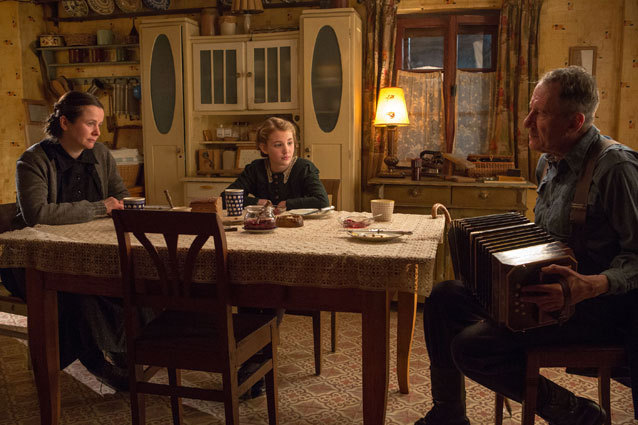
The Book Thief (2013)

Liesel Meminger: There once was a ghost of a boy who liked to live in the shadows, so he wouldn't frighten people. His job was to wait for his sister, who was still alive. She wasn't afraid of the dark, because she knew that's where her brother was. At night, when darkness came to her room, she would tell her brother about the day. She would remind him how the sun felt on his skin, and what the air felt like to breathe, or how snow felt on his tongue. And that reminded her that she was still alive. ~ from The Book Thief (2013)
I finally got around to seeing an excellent film that everyone already seems to have seen, called The Book Thief. Based upon the novel by Australian author Markus Zusak about a little girl growing up in a village in Germany under the Nazis, the film depicts ordinary people standing up to tyranny by defying unjust laws. While it is not a movie for small children, I would highly recommend it as a good history lesson for older children and teens. The story is seen through the eyes of a child in a non-Nazi home. Born of Communists, Liesel becomes loyal to her foster parents, who are hiding a Jewish friend in their cellar. We know, of course, that in many German homes, children were made to report on their parents. 

According to Variety:
 Like its source, the film is narrated by Death (voiced by Roger Allam), who says at the start that he seldom bothers with the living, but took a particular interest in young Liesel Meminger (Sophie Nelisse). Liesel is first seen on a train in 1938 with her mother and brother, en route to a destination that her sickly sibling never makes it to. Neither does her mother, who may be headed to prison due to her communist leanings, it’s later rumored. So Liesel arrives alone at the doorstep of her new foster parents, housepainter Hans Hubermann (Geoffrey Rush) and his endlessly henpecking wife, Rosa (Emily Watson).

When it emerges that Liesel is illiterate — inviting immediate ridicule from  school bully Franz (Levin Liam) — kindly Hans makes a game of teaching her to read. The first tome they conquer is one she’d grabbed when it fell from a laborer’s coat at her brother’s funeral: “The Gravedigger’s Handbook.” Later she dares rescue a burning book from a bonfire of “decadent” works at a Nazi rally. This act attracts the lone notice of the local Buergermeister’s wife, Frau Hermann (Barbara Auer), who later clandestinely lets Liesel use her late son’s personal library during her weekly laundry deliveries to that imposing mansion.

In contrast, the Hubermanns barely scrape along on Rosa’s laundering and little else; we eventually deduce that Hans’ perpetual underemployment is due to his refusal to join “the Party.” As time passes and wartime privations grow worse, their domestic situation turns downright dangerous with the arrival of Max Vandenburg (Ben Schnetzer), the fugitive son of a Jewish comrade who saved Hans’ life during WWI. Honor-bound to hide the young man from the authorities, they nurse him back to health, and he bonds with the fascinated Liesel. She’s sworn to tell no one of his presence, not even best-friend neighbor Rudy (Nico Liersch), though several times the secret comes fearfully close to exposure.

There are modest setpieces: an air-raid, a worrying house-by-house search by Nazi officials, Max’s second serious illness, and Liesel’s hysterical response when Jewish prisoners are marched through town. But “The Book Thief” spans these wartime years from a microcosmic vantage point, seldom straying far beyond the main characters’ ironically named “Heaven Street.” It’s to the credit of Percival (best known for helming several “Downton Abbey” episodes) and Petroni (“The Voyage of the Dawn Treader,” “Possession”) that they refuse to artificially inflate the story’s key points for melodramatic or tear-jerking purposes. By the same token, such intelligent restraint may strike some as too even-tempered and slow-paced, touching our emotions without heightening them in the way that often gets more attention come Oscar time.

Rush generously provides the movie’s primary warmth and humor; Watson is pitch-perfect as a seemingly humorless scold with a well-buried soft side. Hitherto little-noticed New Yorker Schnetzer is a real find, making Max a thoroughly ingratiating figure. (Read more.)
The thought-provoking film has already sparked many important topics of conversation in our family, such as what is the duty of a Christian under an anti-Christian totalitarian government. Unlike The Boy in Striped Pajamas, The Book Thief does not show the horror of the concentration camps. Liesel does not comprehend the full extent of the doom that awaits her family if they are caught hiding Max, but she understands enough to be frightened. The books and her own stories help her and others to deal with fear, whether it is the fear of arrest by the Gestapo or fear of the Allied bombs which drop in the night. The film ultimately celebrates the curiosity and resilience of a child who, in spite of loss and deprivations, is able bring life into a world filled with death, only because she is loved.


Share

The Problem of Being Too Busy

From Seton Magazine:
Of all the excuses invented by man to cover a multitude of situations and to justify unavailability, none is more prolific than the response “I’m too busy.” Of course people who work are occupied with responsibilities and do not have all the leisure in the world to accommodate everyone’s requests. However, if a person is busy on Monday, he should not be equally busy on Saturday or Sunday.

If a person’s work is demanding during seasons and cycles like the sowing and the harvest of the field, the intensity of the work does not persist in all the seasons or months of the year. No one works at the same pace every day, week, month, or year. Busyness is an all-purpose excuse for all seasons.

A person has no time to read, exercise, or pray. A person has no time to call, visit, or write a letter. A person has no time to attend social occasions, host parties, enjoy outings with friends, attend cultural events, or pursue a favorite hobby. The explanation is always the same: I have no time. I am too busy.

No one can be that busy. No one works all the time day and night seven days a week or has a schedule with no free moments at his disposal. Chaucer hints that the busiest people are often the most distracted, filling their time with many trivial, frivolous, or unnecessary activities or burdening themselves with projects, distractions, and unnecessary work deliberately to avoid the more social, civilizing, and human activities that lend balance and contrast to an active life.

Excessive busyness can arise out a compulsive restlessness that breeds the incessant activity known as “workaholism,” an inability to be at peace or have a sense of leisure. Human experience requires both an active life and a contemplative life. (Read more.)
Share

Saturday, April 11, 2015

Spring Recipes

From Food and Wine:
Next week, we’ll be making a very special F&W Best New Chefs announcement—so be sure to stay tuned to our Twitter and Instagram accounts! In the meantime, amp up your spring with these 10 seasonal recipes from past F&W BNCs.
1. Casserole-Baked Halibut with Leeks and Carrots 
This super-simple, ingredient-driven dish is from F&W Best New Chef 2004 Melissa Perello.
2. Fresh Ricotta and Radish Crostini 
F&W BNC 1999 Paul Kahan spreads creamy homemade ricotta on crostini, then adds a few slices of pretty red radish and a sprinkling of pepper for an incredible appetizer.
3. Braised Artichoke Hearts Stuffed with Olives and Herbs 
These elegant stuffed artichokes are from Erik Anderson, an F&W BNC 2012.
4. Creamy Spring Onion Soup 
A swirl of buttermilk mixed with fresh goat cheese gives F&W BNC 2008 Gerard Craft’s fresh-tasting soup a delicious tang.
5. Smoky Glazed Asparagus 
F&W BNC 2009 Nate Appleman sears by coating vegetables with a mayonnaise-based marinade; it creates a beautifully blistered crust when grilled.
6. Lemony Chicken Fricassee with Shallots and Morels 
Typically, a fricassee is made with chicken or another kind of white meat stewed in a white sauce with vegetables. For her version, F&W BNC 1998 Katy Sparks sizzles chicken in butter, then cooks it with shallots and morels.
7. Garden Pea Soup with Morel Cream 
F&W BNC 2005 Daniel Humm swirls sweet pea soup with an ultra-mushroomy morel cream.
8. Herbed Pea Puree and Ricotta Salad 
This wonderful, complex-tasting warm salad by BNC 2014 Matthew Accarrino combines three types of peas with a creamy ricotta-pea puree, sweet-tart lemon confiture and almonds.
9. Asparagus Tempura 
This supercrispy tempura from F&W BNC 1996 Michael Schlow is perfect for cocktail parties.
10. Seared Salmon with Onions and Rhubarb 
F&W BNC 1999 Rocco DiSpirito likes to use bulb onions—immature onions harvested early in the season—in this terrific spring dish. (Read more.)
Share

The Catholic Bubble

Here is an excellent article about the Pharisaism that has crept into the Church. We see in the comboxes  of the internet Catholics who analyze with scrupulous detail the minutiae of doctrine without regard to charity or kindness. They pick apart every word and deed of the Pope, just as Christ was picked apart by the Pharisees. As Our Lord said:
But woe to you scribes and Pharisees, hypocrites; because you shut the kingdom of heaven against men, for you yourselves do not enter in; and those that are going in, you suffer not to enter. Woe to you scribes and Pharisees, hypocrites: because you devour the houses of widows, praying long prayers. For this you shall receive the greater judgment. Woe to you scribes and Pharisees, hypocrites; because you go round about the sea and the land to make one proselyte; and when he is made, you make him the child of hell twofold more than yourselves. ~St. Matthew 23:11-15
From Aleteia:
 Serious Catholics — by and large and in my own experience — don’t spend a lot of time in public spaces. By “serious” I don’t mean the man who goes to the early Mass every day before work, or the group who come to say the rosary on Wednesday evening, deeply faithful as they are, but those of us who care about Catholicism as a thing: the people who read the Catholic press, keep the Catechism by their computer, argue over Francis, can parse the distinction between the ordinary and extraordinary magisterium, mentally grade the homily, take sides on Scott Hahn, follow church politics and fret about the state of the Church, or fuss about those who fret about the state of the Church. Some of them do it for a living.

I speak as one of them. We wear the Church on our sleeve. It is, as I say, a thing for us. The Church is a life and a family but also something external, something we analyze and examine. This is especially true for converts, who make up a higher percentage of this group than they do of the Church in general. For us, the public space we inhabit tends to be the space we choose and the spaces we choose tend to be filled mostly with people like us, which is to say, other serious Catholics. (Read more.)
Share

Friday, April 10, 2015

Statues of Louis XVII

More from Reading Treasure, HERE. Share