Sunday, September 14, 2014

The Politics of Nostalgia

From Sancrucensis:
The great transformation that brought the modern world into being changed things, but this transformation took many centuries, and many resisted it—especially Catholics. When revolutionaries killed King Loius XVI of France, Pope Pius VI commented as follows:
The most Christian King, Louis XVI, was condemned to death by an impious conspiracy and this judgement was carried out. We shall recall to you in a few words the ordering and motives of this sentence. The National Assembly had no right or authority to pronounce it. After abolishing the monarchy, the best form of government, it had transferred the civil power in its entirety to the people, which acts neither by reason nor by good counsel, which does not conform itself in any way to just ideas, which evaluates few matters in accordance with truth and a great number in accordance with opinion; which is always inconsistent, can easily be deceived and drawn to every excess, and is ungrateful, arrogant and cruel; which rejoices in slaughter and in the shedding of human blood, and draws pleasure from watching the sufferings which precede the last breath, just as men in former times used to go to watch gladiators die in the ancient amphitheatres.[2]
At the time, his reaction was by no means extraordinary.

I want to examine why it is that today most people think about democracy and monarchy so differently from Pius VI. I will first consider the view of politics that one finds in the greatest thinkers of the Middle Ages: the ideal of Catholic monarchy that comes from a synthesis of classical philosophy and Christian theology. I then want to explain why modernity sees democracy as the best form of government, and how this is connected to the modern rejection of classical philosophy and the Christian faith. I shall argue that modern preference for democracy is unreasonable, that it flows from a false conception of the end or goal of political life, a false conception of the common good, and a false conception of the source of political authority. And then I shall ask whether any practical consequences can be drawn from my position; after all, it is hardly likely that there will be a restoration of the monarchy here in central Europe any time soon, and it is unclear how one could work for such a thing, if at all. I shall argue that nevertheless there are practical consequences—although it is not feasible to work directly for a restoration, one can work toward a more authentic realization of the common good. Moreover, seeing through the false self-evidence of liberal politics allows one to gain a necessary critical distance from the ideology of our time, thus allowing one to resist certain evils more effectively. (Read more.)
Share

Saturday, September 13, 2014

Grand Duchess Elizabeth Feodorovna

She who later became a nun and a martyr is pictured with one of her ladies. (Via Tiny-Librarian.) Share

Europe's Greatest Sea Monsters

It is amazing they were brave enough to sail on the ocean at all. From io9: "These drawings of sea monsters, taken from books written in Europe centuries ago, prove that you don't need CGI to create a seriously incredible creature." (Read more.) Share

10 Dangers of Georgian London

Without vaccines we would all still be dying of smallpox. From History Extra:
Smallpox was one of London’s biggest killers, and even those who were lucky enough to recover were often badly pock-marked, with patches of hair and eyelashes missing. Smallpox could also leave skin thickened, as if by burns.

Yet, domestic servants who had visible smallpox scars were often preferred to those with unmarked skin, as it was proof that they wouldn’t be bringing the disease into their new household!

Early inoculation was introduced from Turkey by smallpox survivor Lady Mary Wortley Montagu, in 1720, before Edward Jenner introduced mass vaccination in 1796, using a less dangerous strain of cowpox. (Read more.)
Share

Friday, September 12, 2014

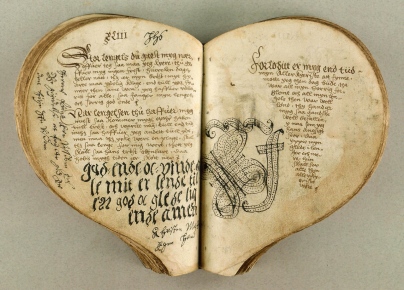
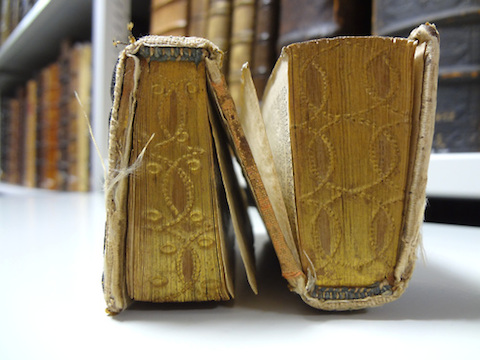
Strange Medieval Books

From Medieval Books:
Written by hand, medieval manuscripts are very different from printed books, which started to appear after Gutenberg’s mid-fifteenth-century invention of moving type. One difference in particular is important for our understanding of manuscripts. While printed books were produced in batches of a thousand or more, handwritten copies were made one at the time. In fact, medieval books, especially those made commercially, came to be after a detailed conversation between scribe and reader, a talk that covered all aspects of the manuscript’s production. This is the only way the scribe could ensure the expensive product he was about to make was in sync with what the reader wanted. Consequently, while printed books were shaped generically and according to the printer’s perception of what the (anonymous) “market” preferred, the medieval scribe designed a book according to the explicit instructions  of its user. (Read more.)
More strange old books, HERE. (Strange but not medieval, in spite of what the article says.)


Share

Modern Slavery

From Aleteia:
One enduring evil, present at all times and in every form of human civilization, is slavery. In May of 2014, the world was awakened to the reality of modern slavery when Boko Haram, a Nigerian Islamist terror group allied with al-Qaida, kidnapped over 200 schoolgirls (mostly Christian) in Chibok, Nigeria. According to Boko Haram’s leader, Abubakar Shekau, the girls were to be sold into sexual slavery.

“Slavery is allowed in my religion,” claimed Shekau, “and I shall capture people and make them slaves.”

As of this writing, the fate of the Chibok schoolgirls is unknown, and every day that passes makes it less likely that they will ever be restored to their families.

Many Muslim leaders reject Shekau’s claim about the permissibility of slavery under Islam, but Boko Haram isn’t the only Islamist organization engaging in such practices. Reports have recently surfaced that the so-called Islamic State (ISIS) group has been abducting and selling Christian and Yazidi women into slavery. According to the Tunisia Daily, ISIS recently sold 700 Yazidi women at a public auction in Mosul. (Read more.)
A young Yazidi girl tells of the hell of being a slave. Not for the fainthearted. May God deliver them.

Another girl's story HERE. She was able to escape. Share

Zurbarán

From the Metropolitan Museum of Art:
Francisco de Zurbarán (1598–1664) was, after Velázquez, the greatest painter of the Golden Age in Spain. He may also be considered the most representative artist of the period, since he did not, like Velázquez, work at the court in Madrid, but for ecclesiastical—primarily monastic—patrons in southern Spain.
Born in the small farming town of Fuente de Cantos in Extremadura, Zurbarán established a workshop in Llerena, some sixty miles to the north. Several pictures he painted for Sevillian monasteries brought him early recognition and an unprecedented invitation from the city government to live in Seville, which "would be honored ... and favor him ... since the art of painting is one of the major embellishments of the state."
Zurbarán's clientele, though restricted, was nevertheless representative of seventeenth-century Spain; his approach to spiritual subjects reflects the authority of tradition, the demands of doctrine, and the requirements of patrons and of a public for whom the story, not the style, was the essence of a work of art. The synthesis of tradition and innovation in Zurbarán's art, of forms that are at once timeless and tangible, perfectly expresses the spirit of Counter-Reformation theology and of contemporary Spanish society, with its faith in both mystical and earthly reality. (Read more.)
Share

Thursday, September 11, 2014

Gallery Walk of September 2014

Punt Boats
In Easton, MD every first Friday the art galleries open in the evening and serve wine, fruit and cheese to art lovers from all over Talbot County. I had the pleasure of taking it in with a painter friend who was able to explain to me what made the good art so good. The highlight was definitely the 717 Gallery which belongs to Louis Escobedo and his wife Yolanda. For one thing, they served the most exquisite selection of cheeses.  Mr. Escobedo is a nationally-known award-winning artist. His works are luminous, especially his paintings of flowers and women. Do take a stroll through his gallery.

Roses
Two Roses
Girl in Sun Dress
Share

The Eagle and the Maple Leaf

The Widowed Empress Zita and her Children
Gareth Russell discusses the Austrian Imperial Family in Canada. To quote:
Having been overthrown at the end of the First World War, the Hapsburg dynasty found itself the focal point of Austrians opposed to their country's Anschluss with Germany in 1938. The last emperor, Karl, had died in exile but his widow, Zita of Bourbon-Parma (right), had been active in monarchist politics throughout the 1930s and their son, Crown Prince Otto, was a vocal opponent of Nazism. As the Wehrmacht moved through western Europe, Zita no longer felt safe and dreaded the prospect of any of her children falling into Nazi hands. She had every reason to be afraid, for as they hurtled towards their own ruin in the fire and horror of war, the Third Reich had no respect for human life, royal or otherwise. Two of the Hapsburgs had already been captured - Maximilian, Duke of Hohenberg, eldest son of the Archduke Franz Ferdinand, whose assassination had helped start the First World War, had vanished behind the barbed wire fences of Dachau concentration camp in southern Germany, for daring to oppose the Anschluss, while the Archduke Albrecht emerged from Gestapo custody blind in one eye and partially paralysed as a result of the torture inflicted upon him. In time, the King of Italy's daughter, Princess Mafalda, was arrested for "subversive activities" and sent to her death at Buchenwald. 
The British Royal family had helped arrange the Austrian Imperial Family's evacuation from Austria in 1919, something I talk about in chapter 12 of The Emperors, and they came to their aid again by arranging safe transport for the Dowager Empress and her younger children to Canada. The family had fled Belgium after the Nazi invasion, making it through France, Spain and Portugal, and across the Atlantic to New Jersey, where they spent some time in New York and the Hamptons, but with the Germans having cut off all access to their bank accounts, funds were tighter than ever and Zita was reduced to making salad made from dandelion leaves. Eventually, the British once again came to her aid by facilitating her move to Quebec, a predominantly Catholic and French-speaking part of the Empire, which suited the Dowager Empress perfectly, since French was her first language and some of her children were still learning English. (Read more.)
Share