

Share


"Protect us from famine, war and plague, Seigneur," cried the Lyonnaise people in 1628. Alas, their pleas came too late--the bubonic plague had already crossed the Rhône River, terrifying the inhabitants and killing half of them.Share
The desperate people prayed to the Virgin Mary to return good health to the city until miraculously, in 1643, the plague disappeared and the Lyonnaise people never doubted their divine protection. So, how did this episode of divine intervention become the largest modern-day international light festival? (Read entire post.)
After that first turbulent year with Mary—during which they ran off in the night to France, walked most of the way to Switzerland and returned broke to England a few months later—he found himself in the countryside north of London, feeling just a bit the worse for wear. Mary suspected that he was merely malnourished, subsisting as he was on a diet that consisted primarily of bread, butter and lemonade. “Lemonade” in this case being a bit of a code word for a widely used and commercially prepared medicinal concoction of opium and ipecac.Share
In short, it is hardly surprising that the poor boy was wasting away. While his vegetarianism as such was hardly to blame, the opium and ipecac were surely not helping the matter.
Into this scene strides the brisk, practical figure of Thomas Peacock, a novelist and poet who had met and befriended Shelley just a few years earlier. Peacock was a few years older than Shelley—just senior enough to be able to get away with ordering the younger man about, it seems—and it’s pretty clear that he had his feet set rather more firmly on the ground. After assessing the situation of his pale, wan friend, Peacock apparently convinced Shelley to expand his diet and experience some good, old-fashioned British cooking. (Read entire post.)
Christmas 1065 was one of the most significant Christmases in England's history. Thanes and their families, bishops and two Archbishops gathered in Westminster for the king's Christmas feast and for the consecration of newly built Cathedral Church of St Peter (Westminster), close to the king's palace on Thorny Island. However, during the twelve days of Christmas the childless King Edward died thus setting in motion a not unexpected succession crisis. (Read entire post.)Share
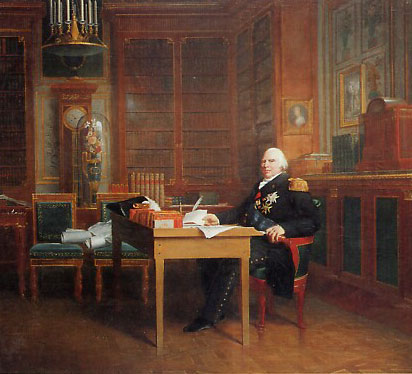
But the joy of the royalists was not unmixed. They found their triumph incomplete. It was quite another sort of Restoration that they had imagined. Louis XVIII was not a king according to their own hearts. They would have accused him of Bonapartism and Jacobinism if they had dared. They thought him ungrateful toward the émigrés and Vendéans. While the five children of Cathelineau, the commander-in-chief of the Vendéan army, vegetated in poverty, Robespierre’s sister received an annual pension of six thousand francs. The government did not even pay the expenses of the last campaign in Vendée, that of 1815, which had, nevertheless, been undertaken only by the King’s command, and they had to be met by the officers. And yet at the same time, the arrears due for the expenses of the Republic and the Empire, and even those of the Hundred Days, were paid without examination. To the émigrés a government which did not restore national property to its former owners was simply a continuation of the Revolution. The most discontented of all were perhaps Louis XVIII’s companions in exile, the courtiers of Mittau and Hartwell, who, having been present in time of trial thought they had a right to form part of the triumph. These could not console themselves for the preferment of a Pasquier, a Mounier, a Portalis, a Siméon, a Decazes. The favors heaped by the King upon Napoleon’s favorites seemed to them an insult to monarchy, a blow aimed at royalty by the King himself. They could hardly conceal their exasperations under an enforced politeness….(Read entire post.)
For more than 260 years, the contents of that page—and the details of this ritual—remained a secret. They were hidden in a coded manuscript, one of thousands produced by secret societies in the 18th and 19th centuries. At the peak of their power, these clandestine organizations, most notably the Freemasons, had hundreds of thousands of adherents, from colonial New York to imperial St. Petersburg. Dismissed today as fodder for conspiracy theorists and History Channel specials, they once served an important purpose: Their lodges were safe houses where freethinkers could explore everything from the laws of physics to the rights of man to the nature of God, all hidden from the oppressive, authoritarian eyes of church and state. But largely because they were so secretive, little is known about most of these organizations. Membership in all but the biggest died out over a century ago, and many of their encrypted texts have remained uncracked, dismissed by historians as impenetrable novelties.Share
It was actually an accident that brought to light the symbolic “sight-restoring” ritual. The decoding effort started as a sort of game between two friends that eventually engulfed a team of experts in disciplines ranging from machine translation to intellectual history. Its significance goes far beyond the contents of a single cipher. Hidden within coded manuscripts like these is a secret history of how esoteric, often radical notions of science, politics, and religion spread underground. At least that’s what experts believe. The only way to know for sure is to break the codes. (Read entire post.)
"Coffee and caffeine have been inexorably intertwined in our thinking, but truth is coffee contains a whole lot of other stuff with biological benefits," said Martin. And most concerns about caffeine's negative effects on the heart have been dispelled. In June, a meta-analysis of ten years of research went so far as to find an inverse association between habitual, moderate consumption and risk of heart failure. The association peaked at four cups per day, and coffee didn't stop being beneficial until subjects had increased their daily consumption to beyond ten cups.Share
Caffeine might also function as a pain reliever. A study from September suggested as much when its authors stumbled across caffeinated coffee as a possible confounding variable in its study of the back, neck, and shoulder pains plaguing office drones: Those who reported drinking coffee before the experiment experienced less intense pain.
The data is even more intriguing -- and more convincing -- for caffeine's effects as a salve against more existential pains. While a small study this month found that concentrated amounts of caffeine can increase positivity in the moment, last September the nurses' cohort demonstrated a neat reduction in depression rates among women that became stronger with increased consumption of caffeinated coffee. (Read entire article.)

In reflecting on the character of the present Emperor Napoleon, and the impression I have conceived of it, the following thoughts present themselves to my mind:Share
That he is a very extraordinary man, with great qualities there can be no doubt—I might almost say a mysterious man. He is evidently possessed of indomitable courage, unflinching firmness of purpose, self-reliance, perseverance, and great secrecy; to this should be added, a great reliance on what he calls his Star, and a belief in omens and incidents as connected with his future destiny, which is almost romantic—and at the same time he is endowed with wonderful self-control, great calmness, even gentleness, and with a power of fascination, the effect of which upon all those who become more intimately acquainted with him is most sensibly felt.
How far he is actuated by a strong moral sense of right and wrong is difficult to say. On the one hand, his attempts at Strasbourg and Boulogne, and this last after having given a solemn promise never to return or make a similar attempt—in which he openly called on the subjects of the then King of the French to follow him as the successor of Napoleon, the Coup d'État of December 1851, followed by great ... severity and the confiscation of the property of the unfortunate Orleans family, would lead one to believe that he is not. On the other hand, his kindness and gratitude towards all those, whether high or low, who have befriended him or stood by him through life, and his straightforward and steady conduct towards us throughout the very difficult and anxious contest in which we have been engaged for a year and a half, show that he is possessed of noble and right feelings. (Read entire post.)











