Saturday, October 25, 2025

Why the New Leisure Class Enjoys Activism and Philanthropy

 From The Palladium Letter:

When we talk about “the leisure class” today, we do not mean people who spend all day watching TikTok or playing video games or listening to true crime podcasts. We are talking about people who engage in conspicuous leisure. By conspicuous, we mean that they show off their exemption from unworthy labor through accomplishments which those without leisure cannot match, for want of time or money or energy. They spend their time and effort in “honorific” pursuits which place them above the base necessity of directly producing wealth.

A meatpacker illegally working twelve-hour shifts can watch Breaking Bad when he comes home, so watching Breaking Bad is just ordinary leisure, and having opinions about Breaking Bad does not demonstrate conspicuous leisure. But only a man of means and distinction can take three-week vacations to go scuba diving in exotic locations—and upload the selfies to social media—so this becomes a mark of honor. In the language of today’s economists, what Veblen calls “conspicuous” might be phrased as “suitable for costly signaling.” Conspicuous leisure often includes mastery of subtle and exacting speech codes, and adherence to precise forms of manners, carriage, and behavior, all of which requires careful study and training within the social milieu of the reputable elites.

This is why class expression is not the same thing as wealth. Many anthropologists of the modern United States, including Paul Fussell in his masterful Class: A Guide Through the American Status System, have observed that there is a large class of wealthy businessmen who own and operate valuable companies, yet do not code as part of the upper class. This is because they make their money through base production. They own and operate farms, or car dealerships, or construction businesses, or the like. They spend their energy in the work of creating wealth—not “creating wealth” in the sense of amassing dollars and stock options and intangible claims on other people’s labor, but “creating wealth” in the sense of manipulating physical objects, the food and cars and houses that people want to acquire with their dollars at the end of all the negotiating and fundraising and politicking about how the dollars will be distributed. In popular perception, perhaps even instinctively, this work of creating tangible wealth is considered inherently base. The entire point of conspicuous leisure is to prove that one is above such concerns, so no matter how much money a physical business operator may make this way, he cannot fully become one of the rarefied gentlemen. (
Read more.)


Share

Friday, October 24, 2025

The Glittering Royal History Behind the Louvre’s Stolen Jewels

Marie-Louise poses beside an imperial crown, wearing an embroidered white gown with swan-carved throne behind.
Marie-Louise of Lorraine-Austria

  From Artnet:

When Napoleon married his second wife, the Austrian Archduchess Marie Louise, in 1811, he ordered two dazzling sets of jewelry from Etienne Nitot and sons, his favored jeweler. One was made in opals and diamonds, and the other in emeralds and diamonds, with both intended to remain part of the empress’s personal jewel case. This would become significant amid the political turbulence of the 1810s, when she would be forced to hand over the crown diamonds to the Bourbons, but not her personal sets.

The eldest daughter of Francis II, the Holy Roman emperor, and Maria Theresa of Naples-Sicily, Marie Louise provided Napoleon with the royal pedigree he desired and, in time, an heir. The emerald and diamond set was made by second-generation jeweler François-Régnault Nitot, with the necklace and earrings including 32 intricately cut emeralds and more than 1,000 diamonds. When Marie Louise bequeathed the set to her cousin Leopold II of Habsburg, it included a tiara, but after being sold by his descendants to the jeweler Van Cleef & Arpels more than a century later, its emerald stones were gradually sold off and replaced with turquoise ones (it’s now in the Smithsonian collection). The Louvre acquired the necklace and earring in 2004 for an estimated $4 million. (Read more.)


A secret history. From Town and Country:

 It began life as a suite created by a husband for his new wife. Napoleon commissioned the emerald and diamond crown, necklace, and earrings for his second wife Marie Louise. Some believe they were a wedding gift, others a push present to the woman who bore him his long awaited heir. The necklace and earrings are among the eight pieces stolen from the Louvre in a brazen heist that took place the morning of Sunday, October 19. They had been on display in the Galerie d’Apollon, a testament to the efforts of the Friends of the Louvre society to reassemble the collection that had been sold at auction in 1887 in an attempt by the third republic to rid the country of any evidence of its imperial past. These particular pieces had, for many years, stayed within Marie Louise’s family. She had been spared Naopoleon’s exile and by treaty was allowed to keep the jewels deemed to be part of her personal collection, including these emeralds. Documentation becomes difficult to trace accurately, but at some point the emerald necklace and earrings become part of the collection of Liliane de Rothschild, a woman known for her penchant for passion for 18th century history and Marie Antoinette memorabilia. When she died in 2003, the obituary in Le Figaro lauded her taste and generosity: “She was a patron as generous as she was discreet,” said Maurice Druon, an academic and member of the Académie Française.

“How many national collections have benefited from her donations, how many important works did she put in our most beautiful galleries, how many institutions did she support with an active and constant attention,” Druon said. The New York Times obituary also noted her deep knowledge of Rothschild family history, her wit and composure, and a friendship with Greta Garbo. (Read more.)


Share

Assimilation, Not Diversity, Built America

 From Amuse on X:

Consider language. English is not a tribal mark. It is the tool that makes a single public square. It binds courts and contracts, newspapers and classrooms, congregations and campaigns. When immigrants learn English quickly and their children learn it almost at once, they gain access to the full economy and to the nation’s conversation. They also gain a share in the country’s memory. Without a common tongue, there can be no shared history and no consistent ways of resolving dispute. The early republic knew this. Schools taught in English, even when communities spoke other languages at home. McGuffey readers and similar texts formed vocabulary and virtue together. The goal was not cultural erasure. It was civic unity.

Turn to law and institutions. American law grew from English common law and from Protestant ideas about human dignity and responsibility. Jurors judge peers because each person carries moral agency. Rights are secured under a written constitution because rulers must answer to higher law. Federalism allows local self government because communities are morally significant. The Anglo Protestant world taught that men are equal in worth and fallen in character. It therefore divided power, protected property, and upheld conscience. One need not be Anglo or Protestant to accept these premises. Millions of Catholic, Jewish, Orthodox, Muslim, Hindu, and secular Americans have done exactly that. The test is adoption, not ancestry.

Education carried the culture. New England’s Old Deluder Satan Act taught children to read so that they could resist ignorance and tyranny. The common school movement in the nineteenth century Americanized immigrant youth by teaching the national history and the civic catechism. Civic ritual, from naturalization ceremonies to Memorial Day observances, mapped private gratitude onto public loyalty. By the mid twentieth century the assimilation model had proven itself. Ethnic neighborhoods retained food, faith, and festivals. At the same time, the children took oaths as soldiers, voted in elections, and married across lines that once seemed high walls. The melting pot never promised uniformity. It promised unity. (Read more.)

Share

How To...Update Your Everyday White Dishes

 From Lane Scott at Matriarch:

Chances are if you have your own household and you live in America, you have some of that trendy and ubiquitous white dinnerware.

You know the kind I’m talking about: It’s white. And it is innocuous in every possible way. The pattern’s curves and shapes render it impossible to place in any one time or setting; it offends no one and projects nothing other than a kind of chic awareness of “timeless pieces” and “non-fussy silhouettes.”

ou likely bought it because it “can be dressed up or down” and is “so versatile.”

If you’re happy with your white dinnerware and it’s performing well for you; that’s awesome.

If, however, you’re looking to upgrade your tablescape for the mid-2020s and have something more sophisticated for the upcoming holiday season, I have a few suggestions.

I think maybe people pick dishes thinking ok. this has got to hold up for years and years, so let’s get something really strong that will last. And for some reason that means chunky pottery or earthenware.

And so they go and buy dishes roughly from Luke Skywalker’s Home Planet. Because nice or fancy = not durable in their minds. (Read more.)

Share

Thursday, October 23, 2025

East of the Sun, West of the Moon


Next Thursday evening the White Bear came to fetch her. She seated herself on his back with her bundle, and thus they departed. When they had gone a great part of the way, the White Bear said: "Are you afraid?" ~ from "East of the Sun, West of the Moon"
"East of the Sun, West of the Moon" seems to be a favorite tale of many of the readers of this blog; it certainly is one of mine. It is a Scandinavian version of the myth of "Cupid and Psyche" from which many other tales flowed, including "Beauty and the Beast." According to SurLaLune:
The tale of Cupid and Psyche is considered by many scholars to be one of the first literary fairy tales. Written by Lucius Apuleius in the second century A.D.... the tale features many characters from Greek/Roman mythology, although earlier records of this tale are not known. Cupid and Psyche was translated into English in 1566 by William Adlington and was well-known throughout Europe. For example, John Milton refers to the story in his Comus, first performed in 1634 and published in 1637....The tale is a direct ancestor of the French Beauty and the Beast tale. However, it bears even closer resemblance to East of the Sun and West of the Moon.

Many such stories involve a prince who has been changed into an animal and whom only sacrificial love can restore to human form. It also has many resemblances to "Snow White and Rose Red," in that a bear shows up at the door of a humble cottage one night. The peasant family pities the bear, who is really a prince in disguise. In "East of the Sun, West of the Moon" the parents entrust their daughter to the bear and she goes off with him. Instead of coming to a predictably dreadful end, the girl finds wealth and love, which she comes close to losing forever through giving in to curiosity. I never understood why the girl should be blamed for wanting to see what the prince looks like. Fairy tales, however, are not always reasonable; this particular one is latent with symbolism.

 Artist Kay Nielsen illustrated the story quite magnificently.

Share

How Immigration Broke NYC and Delivered It to an Islamic Marxist

 From Amuse on X:

Begin with scale, because scale governs possibility. Nearly two fifths of New Yorkers are foreign born, a share that would challenge even a well aligned integration system. The dominant origins today are the Dominican Republic, China, and Jamaica, which is a different profile from earlier European heavy waves. Those facts alone do not indict immigration, they do, however, heighten the importance of a firm common language and shared civic norms. On that front the city is slipping. Roughly one in five residents has limited English proficiency, and New York’s public schools now educate children who, taken together, speak 156 different languages at home. Teachers cannot conjure qualified bilingual staff in dozens of tongues, administrators cannot translate every service into scores of dialects without diluting other priorities, and students cannot reach grade level when the medium of instruction is constantly fragmented. In an earlier era, public schools were engines of Americanization. Today, they are being asked to sustain islands of language alongside the curriculum, which is a very different task.

The second constraint is fiscal. New York has spent billions in a short period to house, feed, and service recent arrivals, including large outlays for emergency shelters and purpose built relief centers. Hospitals expanded taxpayer supported programs so that uninsured newcomers could obtain primary and emergency care. Agencies layered on translation, transportation, technology, and navigation services. None of this is free. City and state watchdogs document multibillion dollar annual costs while warning about overlapping contracts, poor data sharing, and weak accountability. New York has grown a humanitarian bureaucracy inside city government, one that now commands a permanent claim on the budget. Supporters say this is moral leadership. But budgets require tradeoffs. Every dollar that sustains a newcomer in a hotel room is a dollar not spent fixing a boiler in the New York City Housing Authority or putting another cop on the beat. When leadership says there is no money for infrastructure or for restoring police headcount, ordinary citizens notice the contrast.

There is also the matter of what the aid buys. The old integration bargain asked much of newcomers. The new model asks little. City policy cushions extended unemployment among migrants and recent arrivals while guaranteeing shelter, food, and extensive services regardless of status. The point is not to deny emergency aid, the point is to note what prolonged substitution does to human capital formation. If you subsidize non work you entrench non work. The city’s own labor force snapshots show large pools of non employment among immigrant groups, not evenly distributed, and a long queue for work authorization. Advocates insist that work permits will solve everything. Permits help, but they do not supply English, education, or networks, and they do not erase the incentives created by a local welfare architecture that treats new entrants as permanent program clients (literally) rather than temporary beneficiaries aiming for independence. (Read more.)

Share

New Research Rewrites the Origins of Egypt’s Greatest Temple

 From SciTechDaily:

An international team of researchers led by Uppsala University has completed the most extensive geoarchaeological investigation of Egypt’s Karnak Temple complex to date. Situated within modern Luxor, Karnak is among the largest religious sites of the ancient world and forms part of a UNESCO World Heritage area.

Published in Antiquity, the study provides new evidence about the temple’s origins, its possible connections to ancient Egyptian creation myths, and how its surrounding river landscape shaped the site’s establishment, occupation, and growth over three millennia.

“Our research presents the clearest understanding of the landscape upon which the ancient Egyptians founded their temple at Karnak approximately 4000 years ago,” says Dr. Angus Graham, Uppsala University, who led the team. (Read more.)

Share

Wednesday, October 22, 2025

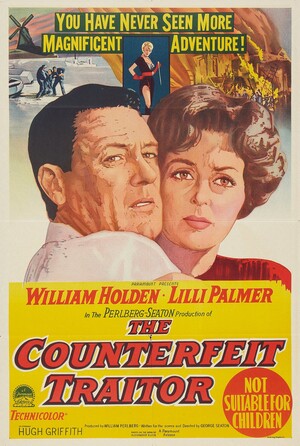
The Counterfeit Traitor (1962)

The Counterfeit Traitor (Film, Spy): Reviews, Ratings, Cast and Crew - Rate  Your Music
Eric Erickson: When other people hate you it's unfortunate. But when you hate yourself, it's unbearable. ~ The Counterfeit Trader (1962)
The Counterfeit Traitor is a film that intrigued me long before I ever saw it. In the days before home video and cable television, it was difficult to see some of the old classics as often as one might like. One of my mother's favorite films was The Counterfeit Traitor. Since there was no way for us to see it, she would tell us the story so vividly that when I finally did see the film I felt it was for the second time. I had already envisioned the scene in which Lilli Palmer, almost fifty but more beautiful than ever, is being led to her execution, and does not hear Bill Holden calling to her from his prison cell, until he shatters the glass. I already knew how she makes the sign of the cross before the shots ring out. Even before I saw the film I was horrified at how the Gestapo have one of their own masquerade as a priest in order to violate the sanctity of the confessional.

The Counterfeit Traitor is a thriller about a Swedish businessman (Holden) who reluctantly becomes a spy for the Allies. A man with no faith and little principle, he is stunned to find in his fellow spy, Marianna (Palmer), a person of true nobility and heroism. Marianna spies on the Nazis because her conscience tells her she must work against the forces of Antichrist. She finds herself, however, in a moral quandary, concerning both her work and her feelings for Holden. The inner tension magnifies the overall impact of the movie in which the viewer is placed in the middle of a global conflict where good seems destined to be overwhelmed by evil. It was the efforts of those who fought in the hidden arena of espionage who helped to turn the tide.

To quote from DVD Review:
The intelligence community tends to play by their own rules, usually out of necessity. Granted, the environment in which they work does not lend itself to hard and fast rules—it's a dynamic, ever-changing climate. They are expected to complete tasks without considering the repercussions, but certain officials in the field must resort to measures that may not be entirely moral. Sadly, that's the nature of war, and neither side of a conflict is immune to such situations. Does that make it right? This is where utilitarianism comes into the picture; how much wrong can be justified to achieve a good end result?

This is a question that comes to haunt Eric Erickson (William Holden). American born, he has made a comfortable life for himself as a prominent oil magnate in Sweden during WWII. He has resided in Stockholm for years, far before Hitler's rise. Thanks to Sweden's neutrality, he has seen good business from both sides of the war, and has enjoyed a sterile distance provided by such a political position. What he is doing is not illegal, and he seems to have a lack of American loyalty that may stem from years of absence from his country of birth.

When his name appears on a list of Nazi collaborators, his position is suddenly made precarious. Being blacklisted for no good reason may be unsettling enough, but he is met by a British intelligence agent (Hugh Griffith) with a proposition: Help the allies spy, and his name will be taken off. He agrees, and is recorded without his knowledge as insurance in case he changes his mind. An anonymous delivery of the wax cylinder to the Swedish authorities would surely land him in jail. Between a rock and a hard place, Eric is forced to spy. His reasons are initially selfish, but events will change his motivations.

Up until now, he has acted as an opportunist, looking out for his own interests. Change comes with a series of frequent meetings with another agent: The beautiful Marianne (Lilli Palmer), who fights for very different reasons. She is a devout Catholic, and to her, Hitler is the Antichrist. She feels it is her moral duty to risk her life to end his tyranny. Eric does not understand this at first, but after witnessing the brutality of the Nazis firsthand, his information-gathering missions become personal. And so it goes as Eric travels back and forth, gathering intelligence and dodging Gestapo suspicion, until tragedy strikes, and he embarks on a daring, final mission to help those who helped him, at his own risk.

This is a stunning, plot-driven under-the-radar film. Beautifully shot in cities such as Stockholm, Berlin, and Copenhagen (they picked some fine locales), the story is set in the authentic locations. George Seaton's script, adapted from the book by Alexander Klein, is intelligent and manages to capture the many shades of European relations with Nazi Germany from the neutrality of Sweden, to the passive resistance of occupied Denmark, seen through a powerful civilian rebellion when Eric most desperately needs it. Things are by no means black and white here. Seaton makes it clear who the true enemy is, but he does not forget the moral violations of those on the right side, including Eric's intelligence "betters," who enjoy a steady diet of fine cheese and lobster while others risk their lives.
Once again it is shown how one soul who takes a stand can influence others for the better. Marianna is by no means a flawless heroine but through her Eric becomes the hero he is meant to be. Share

Leftists Call to ‘Kill Nazis’ Days After Charlie Kirk’s Death and They Mean Republicans

 From Direct Line News:

The No Kings rallies hit city after city. And what did we see? Posters screaming “I WANT TO KILL NAZIS.” When reporters asked, “Who do you mean by Nazis?” they didn’t hesitate, “Republicans.”

I wish I were kidding.

This wasn’t a one-off. The footage is everywhere. Protesters in masks, waving handmade signs that look straight out of some dystopian satire, shouting about killing ICE agents and conservatives. These aren’t trolls on the internet. These are people in the streets, on camera, saying violence is justified if the target votes differently from they do.

And here’s the irony: this was supposed to be the weekend of reflection.

Even The Atlantic’s David Brooks, their “center-right” mascot, went on MSNBC to play philosopher. Brooks said the No Kings protests are “a spontaneous expression of democratic passion.” He called it “messy but necessary.” Great. So was the French Revolution. That didn’t exactly end well either.

Meanwhile, Robert De Niro jumped on MSNBC to remind everyone why he’s become the left’s favorite angry uncle. He called Trump a “bully,” compared Stephen Miller to Goebbels, and dropped a few F-bombs for emphasis. De Niro says he’s just “fighting for democracy.” But let’s be real, this wasn’t about democracy. It was about feeding a mob.

De Niro’s interview poured gasoline on a fire that was already burning hot. You could see the crowd’s energy shift in the coverage that followed. “We have to fight!” he shouted, and they did. Only their definition of “fight” keeps getting broader. It’s not just Trump anymore. It’s Republicans. It’s ICE agents. It’s anyone who doesn’t sign on to the latest protest slogan.

Charlie Kirk’s death should have been a turning point, a moment to ask what all this rage is doing to our country. He was a controversial guy, sure. But even the left admitted he didn’t deserve the hate he got. For a brief second, people talked about grace. Then the weekend came, and grace went right out the window.

Let’s not sugarcoat this: the No Kings protests aren’t about civil discourse anymore. They’ve turned into emotional rallies where violence gets romanticized as resistance. Brooks calls it a “distributed movement.” That’s a polite way of saying chaos without accountability. (Read more.)

Share