Saturday, January 14, 2023

CDC Finally Releases VAERS Safety Monitoring Analyses For COVID Vaccines

 From Zero Hedge:

  • CDC’s VAERS safety signal analysis based on reports from Dec. 14, 2020 – July 29, 2022 for mRNA COVID-19 vaccines shows clear safety signals for death and a range of highly concerning thrombo-embolic, cardiac, neurological, hemorrhagic, hematological, immune-system and menstrual adverse events (AEs) among U.S. adults.

  • There were 770 different types of adverse events that showed safety signals in ages 18+, of which over 500 (or 2/3) had a larger safety signal than myocarditis/pericarditis.

  • The CDC analysis shows that the number of serious adverse events reported in less than two years for mRNA COVID-19 vaccines is 5.5 times larger than all serious reports for vaccines given to adults in the US since 2009 (~73,000 vs. ~13,000).

  • Twice as many mRNA COVID-19 vaccine reports were classified as serious compared to all other vaccines given to adults (11% vs. 5.5%). This meets the CDC definition of a safety signal.

  • There are 96 safety signals for 12-17 year-olds, which include: myocarditis, pericarditis, Bell’s Palsy, genital ulcerations, high blood pressure and heartrate, menstrual irregularities, cardiac valve incompetencies, pulmonary embolism, cardiac arrhythmias, thromboses, pericardial and pleural effusion, appendicitis and perforated appendix, immune thrombocytopenia, chest pain, increased troponin levels, being in intensive care, and having anticoagulant therapy.

  • There are 66 safety signals for 5-11 year-olds, which include: myocarditis, pericarditis, ventricular dysfunction and cardiac valve incompetencies, pericardial and pleural effusion, chest pain, appendicitis & appendectomies, Kawasaki’s disease, menstrual irregularities, vitiligo, and vaccine breakthrough infection.

  • The safety signals cannot be dismissed as due to “stimulated,” exaggerated, fraudulent or otherwise artificially inflated reporting, nor can they be dismissed due to the huge number of COVID vaccines administered. There are several reasons why, but the simplest one is this: the safety signal analysis does not depend on the number of reports, but whether or not some AEs are reported at a higher rate for these vaccines than for other non-COVID vaccines. Other reasons are discussed in the full post below.

  • In August, 2022, the CDC told the Epoch Times that the results of their safety signal analysis “were generally consistent with EB [Empirical Bayesian] data mining [conducted by the FDA], revealing no additional unexpected safety signals.” So either the FDA’s data mining was consistent with the CDC’s method—meaning they "generally" found the same large number of highly alarming safety signals—or the signals they did find were expected. Or they were lying. We may never know because the FDA has refused to release their data mining results. (Read more.)

Share

The Reality of Grace in 'Rings of Power'

From US Catholic:

Catholic tradition has always held evil to be a privation of what in origin is fundamentally good. The Book of Genesis tells us that God looked out on the world when God finished forming it and declared it good. Evil as a force of its own forms no part of creation.

This is a key theme underlying Amazon’s much anticipated Lord the Rings: The Rings of Power. It’s interesting to consider how the series’ producers fleshed out the origins of evil in J. R. R. Tolkien’s Middle Earth, staying true to Tolkien’s own Catholic sensibility. “Nothing is evil in the beginning,” as one of the chief characters states in The Fellowship of the Ring.

Of equal importance to Tolkien in his fantasy world is a fundamental diversity of races. As a Catholic in early 20th-century Britain, Tolkien grew up aware of the prejudice against his faith and church throughout his life. He was careful to reveal and dramatize this awareness through the tensions between the elves, dwarves, men, and hobbits that populate Middle Earth.

It’s all the more ironic, then, that even before the first episode of Amazon’s series premiered, controversy arose about what Tolkien purists complained was the producers’ forced inclusion of people of color in major roles to make Middle Earth appeal to members of a wider audience, many of whom were not even born when Peter Jackson’s spectacular film adaptations were released 20 years ago.

But series producers J. D. Payne and Patrick McKay have succeeded in assembling a marvelous troop of believable actors, staying true to the diversity at the heart of Tolkien’s work from the earliest of his writings. For example, by starting with the darker-skinned hobbits (the Harfoots), the series sets up the future meeting of these rustic travelers with their more adventurous and fairer-skinned Fallohide and Stoor relatives. Indeed, Tolkien deliberately modeled the three ethnic groups of hobbits on the three major ethnic groups that established England in the early Middle Ages: the Angles, the Saxons, and the Jutes. (Read more.)


Share

Friday, January 13, 2023

Giving Scandal

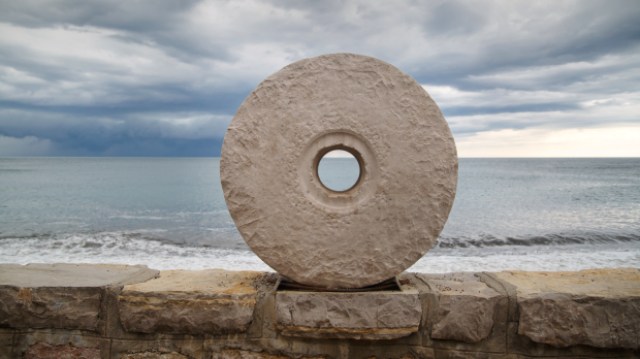
A millstone

https://scontent-iad3-2.xx.fbcdn.net/v/t39.30808-6/324464433_3294013674192283_6534187366331963816_n.jpg?stp=dst-jpg_s640x640&_nc_cat=104&ccb=1-7&_nc_sid=730e14&_nc_ohc=_S3sSvONtzAAX9fDZT1&_nc_ht=scontent-iad3-2.xx&oh=00_AfCV8dYDV3zNFR0_Vr8HwRBuBKEc9k4Y8aH9XXoE57NI6g&oe=63C3A789
Jesus preaching in Capernaum by Gottlieb
 And [Jesus] said to his disciples: It is impossible that scandals should not come: but woe to him through whom they come. It were better for him, that a millstone were hanged about his neck, and he cast into the sea, than that he should scandalize one of these little ones. Take heed to yourselves. If thy brother sin against thee, reprove him: and if he do penance, forgive him.—Luke 17: 1-3

Giving scandal is a serious sin for Catholics, yet one which is continually overlooked. It is particularly bad when a priest, nun or devout lay person, especially one who is committed to a pious union or secular order, give scandal by publicly violating the moral law. Those who teach the Holy Catholic Faith but then flout the teachings of the sixth and ninth commandments as if they do not apply to them do a great deal of damage especially to the conduct of young people. Our Lord had strong words for those who cause little ones to go astray through scandal, saying it "would be better if they had not been born." (Luke 17: 1-3) Harsh words, but Jesus said them. According to Aleteia: "We are helped in our understanding of this Gospel passage by Simon Légasse, who wrote 'the terrible fate of the drowning man with a stone around his neck is nothing compared to what awaits at God’s judgment the one who caused someone to stumble.'"

Often in the past, reformed ladies of notoriety, such as Madame du Barry, would spend time in a monastery, some even became nuns. Giving scandal was seen as no small matter; the damage done to both the individual and to others was such that temporary withdrawal from the world was definitely part of the healing process. However, fallen women belong to a bygone era. Someone can only be "fallen" if there is a certain standard from which to fall. In our time, most standards of what once constituted decent behavior have been drastically altered. Situations that formerly belonged to the "half-world," the demi-monde, are now mainstream.
 
Yet there are things that remain constant. Promiscuity, then as now, has a hardening effect upon the psyche, as well as destructive, long-term consequences. Such a life leaves many scars. Prostitution in any form is degrading, even the very glamorous whoredom portrayed in Camille, the 1937 cinematic masterpiece starring Greta Garbo and Robert Taylor. Based upon the 1848 novel La dame aux camélias by Alexandre Dumas fils, the "Lady of the Camellias" had already been the subject of an opera by Verdi, as well as several films.

Because in past times it was frowned upon by society that men and women live together without being married, there was more hope that the relationships be broken off, especially if marriage was out of the question. Guilt is not healthy if nourished but it can and does lead to repentance. We live now in a shameless time. Parents no longer intervene as the fathers do in both Verdi's La Traviata and Puccini's La Rondine. In those old operas, there was sin, there was great passion, but there was also great love and the willingness to make sacrifices for the beloved. There is now little shame, little love and few willing to sacrifice. And sometimes I wonder if people are really happy.

Here is a brilliant article by Father John Flader from Australia.  (I love Father Flader and had a lovely dinner with him at a Japanese restaurant in Auckland, NZ.) Not sure why Manet's Olympe is dragged out by the editors as an example of scandal but I guess it makes the point. To quote:

There are many ways in which one can commit scandal. The most obvious is by leading another person directly into sin. A young man who engages in sexual activity with a girl, a married man who entices a woman to commit adultery with him, a person who invites someone to attend an inappropriate film or show, someone who encourages another to commit a crime with him, a business manager who tells his staff to lie to the customer, etc., all commit scandal and are responsible not only for their own sin but also for that of the other.

Another obvious way of committing scandal is by giving bad example, without necessarily intending to lead others into sin. This can include using bad language, dressing immodestly, praising a film that contains inappropriate material, drinking alcohol to excess, etc. This is what we mean by scandalous behaviour.  A girl, or a boy for that matter, who dresses or behaves immodestly can be guilty of the sins of all those who look at them with lust or have impure thoughts or desires as a result. Parents have a special responsibility to take care that their children dress and act appropriately.

Parliamentarians who vote for legislation that permits immorality in such forms as abortion, pornography or embryonic stem cell research are guilty of scandal and are responsible for all the sins committed as a result. Similarly those who make immoral films, who make and sell immodest clothing, who run brothels, etc., are guilty of scandal on a grand scale. (Read more.)

From Catholic Answers:

The Catechism explains that scandal is greater according to the authority of the one scandalizing. It is one thing for a four-year-old to say, “Jesus isn’t the Son of God,” but it would be another thing entirely for a bishop to say this. Because of the authority of the episcopate, the bishop can influence more people more effectively, increasing the gravity of the harm done to those who hear him. If the faithful (or unfaithful) believe him, they move away from Jesus Christ and the salvation he offers us.

This example displays a second, closely related element of scandal: it increases when the speaker has a duty to teach the truth. Since people trust their bishops to teach them the true Catholic faith, their errors are particularly harmful. Even when the faithful don’t believe it, the above statement is still scandalous. The faithful feel betrayed by their shepherd, who should be witnessing to Christ’s truth. This can cause a mistrust of the hierarchy and a disrespect for the priesthood.

The Catechism names two more factors that can increase the gravity of scandal. It becomes more grave when the scandalized person is especially weak or when others are deliberately led into grave sin. Given the poorly formed faith of so many Catholics, this means that today the opportunities for scandal are many. The improperly catechized can easily mistake vice for virtue and be led into sin.

In cases where scandal occurs but is less grave, it may lead to a simple misunderstanding. In the graver cases described above, scandal can encourage a gravely improper view of reality, to the point that a person sees good as evil and evil as good. In the most severe cases, as when a Catholic leader endorses a sinful lifestyle, someone could get the wrong idea about God, the Church, or salvation, causing him to run towards hell while thinking that he is closing in on heaven. This potential is amplified when the listeners are young and impressionable. (Read more.)

It is hard to resist the temptation to fall into scandalous behavior if one has been sad and lonely. But to be a Christian means taking up the Cross with Our Savior. People mistake pleasure for happiness. But God is not mocked. In the words of the great St. Teresa of Ávila: "Remember that you have only one soul; that you have only one death to die; that you have only one life, which is short and has to be lived by you alone; and there is only one Glory, which is eternal. If you do this, there will be many things about which you care nothing." 

(Image source.)

Share

Why Biden Took ‘Classified’ Documents

 From Becker News:

“Among the classified documents from Joe Biden’s time as vice president discovered in a private office last fall are US intelligence memos and briefing materials that covered topics including Ukraine, Iran and the United Kingdom,” a source told CNN. “A total of 10 documents with classification markings were found last year in Biden’s private academic office and they were dated between 2013 and 2016,” the report added. In a situation similar to the “classified” marked documents found at former President Donald Trump’s residence at Mar-a-Lago, the boxes found at the Penn Biden Center with these classified records also contained personal Biden family documents. (Read more.)


From Just the News:

The issue of handling of classified documents boomeranged Monday on President Joe Biden, just months after the FBI raided Donald Trump's Florida home, as officials confirmed a small number of classified documents were found in a private office once used by the current president at his think tank.

A senior government official directly familiar with the discovery told Just the News that the National Archives asked the Justice Department to open an investigation in November after a small number of classified documents -- some marked top secret -- were found in a locked closet in the Penn Biden Center in Washington, where Biden worked after he left the Obama administration.

The official, who spoke only on condition of anonymity, said Attorney General Merrick Garland has asked a U.S. attorney in Illinois -- a holdover from the Trump administration -- to oversee the investigation with NARA and the FBI. The documents appear to be from the Obama administration.

The White House released a statement Monday evening confirming the discovery and the investigation, saying Biden's lawyers self-disclosed the existence of the documents when the office previously used by the president was being vacated for another party.

"The White House is cooperating with the National Archives and the Department of Justice regarding the discovery of what appear to be Obama-Biden Administration records, including a small number of documents with classified markings," White House special counsel Richard Sauber said in a statement after the discovery was reported by CBS and CNN. "The documents were discovered when the President's personal attorneys were packing files housed in a locked closet to prepare to vacate office space at the Penn Biden Center in Washington, D.C." (Read more.)


From The Post Millennial:

A Chicago attorney has been assigned by US Attorney General Merrick Garland to review classified documents found at the Penn Biden Center for Diplomacy and Global Engagement in Washington, reports CBS News. This relates to about 10 documents from President Biden's vice-presidential office, two sources said.

The materials were identified by personal attorneys for the president on November 2, just days before the midterm elections, according to special counsel to the president Richard Sauber. The documents were discovered when Biden's personal attorneys "were packing files housed in a locked closet to prepare to vacate office space at the Penn Biden Center in Washington, D.C.," Sauber said in a statement. (Read more.)
 

From Breitbart:

At least $54 million has been donated by Chinese Communist Party-linked individuals or entities between 2014 and 2019 to the Penn Biden Center for Diplomacy and Global Engagement in Washington at the University of Pennsylvania, according to public records reported by the New York Post, where it was revealed this week that Biden had stashed a trove of classified documents.

The University of Pennsylvania announced it would create the Biden Center in 2017, the same year then-Vice President Biden left the White House. Most of the anonymous donations were given to the Biden Center after the university announced the Penn Biden Center, the Post reported. (Read more.)

Share

New Assessments of Oppenheimer’s Role in History

 From PBS:

Christopher Nolan's upcoming film "Oppenheimer" tells the story of the brilliant physicist and his intense work to develop the weapons that would help America win the Second World War. Two of the bombs he and his colleagues helped create were dropped on Japan, killing several hundred thousand people, mostly civilians, but helping bring the war to a quicker end. Afterwards, Oppenheimer expressed regret about these weapons and worked to stop their proliferation.

In 1954, at the height of anti-Soviet fervor, his security clearance was revoked over allegations that he had ties to communism. But almost 70 years later, long after his death, Energy Secretary Jennifer Granholm reversed that decision, saying: "As time has passed, more evidence has come to light of the bias and unfairness of the process that Dr. Oppenheimer was subjected to, while the evidence of his loyalty and love of country have only been further affirmed."

For more on this complicated man and his role in history, I'm joined now by Alex Wellerstein. He's a historian of nuclear weapons, a professor at the Stevens Institute of Technology, and author of "Restricted Data: The History of Nuclear Secrecy in the United States." (Read more.)

Share

Thursday, January 12, 2023

The Art of Oyster Shucking


 From Baltimore Fishbowl:

Thomison, 19, a recent graduate of the nearby Academy for College and Career Exploration (ACCE), has proven to be a rare find: an oyster shucker with the talent, strength, work ethic and patience to feed a restaurant full of discerning mollusk-lovers. Sometimes Patrick Hudson, the owner of True Chesapeake, can’t believe his luck in finding this oyster-shucking phenom. Hudson opened the restaurant in 2019, stocking it with oysters grown on the harvesting farm he started in 2012 on St. Jerome Creek in southern Maryland. By that time, the Chesapeake Bay, once capable of yielding millions of bushels of oysters a year, was oystered-out – a decline that had started in the 1970s. Farmed oysters, Hudson had told himself and his investors, were the sustainable and delicious future of quality seafood restaurants in the region. State lawmakers thought so, too, making oyster farming legal starting in 2009. But when Hudson opened the restaurant, experienced shuckers were in short supply. The decades-long chain of one generation teaching the next had been broken. “It’s kind of a lost trade,” says Hudson.

Shucking an oyster is a little bit physics, a little bit love, and a lot of attention to detail. By 2019, the few experienced shuckers still working were close to retirement. They hadn’t taught potential successors how to grip the bulb at the end of the specially designed knife, how to insert the knife tip into the tightly clasped shell, how to wiggle and turn that knife, how to assess that each oyster is healthy and sweet, how to slice the muscle holding the meat to the shell. And they certainly hadn’t taught anyone how do it again and again, 999 more times in a single night. (Read more.)

Share

A Radical Proposal for the USCCB’s Eucharistic Revival

 From Fr. Perricone at Crisis:

One need not be a trained phenomenologist to appreciate the importance of symbolic acts in man’s self-disclosure. Insouciance in the presence of the Holy Eucharist is a damning sign—not only of the total absence of rudimentary piety, but of a withered belief in the doctrine itself. One flows from the other as certainly as day follows night. If a Catholic shows as much attention to the Holy Eucharist as he does to collecting his order at Starbucks, something is awry.

The American bishops seemed to have noticed this alarming anomaly in the past year
. Odd that they should have detected this doctrinal collapse so recently, since it has been glaringly evident for over a half-century. It is rather like a man being bitten by a shark and only screaming an hour later.

[...]

The esoteric ruminations of faux Catholic scholars would have collected dust on university/seminary shelves unless they were translated into praxis by the instruments of liturgy and catechesis. This is exactly what was done with impressive and sweeping results. In the case of catechesis, the old Baltimore Catechism anchored the Faith firmly in the minds of the young; its successor leaves young Catholics adrift in a sea of passé Sixties flotsam. And all of this has taken place over the past sixty years under the unwatchful eyes of pastors and bishops. Or, shall we say, watchful eye.

So thorough was this transformation of Eucharistic theology that well-meaning Catholics now confidently call the Mass “a meal” and the Holy Eucharist “bread of fellowship.” Under this logic, it is quite hostile, to say nothing of actionable, to refuse any man or woman access to the Holy Eucharist. Not a few bishops growl at a priest even publicly repeating the traditional requirements for reception of Holy Communion. So very “unwelcoming,” you see. This alarming doctrinal breakdown entrenched itself so deeply that it even dictated new architectural forms for churches, confirming the Marshall McLuhan principle: the medium is the message. (Read more.)


From EWTN:

In an attempt to justify taking Communion in the hand, it could be argued that the hand is not more sinful than the tongue and that all that is being done is taking Communion as it was done during the Last Supper... Someone else may even say that holding the host in their hands (and some kiss it before eating it) gives them a more intimate relationship with Jesus and it is as if they were holding baby Jesus in their arms. Let us dispose of the last argument first. The consecrated host is not baby Jesus but the resurrected and glorified Lord; as such, His sacramental presence is not equivalent to the privilege given to Jesus' contemporaries. A more fitting relationship to the Real Presence is the reaction of St. Thomas who kneels and exclaims: "My Lord, and my God" (John 20:28), or the encounter that the apostle John had with Jesus in heaven as related in the book of Revelations Chapter 2, verse 17: "When I saw him, I fell at his feet as though dead"; this is the very apostle who once "was lying close to the breast of Jesus" (John 13:25), the "beloved disciple." The apostles show us, as if in anticipation of the present irreverence, the proper attitude vis-a-vis the resurrected Lord.

We see the motivation for the change by reading "Memoriale Domini" where it states "in order to help the episcopal conference fulfill their pastoral office in today's often difficult situation". Some bishops, in an attempt to bridge that gap, encroached against "the long received manner of ministering Holy Communion", for the dangers that it warned against have not been avoided. Namely, of "insufficient reverence and false opinions of the Holy Eucharist." It is not the purpose of this paper to establish that the hand is any less or any more sinful than the mouth, but to indicate that receiving Communion in the hand introduces a de facto watering down of our faith, as well as possible desecration.

Historically speaking, we have already established that Saint Thomas Aquinas, all the way back in the 13th century, spoke authoritatively and sternly about not touching the consecrated bread. We can thus conclude that the practice of Communion in the hand was well established by then. When we search further back in history, we see that Communion in the hand was viewed as an abuse at the Synod of Rouen in the year 650. Communion on the tongue is then, as the Holy Father Paul VI says, "a very ancient and venerable tradition."

In order to dispose of the more insidious argument for taking communion in the hand, namely that the apostles received in the hand during the Last Supper, thus entitling anyone to receive the Eucharist in this manner, we need to do a quick tour in biblical exegesis that will indicate that the apostles were already priests when they received the Eucharist. (Read more.) 


Here are quotations from saints, popes, and Church councils at Catholic Tradition:

St. Sixtus 1 (circa 115): "The Sacred Vessels are not to be handled by others than those consecrated to the Lord."

St. Basil the Great, Doctor of the Church (330-379): "The right to receive Holy Communion in the hand is permitted only in times of persecution." St. Basil the Great considered Communion in the hand so irregular that he did not hesitate to consider it a grave fault.

The Council of Saragossa (380): Excommunicated anyone who dared continue receiving Holy Communion by hand. This was confirmed by the Synod of Toledo.

The Synod of Rouen (650): Condemned Communion in the hand to halt widespread abuses that occurred from this practice, and as a safeguard against sacrilege.

6th Ecumenical Council, at Constantinople (680-681): Forbade the faithful to take the Sacred Host in their hand, threatening transgressors with excommunication.

St. Thomas Aquinas (1225-1274): "Out of reverence towards this Sacrament [the Holy Eucharist], nothing touches it, but what is consecrated; hence the corporal and the chalice are consecrated, and likewise the priest's hands, for touching this Sacrament." (Summa Theologica, Part III, Q. 82, Art. 3, Rep. Obj. 8.)

The Council of Trent (1545-1565): "The fact that only the priest gives Holy Communion with his consecrated hands is an Apostolic Tradition."

Pope Paul VI (1963-1978): "This method [on the tongue] must be retained." (Memoriale Domini)

Pope John Paul II: "To touch the sacred species and to distribute them with their own hands is a privilege of the ordained." (Dominicae Cenae, 11) 
(Read more.)

Share

Only Style Survives: On Chateaubriand

 From The Paris Review:

I compile an undisciplined index on the flyleaf of the first volume as I read it, as a future aid to memory but also for the private pleasure of watching this crooked list accrue in its variously colored inks. On page 336 he haughtily refers to Rousseau as a kind of cobbler or a schoolmaster. His praise for Lord Byron receives an entire chapter in the twelfth book. As a boy he learns about love from the Latin poets: he voluptuously reads Lucretius in bed at night, by the light of stolen candles....Chateaubriand’s own boyhood coverlet was almost certainly of coarse manufacture; his father’s version of domestic economy in their moldering château was Spartan, inadvertently preparing the writer for his future exile and penury. An aficionado of exile, four times he mentions the troubadours in the first volume. Of all the items I have noted in my index, the one with the most entries is tomb. This shouldn’t surprise: everyone dies. Entire languages violently disappear. There’s not a place on earth, he says, that’s tombless. It is to him the most fascinating subject. He sees America, where he traveled at length during the Terror of the French Revolution, as nothing but the tomb of the great Indigenous nations reduced to ruin by Europe. On page 493, he describes how at Niagara Falls he heard an Iroquois girl named Mila sing a song about the beautiful pattern of the adder’s skin; as she sings, he realizes that he already knows the song, which was recorded, he says, in an essay by Montaigne, who had heard a different Iroquois girl sing it two centuries before in Rouen. I am enchanted by this incredible story, so I look further, and learn the adder song has a spurious linkage. The girl at Niagara Falls could not have sung the song cited by Montaigne, who writes in his 1580 account “Of Cannibals” that it was sung by a captive Tupinambá girl from Brazil, in the Tupi language. So am I to believe Chateaubriand when he says that he has handled the decomposed skull of Marie Antoinette? It is he who identified the remains of the guillotined queen, he claims, which had been thrown perfunctorily into a collective pit. He knew her, he says, by means of the set of the teeth in the jawbone; at Versailles, in his youth, he had been familiar with the Queen’s wide smile.

In July of 1791, alone in the forest near Albany, seeking, as he explained, the Northwest Passage, and believing himself to be in a primordial embrace with Nature, Chateaubriand heard the sound of a fiddle in the woods. He approached the surprising music to discover in a clearing a French dancing master in a powdered wig, apple-green suit, and lace jabot and cuffs, playing a tune for a group of twenty bare-torsoed, feather-wearing, dancing Iroquois men. These were the first Indigenous people the young exile had ever met. The fiddler’s tune, “Madelon Friquet,” had been a popular French fairground song. French dancing masters were then common in America, the notes inform me, having been displaced and there being no further call for them during the revolution. A faintly comedic melancholy is this book’s mother tongue.

Chateaubriand says that the pleasures of youth revisited in memory are ruins seen by torchlight. I don’t know whether I’m the ruin or the torch.

Montaigne was dead at fifty-nine—kidneys; Baudelaire at forty-six—syphilis, probably. Rousseau died at sixty-six of causes unconnected to his lifelong urethral malformation, described so exhaustively and enticingly by Starobinski; Lord Byron died of fever at the age of thirty-six in the Greek War of Independence in 1824, the year of Baudelaire’s birth. After a final visit to his mistress, Madame Récamier, he by then blind and she paralytic, Chateaubriand died at the age of seventy-nine, in 1848, the year of the third revolution and its failure and of Baudelaire’s grand political disillusionment.

The attribution of causation to human behavior is generally a work of fantasy. Birds will speak the last human words, Chateaubriand says. Each one of us is the last witness of something—some custom, habit, way of speaking, economy, some lapsed mode of life. He says only style survives. (Read more.)

Share

Wednesday, January 11, 2023

13 Historic American Houses Every Design Lover Should Visit


Rosecliff

From Architectural Digest:

Another must-visit among America’s finest historic houses is Rosecliff, located in Newport, Rhode Island. “Of all the Newport mansions, Rosecliff is by far my favorite,” says designer Lindsey Coral Harper, who fell in love with the city during formative summers escaping New York. The turn of the 20th century home of Theresa Fair Oelrichs, heiress to a silver fortune, was modeled after Versailles’s Grand Trianon and named for the thousands of roses planted along the Cliff Walk. “I am a huge fan of Stanford White architecture and the exterior of this H-shaped building is perfect. The inside is breathtaking—the perfect setting for filming the parties of The Great Gatsby. I always find inspiration for window treatments, valances, and pelmet shapes when walking through.” (Read more.)

Dining room at Marble House


Share