As I work on the second volume of the
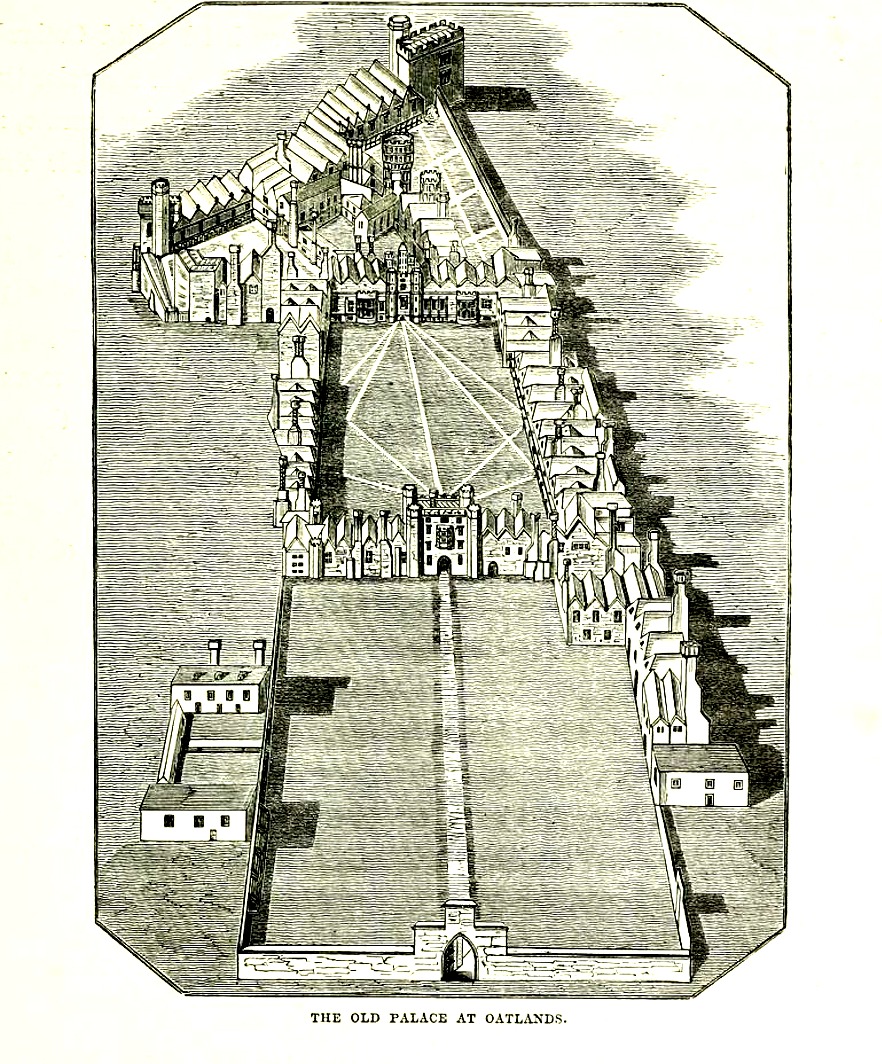
Henrietta of France Trilogy, I have been researching Oatlands Palace where Henriette stayed with all of her living children together for one of the last times before war divided them. While Henry VIII had intended Hampton Court to be the King's hunting lodge, and Nonsuch to be the Prince of Wales' hunting lodge, Oatlands was to be the Queen's hunting lodge. Sadly, it no longer exists. From
Royal Palaces:
At the time of Henry’s death Oatlands was classed as a ‘standing
house’, this meant that it was one of the few that was kept permanently
furnished in readiness for the king. Elizabeth I used Oatlands for short
summer breaks but under James I the house, once more, took on its
original purpose. It was granted to Anne of Denmark, his queen, in 1611
and was used almost every summer for hunting trips. Anne commissioned
Inigo Jones to modernise the interiors, most of which were more or less
as Henry VIII had left them. The Tudor furniture was thrown out and
brand new beds, tables and chairs were commissioned; silk wall hangings
were woven and panelling replaced with designs of a more contemporary
feel.
After Anne of Denmark’s death in 1619 James continued to use Oatlands
for hunting trips so much so that he had his bedchamber rebuilt to make
his visits more comfortable. Yet it was in the reign of his son that
Oatlands had its golden age.
On his accession in 1625 Charles I made Oatlands over to his queen.
Henrietta Maria was a French Princess who essentially regarded English
taste in interior decoration old fashioned and provincial. She refitted
her London residence, Somerset House, and soon did the same at Oatlands.
Her architect was Inigo Jones who replaced the remaining Tudor
chimneypieces with more modern ones in a French style and redesigned
panelling and door cases.
New hangings and furniture were ordered for the royal lodgings.
Perhaps the most important improvement was in Henrietta Maria’s gallery
where, on the ground floor, a series of stucco frames designed by Jones
framed views of her other houses, such as Pontefract castle, Eltham
Palace and Oatlands itself. When she had finished Oatlands was the most
modern and comfortable of all the royal country houses. As a result it
became the usual summer residence of the Stuart Court between 1635 and
1642.
The civil war was disastrous for England’s royal palaces. Outside
London only Hampton Court was to be kept. All the other palaces were to
be sold to pay off parliament’s debts. Most were simply auctioned for
their building materials and this was the fate of Oatlands. By 1660 all
that remained were the garden walls. (Read more.)
Oatlands was where Henry VIII married his fifth queen, the very young and ill-fated Katherine Howard. From The Tudor Travel Guide:
By the mid 1530s, the principal country seat
of the English monarchy had moved westwards from Greenwich to Hampton
Court. According to Simon Thurley’s contribution in Poulton’s Excavations at Oatlands Palace, the acquisition of Oatlands in 1537 from the wealthy Reed family was: "… part of a project masterminded by
Thomas Cromwell, to provide the new palace [Hampton Court] with the
ancillary lands and subsidiary houses necessary for its status."
At its peak, The Honour of Hampton Court
consisted of a huge area covering 40,000 acres. This included the
palaces of Oatlands and later, Nonsuch. The transformation of Oatlands
was closely linked with the development of Henry’s principal out of town
residence; the same master craftsmen oversaw its remodelling, and a
road was built directly between the two in the summer of 1537. It has
been proposed by Thurley that the intention was that Hampton Court would
be assigned as the king’s residence, Oatlands the queen’s, and Nonsuch
reserved for the use of Edward, Prince of Wales. Given the timing of
this building project, the hypothesis is that the manor of Oatlands was
originally intended as a palace for Anne of Cleves. (Read more.)