|
| Danielle Deadwyler as Mamie Till-Mobley and Jalyn Hall as Emmett Till |
|
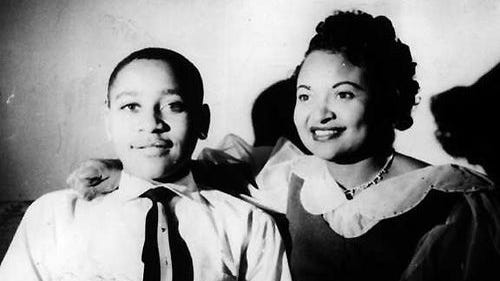 |
The real Emmett and his mother Mamie
|
I could not get anyone to watch Till with me so I watched it alone on Christmas Day while recovering from Covid. Knowing what it was about caused me to be numb with horror from the beginning, a feeling which increased as the movie went on. The fact that the film is from the point of view of Emmett Till's mother Mamie Till-Mobley makes it easy to relate to the tragedy as a parent, although many of us would drop dead from horror if we had to go through what that poor mother endured. By the end horror was mixed with wondering anger at the murderers of Mamie's child and why such sick and crazed individuals were allowed to live out their wretched lives in freedom. So one night during the Christmas octave I stayed up late researching the case, trying to figure out the background causes of the level of hate that would commit such an atrocity. Yes, there are racists that hate others because of their skin color but the rage inflicted upon that little boy's body by grown men seemed to be fed by something else in addition to their homegrown race hatred. As for the film, I thought it was well-done, well-acted, and more or less accurate historically. The director Chinonye Chukwu chose not to show the torture and murder directly, but rather allow the viewer to see through the eyes of the victim's mother as she views his mutilated body in the morgue. It is a scene which leaves only the hardest of hearts unchanged.
The film is based upon the murder of fourteen-year-old Emmett Till in the summer of 1955 in the town of Money, Mississippi. Emmett was visiting his great-uncle, great-aunt and cousins who worked as sharecroppers. His great-uncle Moses Wright was also known as "Preacher" for his eloquent preaching of the Gospel at local church services. When frequenting a shop in Money, Emmett said something to a twenty-one year old married white woman named Carolyn Bryant, whose husband owned the shop. In the movie, Emmett tells her she is as "pretty as a movie star." Later, at the murder trial, the description of Emmett's behavior morphed into attempted rape. While few could agree about what happened inside the store, everyone present heard Emmett's whistle outside the store, which Mrs Bryant assumed was aimed at herself, in spite of the fact that Emmett had a stutter and often whistled to steady his speech.. Mrs. Bryant retrieved a pistol from her truck, later claiming that she and her four babies were in danger. Emmett and his cousins ran away; he made the other boys promise that they would not tell Preacher about the event. Four days later, at 2:30 in the morning, Mrs. Bryant's husband Roy Bryant and his half-brother John Milham kidnapped Emmett from the Wright family cabin and took him to a barn where they tortured and beat him to death, throwing his body into the river. The culprits were arrested and tried for murder but the all-white jury found them not guilty. However. Emmett's mother Mamie, with the help of the NAACP, Medgar Evers, and other activists, raised the alarm throughout the country, where people everywhere were horrified by the injustice.
From Plugged In:
Too far. Too far.
Oh, it isn’t technically too far to Mississippi—not in 1955.
A train could whisk you down South from Chicago in a day. Emmett—whom
everyone called Bo—wouldn’t be gone long, either. He’d spend several
days with his cousins near Money, Mississippi, and head straight back
home. Those cousins would watch him closely, making sure he didn’t get
into trouble. He’d be fine, Preacher promises Mamie Till. They’d keep
him safe.
Mamie is nervous all the same. Bo has lived all his life in Chicago—a
place where whites and Blacks lived in, if not harmony, at least
compatibility. Mamie has a good job, a good home, a good life in the city. Emmett has known nothing else.
But Mississippi isn’t Chicago. Jim Crow reigns down there. And people
like Mamie and Bo—they go to the back of the bus, drink from different
fountains. And if a Black person even dares to hint that they are
created equal, well, heaven help that person.
“They have a different set of rules for Negros down there,” she cautions Emmett just one more time. “Are you listening to me?”
Bo says yes. But she worries. The boy’s always been so happy, so
carefree. How can he really know what it’s like down there until he sees
for himself? And what if he sees too late?
Mamie swallows her worry and sends her boy off, praying every night for his safe return.
A week later, Emmett Till is dead.
His mutilated, bloated body is fished out of Tallahatchie River.
Mamie demands Mississippi send the body home to Chicago. And when the
body is finally returned, the undertaker cautions Mamie that the sight
won’t be pretty. “I need to prepare you.”
She sees the body. She sees her boy. She runs her fingers over his
swollen feet, his bloated legs. She sees the face, barely recognizable
as a person, much less her son—the side of the head caved in by a bullet, an ear torn, the wounds too many to count.
And in that moment, Mamie realizes the world must see. Bo’s not the
only one to die for the “sin” of skin color. For too many years, people
have literally gotten away with murder. Now, Mamie will force the world
to see. She will force the world to feel her grief.
Too far. This time, they’ve gone too far. (Read more.)
From Mommy Factor:
The film TILL shows the lifestyle of Emmett Till and his mom Mamie. A
peek into moments during their day to day to life. Moments of laughter,
preparing for a trip to visit family and even "reminder" between them.
As any mother would do with her child. It's a lifestyle that any parent could can relate to, no matter their race or background. While race did bring a separation in how Emmett is treated in society,
there is no separation when a parent has to grieve the death of their
child. That type of grief is felt by all and transcends everything. There's a moment when Mamie describes how she knew her son and truly
it's a moment all parents, especially mothers will felt down to their
souls. It's that parentally connection, that mothers love, that touched that
nation back then and will touch the views now. No matter race or
background. (Read more.)
Emmett's mother Mamie was a lovely and refined person who had built a middle class life in Chicago for herself and her son. She had a good job working for the air force and could afford to shop at the best stores. Emmett was a high-spirited, mischievous and cheeky teen, and as an only child was perhaps just a tiny bit spoiled. In spite of his mother's divorces, he had a secure family situation, with loving grandparents and a supportive circle of friends and relatives. Emmett was intelligent and had a bright future ahead of him. As parents of only children know, "cousin time" is important. In spite of
the possible dangers of life for black people in Mississippi, Mamie
wanted Emmett to have fun with his cousins and see how they lived. In
real life, Emmett was accompanied by family members even on the train so
that he would be safe.
Now the place in Mississippi ironically called "Money" was a dead end of sorts, especially for white people. The Bryants, who owned the store, served a primarily black clientele, sharecroppers who they no doubt looked down on for being poor as well as black. However, one can pretty much guess that in the white community, the Bryants were at the bottom of the totem pole, their skin color being the only aspect of their existence which kept them from being classed with the black sharecroppers. So to the Bryants, their whiteness was their lone claim to a rather shaky status in the wider community of Leflore County. They were what a lot of white and black people would have sympathetically called "poor white trash." Carolyn Bryant at 21 was already the mother of four. There were no nice stores or colleges in her future. We know, based upon what followed, that her husband had a tendency to extreme violence. Her life was bleak, to put it mildly. So one hot summer afternoon into her store bounds a young black boy on the brink of manhood, well-dressed and confident, who looks at her as the pretty woman that she is. Emmett probably and unknowingly broke four or five taboos before he even opened his mouth. He had no concept that he was supposed to pretend to be inferior to someone like Carolyn Bryant. Once he opened his mouth, it was all over, because he spoke to her as an equal, looking into her face, not with eyes downcast, saying, "Miz Bryant, ma'am." But even then, Carolyn Bryant did not tell her husband right away, and by her later testimony did not plan to tell him at all, afraid he would "beat up the little boy." But Roy Bryant found out.
Bryant and Milam discovered Emmett's identity and where to find him, and with other men, two of whom were black, to help them, dragged him away into the night. In the film Till, when Mamie eventually visits the Wright cabin from which her son Emmett was abducted, she notices her uncle's shot gun and asks him why he did not use it to protect Emmett. Preacher tells her that if he had shot a white man his whole family would have been killed and perhaps the entire black population of Money as well. There had indeed been recent assassinations of black leaders in Mississippi and so such atrocities were not unknown. After their acquittal, Bryant and Milam gave an interview to Look magazine admitting to the murder of Emmett. They claimed it had been their original intention to beat him and throw him in the river alive. But according to Milam, Emmett's demeanor made them resolve to kill him. Because they could probably tell that in spite of his fear and pain he saw them as the pathetic, ignorant, scared, white trash bullies that they were, and that they would never be anything else, no matter how many fourteen-year-old boys from Chicago they killed. As William Faulkner wrote of the interview:
If the facts as stated in the Look
magazine account of the Till affair are correct, this remains: two
adults, armed, in the dark, kidnap a fourteen-year-old boy and take him
away to frighten him. Instead of which, the fourteen-year-old boy not
only refuses to be frightened, but unarmed, alone, in the dark, so
frightens the two armed adults that they must destroy him ... What are
we Mississippians afraid of? (William Faulkner, "On Fear")
After Emmett's murder, the Bryant and Milam families found themselves shunned all over the Delta area, by whites and blacks alike. Unfortunately the outrage over Emmett did not extend to the jury, who found the two perpetrators to be "innocent." However, the black sharecroppers refused to patronize the Bryant store and it went out of business. The film shows white people uniting behind the murderers at the trial. If that was the case, the Look interview, in which the men bragged about their crime, finished them in the eyes of their fellow Mississippians. To this day, there are pink signs in the vicinity of Money to tell wayfarers that they are near to a place which played a part in the gruesome history of the murder of Emmett Till. The signs keep getting shot up. I must say that the pink color is jarring given the hideous nature of the case. Plus the signs are adorned with a magnolia blossom, which seems bizarre, since it is nothing for the state of Mississippi to take pride in. As for the state of Illinois, where Emmett is buried, every weekend in his native Chicago sees the murder of black teens and children, sometimes in broad daylight. Mothers are still weeping.
More on the Till case and film: HERE, HERE, HERE, HERE and HERE.
Share