Monday, December 26, 2022

To Censor the Canadian People

It all depends on what your definition of "hate" is. From Slay:

Canada’s liberal Prime Minister Justin Trudeau has renewed his government’s push to crack down on so-called “hate speech” and censor the Canadian people. Trudeau has signaled that one of the contentious proposed laws, Bill C-36, tabled and dropped in 2021, could make a comeback. The Liberal Party leader indicated during remarks made several months ago that his administration will be forcefully pushing plans for “countering hate rhetoric” online. A new memo has now been leaked from Trudeau’s cabinet that reveals the PM is planning to renew the plans proposed in Bill C-36. According to the government memo, Trudeau reportedly believes that social media has created a “new way to foment anger and hate that is different from anything we have seen before…and it is destabilizing our democracy.”

It also states that Trudeau claims he “believes in free speech,” but that he also “emphasized the need for governments to take online rhetoric seriously.” The plans to reboot the censorship agenda have also been affirmed in comments from Heritage Minister Pablo Rodriguez, who also suggested a version of Bill C-36 could in fact be reintroduced. C-36 was presented last year, as an act to amend the Criminal Code and the Canadian Human Rights Act. It sought to make related amendments to another act regulating hate propaganda, hate crimes, and hate speech. Those behind the bill said its goal was to deal with hate propaganda and hate crime, but also to define hatred. (Read more.)

Share

Misreading 'Ulysses'

 From The Paris Review:

Joyce’s prose is famous, in this novel and elsewhere, for its density, its radical novelty, and for its exquisite and unexpected beauty. For this reason, I think, Ulysses is a book that is often experienced “partly.” If you ask a person whether they have read, for example, Crime and Punishment, the answer is pretty much always yes or no. But if you ask whether someone has read Ulysses, the answer is often “bits of it, but not the whole thing.” What gives Ulysses this quality—this “bits of it” appeal—is that so many passages of the work can yield a rich and immersive pleasure even outside the context of the overarching narrative. In the history of the English novel, this style represents a definitive break from the established nineteenth-century tradition. Even the word style is misleading, because throughout the novel, as you probably know, Joyce cycles through any number of distinctive styles, using and discarding them as they suit his purposes. In a sense, then, maybe my plot summary was beside the point: maybe the real pleasures and triumphs of Ulysses are on the level of the sentence. To an extent, I think, but not entirely. Joyce’s language is certainly very beautiful, but he wasn’t the first or only talented prose stylist of his generation—and there’s more going on in Ulysses than fine writing.

The brilliant novelist and critic Anne Enright recently wrote: “Apart from everything that you could possibly imagine, nothing much happens in Ulysses.” It’s very true. We might sense something daringly lifelike in the way that Ulysses rejects the contrivances of traditional plots and structures. And maybe it is this quality, this sense of “faithfulness to reality,” that gives the book its special place in literary history. Here are some of Bloom’s thoughts, for instance, as he walks toward Sweny’s pharmacy to get a special lotion made up for his wife:

He walked southward along Westland row. But the recipe is in the other trousers. O, and I forgot that latchkey too. Bore this funeral affair. O well, poor fellow, it’s not his fault. When was it I got it made up last? Wait. I changed a sovereign I remember. First of the month it must have been or the second.

None of this mental fretting on Bloom’s part serves any of the usual purposes of novelistic prose. Nothing in the plot of the book actually depends on whether he gets the lotion made up for Molly or not. On the contrary, he’s just thinking, the way we all think, aimlessly, doubling back, worrying, forgetting, remembering. In our real lives, thoughts don’t occur to us in service of some grander narrative or final meaning: we just wake up, think all day long, and then go to sleep. In that sense, we might propose a Ulysses that concerns itself with the radical banalities of everyday existence, a novel in which nothing of significance takes place. People eat, drink, walk around, use the toilet, often in meticulous detail, but the conventional machinery of narrative is absent: like life itself, it’s just a lot of random events in no meaningful order. This, then, might be the grand attack that Ulysses launches on literary tradition: an unprecedented fidelity to the shapelessness of lived experience. After Ulysses, how could we ever return to conventional narrative devices? How could readers—or writers—go back to breathing in the stale odor of plot after the bracing fresh air of life itself? (Read more.)

Share

Sunday, December 25, 2022

"The Burning Babe"


The poem by St. Robert Southwell, priest and martyr. 
As I in hoary winter's night stood shivering in the snow,
Surprised I was with sudden heat which made my heart to glow ;
And lifting up a fearful eye to view what fire was near,
A pretty babe all burning bright did in the air appear ;
Who, scorchëd with excessive heat, such floods of tears did shed
As though his floods should quench his flames which with his tears were fed.
Alas, quoth he, but newly born in fiery heats I fry,
Yet none approach to warm their hearts or feel my fire but I !
My faultless breast the furnace is, the fuel wounding thorns,
Love is the fire, and sighs the smoke, the ashes shame and scorns ;
The fuel justice layeth on, and mercy blows the coals,
The metal in this furnace wrought are men's defilëd souls,
For which, as now on fire I am to work them to their good,
So will I melt into a bath to wash them in my blood.
With this he vanished out of sight and swiftly shrunk away,
And straight I callëd unto mind that it was Christmas day.


Share

Saturday, December 24, 2022

The Wonder (2022)


Lib Wright: That's a story, Kitty. I'm looking for facts. ~from The Wonder (2022)


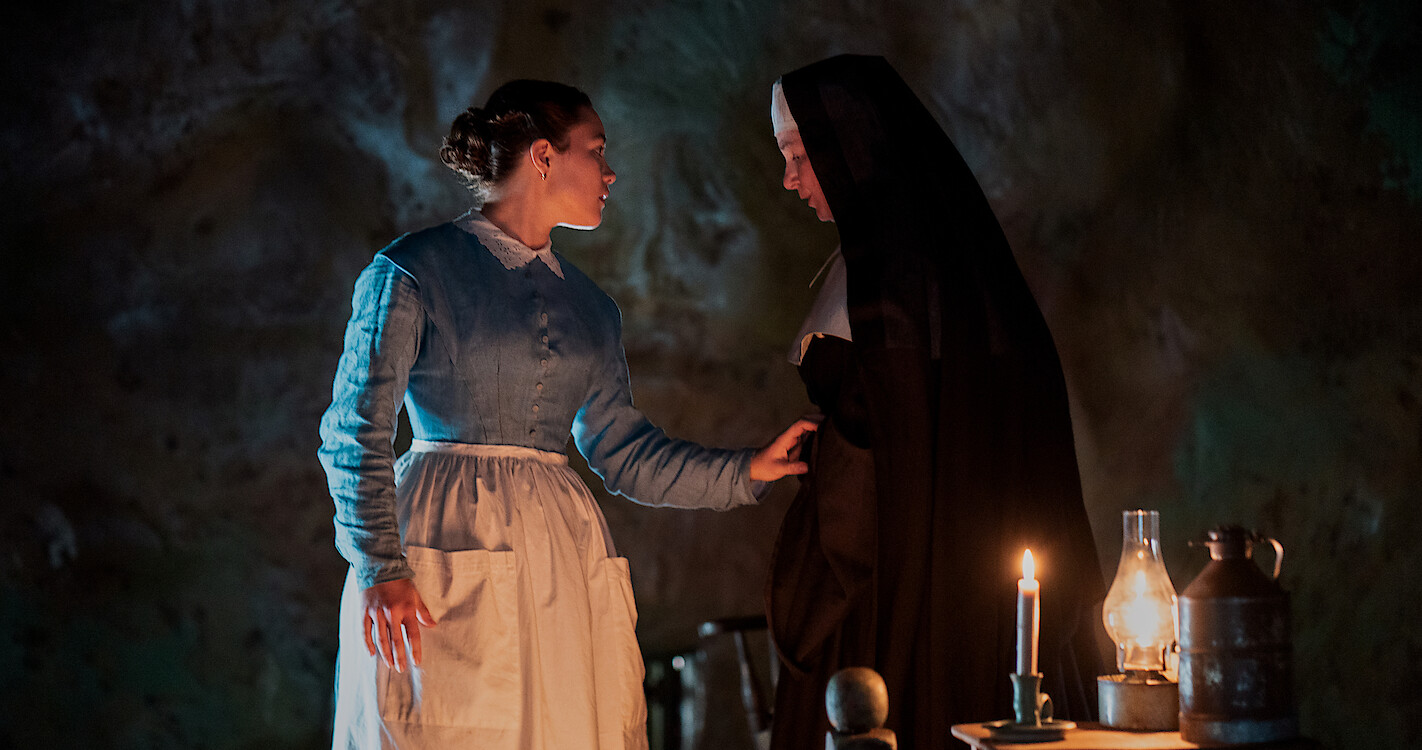
[Warning: Spoilers] There is a phenomenon in the lives of certain Catholic saints of the person living only on the Holy Eucharist, sometimes for many years. St. Catherine of Siena and St. Angela of Foligno are among those who were known to have lived solely on the Blessed Sacrament for long spans of time. Their cases were carefully scrutinized during their lifetimes and afterwards by the authorities to ascertain that a supernatural phenomenon had indeed occurred. Scrupulous care to determine the truth was and is taken by the Church hierarchy in the face of miraculous claims. The reason is because often there are natural explanations which, when revealed, prove that a "miraculous fast" did not actually occur. Likewise, there have always been tricksters and those who wish to profit from fake miracles.

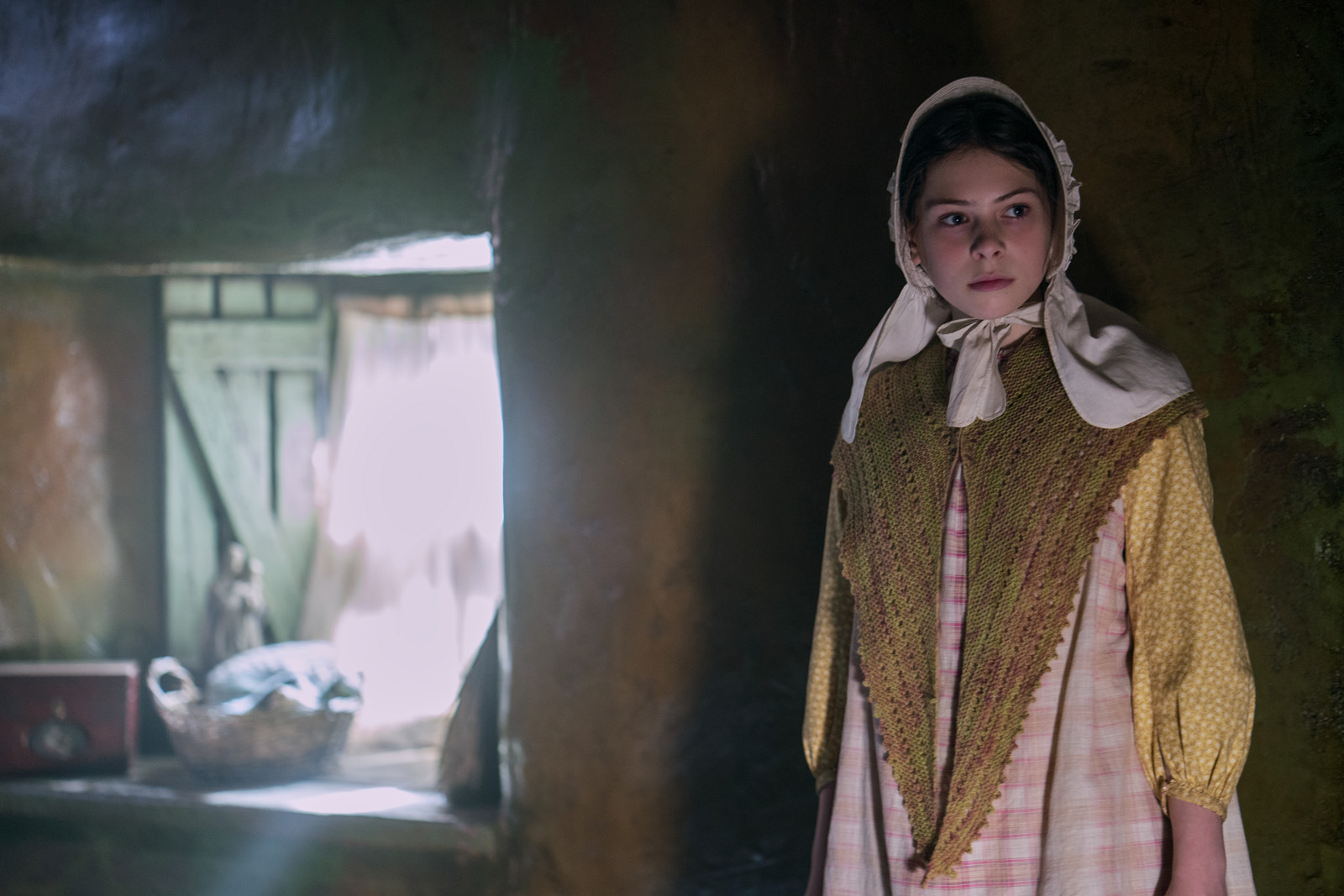
In the film The Wonder, an Irish Catholic girl named Anna in the 1860's, whose parents survived the Great Famine, claims to be able to live without food. She says her only sustenance is "manna from Heaven" but, other than her First Communion, the Holy Eucharist is not mentioned at all. In fact, none of the sacraments are mentioned; we never once see the inside of a church or glimpse the Mass which was central to the lives of Irish Catholics. Perhaps this is because the film is loosely based on the case of the "fasting girls" in Wales, who may or may not have been Catholic. While the film is full of Catholic sacramentals such as statues and holy images as well as featuring a priest and a nun, there is little about the substance of what the Faith is really about. The English nurse Lib Wright, who is brought in to observe Anna, discovers that the child is not only a victim of egregious abuse, but that her mother is secretly feeding her. It turns out that Anna's older brother, who died, had been molesting her. The parents have forced Anna into an unholy charade in order to atone for her sins and deliver her brother's soul from the punishments of the afterlife.

According to Digital Mafia Talkies:

 Set in 1862 Ireland, “The Wonder” follows Nurse Lib Wright as she enters a village to observe a girl named Anna, who has stopped eating for the last four months and is apparently doing fine. A council full of men—Dr. McBrearty, Sir Otway, Father Thaddeus, John Flynn, and Seán Ryan—puts Lib and Sister Michael on eight-hour shifts to see how Anna is actually doing this. Lib and Michael aren’t supposed to talk to each other about their inferences so that their final review of the situation can be as uninfluenced as possible. Lib’s watch begins on an ordinary note as she passively documents everything that she sees about Anna. But her parents’ proximity to her and the frequent appointments with visitors (coming in from far and wide to see her and donate to the cause) make Lib suspicious. So, she puts a pause on Anna’s meetings with her parents and random people under the guise of getting a proper reading. And that’s exactly when things start to go downhill. (Read more.)
The above article above goes on to make the following statement: "Ireland’s 'Punishment of Incest Act 1908' states that incest is a punishable offense, even if it is consensual in nature. That means the practice of getting into a romantic relationship with one’s relative was fairly common up until 1908." This is an astonishing and untrue contention. While the upheavals of the industrial revolution, which broke up traditional communities and often caused families to be crowded together in unsanitary and cheerless conditions, caused many countries to pass such laws, there is nothing to indicate that incestuous unions were ever part of Irish culture, at least not since ancient pagan Celtic times. And even then it was mostly for the royals, just like the ancient Egyptians.

 It is a shame that the Faith which sustained the Irish people through centuries of persecution is shown in the film to be superstitious and child-abusing humbug. I am aware that there were genuine cases of various kinds of abuse, some of which the Church authorities tried to cover-up, but such horrors were not unique to Ireland. Otherwise, the film has magnificent acting and starkly beautiful vistas, and everything that goes into creating a powerful drama.

From The Collider:

Florence Pugh is without a doubt, one of Hollywood’s most in-demand actresses. She gained the affection of the public thanks to critically acclaimed movies such as Midsommar, Little Women, and Black Widow, and she will soon star in the highly anticipated Dune: Part 2. 2022 has been a busy year for Pugh, with the highly-publicized release of Don't Worry Darling, which was not a critical darling but most praised Pugh's lead performance. Her latest film, The Wonder, is out now on Netflix. Based on Emma Donoghue's novel of the same name and directed by Sebastián Lelio (Disobedience), this period drama is set in the 19th century and tells the true story of a social phenomenon called the "fasting girls," where young girls claimed to be able to go without eating for months. Many cases have been described and reported, the most famous one being a young Welsh girl named Sarah Jacob, who died of starvation in 1869.

Emma Donoghue didn’t base her novel on one case in particular, but rather on the many tales of these unexplained events. The writer set her story in Ireland during the Great Famine that took place between 1845 and 1851. In the film, Pugh portrays Lib Wright, an English nurse who tries to uncover the mystery surrounding the claims of Anna O'Donelle, an 11-year-old girl, who professes that she only lives on "manna from heaven." Is it a fraud? A miracle? Or is something much more sinister hiding behind Anna’s declarations? Lelio declared in a statement that bringing The Wonder to the screen offered him the chance to portray the collision between reason and faith, individual and community, but also to explore his own interpretation of what a "period" film can be. (Read more.)

When Nurse Lib separates Anna from her parents, the little girl begins to truly starve, since the mother is no longer able to secretly feed her. She soon becomes debilitated due to malnutrition, and Lib decides to risk everything in order to rescue her. By the end of the film, one can only be relieved that Anna is escaping her crazy family, a crazy religion and a crazy country. The Wonder certainly makes Ireland and Catholicism look bad, which is a shame since  the original cases occurred in Great Britain. For film makers who wish to portray Ireland as a dark place, there have been some genuinely terrible things that happened over the years; just watch The Hanging Gale. No need to project a story which happened elsewhere onto a country rich with its own tales of good and evil, darkness and light, tragedy and triumph.

Share

The SBF Scandal: The Players and the Money

 From Jeffrey A. Tucker at Brownstone Institute:

What we really need in the months or even years in which it will take to sort all of this out is some kind of key to the major players. What follows is a list which we’ve put together in order of network importance for easy reference. This small effort is made necessary because there seems to be very little attention being given to the entire SBF empire, both in terms of the players with whom he worked and where the money ended up. 

It’s nowhere near being a guide to the fullness of the networks of funding and influence, and can only begin to hint at the real story of what was really behind this magic bean factory in the Bahamas. Their operations and networks are deliberately obscure and fan out over many countries, institutions, and individuals. There is a strange silence in the air about the details other than the general observation that Sam Bankman-Fried was up to no good. 

And yet there were obviously many people involved. It’s probable that the main point was to fund political causes in a way that gets around federal election law, as the indictment suggests in count eight. However, a close examination of the networks keeps coming back to the strange theme of pandemic planning and support for various methods of controlling the population in the name of controlling infectious disease. Aside from political donations, this was a central concern. What that has to do with a crypto exchange is another matter. 

All of which should raise a question given the time of the life of FTX (2019-2022): to what extent was the network surrounding this institution useful in providing back-channel funding support for (and lack of opposition to) the most unprecedented attack on human liberty in our lifetimes? This question applies to both the direct political contributions and the various other donations to institutions and individuals. (Read more.)

Share

Friday, December 23, 2022

Covid Critics on Secret ‘Blacklist’

 From Becker News:

Twitter kept secret “blacklists” that included a doctor at Stanford and several prominent conservative voices that suppressed their ability to be found or heard on the social media platform, according to journalist Bari Weiss, founder and editor of The Free Press and former Wall Street Journal and New York Times columnist, who launched the second chapter in Elon Musk’s so-called “Twitter Files” Thursday evening.

Weiss tweeted what appeared to be a photo of Stanford University’s Dr. Jay Bhattacharya, a professor of health policy, with his account being prominently marked as being under a “Trends Blacklist.” Bhattacharya was secretly blacklisted because he “argued that Covid lockdowns would harm children,” and was thus unable to trend on the platform, according to Weiss.

In addition to Bhattacharya, Twitter placed Turning Point USA founder Charlie Kirk under a “Do Not Amplify” notice, while right wing talk radio personality Dan Bongino, who has appeared on Alex Jones’ InfoWars, was placed under a “Search Blacklist,” according to Weiss. The practice of limiting the access or reach of users’ content, commonly referred to as “shadow banning,” is something that Twitter has denied doing in the past, and is referred to internally as “Visibility Filtering” or “VF,” Weiss reported.

“Think about visibility filtering as being a way for us to suppress what people see to different levels,” a senior Twitter employee reportedly told Weiss. “It’s a very powerful tool.” (Read more.)


 And a very tragic story, HERE.


Share

Dr. Denise Maior-Barron's Book about Marie-Antoinette at Petit Trianon

Sections of Dr. Denise Maior-Barron's book on Marie-Antoinette are available online. Here is one of the sections in which she mentions my work. The novel she refers to is Trianon. Notice that on her hat the Queen is wearing what is called the "Hope Diamond."

More on Dr. Maior-Barron's work, HERE. Her book is available for purchase, HERE.

Share

Thursday, December 22, 2022

When Truth is Abandoned

 From Return to Order:

First, a person is limited by nature by not being God. Each person was born in a specific time and place, to a particular pair of parents, with certain specific biological traits—including those that determine sex. Individuals share a human nature that cannot be changed. Some are born male, and others are female. There is nothing in-between.

To argue otherwise is to say that God made mistakes when He made each person. No one who believes in an omnipotent, omniscient, omnipresent God—as all Christians do—can assert that God errs when making all either male or female. He would not be so cruel as to place a male in a female body or vice versa.

Therefore, only by acting within those limitations can each person find happiness within God’s perfect will. The pretense of being something else ultimately destroys the soul. It leads the individuals to fantasies that eventually lead them to imagine God in their own image and likeness or as “transsexual,” as found in the blasphemies of Dr. Heath. (Read more.)

Share

Wednesday, December 21, 2022

How Lockdowns Made Us Sicker 

 From Jeffrey Tucker at Brownstone Institute:

Early during lockdowns in 2020, when the whole of the media marched in lockstep with the most appalling reach of public policy in our lifetimes, two doctors from Bakersfield, California went out on a limb and objected. Their names: Dan Erikson and Artin Massihi from Accelerated Urgent Care. They held a press conference in which they claimed that lockdowns would only delay but not finally control the virus. Moreover, they predicted, at the end of this, we would also be sicker than ever because of our lack of exposure to endemic pathogens. You could say they were brave but why should it require bravery simply to share conventional wisdom that is part of every medical background? Indeed, the idea that reducing exposure to pathogens creates more vulnerability to disease is a point every generation in the last hundred years has learned in school. 

How well I can recall the outrage! They were treated like seditious cranks and new media blasted their comments as somehow radically heterodox, even though they said nothing I had not learned in 9th-grade biology class. It was utterly bizarre how quickly lockdowns became an orthodoxy, enforced, as we are now learning, by media and tech platforms working closely with government agencies to warp public perceptions of science. Among those warpings was an incredible blackout concerning the basics of natural immunity. My goodness, why did this happen? It’s not conspiracy to draw an obvious reason: they wanted to sell a vaccine. And they wanted to push the idea that Covid was universally deadly for everyone so that they could justify their “whole-of-society” approach to lockdowns. 

Here we are three years later and the headlines are all over the place. 

And so on. 

Isn’t it time to give these doctors some credit and perhaps regret their vicious treatment at the hands of the press? (Read more.)


From Human Flourishing:

Fauci was ready for his moment in the sun. A consummate DC insider, he had cultivated a power base in Washington and the media for decades. He served in several administrations, under both parties, and craftily used the AIDS epidemic to increase funding for NAIAD and gain enormous control over biomedical research in the United States. He also cultivated media allies, who were eager for access to Fauci’s insider scoop when the pandemic broke.

Fauci’s influence on the recent US pandemic response extends back decades. In 1989, Fauci organized a conference in Washington to introduce a novel concept: a biosecurity threat. People had worried about biological weapons prior to 1989, of course, but Fauci’s conference introduced a consequential reframing: The potential threat was no longer a novel pathogen, such as a virus or bacteria, whether of natural origin or developed as a bioweapon. Rather, the new paradigm focused instead on humanity as a microbial population vector. The challenge, in other words, was that people functioned as a conveyance apparatus for viruses or bacteria.

Grasping this point goes a long way toward helping us understand our disastrous Covid response. In Fauci’s frame, the human population itself becomes a dangerous problem to be solved by experts—by a new caste of technocrats who must be granted unprecedented powers to control their fellow human beings. This biosecurity model became America’s infectious-disease-response policy following the Anthrax attacks shortly after 9/11. That’s when we began to hear the language of pandemic “countermeasures”—which isn’t a medical term, but the jargon of spycraft and soldiering.

As Ashley Rindsberg has documented, contrary to popular opinion, far from being a public health expert, since 2003 Fauci has sat atop America’s bio-defense infrastructure—wielding the enormous post-9/11 powers and budget this brought to his previously obscure NAIAD, one of 27 divisions at the NIH.

In Fauci’s reconfigured agency, with no oversight structure above him, the distinction between biodefense and scientific research collapsed. As Rindsberg explains: “Biodefense projects that formerly would have fallen under the authority of military or intelligence agencies were now under his direct supervision.” This also explains why Fauci is the highest paid federal employee, earning more than the US president, our four-star generals, senators, and Supreme Court justices, and why he makes roughly double the salary of his nominal superior, the NIH director—a fact that indicates who really holds sway over biomedical research funding in the United States.


It took more than 20 years, but the biosecurity approach became the default strategy during the Covid pandemic. Over the last three years, the biomedical-security paradigm has been rolled out on a global scale, shaping what I dubbed our New Abnormal. Recall how the phrase “the new normal” emerged almost immediately in the initial weeks of the pandemic, and how many ordinary social norms and expectations were rebranded as dangerous. In the first month of Covid, Fauci even suggested that perhaps we would never again go back to shaking hands.

Authoritarian lockdowns, school closures, vaccine and mask mandates, vaccine passports, and other assorted biosecurity measures proved ineffective at stopping the spread of the virus, and thus failed to achieve their intended goals. Instead, these previously untested policies inflicted enormous collateral damage. The full measure of these harms—the medical, psychological, and spiritual carnage—will take decades to unpack, though there is already plenty of available evidence to sift through.

The Missouri v. Biden case, in which I’m one of the plaintiffs, is a First Amendment free-speech lawsuit alleging that government officials across at least 17 different federal agencies leaned on social-media companies to suppress free speech, especially when it involves the government’s pandemic response. During his recent deposition in our case, Fauci confirmed what many suspected regarding the origins of lockdowns—namely, that the decision to lock down wasn’t based on empirical data, but on the word of the Chinese authorities as conveyed by Fauci’s deputy at NAIAD, Clifford Lane. Indeed, in February 2020 there was no empirical data for this previously untested intervention, only flawed and now-disproved predictive computer models, like that of the Imperial College London, which were off by several orders of magnitude.

Tocqueville warned that democracy contains built-in vulnerabilities that can lead democratic nations into despotism. In our case, that vulnerability had a name and a representative figure: Anthony Fauci, an official who looked to a totalitarian state as the exemplar for managing a pandemic. The first state-ordered lockdown occurred in Wuhan and nearby Chinese cities. In mid-February 2020, the World Health Organization sent a delegation to China to investigate Covid. As the US delegate, Fauci dispatched Lane, his deputy.

Immediately upon returning, Lane convinced Fauci the United States should emulate China’s response. Given his adoption of the biosecurity model more than 20 years earlier, Fauci probably didn’t take much convincing. Chinese authorities told the WHO delegation that they had contained the virus through draconian lockdowns—a claim now clearly demonstrated to have been false. Had lockdowns worked in China as advertised in February 2020, we wouldn’t be seeing today record numbers of cases in China, notwithstanding the Communist Party’s increasingly terrifying and dystopian measures.

Given China’s historical pattern of falsified information, Lane and Fauci should have approached this intel with skepticism. After all, lockdowns were wholly untested and unprecedented. But as one of our lawyers in the case, Jenin Younes of the New Civil Liberties Alliance, put it, Fauci “was apparently willing to base his lockdown advocacy on the observations of a single guy relying on reports from a dictator.” Not exactly a double-blind randomized trial level of evidence for a man who identifies himself with The Science.

Days after Lane returned, the WHO published its report praising China’s strategy. Uncritically echoing Chinese propaganda, the report claimed: “China’s uncompromising and rigorous use of non-pharmaceutical measures to contain transmission of the COVID-19 virus in multiple settings provides vital lessons for the global response. This rather unique and unprecedented public health response in China reversed the escalating cases.”

Lockdowns were first imposed in the West in Italy, then adopted at the recommendation of Fauci and White House Coronavirus Response Coordinator Deborah Birx in the United States. Within weeks, the whole world was locked down. From the outset, the evidential basis for this global policy catastrophe was paper-thin. Fauci knew this—or at least, he should have. But what China had done was aligned with his own reframing of public health as management of biosecurity threats through the control of entire populations. Indeed, to this day, he is prepared to support the ongoing Chinese lockdowns if they function as a useful fulcrum to coerce compliance with other public-health mandates.


After bringing China’s unprecedented authoritarian measures to the United States, Fauci next resolved that the entire population must be vaccinated. To this end, the psychological strain of prolonged lockdowns and school closures offered useful leverage: If you wanted to avoid further forced isolation, it was up to you to get the jabs. Pressing this logic to its logical conclusion, as recently as last month Fauci told CNN that the continued lockdowns in China could be justified, at least for a period of time, if the goal was to force vaccine compliance: “If the purpose is, ‘Let’s get all the people vaccinated, particularly the elderly,’ then OK.”

Fauci’s promotion of mass vaccination was ideologically of a piece with his support for lockdowns. Rather than targeting the response at those most vulnerable to the virus, both policies sought a one-size-fits-all approach to control the behavior of the entire population. However, he likely had other reasons for aggressively pushing the vaccines. Most people are still unaware that NAIAD, Fauci’s division of the NIH, co-owns the patent on the Moderna vaccine, among thousands of other pharma patents.

Rather than providing grants to university-based investigators to run the clinical trials on their own Moderna vaccine, the NIH conducted this research internally, a clear conflict of interest. NIAID will earn millions from this vaccine’s revenue, with several NIH employees (and their heirs) personally receiving up to $150,000 annually from Moderna vaccine sales. Indeed, the NIH went to bat in a lawsuit with the company to fight for its share of the patent. Big money is at stake: The Government Accountability Office estimated recently that the NIH has earned $2 billion in royalties since 1991 from its patents for FDA-approved drugs. (Read more.)

Share