Monday, July 25, 2022

Battle of Sherburn-in-Elmet

 From Allegiance of Blood:

If you ask anyone about the most decisive battle of the English Civil War, they are most likely to answer Naseby, which took place in Northamptonshire on 14th June 1645. Considering this is where King Charles I’s veteran infantry were obliterated and his cabinet of private letters captured, then you can understand why. The royalist cause is billed as being irretrievably finished after Naseby and victory for Parliament merely a matter of time.

But … thousands of the King’s elite cavalry survived. His Lieutenant-General in Scotland, the Marquis of Montrose, had just secured that entire kingdom. New infantry recruits were due from Wales and more reinforcements expected from Ireland. Naseby was a decisive defeat for the King, but it was an almost forgotten battle at Sherburn-in-Elmet four months later that dealt the real killer blow. 

Lord George Digby – an English Rasputin – had been King Charles’s Secretary of State since 1643. He was a silver-tongued, self-obsessed man with a devious streak and a hypnotic charm. Like an impervious cockroach, he would successfully crawl out from under the destruction he had wrought in the royalist ranks. The hard shell of this deluded politician had the King believe that every setback was someone else’s fault; and that there was always a silver lining just around the corner. It was Lord George Digby who was placed in command of the King’s elite cavalry. His last hope. 

On 13th October 1645, at Welbeck, Digby’s fateful appointment as Lieutenant-General of the forces north of the River Trent was confirmed. It seems to have been the result of his private connivance, because none of the King’s officers – including the council of war – had any inkling that it was going to happen until the monarch revealed the decision in a speech to his cavalrymen. And well may Digby have wanted it this way, for the King had no less than 24 officers with him ranked colonel or above who could have filled the role, and the surprise prevented any coherent protest. Of course, Digby claimed never to have known that the appointment was coming and wrote, ‘At half an hours warning having (I protest to God) not dreamt of the matter before, I marched off from the rendezvous’.1 The experienced Sir Marmaduke Langdale was to support him. Typical of the two-faced Digby was the fact that he had described Langdale as ‘a creature of Prince Rupert’s’2 but now that he needed this ‘creature’ he embraced Langdale.

The Parliamentarian, John Rushworth, noted Digby’s next move. ‘It was agreed, that the northern horse, commanded by Sir Marmaduke Langdale, my Lord Digby … should march into the north, to join [the King’s Scottish general, the Marquis of] Montrose’.3 Once united, Digby and Montrose would restore royalist fortunes in England. The one snag, unbeknown to Digby, was that Montrose had been defeated several weeks earlier. 

Nevertheless, Digby’s small force struck at Doncaster, beating up some of the enemy there and then scattered some more at Cusworth. Upon nearing Sherburn-in-Elmet, Digby ran into an infantry regiment of 1000 parliamentarians commanded by a Colonel Wren. The royalists went on to defeat Wren’s force, but no sooner had Digby taken them prisoner and had them hand over their arms and weapons, than he was informed of the approach of a second enemy detachment. (Read more.)

Share

Sunday, July 24, 2022

Queen of Mary's Land

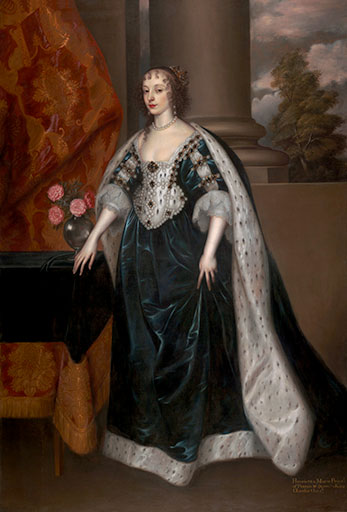
Unknown artist after Anthony van Dyck's 1637 portrait
Medium: Oil on canvas, late-18th century

 A portrait of Queen Henrietta Maria, wife of Charles I, for whom the state of Maryland was named, hangs in the Governor's Reception Room of the Maryland State House in Annapolis, the state capital. Annapolis was named for Charles' and Henrietta Maria's granddaughter, Queen Anne. From The Maryland State House:

The history of the room now known as the Governor's Reception Room dates back to the original construction of the State House between 1772 and 1779. A floor plan published in 1789 in the Columbian Magazine indicates that the large corner room (the modern-day Governor's Reception Room) was then the Council Chamber, home to the Governor and Council, the state's executive body. Adjacent to this room was a jury room for the Court of Appeals and a repository for stores and arms.

The Constitutional amendments of 1838 sparked a reorganization of the executive branch by replacing the Governor and Council with a popularly-elected governor and the establishment of the office of secretary of state. The large corner room served as the public office of the governor, as well as the offices of the secretary of state and staff of the governor and the secretary of state. This room was referred to as the Executive Chamber until the 1860s, when it became known as the Governor's Reception Room. Because of the reorganization of the executive space, the governor may have set up a private office in the former jury room.

When the State House was enlarged and completely refurnished in 1905, the offices of the adjutant general and secretary of state were relocated to the side now used by the lieutenant governor. The Governor's Reception Room was used solely as the ceremonial public room of the executive department. To improve the appearance and to demonstrate the ceremonial function of this important space, Governor Edwin Warfield ordered the room be restored to its colonial appearance and that portraits of former governors and secretaries of state be displayed in the room. (Read more.)

The Widowed Queen by Sir Peter Lely in 1660

Another Van Dyck portrait of Henrietta Maria in black, from 1632.

My Queen, My Love: A Novel of Henrietta Maria by Elena Maria Vidal

Share

Why Wait for Marriage?

 From Phil Lawler:

In June the Dicastery for Laity, Family and Life released new guidelines for marriage preparation, suggesting—among other things—that the normal period of formal preparation for marriage should be one year. The longer period of engagement, the Vatican explained, would encourage the practice of chastity.

Really?

Am I missing something? Take two healthy young people who are in love, anxious to fulfill that love and begin their life together. Now tell them that they’ll have to wait a year. Yes, they might practice chastity, and gain much grace in the practice. But let’s face it: there is another option. The 97-page Vatican document makes the argument for chastity, but the arguments for unchastity are coursing through the bloodstreams of ardent young couples. Is it wise, is it prudent, is it pastoral to say that—as a blanket policy, applied to every couple—they must wait?

(Just by the way, there are some good people who find love late in life. Isn’t in uncharitable to tell an older couple that they must wait a year—when they might not have many years left?)

Faced with that one-year waiting period, some couples will remain chaste. (Those couples, I suspect, will be those who are least in need of extra marriage preparation, because they have already formed habits of virtue and already gained a reverence for the sacramental bond.) Other couples will aim for chastity, perhaps with the best of intentions, but fail, because the natural drives—not merely for sex, but for healthy human love—are strong.

Still other couples will nod their heads when the priest (or other marriage-prep counselor; see below) advise them to practice continence before marriage—and then go home to the apartments where they are already living together, having set up joint housekeeping long ago. For them too, the year-long wait will produce no dividends; it is simply a paperwork requirement. So as a practical matter the longer wait does not promote chastity; it merely adds hypocrisy to the indictment.

But again there is another option. The young couple, ready and anxious to marry, visit their pastor to tell him their plan. He announces that they must wait at least a year. They don’t want to wait; they are deeply in love. So they walk down the street to the Protestant church, or to the justice of the peace, and begin their life together without the grace of the sacrament.

Surely that is not the intent of the Vatican directives: to discourage couples from marriage in the Catholic Church. Indeed the document cites the decline in church weddings, along with the frequency of divorce, as reasons for better marriage-prep programs. But is it not quite predictable that, when the formal requirements for a marriage in the Church become more onerous, many couples will look elsewhere?

The Vatican document traces many of the problems with marriage to “too superficial a preparation” for the sacrament. True, but if Catholics have not received a fundamental understanding of the sacramental bond by the time they reach marriageable age, a year of coursework is unlikely to remedy that problem. Real preparation for marriage begins in childhood, with the example of the parents, and continues in church with the preaching of pastors. If parents and pastors have failed in their responsibilities, marriage-prep counselors will need more than a year to do the remedial work.

Especially because—and here we must consider the practical application of the Vatican guidelines—many of the lay couples who volunteer to be marriage-prep counselors are actively discouraged from offering an uncompromising version of Catholic teaching. A clear rejection of divorce might not sit well with young people whose parents are divorced; a condemnation of fornication would offend the couples already living together. And although the goal of the class might be proper preparation for sacramental marriage, another unspoken goal—and one much easier to measure for success—is to keep couples involved, to minimize the dropout rate.

“Even in the case of cohabiting couples, it is never useless to speak of the virtue of chastity,” the Dicastery tells us. But for the young priest tackling his first marriage-prep classes, things aren’t so simple. He has been instructed by the pastor not to drive people away from the parish. He is keenly aware that at the parish down the road, his counterpart doesn’t challenge cohabiting couples on the matter. How can he persuade young people to comply with what they see as simply a rule—and a rule that seems to apply only within the geographical bounds of this one parish?

The one-year period of marriage preparation gives counselors more time to offer compelling arguments for chastity. And there are many available volunteers—armed with the best of intentions and with coursework in theology and apologetics, confident in their powers of persuasion—ready for the job. But how often are people argued into chastity, or any other virtue? How many loving couples carefully weigh the pros and cons, and break off a passionate embrace? Marriage preparation is not like an academic course; it is a lifelong process.

Years ago I heard an Orthodox rabbi explain why the rate of premarital pregnancy is so low among young Orthodox Jewish women. From their early days, these girls have been trained to avoid things that their friends and neighbors enjoy—things that have a powerful natural appeal. The smell of bacon is tantalizing, but they do not eat it. So when they feel the power of sexual impulses they are not defenseless. They have practiced self-discipline and they have learned the Law. (Read more.)

Share

The Hard and Dirty Life of a Medieval Peasant

 From Ancient Origins:

At the bottom of the medieval peasant hierarchy were serfs or villeins. These peasants were tied to the land of the local lord they worked or labored for. To move or get married, they had to request the permission of the lord, and to obtain the land in the first place they had to swear an oath of obedience to the lord on the Bible. In turn for being tied to their lord and his land, serfs were allowed to farm a section of his land from which they were obliged to give him some of the produce every year. Effectively, they were owned by the lord for whom they worked. Not all medieval peasants were tied to the land or the local lord in this way, however. At the top of the peasant hierarchy were the freemen who owned their own land and could travel and marry freely. Despite their additional freedoms, they were not rich and would have often struggled alongside the serfs.

Peasants did not get this land for free, however, and were obliged to pay rent for their land and a tax to the church (a tithe). The tithe was 10% of the value of what their farmland produced every year, which was a considerable amount. This could be paid in kind (with produce from their farm) or in cash. Paying in kind could also include payment in seeds or in equipment.

As one can imagine, this tax was highly unpopular. It could make or break a family and determine how much they would have to suffer in the coming year. If they were unable to pay in cash and therefore had to rely on paying in kind, they were often forced to sacrifice things they relied on. For example, equipment. It was so common that the Church was given an overwhelming amount of produce that special barns called tithe-barns had to be built to store it all. For many medieval peasants, these tithe-barns simply acted as a visual reminder that their hard-earned farm work was going to waste. (Read more.)

Share

Saturday, July 23, 2022

Art Begins Its Quest to Paint the Soul

 From Catholic Exchange:

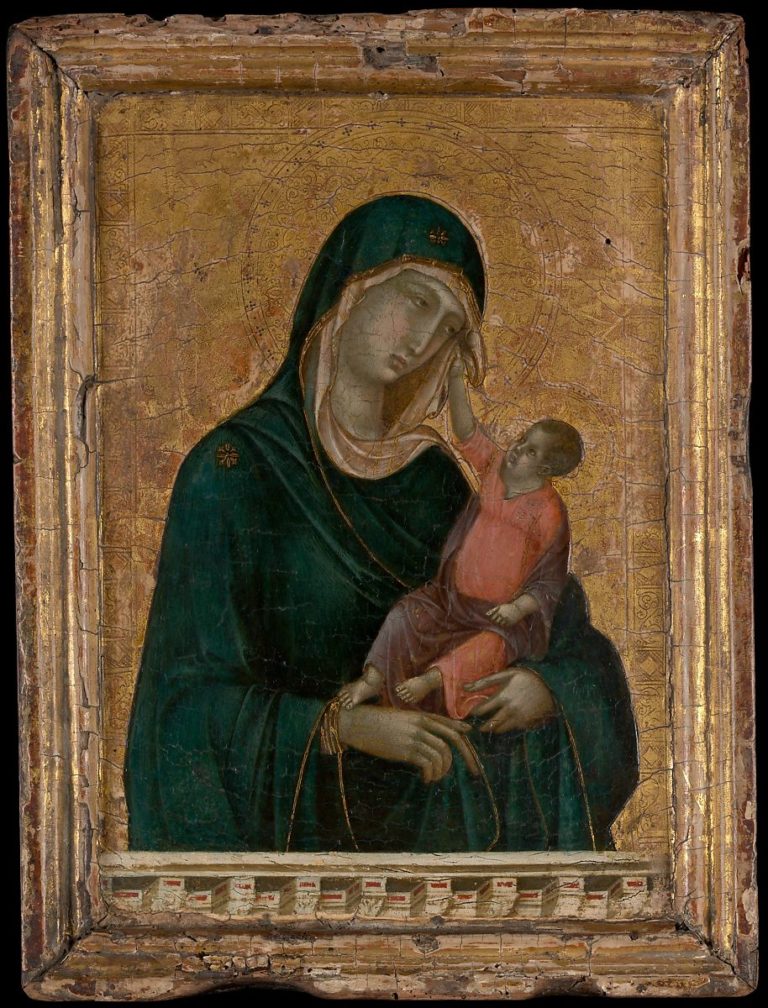
To many casual visitors, this Madonna and Child, at first glance, looks similar to the Byzantine icon paintings, familiar to us from the Berlinghiero, on whose spiritual and artistic heritage it draws. Key elements of the Byzantine formula remain very much intact, including the gold backdrop signifying Heaven and the pose of Mary, cradling the Baby Jesus in her arms, her eyes firmly focused on Him, our God.

But look again. Something very different is happening here. Notice the balustrade along the bottom of the painting. It is not part of the frame. Duccio painted it as if to invite us to look in on this scene through the window of an inn in Bethlehem, not in Heaven—as if it is here, on Earth. (Read more.)

Share

You're a Scientist? So What?

 From Dennis Prager:

A caller to my radio show yesterday, a physician, took strong issue with me regarding COVID-19 therapeutics. He accused me of not believing in science. His last words before we had to go to a commercial break were, "I'm a scientist." 

Given that I am not a scientist, he assumed that comment would persuade me -- or at least persuade many listeners -- that I was not qualified to disagree with him.

If that was his assumption, he was wrong.

"I don't care," I responded. "It's irrelevant. Scientists have given science a bad name."

I would not have said that as recently as three years ago. 

But in recent years, and especially in the past two years, some basic suppositions of mine have changed.

I no longer assume when I read a statement by a scientist that the statement is based on science. In fact, I believe I am more committed to scientific truth than are many scientists.

The American Medical Association advocates the removal of sex designation from birth certificates. If many doctors or other scientists have issued a dissent, I am not aware of it. 

"Assigning sex using binary variables in the public portion of the birth certificate fails to recognize the medical spectrum of gender identity." Those are the words of the author of the AMA report, Willie Underwood III, M.D.

Sarah Mae Smith, M.D., an AMA delegate from California, speaking on behalf of the Women Physicians Section, said, "We need to recognize gender is not a binary but a spectrum."

When the American Medical Association and a plethora of physicians tell us that human beings, unlike every other animal above some reptilian species, are "not binary," i.e., neither male nor female, the assertion "I am a scientist" becomes meaningless. (Read more.)

Share

On Progressive Christianity

 From The Wine Patch:

Progressive christianity is no longer an off-broadway troupe serving up budget performances like Deconstruction The Musical and Affirmation Nation. In true form of how the left is relentless until it ruins everything it touches, the Christian progressives have broached the rotunda of time-honored theology, are taking selfies in the sacristy, and mooning the cross.

An immutable attribute of the father of lies is that he is forever incapable of creating anything. Adonai is the only One who called forth life from the dank hollows of inert chaos. This is why the den of serpents never lights up the marquis to promote an original work — they don’t have one. No, this accuser of the brethren is only able to twist a truth, dim the light, and insatiably kill babies.

As I peruse the progressive playbills, I see nothing beautiful, nothing noble, nothing lovely, and certainly nothing divine. Therefore, while I’m not sure I wholly identify as a conservative Christian, I can confidently state that I am an avowed anti-progressive.

Progressives routinely accuse conservative Christians of infusing too much politics with their faith. The catch-all charge levied most often is; Christian Nationalist. I’ve been tracking this nascent trend these past few years and can confidently state: It’s the progressives whose foundational fixations are fueled by the yeast of politics, not the conservatives.  (Read more.)
Share

Friday, July 22, 2022

The World of Alfred the Great


 From Lady Carnarvon:

Wyverns look a little like dragons but have only two legs, unlike a dragon which has has four, and they are an imaginative mixture of a scaly reptile and dragon type often used in heraldry. Typically a wyvern is depicted resting upon its legs and tail but it can also be shown with its claws in the air and supported only by its tail. These carved figures recall the Anglo-Saxon times and are symbols often associated with the Kingdom of Wessex which was nearly completely overrun by the Vikings around 870AD but was finally united and protected through the military endeavours and the later cultural leadership, of the renowned King, Alfred (849-899AD).

Under King Guthrum, the Vikings had swept down from their northern kingdoms and, in a lightning strike, seized much of what is now Wiltshire and from there laid waste to Wessex. Alfred withdrew in haste to the Somerset tidal marshes with what few followers remained. From there he reorganised the fyrd (existing army), calling more to his cause but keeping them to a rota basis to enable him to could raise a ‘rapid reaction force’ to deal with the raiders whilst ensuring that farming could continue, thus preserving food supplies. Apart from mythically burning the cakes (his mind might have been elsewhere), Alfred proved himself a creative and innovative leader on the battlefield. Finally, in May 878, his army defeated the Vikings (Danes) at the battle of Edington and they all sued for peace, creating a north south divide across England.

The centre of Alfred’s world was his royal palace in Winchester from which he developed a network of burghs so that no one was more than 20 miles from the refuge of one of these settlements. In addition, he built new fast ships to create a navy which helped support and protect Wessex and southern England. The very word 'borough' comes from the Anglo Saxon meaning a fortified market place as Alfred needed both to promote trade – markets – and defend the population. Towns today still bear reference to these origins – New-burgh-(bury) is one example which is the town closest to Highclere. (Read more.)
Share

Pediatric Gender Medicine and the Moral Panic Over Suicide

 From Reality's Last Stand:

In a recent exchange between Senator Josh Hawley (R-MO) and Berkeley Law professor Khiara Bridges on the ramifications of the Supreme Court’s decision to overturn Roe v. Wade, Hawley wanted to know whether the Court’s decision affected women as a class. After initially informing Hawley that not all “cis women” have the “capacity for pregnancy” while some “trans men” and “non-binary” people do, Bridges appeared caught between her loyalties to gender identity ideology and to the long-held idea that abortion is a women’s issue. And so rather than clarify her position, Bridges berated Hawley for his “transphobic” line of questioning, insisting that he and those like him are the reason why “one in five” transgender people attempt suicide.

The affirm-or-suicide mantra has become the central strategy of contemporary transgender activism, and at times it would seem that activists have little else in their rhetorical arsenal. Federal courts have used it to impose new policies on schools under Title IX. When Florida passed the Parental Rights in Education Act—a law that limits classroom discussion of gender identity and sexual orientation to “age appropriate” circumstances and that requires schools to notify parents when their children are being “socially transitioned” to the opposite gender—Secretary of Transportation Pete Buttigieg agreed with his husband Chasten that it would “kill kids.” Florida’s law was in response to, among other things, books like Gender Queer: A Memoir, which contains graphic depictions of oral sex, appearing on school library shelves. The book’s “non-binary” author, Maia Kobabe, countered that her book’s presence in libraries was “life-saving.”

A few weeks later, transgender Assistant Secretary for Health and Human Services Rachel Levine used the same word to justify the federal government’s support for “gender affirming” interventions. Neither Levine nor President Biden, who has given his own imprimatur to the controversial practice, seemed to care much that Europe’s most progressive welfare states have been moving in the opposite direction, placing strict limitations on the use of puberty blockers to treat adolescents in distress presumably because of their “gender.” Scandinavians are not indifferent to teen suicide. Rather, they have examined the evidence behind the affirm-or-suicide claim and have found it wanting.

Despite the unwaveringly confident manner in which these claims are often asserted, there is no good evidence that failing to “affirm” minors in their “gender identity” will increase the likelihood of them committing suicide. As I discuss below, that claim is based on a small handful of deeply flawed studies that, at most, find loose correlations between “affirming” interventions and improved mental health. Some find no reduction of suicide at all, and a new study claims to find that puberty blockers actually increase the risk of suicide.

Not only is the empirical basis for the affirm-or-suicide mantra shoddy at best, but its dissemination is also profoundly irresponsible. Such extreme rhetoric limits our ability to better understand and respond to mental health problems in vulnerable youth, and may itself contribute to the real and documented phenomenon of “suicide contagion.” (Read more.)
Share