From
Ancient Origins:
Egyptian Blue, also known as calcium copper silicate, is one of the
first artificial pigments known to have been used by man. The oldest
known example of the exquisite pigment is said to be about 5000 years
old, found in a tomb painting dated to the reign of Ka-Sen, the last
pharaoh of the First Dynasty. Others, however, state that the earliest
evidence of the use of Egyptian blue is from the Fourth Dynasty and the
Middle Kingdom, around 4,500 years ago. Nevertheless, by the New
Kingdom, Egyptian Blue was used plentifully as a pigment in painting and
can be found on statues, tomb paintings and sarcophagi. In addition,
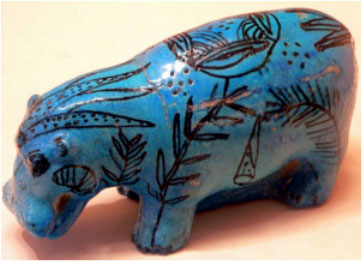
Egyptian blue was used to produce a ceramic glaze known as Egyptian
faience.
Its characteristic blue colour, resulting from one of its main
components — copper — ranges from a light to a dark hue, depending on
differential processing and composition. If the pigment is ground
coarsely, it produces a rich, dark blue, while very finely-ground
pigment produces a pale, ethereal blue. It is made by heating a mixture
of a calcium compound (typically calcium carbonate), a
copper-containing compound (metal filings or malachite), silica sand and
soda or potash as a flux, to around 850-950 C.
In Egyptian belief, blue was considered as the colour of the heavens,
and hence the universe. It was also associated with water and the Nile.
Thus, blue was the colour of life, fertility and rebirth. One of the
naturally blue objects that the Egyptians had access to was lapis
lazuli, a deep blue semi-precious stone which could be ground up into
powder, although this was a luxury item and had to be imported from
Afghanistan. Therefore, it is not too surprising that the Egyptians
sought to produce a synthetic pigment to use as a substitute for the
blue lapis lazuli.
The manufacture of Egyptian Blue eventually spread beyond Egypt’s
borders, and can be found throughout the Mediterranean. Egyptian Blue
has been found in numerous Greek and Roman objects, including statues
from the Parthenon in Athens and wall paintings in Pompeii. Despite its
extensive application in art, Egyptian Blue ceased to be used, and its
method of production was forgotten when the Roman era came to an end.
In the 19 th century, Egyptian Blue was re-discovered. The
excavations at Pompeii revealed that many wall paintings had Egyptian
Blue on them, and this prompted scientists to investigate the exact
composition of this pigment. Since then, researchers have gained a much
deeper understanding of its unique properties. Experiments found that
Egyptian Blue has the highly unusual quality of emitting infrared light
when red light is shone onto it. This emission is extraordinarily
powerful and long-lived, but cannot be seen by the naked eye, because
human vision does not normally extend into the infrared range of the
light spectrum. In addition, scientists unexpectedly discovered that
Egyptian Blue will split into ‘nanosheets’ – a thousand times thinner
than a human hair – if stirred in warm water for several days.
Scientists now believe that its unique properties may make Egyptian Blue
suitable for a variety of modern applications. (Read more.)
Share


.jpg)