Wednesday, April 27, 2022

Famine Stela

 From Historical Eve:

In 1889 the journalist and Egyptologist Charles Edwin Wilbour, who for about ten years had spent every winter in Egypt aboard a dahabiya (a typical Nile passenger boat with two sails) that he had converted into his home and library, visited Aswan and its surroundings.

But in that same expedition Wilbour also approached another island, that of Sehel, located in the Nile about 3 kilometers southwest of Aswan, before the first cataract of the river. In it there are numerous archaeological sites and a temple, that of Anuket, the Egyptian goddess of water and the Nile falls. But the place was mainly a granite quarry used since ancient times and at different times. For this reason, there are numerous inscriptions on the stones and boulders, left mainly by workers, but also by travelers who began or ended their journey to Nubia there. Some narrate historical events. And precisely Wilbour was going to discover one of the most curious of all. (Read more.)

Share

Tuesday, April 26, 2022

On the Illumination of Saint Peter's Basilica


 From Liturgical Arts Journal:

In July of 2020 we covered the subject of The Sanpietrini and the Illumination of St. Peter's Basilica. In that article we gave some of the background and the mechanics of this practice, showing both interior and exterior images of the same.  Since the writing of that article some more images of this have come to light, specifically of the lighting up of the exterior of the basilica -- which, to remind our readers, was a practice done for the most solemn occasions, such as canonizations. 

The 18th-19th century German writer Goethe, author of Faust, had this to say about his impressions of this noble custom in 1780:

"Enlightenment is a spectacle of the amazing world of fairy tales; you don't believe your own eyes... The beautiful shape of the colonnade, the church and the dome, first of all in a burning fire frame and, after about an hour, in a burning mass, it is a unique and magnificent show to see."

Regrettably, most of us today have been deprived of any opportunity to experience this magnificent spectacle; a spectacle that had the power to capture the heart and mind of Catholic and non-Catholic alike. (Read more.)

Share

Legacy of Healing

 From Catholic Herald:

She has met two popes and was known for her pro-life work, particularly for founding Project Rachel, a ministry focused on healing for post-abortive women. Vicki Thorn, 72, died of a massive heart attack Wednesday, April 20. She was a member of St. Catherine Parish, Milwaukee, and is survived by her husband of 50 years, Dr. William Thorn, six children and 19 grandchildren. She leaves behind an inspiring legacy of healing. In 1976, Thorn began serving as director of the Respect Life Office in the Archdiocese of Milwaukee.

Since beginning Project Rachel in 1984, this ministry of the Catholic Church has provided healing for those impacted by abortion. It is a diocesan-based network of specially trained priests, religious, counselors and laypersons who provide a team response of care for those suffering in the aftermath of abortion. Project Rachel is found in more than 110 dioceses in the United States and provides confidential and skilled help to anyone coming to the ministry, and is open to women, men, parents, grandparents, siblings, friends and others whose lives are affected by abortion. (Read more.)

Share

Life in the Royal Ancient Egyptian ‘Harem’

 From Historical Eve:

At the top of that female pyramid of power was the queen herself. She was the chief wife of the pharaoh and the mother of the crown prince, and as a companion to the king, she was considered a goddess. Both, the pharaoh and she, embodied the masculine principle and the feminine principle that guaranteed the existence of order or Maat, an essential concept of the Egyptian worldview that represented harmony, the cosmic balance that prevailed in the world since its origin. And in order to maintain the masculine-feminine duality, the main wife had to accompany the monarch during the ceremonies. Of course, she always occupied a secondary level with respect to him. And sometimes the position of Great Royal Wife was held by more than one woman at the same time.

For Miriam Bueno, art historian and doctoral student in Egyptian art, the term ‘harem’ is not suitable to describe this type of institution in ancient Egypt:

“The oldest term interpreted as “harem” is that of “ipt”, found from the 1st Dynasty, and referring to a group of women and children (who were educated there) who belonged to the court but lived in separate rooms or building. (Read more.)

Share

Monday, April 25, 2022

More on 'Art Nouveau'


From Emily Henderson:

Here’s the deal: Art Nouveau was a FLASH IN THE PAN. It came out of nowhere in the 1890s and it was florid and futuristic and sculptural – in modern terms, it’s kind of like The Hobbit meets Vogue. Art Nouveau picked up steam and spread across the globe for 20 years like wildfire, but its ornate aesthetic was too expensive to justify during the First World War. Instead, we saw the rise of Art Deco, which was a simple and streamlined version take on Art Nouveau – deco’s geometric shapes and straight lines were more affordable to produce than all of nouveau’s whiplash curves. BUT THAT’S ENOUGH HISTORY (for now, at least), LET ME SHOW YOU A BUILDING!

PS. There’s no Gaudi in this post because (a.) he’s already world-renowned and (b.) less famous places from my incredibly dense Pinterest board deserve some shine, too. I’ll link up some of his work at the bottom if you want to explore more in this style, though. OKAY NOW HERE’S A BUILDING! (Read more.)


Share

France Turning Back to Nationalism

 From The American Conservative:

Bloomberg columnist Therese Raphael noted that after Ukraine: “There is also a sense that Macron’s grand vision of Europe has taken a hit. He defined France’s mission as restoring Europe as a great, singular civilization, with a leadership role for France. He wanted a security doctrine that built Europe’s ability to balance other powers and gain strategic autonomy.” The continent now feels under threat from Russia and even more dependent on America.

More ominously for Macron, the French political system has shifted in a broadly nationalist and radical direction. Macron, who declared late and refused to debate before the first round, only won among over 60-year-old voters, a shrinking share of the electorate; he came in third among the 18–24-year-old cohort.

More than half of first-round ballots went to the most extreme candidates, two on the right and one on the left. Voters essentially wiped out the moderate right and left, Republicans and Socialists, respectively, the traditional governing parties that ruled the fifth republic until Macron’s rise atop an entirely new party. Together, they gained less than 7 percent, compared to 56 percent a decade ago and 26 percent five years ago. Neither received the 5 percent necessary to win government reimbursement of their electoral expenses. The Greens also fell short. A new rightwing candidate, a professional journalist who formed his party just three months ago, humiliated the establishment parties by receiving 7.1 percent.

Macron is making populist appeals and is still favored to win—the Economist gives him a 93 percent likelihood of victory, for instance—but the margin is expected to be narrow. Five years ago he won the run-off with about two-thirds of the vote. The latest poll aggregates show Macron with about 56 percent.

Several factors make the race closer. Le Pen eliminated the overt xenophobia and antisemitism that characterized the earlier incarnation of the National Rally party founded by her father, Jean-Marie Le Pen. She also downplayed previous criticism of the European Union and instead focused on pocketbook and other populist issues. Among them, the cost of living, public services, “social inequalities,” Macron’s proposed pension reforms, a job and service preference for French citizens, and, most unusual, national referendums, to stage what she termed “a revolution by referendum.”

Moreover, the left has soured on Macron—who moved rightward once in office. Critics complain that he now “is chasing voters on the right by focusing on law and order, promising to double the number of police on the streets.” Yet some leftwing nationalists will back Le Pen to upend the status quo. In an echo of the 2016 U.S. presidential race, in which some Bernie Sanders voters supported Donald Trump, polls indicate that Le Pen will pick up a significant share of the hardline leftwing vote which went to Jean-Luc Melenchon in the first round. In conceding he criticized Le Pen, but so far has not endorsed Macron.

The possibility of a Le Pen victory has unnerved the Eurocratic elite that dominates Brussels and most European governments. Although such a result once was seen as inconceivable, in 2016 the British public shocked even many Brexit backers by voting to leave the E.U. And she is running much closer to Macron than in 2017.

France has a strong presidency, which would give Le Pen a sizable platform. And she would hold that position when continental leadership was weak, following last year’s departure of Germany’s Angela Merkel. Although Berlin has been France’s traditional E.U. partner, today it is still adapting to an ungainly tripartite coalition and thus would have a more difficult time restraining an assertive Le Pen. Moreover, Le Pen’s victory would revive the morale and political prospects of nationalist groups across the continent.

To the chagrin of those seeking a consolidated continental state, Le Pen would pose a major threat, much greater than previous E.U. bete noires, including Austria, Hungary, Poland, and the United Kingdom. (In her Frenchness, she even promised to reduce the dominance of English in E.U. proceedings!) (Read more.)

Share

Abyssinia and the Ethiopian Empire

 From Ancient Origins:

The Horn of Africa is a region with a unique identity and vibrant history. Close to the Arabian Peninsula, it always stood out from the rest of the African continent. Today, the Horn of Africa is home to the modern nations of Ethiopia, Djibouti, Eritrea, and Somalia, comprising some 115 million people. Throughout centuries of rich history, Ethiopia has managed to persevere and preserve its identity, despite many pressures. Once known as the Ethiopian Empire, or Abyssinia, which existed from 1270 to 1974, it is one of the longest surviving empires in history and is defined by its distinctive character and a past filled with defining moments. Today we’ll be stepping back in time, as we recount the ancient and modern ages of the venerable Ethiopian Empire.

The earliest origins of the Ethiopian Empire reach back before 1270. The story begins with the Kingdom of Aksum , also known as the Aksumite Empire , an ancient kingdom of great import in the classical world. Aksum was located in today’s northern Ethiopia, and flourished from about 80 BC to 825 AD. Taking its name from its key city, the capital called Axum, its strategic location played a crucial role in the trading routes of the ancient world, particularly between ancient India and the Roman Empire. In time, Axum grew in power and importance, and eclipsed the neighboring and older Kingdom of Kush. (Read more.)


Share

Sunday, April 24, 2022

Charles I and the Order of the Garter

King Charles I was greatly devoted to the chivalric mission of the English Order of the Garter, founded by Edward III on Saint George's Day, 1348. Charles I had the Garter Star embroidered on the cloaks of all the knights, as a "testimony to the World." From The Victoria and Albert:

This form of the Order of the Garter (the highest order of English knighthood) as a star was introduced by Charles I (ruled 1625-1649) in 1627. It was to be worn by Knights of the Garter 'upon the left part of their cloaks, coats and riding cassocks, at all times when they shall not wear their robes, and in all places and assemblies...a testimony to the World, of the honour they hold...the Order Instituted and Ordained for persons of the highest honour and greatest worth'. (Read more.)
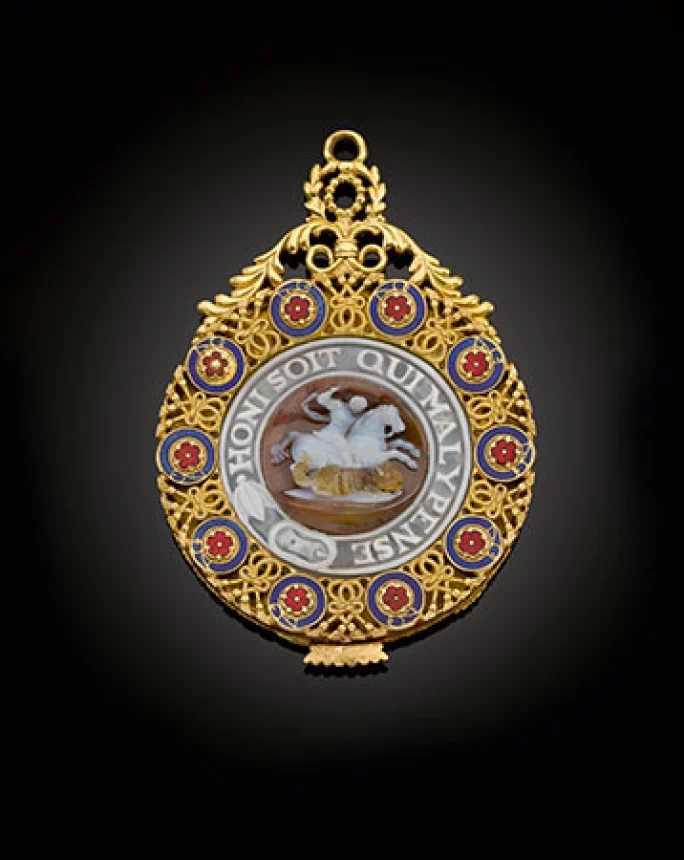
A pendant of Saint George slaying the dragon was also worn. From Sotheby's:

By the end of the fifteenth century a collar had been added to the regalia, possibly as a result of the influence of foreign Orders where a collar was worn to form a badge. The collar design has changed very little since its introduction being composed of a series of gold heraldic knots and roses encircled by the Garter, with a hanging pendant of St George slaying a dragon, known as the Great George.  As for other British chivalric orders, the collar is worn on ceremonial occasions and designated Collar Days throughout the year.

Over time the collar came to be regarded as an encumbrance during ordinary activities and by the early sixteenth century the first reference can be found to the Lesser George [Lots 24; 28], an image of St George encircled with the Garter worn as a separate badge. Lesser Georges were originally hung from a blue ribbon around the neck so as to be worn upon the breast. But by the late seventeenth century it had become practice to sling the Lesser George under the right arm, a contemporary chronicler explaining that this was for ‘conveniency of riding and action’. 

The riband was thereafter worn over the left shoulder and under the right arm as a wide sash [Lot 26].  The Lesser George and riband are now worn on all formal occasions when the collar is not used, as is the Garter Star [Lots 25; 29] which originated in 1626 as a more informal item of regalia required to be worn by Knights Companions whenever they were not wearing their robes. (Read more.)

From the Royal Collection Trust:

A length of blue silk attached to a book in the Royal Collection may in fact be the Garter ribbon worn by Charles I as he sat for Sir Anthony van Dyck’s famous triple portrait, scientific analysis has revealed. The portrait and the ribbon will be brought together for the first time for In Fine Style: The Art of Tudor and Stuart Fashion, which opens on 10 May, 2013, at The Queen’s Gallery, Buckingham Palace.  The exhibition explores the changing fashions of the rich and powerful of the Tudor and Stuart era through paintings, drawings and prints, as well as rare surviving examples of clothing and accessories.

Charles I placed great importance on the Order of the Garter, the oldest and highest order of chivalry in England – even wearing a Garter badge to his execution in 1649.  Fourteen years earlier, in Van Dyck’s portrait, the monarch is shown wearing a pale blue Garter ribbon around his neck. 

The inclusion of Van Dyck’s painting in the exhibition prompted Royal Collection Trust curators to take a closer look at four lengths of blue silk ribbon attached to the binding of a copy of the Eikon Basilike (‘The Royal Portrait’), now in the Royal Library, Windsor Castle.  The book was first published just ten days after the monarch’s execution on 30 January 1649 and quickly became one of the biggest-selling books of the 17th century, fuelling the image of Charles I as a martyr.

Curators were initially guarded about the authenticity of an inscription in the book which suggested it had been a gift from Charles I’s Master of Ceremonies, Sir Oliver Fleming, and that the silk was Charles I’s Garter ribbon.  Now, radiocarbon dating of a detached fragment of the silk ribbon has indicated that the fabric could indeed date from Charles I’s reign, placing it between 1631 and 1670.  Further investigation during conservation of the ribbon revealed that the silk is also the right width and length to have been a Garter ribbon – perhaps that recorded by Van Dyck. (Read more.)

Charles I never converted to Catholicism, in spite of his wife Queen Henrietta Maria's efforts and prayers. He continued to collect recusancy fines from practicing Catholics throughout his personal rule. However, he frequently showed  leniency to Catholics who had been arrested. Charles insisted that the Church of England be hierarchical and appointed bishops who were in favor of a majestic and dignified liturgy. His mentor and Archbishop of Canterbury, William Laud, upset the Puritans when he said that the Church of Rome was not the "Whore of Babylon." (In spite of that, Henrietta Maria never liked him.) From The Amish Catholic on the life and death of Charles I:

A few years ago, Fr. Hunwicke produced a very good argument as to why, canonically and liturgically, a soul who died in schism could be recognized as a saint (taking the precedent of various Eastern saints like Palamas and Gregory of Narek). He has argued for a favorable reading of Charles’s Catholicizing tendencies before.

I would add my voice to Fr. Hunwicke’s. Charles was, on the whole, a boon to the Catholic Church. Charles’s marriage to a formidable Catholic princess, Henrietta Maria of France, saw the arrival at court of Roman Catholic priests, a first since the days of Mary Tudor. He allowed the ambassadors of foreign courts to hold their own chaplains, notably at St. James’s, Spanish Place. Charles even opened up diplomatic talks with the Pope for the first time in decades, receiving more than one papal legate during his personal reign. High-level talks about reunion between the two churches were carried on in secret. He wrote to the Pope, in a letter of 1623 preserved and collected for publication by Sir Charles Petrie (1935),

Be your holiness persuaded that I am, and ever shall be, of such moderation as to keep aloof, as far as possible, from every undertaking which may testify any hatred towards the Roman Catholic religion. Nay, rather I will seize all opportunities, by a gentle and generous mode of conduct, to remove all sinister suspicions entirely; so that, as we all confess one undivided Trinity and one Christ crucified, we may be banded together unanimously into one faith. (See Petrie, The Letters…of King Charles I, pg. 16).

Of course, Charles was inconstant in these measures of good will. He was harsher on Recusants when it came to fines, but significantly lowered priest-hunting efforts. I believe I will not err in saying that, among the many martyrs of the English Reformation, none came during the King’s personal reign in the 1630’s. I only count four overall, of which we can probably acquit Charles from the burden of guilt. The two Catholics executed in 1628 – St. Edmund Arrowsmith, a Jesuit, and Blessed Richard Herst, a layman – seem to have fallen victim to the prejudices of lower officials rather than to any especially anti-Catholic venom emanating from the Crown. And once trouble with the Scots and Parliament began, Charles attempted to hold the situation together by, among other things, clamping down on priests. But even those martyrs which followed in the wake of these efforts owe their deaths more to the actions of local and middling anti-Papist forces than to the intentions of a harried crown. Only two seem to have died in 1641, the last year the King had any discernible control over what was going on in London. Realistically, it would be more appropriate to blame parliament for those deaths. In his church appointments, Charles always preferred those clerics who showed a marked sympathy to the doctrine of Rome. William Laud is only one among several examples that could be cited. (Read more.)

This triple portrait by Van Dyck was for the purpose of making a sculpture of the King


Share

Libs Of Tik Tok

 From The Federalist:

“Libs of Tik Tok” has been instrumental in helping parents understand the insane indoctrination occurring to their children every day, which is why Twitter wants to squash it under its authoritarian boot.

“[A] lot of parents are really getting awakened now. My account has been very influential on this, as well as other accounts and media outlets, in really showing parents what is going on in the schools that they otherwise wouldn’t know or realized. So I think that I do have a lot of hope for the future. And I think that we’re going to retake our school,” the “Libs of Tik Tok” creator told The Post Millenial last week. “…The average parent doesn’t want their six-year-old to be taught about pansexuals.”

“Libs of Tik Tok” knew Twitter’s penchant for censoring its political enemies would eventually catch up to it. The account’s creator foreshadowed as much not long after Twitter censored The Babylon Bee, Charlie Kirk, and even Federalist Senior Editor John Daniel Davidson for simply stating that men are men.

The left has waged a war on parents, tradition, religion, and conservatism but their attempts to change the culture by brainwashing kids will not go unnoticed by “Libs of Tik Tok.” Without that account, much of the delirium cursing our institutions, especially public schools, would stay behind closed doors because the left doesn’t want parents to know how they are using their children as political pawns. (Read more.)

Share



