Sunday, April 24, 2022

If the Turin Shroud is a Forgery...

 From The Guardian:

Many would argue that, even if the shroud could be proved to be the burial cloth of the man named Jesus who was crucified 2,000 years ago, that doesn’t amount to proof of his resurrection, the central tenet of Christian belief. “The carbon dating could show it was definitely from the time of Christ, but it’s still a stretch to go from that to seeing it as proof that he rose from the dead,” says Richy Thompson of Humanists UK. “Some people believe that, yes, Jesus was a real person, and we know crucifixion was a thing in those times, and Pontius Pilate is a well-documented historical figure.

“What many non-religious people would say is, where is the evidence? Because if you’re going to make extraordinary claims, you need strong evidence to back it up. And the fact that people believe [in the resurrection] is not in itself evidence that it actually happened.”

Rolfe is unperturbed: he says the image on the cloth seems to have come from a massive burst of radiation, emitted in a fraction of a second.

When it comes to the carbon dating, he’s certainly not alone in his scepticism. Barrie M Schwortz, a photographer who documented the shroud in 1978, says “murky” would be a good word to describe the events of 1988.

“Today there are at least six peer-reviewed scientific articles that challenge the results of the carbon dating,” he says. In his view, the players involved were in a hurry to get the job done, because they wanted to get carbon dating on the map. “Those tests made it a household name, and today it’s used widely in archaeology,” he says. “I’m Jewish, so I don’t have a horse in this race, but I’ve come to believe it’s the authentic burial cloth because I’ve looked at the science.”

The British Museum is less willing to get involved this time around. “Any current questions about the shroud would be best put to those who currently care for it in the royal chapel of the cathedral of Turin,” a spokesperson said. (Read more.)


From Aleteia:

In his report, published on the website of Italy’s Department of Chemical Sciences and Materials Technologies, de Caro pointed out a few flaws with dating by Carbon-14 analysis. He noted that textile samples can easily become contaminated with substances that could skew its results. He wrote: 

“Molds and bacteria, colonizing textile fibers, and dirt or carbon-containing minerals, such as limestone, adhering to them, in the empty spaces between the fibers that at a microscopic level represent about 50% of the volume, can be so difficult to completely eliminate in the sample cleaning phase, which can distort the dating.”

De Caro noted that fabric can even become enriched with new Carbon-14 samples. At this point, it would become hard to identify if carbon dating measured the original fabric, or a layer of carbon that was accumulated over time. (Read more.)


Share

Saturday, April 23, 2022

Caserta


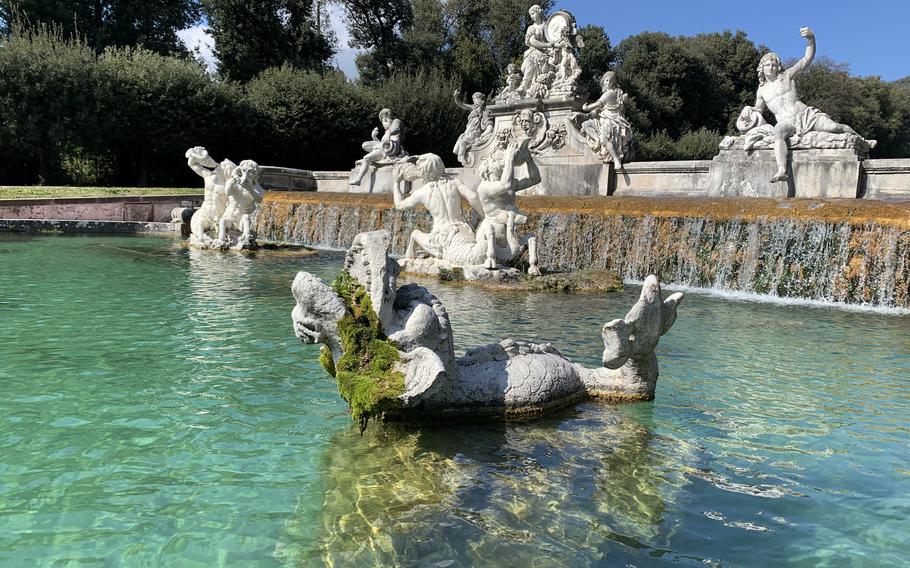
Home of Marie-Antoinette's beloved sister, Queen Maria Carolina. From Stars and Stripes:

The Royal Park features vast lawns, wooded areas, reflecting pools, fountains and gardens, making it a perfect place to take the kids to explore or find a quiet spot away from the chaos that is Naples. To get there, take a 45-minute train ride from Naples Centrale station to Caserta. It won’t be hard to find the palace; it’s across the street from the train station. A five-minute walk across an expansive garden puts you at the main entrance.

From there, you have a choice to make. Head straight through the palace’s portico and out the back entrance if you want to see the park first. Midway through the portico, on the right, is an impressive staircase leading to the palace’s apartments.

Depending on the time of year, the park can close as early as 3:30 p.m., and caretakers are very firm about closing time. The apartments close at 7:30 p.m., with the last admission at 6:30 p.m. Once you step through the palace’s back entrance, stop to take in the telescopic view leading from the parterre through a series of reflecting pools, also known as the waterway, to the Great Waterfall. (Read more.)


Share

More on Spygate

 From The Federalist:

Last month, The Federalist first reported that Special Counsel John Durham’s team asked lead Georgia Tech researcher Manos Antonakakis: “‘Do you believe that DARPA should be instructing you to investigate the origins of a hacker (Guccifer_2.0) that hacked a political entity (DNC)?’” Antonakakis responded that that was a question for the DARPA director, an implied acknowledgment that yes, DARPA had asked him to investigate the hack.

In response, DARPA’s chief of communications denied any involvement “in efforts to attribute the DNC hack.” “Dr. Antonakakis worked on DARPA’s Enhanced Attribution program, which did not involve analysis of the DNC hack,” DARPA spokesman Jared Adams told the Washington Examiner. Adams further told the Washington Examiner that “DARPA was not involved in efforts to attribute the Guccifer 2.0 persona, nor any involvement in efforts to attribute the origin of leaked emails provided to Wikileaks.”

But now an email obtained by The Federalist indicates Georgia Tech researchers drafted a series of white papers for DARPA, including on the “DNC attack attribution,” and on what they called a “Mueller List” of “domains and indicators related” to DNC hackers. (Read more.)


Share

From Feminist to Traditionalist

 From The Post-Gazette:

For a girl who grew up with no stronger anchor for my identity than sharing a love of 90s cartoons with my peers, this was revolutionary. Here was a tradition of faith and reason and living with roots deeper than I could ever know. Here was something, at once deeply human and beautifully transcendent, that existed for millennia before me and will exist long after I am gone, something that can give shape and structure and meaning to my life in a way nothing else could.

It was irresistible.

When I was baptized, many friends and family assumed it was because of a boy. While it was strange for self-described feminists to deny my agency like that, it wasn’t completely wrong. I had been on this journey for years when I met the man who would become my husband, a cradle Catholic who wasn’t terribly devout, but felt similarly unmoored on the tides of mainstream culture. We became, and still are, excellent travelling partners — not through distant lands, but through the faith tradition, ever ancient, ever new, in which we feel so beautifully at home.

I was aware, as the priest poured water over my head 15 years ago, that I was making a conscious choice to belong to something — to Someone — beyond myself. A baptism is a rebirth, and as with any new beginnings, you can never tell where they’re going to lead.

Even so, I would never have believed that in 2022 I would be expecting my sixth child, that my family is one of the “very religious” ones that prays grace before every meal and a rosary every day. I change the linens at our home altar to correspond to the color of the liturgical season. My children know the saints they are named for, and with delight pick a dessert to honor their feast days. They excitedly learn the prayers of generations past in both English and Latin.

They also have an encyclopedic knowledge of the Star Wars universe. There are, after all, different kinds of rootedness: Going deeper into the ancient doesn’t have to exclude a healthy love of the here and now.

But it can’t end there. That, at least, is what I have learned from my own life, marked for so long by confusion and insecurity and aimlessness. I have found peace — a peace I hope to pass down to my children — in contemplating the unending depths of divine beauty, goodness and truth. (Read more.)

Share

Friday, April 22, 2022

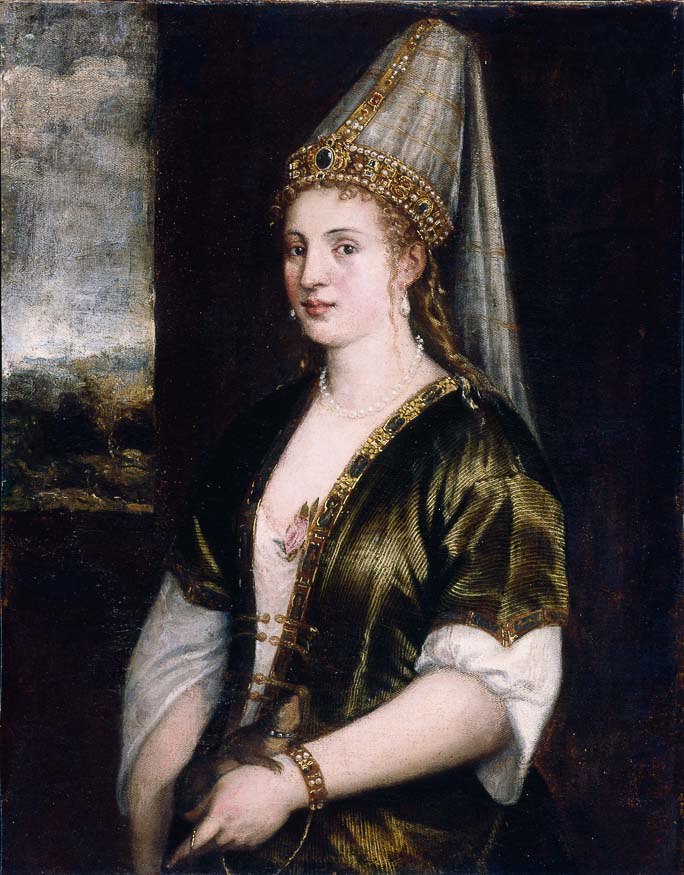
Hürrem Sultan, the Cheerful Rose of Suleiman I

La Sultana Rossa by Titian

 From Ancient Origins:

From 1520-1566, the Ottoman Empire was ruled by Suleiman I, who many claim was the greatest Sultan in history. He was also known as Suleiman the Magnificent or Kanuni – The Lawgiver. During his time in power, he made an impact on the history of many countries in Europe and the Middle East. Suleiman’s life took a radical change in 1520. In September of that year, his father Selim I passed away accidentally, and with his death, Suleiman’s carefree life in the Manisa province came to an end. He was called to the capital city to rule the empire. At the same time, he met the woman who would forever change his life. History has remembered her as Roxolena or Roksolana, Roxalene, Roxolane, and Rossa. However, the name she was called for most of her life is Hürrem. She received this name due to her cheerful personality.

Hürrem was born as Alexandra Lisowska in the town of Rohatyń, 68 km (42.3 miles) southeast of Lwów in the Crown of the Kingdom of Poland (today in Western Ukraine). In the 1520s Crimean Tatars captured her during one of their raids in this region. They took her as a slave to a major center of the slave trade in the Crimean city of Kaffa. Then she was transported to Constantinople and selected for the harem. Hürrem’s influence on Suleiman was almost immediate - it only took a few months from the day that she met Sultan Suleiman to the moment when she became the most important consort in the harem .

Due to her beauty and intelligence she quickly came to the attention of the Sultan. At the same moment she attracted the jealousy of her rivals in the harem, including Mahidevran Sultan, mother of the heir apparent Mustafa. Historians note that these rivalries led to a few attempts to take Hürrem’s life. The most famous is Mahidevran's attack on Hürrem, which was followed by Suleiman banishing his former favorite, and her son, to the provincial capital of Manisa.

[...]

 Suleiman was not only a sultan, but a poet. Many of his poems are dedicated to Hürrem after she became his wife. He signed these poems as "Muhibbi," meaning "lover" or "sweetheart." This is one example of a poem he wrote:

Throne of my lonely niche, my wealth, my love, my moonlight.
My most sincere friend, my confidant, my very existence, my Sultan, my one and only love.
The most beautiful among the beautiful...
My springtime, my merry faced love, my daytime, my sweetheart, laughing leaf...
My plants, my sweet, my rose, the one only who does not distress me in this world...
My Istanbul, my Caraman, the earth of my Anatolia
My Badakhshan, my Baghdad and Khorasan
My woman of the beautiful hair, my love of the slanted brow, my love of eyes full of mischief...
I'll sing your praises always
I, lover of the tormented heart, Muhibbi of the eyes full of tears, I am happy.

(Read more.)


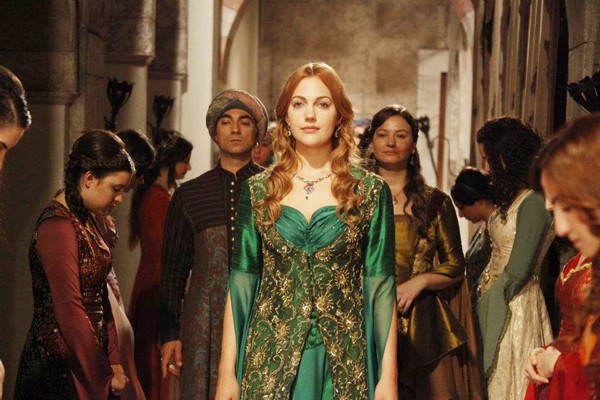
I enjoyed the portrayal of Hürrem in The Magnificent Century (4 Seasons, 2011-2014)


The Turkish production Muhteşem Yüzyıl is based upon the sixteenth century life of Suleiman the Magnificent, sultan of the Ottoman Empire, and his marriage to the Russian Christian captive Alexandra, called Hürrem, who became his co-ruler. On one level the drama can be seen as a Turkish soap opera, and an extremely soapy one at that. However, it depicts the thriving slave trade of fair-skinned women that endured for hundreds of years in Central Europe and Asia in order to fill the harems of wealthy Turks with white girls. The story of Hürrem is the tale of a woman who through intelligence and determination overcame the life of slavery to which she had been condemned. Not only through brains and grit, but through the love she shares with Suleiman, she manages to become his legal wife and the mother of five of his children. In the meantime, every attempt is made by other members of the Sultan's household to destroy Hürrem. Most of the episodes deal with her ongoing power struggles with the Sultan's mother Hafsa and with Mahidevran, the mother of the Sultan's oldest son. The Sultan's grand vizier and brother-in-law Ibrahim Pargali also tries many times to ruin Hürrem and her influence with Suleiman but by doing so brings about his own destruction. Muhteşem Yüzyıl was a run-away success in the Middle East, but for some reason only Season 1 is available on Netflix. The entire series can be watched on YouTube but the later episodes are without subtitles. I found the synopses on Facebook which helped me to follow the drama, HERE. Share

What the Left Has Done to Women

 From Denis Prager at Real Clear Politics:

For all of recorded history, virtually all women sought a man with whom to bond. Of course, a progressive would argue that this was true only because all societies implanted this desire in women or because societal pressure gave women little choice about the matter. It is not, progressives would argue, innate to female nature to yearn for a man. 

But whatever the reason -- innate nature or societal expectation -- it is a fact that women desiring a man was virtually universal.

Then along came modern left-wing feminism, which communicated to generations of young women through almost every influence in their lives -- most especially teachers and the media -- that a woman doesn't need a man. In the witty words of one feminist aphorism, "A woman without a man is like a fish without a bicycle."

Unfortunately, however, the reality is most women need a man just as most men need a woman. Most men don't fully grow up without a woman, and most women don't fully grow up without a man (I am, of course, referring to heterosexual women and men). If you need proof, ask almost any married person, man or woman, if marriage matured them. (Read more.)

Share

Research Reveals Long-Term Harm

 From Psychology Today:

If there was ever a time to attend seriously to research concerning effects of early childhood education, this is it. If President Biden’s plan for universal state-run preschool for 3- and 4-year-olds is approved, the results could be disastrous. I have previously summarized several well-controlled studies showing that academic training in preschool or in kindergarten, while improving test scores in the short term, causes long-term harm (here). One of those, which bears reviewing here before I move on to the recent study in Tennessee, was a government-sponsored study conducted in Germany in the 1970s (described by Darling-Hammond & Snyder, 1992).

The German government was trying to decide whether it would be a good idea, or not, to start teaching academic skills in kindergarten rather than maintain kindergarten as purely a place for play, stories, singing, and the like, as it had always been before. So, they conducted a controlled experiment involving 100 kindergarten classrooms. They introduced some academic training into 50 of them and not into the other 50.

The graduates of academic kindergartens performed better on academic tests in first grade than the others, but the difference subsequently faded, and by fourth grade they were performing worse than the others on every measure in the study. Specifically, they scored more poorly on tests of reading and arithmetic and were less well-adjusted socially and emotionally than the controls.

The Germans, unlike we Americans, paid attention to the science. They followed the data and abandoned plans for academic training in kindergarten. They have stuck with that decision ever since. For one parent’s comparison of German kindergartens to US kindergartens, see here. Today we have much more evidence of long-term harm of early academic training than the Germans had in the 1970s, yet we persist in such training in almost every public kindergarten in the country. Worse, we now even teach academics in many if not most preschools! As a people, we are pretty good at putting our heads in the sand to avoid looking at data that run counter to our prejudices.

Now I turn to newly reported findings from the first well-controlled long-term study that has ever been conducted of a state-wide publicly supported preschool program in the United States—the Tennessee Pre-K Program (Durkin et al., 2022). If this study doesn’t put the nail in the coffin of academic training to little children, it’s hard to imagine what will. (Read more.)

Share

Thursday, April 21, 2022

Mary Tudor and Fashion

Like her mother Katherine of Aragon, Mary Tudor was truly a Renaissance queen, presiding in glittering array. To quote:
Mary adored clothes and jewels. During her years of disgrace (1533-1536), a number of her fine gowns and jewels were taken away in punishment over her refusal to recognise her new demoted status. She complained bitterly and was reduced, the imperial ambassador claims, to ‘send[ing] a gentleman to the King, her father, begging him to provide her with the necessary articles.’ Her subsequent vast expenditure on clothes, namely as queen, was in some respects a way of compensating for that experience. Yet there was also a sense of sheer joy in fashion. In 1554 the Venetian ambassador remarked that Mary 'seems to delight above all in arraying herself elegantly and magnificently.’ She ‘changes every day’. In the later years of her father’s reign, when she was back in favour, she would pay great attention to her inventory of jewels. We find her hand in the inventory of 1542-46, carefully documenting all the items bestowed upon her. The pleasure was not only in receiving. Mary indulged in the customary practise of awarding articles of jewellery and clothing as gifts. One ‘grene Tablet garneshed wt golde hauyng the Picture of the trinite in it’ was given to ‘my laday Elizabeth grace’, her half-sister, whilst she granted one Mistress Ryder a ‘rounde tablet blacke enamelled wt the Kings Picture and quene Janes [Seymour]’ on the occasion of this woman’s marriage. Philip also received gifts of clothing from his wife. For their wedding, Philip wore a mantle of gold cloth that Mary had given him. The mantle was set with numerous precious stones.
Share

American Occupation

 From David Mamet at The Tablet:

Over the last two years in America, I’ve witnessed our own forces of evil with incredulity, despair, and rage. Corruption, blasphemy, and absurdity have been accepted by one-half of the electorate as the cost of doing business; as has the fear this acceptance generates. Does anyone actually believe that men change into women and women into men who can give birth, that the Earth is burning, the seas are rising, and we’ll all perish unless we cover our faces with strips of cotton?

No one does. These proclamations are an act of faith, in a new, as yet unnamed religion, and the vehemence with which one proclaims allegiance to these untruths is an exercise no different from any other ecstatic religious oath. They become the Apostles’ Creed of the left, their proclamation committing the adherent physically to their strictures, exactly as the oath taken on induction to the armed services. The inductee is told to “take one step forward,” and once they do he or she can no longer claim, “I misunderstood the instruction.”

Those currently in power insist on masking, but don’t wear masks. They claim the seas are rising and build mansions on the shore. They abhor the expenditure of fossil fuels and fly exclusively in private jets. And all the while half of the country will not name the disease. Why? Because the cost of challenging this oppressive orthodoxy has, for them, become too high. Upon a possible awakening, they—or more likely their children—might say that the country was occupied. And they would be right. (Read more.)
Share