Wednesday, April 4, 2018

Scalpels Kill More Kids than Guns

From American Thinker:
If you shoot children in a school, liberals are justifiably outraged, as are we all, even if our solutions to the problem are different. But when children are murdered in their mother’s womb? Liberals like to talk about the need for safe spaces, sanctuary cities, and the need to keep our kids safe from gun violence. Yet they support the ultimate form of violence in what should be the safest space of all, again, their mother’s womb. As one who believes that life begins at conception and ends at natural death, I object to this double standard which says the NRA fosters violence against America’s children, but Planned Parenthood does not. As one wag put it, one of these groups sells arms while the NRA supports the Second Amendment. (Read more.)
From Town Hall:
Young people are more influenced by social media than any other generation. In a recent survey, teenagers reported that they often feel bad about themselves (or their lives) when viewing the social media posts of their friends. More importantly, teenagers said they are often bulliedon-line. That’s important, because the killers in each school shooting were also said to have been criticized or ostracized prior to the crime. While bullying is not new, the way young people bully each other has shifted. Social media intensifies bullying because it increases its severity, proximity and consistency. We are far harsher when criticizing others on social media. Worse yet, in a smart phone culture, the bully is as near as your phone. Those of us who were bullied in the past could at least find solace and protection in our own homes; bullying stopped as soon as we left the school grounds. Not so today. Bullies follow their victims home every night and sleep next to them on their nightstands. The way people interact has changed, and this shift is seen in the lives of school shooters. Many have been harboring growing animosity stoked by social media. (Read more.)
From Return to Order:
The first is that this popular youth culture is extremely self-centered. Everything is thought to exist in function of the individual. Persons can, for example, self-identify as whatever they wish to be. Individuals determine the terms of their own existence, behavior and values. This creates an artificial and insecure world marked by self-gratification. In this culture, young people want everything instantly, effortlessly and regardless of the consequences. They have no patience with anything that stands in the way. They are easily offended by any certainty or moral standard that “micro-aggresses” them.

With the advent of social media, this self-centeredness is represented by an enormous pressure upon young people to project a self-image beyond reality. Social success is measured in validating texts, self-absorbing posts and impulsive likes. The selfie has become an expression of self-projection. In such a climate, concern for others is diminished, and people can quickly become ostracized. Those who fail to live up to the image of their self-aggrandizement become depressed and resentful. With few moral restraints, it can give rise to situations when young people kill other young people. (Read more.)
Share

Fools and Mortals

From The Federalist:
Cornwell has shown glimpses of historical dramaturgy in a couple of novels, but he pulls out all the stops in “Fools and Mortals.” We get a thorough behind-the-scenes look at the Elizabethan theater — the craft, who the actors were, and even the materials that went into make-up. “Fools and Mortals” may not feature the blood-soaked proto-England of Uhtred or the dangerous American Civil War battlegrounds of Nathaniel Starbuck, but there is plenty of grit, not a little blood, and some realistic heroism and good swordfighting. In other words, it’s a Cornwell historical.

Our hero and narrator is the morally-suspect Richard Shakespeare. As the novel begins, we find that Richard is not a fan of his older brother, William. Seems William treats Richard like hired help. While he’s gotten Richard a job at the theater, he’s left Richard scratching for pennies. Plus, William offers no hope that Richard will be able to climb the theatrical food chain and get better gigs. William can’t resist any opportunity to take a verbal jab at Richard every time he sees him. Then, he twists the knife of contumely even more, just when Richard thinks he’s escaped his brother’s tender ministrations.

Richard had arrived in London several years before, having escaped an odious carpenter’s apprenticeship arranged by his father. His brother, who has fled the confines of Stratford for his own reasons, is not amused to find a teenager at his doorstep wanting to be a player. William rather brutally hands him over to a trainer of chorister boys. There Richard receives training as an actor, a thief, a fighter, a dancer, and a prostitute for those with a taste in boys. In other words, the usual dramatic apprenticeship in 1590s London. (Read more.)

Share

Tuesday, April 3, 2018

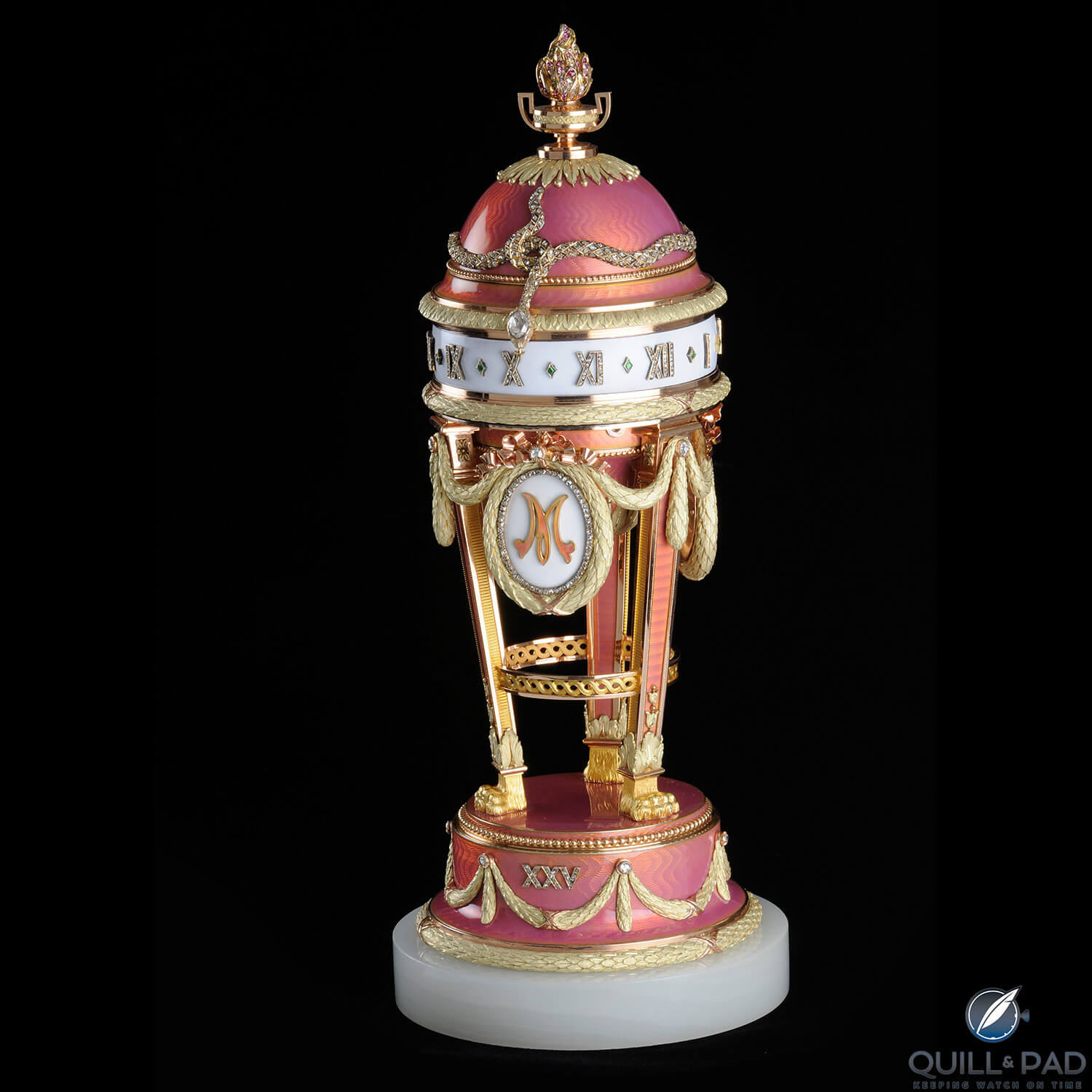
The Yusupov Fabergé Egg of 1907

From Quill and Pad:
The egg made in St. Petersburg by Fabergé under workmaster Henrik Wigström – Fabergé used the word “workmaster” instead of “creative director” or even “supplier” – was given to Felix’s mother, Zinaida, the seventh princess of Yusupov, by his father, Count Felix Felixovich Sumarokov-Elston, on the occasion of their twenty-fifth wedding anniversary in 1907.

Princess Zinaida Yusupov, a lady-in-waiting to two Russian empresses, owned the most significant collection of historical jewels in pre-Revolution Russia after the imperial family. When the princess fled Russia as the Revolution began, she left most of her financial assets in the country, including her collection of jewels and objets d’art, which were hidden in a secret vault in Moika Palace. Within five years the Bolsheviks had found the stash, though, and these items were sold off. The egg was likely sold by Russian officials in Paris or Berlin, and by 1949 it was owned by dealers in London, who sold it to Maurice Yves Sandoz (1892-1958) in 1953.

It went from Maurice to the collection of Edouard Marcel Sandoz (1881-1971) and finally to the Sandoz Foundation in 1995, established in 1964 by Edouard Marcel as a family foundation to encourage entrepreneurial commitment, creativity, and private initiative. The Sandoz Foundation owns Parmigiani Fleurier and a number of direct suppliers (including the controlling portion of Vaucher) as of 1996. (Read more.)
Share

Terri Schiavo: Thirteen Years Later

I will never forget that dark Easter. From Bobby Schindler at Life News:
Every year, I write to honor my sister, Terri Schiavo, on March 31st, the anniversary of her death. For those who do not remember, Terri, at the age of 26, experienced a still inexplicable collapse resulting in a severe brain injury. Terri’s case and condition continue to be inaccurately reported. For example, reports falsely suggesting Terri variously had a terminal condition, needed “machines,” was in a coma, or even was outright “brain dead” are all incorrect.
Sadly, after a few years of caring for Terri, Michael Schiavo, who was Terri’s husband and guardian, lost interest, and eventually petitioned the courts for permission to deliberately starve and dehydrate her to death by having her feeding tube removed. Due to her brain injury, she was unable to swallow using conventional utensils, and like many Americans required nutrition and hydration by feeding tube in order to live.

Another false description of Terri was that this sort of food and water constituted “life support,” when in fact she was lively and stable, and simply required food and water in the same way that any of us do. Nonetheless, by the order of Judge George W. Greer, Terri was deprived of water and food for more than 13 days. She died on March 31, 2005 of intentionally caused extreme dehydration.
In response to Terri’s death, my family established the Terri Schiavo Life & Hope Network to advocate for medically vulnerable persons, accessing families to resources they need to fight in their time of crisis. Too often, medically vulnerable persons and their families and advocates are confronted with having their basic care denied, as a rising “quality- of-life” mentality continues to influence the sort care they receive.

Indeed, if we look just this past year, you will see the progress of those who are advancing a “death-with-dignity” worldview, and that it ought to be our right to choose death. This view mistakes “dignity” for describing essentially “How independent I am”, rather than recognizing the principle that dignity is fundamental, innate, and not conditional based on our changing life circumstances. In addition to this, it is now legal in every U.S. state to deny a patient food and water, as in Terri’s situation, as the erosion of a patient’s right to receive proper care progresses. (Read more.)
Share

Hate Crimes in Scotland

From The Catholic Herald:
 A Labour Member of the Scottish Parliament has called on Holyrood to recognise the growing problem of anti-Catholicism in Scotland. It follows a government report which suggests that Catholics are the victims of 57 per cent of all religiously aggravated offences reported in the country. Elaine Smith MSP raised the subject in the Scottish Parliament last week, following an incident in which a church near Glasgow was vandalised and the Blessed Sacrament desecrated. Smith noted that not only are Catholics now the victims of more hate crime than all other religious groups in Scotland combined, but that this is also an increasing trend (a 14 per cent increase in one year). Smith continued, calling on the SNP Government to “go out to the Catholic population and listen to their concerns”, adding that while Islamophobia and anti-Semitism have prominent places in public debate the same cannot be said of anti-Catholicism. (Read more.)
Share

Monday, April 2, 2018

Big Everybody Is Watching

From American Consequences:
Orwell captures totalitarianism’s interference in every aspect of existence in the first sentence of his book: “…the clocks were striking thirteen.” Whenever “the authorities” start meddling with ancient and customary traditions, something is wrong. So it was when President Jimmy Carter tried to put America on the metric system. And so it is today with an ancient and customary tradition we used to have… that the President of the United States was someone you would welcome into your home.

1984 has a “Two Minutes Hate” where everyone has to stop what they’re doing and despise Emmanuel Goldstein, “Enemy of the People.” We voluntarily stop what we’re doing and spend much more than two minutes despising Donald Trump on MSNBC. Or, if that doesn’t suit us, we despise Nancy Pelosi for hours on Fox News. Winston Smith “set his features into the expression of quiet optimism which it was advisable to wear when facing the telescreen.” This is nothing compared to the expression of smug and idiotic blow-hard certainty which it is advisable to wear when facing the cameras on MSNBC and Fox. (Read more.)
Share

Homeschool Co-ops

From The Homeschool Post:
A homeschool co-op can be a great thing for your family. But it can also turn into a headache and something that the family dreads. So…how do you know if you should really join a homeschool co-op? Here are four reasons why you shouldn’t. If any of these fit your situation, don’t join. Even if you feel pressured to do it…don’t. A negative homeschool co-op experience isn’t fun for anyone. Trust me. And if the co-op you’re considering isn’t a good idea right now, don’t lose hope. Consider other co-ops or wait until a different season of life. A positive co-op experience is worth it, and you’ll be glad you waited. (Read more.)
Share

Sunday, April 1, 2018

The Veiled Christ

From Aleteia:
The Cristo Velato (that is, the Veiled Christ) is a sculpture completed in 1753, originally (mis)attributed to Antonio Corradini and considered one of the world’s most remarkable pieces of art. In fact, the great neoclassical maestro Antonio Canova, who tried to buy the work, said he would gladly give up ten years of his life to produce such masterpiece.

Although Corradini was in fact commissioned with the job in the first place, he died having only produced a clay model for what would later be a definitive piece sculpted in marble. It was Giuseppe Sammartino, then, who ended up producing the astonishing sculpture of a dead Jesus, covered by a transparent shroud carved out of the very same marble block shared with the rest of the statue. Sammartino’s mastery – the veil covering the figure of Jesus being in fact “transparent” — didn’t only gain him a well-deserved place in the history of Western art, but also turned his artwork into the stuff of legend.

Some stories claim Sammartino covered his sculpture with a linen veil he managed to transform into marble by means of complex chemical-alchemical processes. Those very same legends would also claim that Raimondo di Sangro, the commissioner of the sculpture, was himself an alchemist who taught Sammartino the mysteries of his pseudo-science. Of course, these are but legends. (Read more.)
Also from Aleteia, an article about a statue made from the Shroud of Turin:
 This statue is the three-dimensional representation in actual size of the Man of the Shroud, created following the precise measurements taken from the cloth in which the body of Christ was wrapped after the crucifixion,” explains Giulio Fanti, teacher of mechanical and thermal measurements at the University of Padua, who studies the Shroud. Based on his measurements, the professor has created a “carbon copy” in 3D which, he claims, allows him to affirm that these are the true features of the crucified Christ.

“Therefore, we believe that we finally have the precise image of what Jesus looked like on this earth. From now on, He may no longer be depicted without taking this work into account.” The professor granted exclusive coverage of his work to the weekly periodical Chi, to which he revealed: “According to our studies, Jesus was a man of extraordinary beauty. Long-limbed, but very robust, he was nearly 5 ft. 11 in. tall, whereas the average height at the time was around 5 ft. 5 in. And he had a regal and majestic expression.” (Vatican Insider)

Through the study and three-dimensional projection of the figure, Fanti was also able to count the numerous wounds on the body of the man of the Shroud:

“On the Shroud,” the professor explains, “I counted 370 wounds from the flagellation, without taking into account the wounds on his sides, which the Shroud doesn’t show because it only enveloped the back and front of the body. We can therefore hypothesize a total of at least 600 blows. In addition, the three-dimensional reconstruction has made it possible to discover that at the moment of his death, the man of the Shroud sagged down towards the right, because his right shoulder was dislocated so seriously as to injure the nerves.” (Read more.)
Share

The Eighth Day


Let, then, the week with its Sabbath pass by; what we Christians want is the eighth day, the day that is beyond the measure of time, the day of eternity, the day whose light is not intermittent or partial, but endless and unlimited. Thus speak the holy Fathers, when explaining the substitution of the Sunday for the Saturday. It was, indeed, right that man should keep, as the day of his weekly and spiritual repose, that on which the Creator of the visible world had taken his divine rest; but it was a commemoration of the material creation only. The Eternal Word comes down in the world that he has created; he comes with the rays of his divinity clouded beneath the humble veil of our flesh; he comes to fullfil the figures of the first Covenant. Before abrogating the Sabbath, he would observe it as he did every tittle of the Law; he would spend it as the day of rest, after the work of his Passion, in the silence of the sepulchre: but, early on the eighth day, he rises to life, and the life is one of glory.

Share