A place for friends to meet... with reflections on politics, history, art, music, books, morals, manners, and matters of faith.
A blog by Elena Maria Vidal.
"She was not a guilty woman, neither was she a saint; she was an upright, charming woman, a little frivolous, somewhat impulsive, but always pure; she was a queen, at times ardent in her fancies for her favourites and thoughtless in her policy, but proud and full of energy; a thorough woman in her winsome ways and tenderness of heart, until she became a martyr."
"We have followed the history of Marie Antoinette with the greatest diligence and scrupulosity. We have lived in those times. We have talked with some of her friends and some of her enemies; we have read, certainly not all, but hundreds of the libels written against her; and we have, in short, examined her life with– if we may be allowed to say so of ourselves– something of the accuracy of contemporaries, the diligence of inquirers, and the impartiality of historians, all combined; and we feel it our duty to declare, in as a solemn a manner as literature admits of, our well-matured opinion that every reproach against the morals of the queen was a gross calumny– that she was, as we have said, one of the purest of human beings."
"It is now sixteen or seventeen years since I saw the queen of France, then dauphiness, at Versailles; and surely there never lighted on this orb, which she hardly seemed to touch, a more delightful vision. I saw her just above the horizon, decorating and cheering the elevated sphere she had just begun to move in, glittering like a morning star full of life and splendor and joy. Oh, what a revolution....Little did I dream that I should have lived to see such disasters fall upon her, in a nation of gallant men, in a nation of men of honor and of cavaliers! I thought ten thousand swords must have leaped from their scabbards, to avenge even a look which threatened her with insult. But the age of chivalry is gone; that of sophisters, economists, and calculators has succeeded...."
~Edmund Burke, October 1790
A Note on Reviews
Unless otherwise noted, any books I review on this blog I have either purchased or borrowed from the library, and I do not receive any compensation (monetary or in-kind) for the reviews.
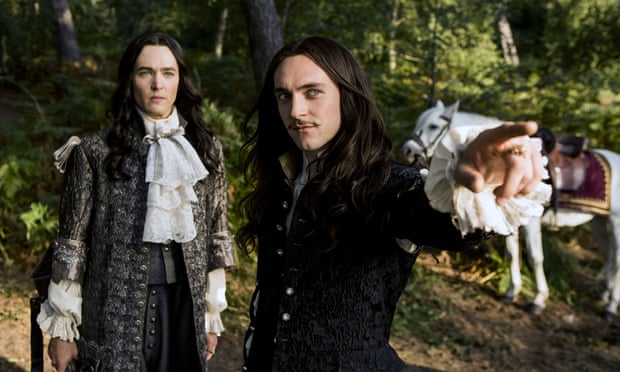
Alexander Vlahos as Philippe d'Orléans (Monsieur) and George Blagden as Louis XIV
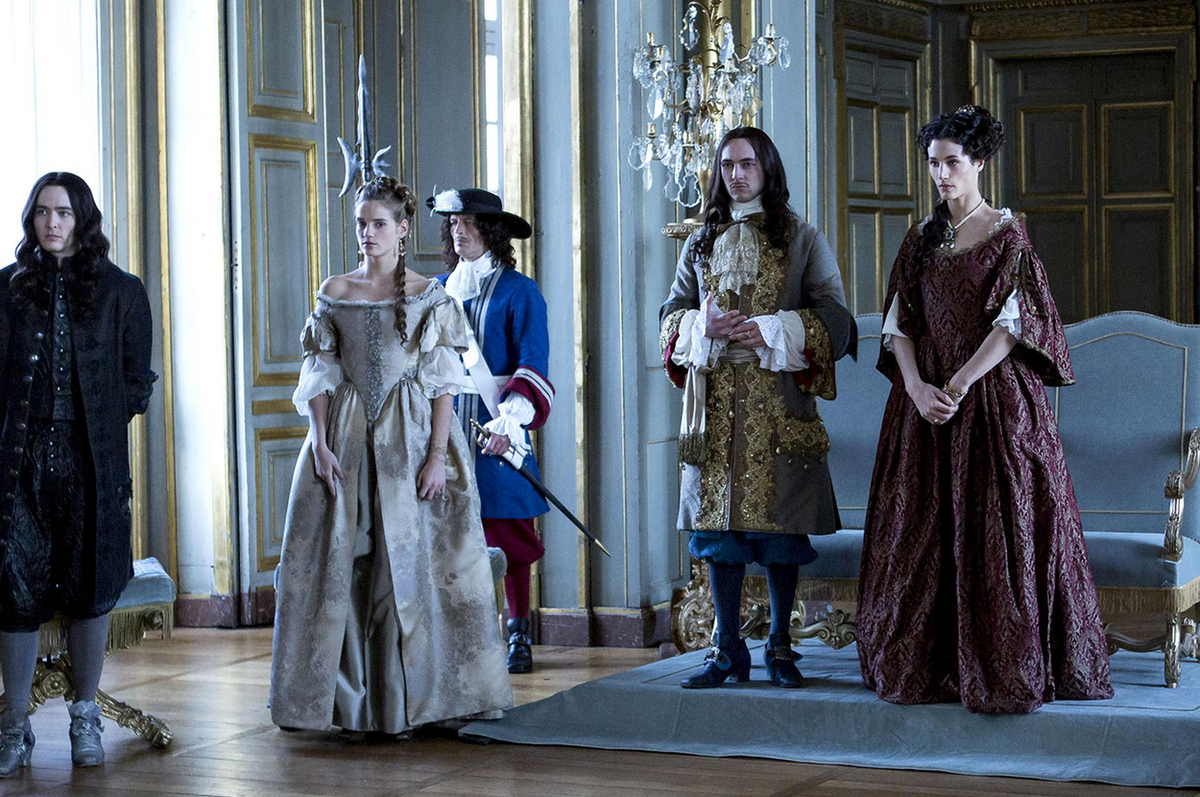
For those who enjoy historical dramas, Netflix has several television series of varying quality. One series which offers exquisitely crafted costumes and magnificent authentic sets is Versailles, depicting the seventeenth-century court of the Sun-King, Louis XIV. Filmed in English rather than French, to the disappointment of many, the program focuses on Louis XIV's plan to strengthen and safeguard his throne, his kingdom and his family by neutralizing his nobility. He accomplishes his goal through the establishment of the most glamorous court in the world at a palace which he crafts to be like no other. Originally a hunting lodge, Versailles grows and expands around Louis and his family, and the nobles, for whom it is intended to be a golden cage to keep them from rebellion. The drama mixes fact with fiction yet succeeds in capturing the overall grand dream of the young monarch, brought slowly to fruition by bursts of inspiration which to this day set Louis XIV apart from other monarchs. Among great kings, he shines as one of the greatest; Versailles teaches us why.
Unfortunately, the story line is not helped by the sex scenes, which particularly clog up the early episodes. For one thing, there are so many characters that it is difficult to figure out who they all are, especially the fictional ones. The bedroom gymnastics make character identification more challenging. To show Louis having an oddly passionless physical affair with his sister-in-law, Henriette of England, destroyed the sense of what their actual relationship might have been. It is unlikely that Louis would have slept with Henriette because as her brother-in-law intercourse with her would have been considered incestuous. In spite of the probable platonic nature of their relationship, it was a volatile one, nevertheless. It was good how the filmmakers showed how both brothers, Louis and Philippe, caused Henriette to suffer and that being caught between them led to her destruction. Her death scene is one of the most beautiful and heartrending moments, as Louis tries to bring the garden into her room, and with her last sigh she claims that she hears the flowers singing.
Another compelling aspect of the series is the depiction of Louis' younger brother, Philippe d'Orléans. Philippe is usually portrayed in films as a stereotypical mincing and prissy homosexual. But in Versailles his character is fleshed out; he is no longer a caricature but a genuinely complex human being. The show points out how Philippe was encouraged to be effeminate by his mother so that he would never be a threat to Louis. Philippe struggles with the knowledge that his own family sought to emasculate him; his dreams of military glory are thwarted. He is repulsed by his decadent lifestyle while being inextricably drawn to it, a lifestyle which includes his lover the Chevalier de Lorraine. This naturally causes tension in his relationship with his wife Henriette. In real life, Henriette spent a great deal of her life being pregnant with Philippe's children, all of whom died except for two little girls. Philippe's bond with his brother Louis is portrayed as being one of the most important in both of their lives, although they fight and disagree over any number of issues. Where Louis always sees the big picture, the grand spectacle of his kingdom and his people, Philippe sees individuals, and the personal cost of events on certain souls. Louis listens to Philippe, who can speak to him with frankness as no one else can; the brothers are often shown walking through the palace engaged in debate, going from room to room, talking as if they are alone in their boyhood nursery.
Louis' pious Spanish queen, Marie-Thérèse d'Autriche, is represented as a devoted wife whose strong quiet love surrounds her husband even when he is distracting himself with other women. She accompanies him to the monastery where his former mistress, Louise de La Vallière, takes the veil. When Henriette is dying, Marie-Thérèse prays the rosary at the foot of her deathbed. It is entirely overlooked, however, that the Queen was a blonde Habsburg; like her younger siblings Carlos II and Empress Margarita she bordered on being albino as a result of chronic inbreeding. The bizarre episode which has the Queen giving birth to a black child, the result of an extramarital affair with either her dwarf or a visiting African prince is, oddly enough, rooted in history.
Given the plot twists, and need for thrilling jeopardy, some crucial characters
in the series are wholly invented, thereby allowing the showrunners to
bump them off without altering history. The fictional villains comprise
the conspiratorial Duke of Cassel; the Protestant Béatrice de Claremont (and her innocent daughter, Sophie); Mike, the masked assassin who colludes with Louis de Rohan; and the back-stabbing Montcourt who slaughters the (also fictional) Parthenay family on the roads near Versailles.
Louis’ fictional allies include the psychopathically effective head of security, Fabien Marchal,
who is alarmingly fond of hammers and eye-gouging; his one-armed
gardener, Jacques – a sort of a horticultural Obi Wan Kenobi, often
dispensing wisdom in plant metaphors – and, of course, the King’s
overworked medical advisors, Dr. Masson and his talented daughter
Claudine. In reality, no woman every practiced medicine at the court –
Louis’ real doctor at this time was called Antoine Vallot.
However, the drama is also populated by many real people from Louis’
court. His mother (Queen Anne, seen dying in a flashback); Spanish wife
(Queen Marie-Thérèse); brother (Philippe, Duke of Orléans); English sister-in-law (Henriette-Anne, or ‘Minette’); outgoing mistress (Louise de La Vallière); incoming mistress (Athénaïs de Montespan); loyal valet (Bontemps);
son (the kidnapped Dauphin); chief advisors (Colbert & Louvois –
though Louvois was much younger in reality); and – most thrillingly –
the treacherous old friend (Louis de Rohan, a former childhood pal who
really did join a northern plot to kidnap the Dauphin and murder the
King).
We might also make special mention of Prince Annabar (Aniaba of Issigny)
who turns up in the historical sources, but is a bit of a conundrum.
There are some doubts as to whether he was a genuine African prince, but
we know Louis treated him as the real deal and eventually supported his
claim to the throne in Senegal. However, this wasn’t until 1700, by
which time Aniaba had been in France for several years. In the episode we are told he arrives for a trade deal and leaves almost immediately.
This also brings us onto the black baby, born in front of a shocked crowd in episode one.
Various gossipy chroniclers recounted this tale, but all of their
scurrilous stories date to several decades after the event. Crucially,
none of them implicated Prince Aniaba by name: that is a modern writerly
invention. So, where does the 'black baby' story come from?
Queen Marie-Thérèse’s ‘dark’
baby was, in all likelihood, born premature with her skin a violent
purple hue – she died soon after, perhaps of oxygen deprivation during
delivery. In the drama we then see the Queen’s scandalous child being
given to the nunnery, and the death is faked. This is a conflation of a
separate story. As far as we can tell, a real black baby was indeed
taken from the palace to a convent, and grew up to become the infamous Black Nun of Moret.
Her portrait was painted by the King’s artist, and, as an adult, she
was apparently visited by the King and his court, suggesting she knew
who her father was! But the implication here was that the Black Nun was
Louis’ lovechild, not Marie-Thérèse’s.
This
shouldn’t be a surprise. Louis had affairs with perhaps as many as 20
women in his life, and was likely responsible for as many pregnancies.
Tragically, miscarriages and infant death was horribly common for Louis’
lovers. The Queen fell pregnant six times, yet only the dauphin
survived to adulthood. Louise de La Vallière bore Louis five children,
but the first three never reached their third birthdays. The King’s
brother, Philippe, certainly preferred sex with men, but he did his
marital duty often enough to see Henriette-Anne’s body ravaged by eight
pregnancies in nine years – with only two daughters outliving their
tragic mother. (Read more.)
One anomaly of the series is that, although Versailles was unquestionably a hunting lodge, there are no depictions of the king and his court hunting. There are no hounds, or stags, either, for that matter. No one is shown killing an animal or a bird, although plenty of people die in various macabre ways. It would have better caught the atmosphere of the place if more animals were shown, particularly dogs, who livened as well as dirtied the royal residences.
As far as religion goes, all the characters are unquestionably Catholic, with the exception of one or two secret and murderous Huguenots. It was funny how the courtiers are shown lined up to receive Holy Communion at Mass, and receive the hosts standing. In reality, few people received Communion in those days and when they did so they knelt at the altar rail. It was strange that the otherwise meticulous research did not extend to liturgical practices.
Elisa Lasowski as the Queen, Marie-Thérèse d'Autriche
Noémie Schmidt as Henriette-Anne d'Angleterre (Madame)
Louis XIV and Henriette
The Royal Family: Philippe, Henriette, the King and the Queen
The media suffer the lowest approval numbers in nearly a
half-century. In a recent Emerson College poll, 49 percent of American
voters termed the Trump administration “truthful”; yet only 39 percent
believed the same about the news media. Every president needs media audit. The role of journalists in a free
society is to act as disinterested censors of government power—neither
going on witch-hunts against political opponents nor deifying
ideological fellow-travelers.
Sadly, the contemporary mainstream media—the major networks (ABC,
CBS, NBC, CNN), the traditional blue-chip newspapers (Washington Post,
New York Times), and the public affiliates (NPR, PBS)—have lost
credibility. They are no more reliable critics of President Trump’s
excesses than they were believable cheerleaders for Barack Obama’s
policies. Trump may have a habit of exaggeration and gratuitous feuding that
could cause problems with his presidency. But we would never quite know
that from the media. In just his first month in office, reporters have
already peddled dozens of fake news stories designed to discredit the
President—to such a degree that little they now write or say can be
taken at face value.
No, Trump did not have any plans to invade Mexico, as Buzzfeed and the Associated Press alleged.
No, Trump’s father did not run for Mayor of New York by peddling racist television ads, as reported by Sidney Blumenthal.
No, there were not mass resignations at the State Department in
protest of its new leaders, as was reported by the Washington Post.
No, Trump’s attorney did not cut a deal with the Russians in Prague.
Nor did Trump indulge in sexual escapades in Moscow. Buzzfeed again
peddled those fake news stories.
No, a supposedly racist Trump did not remove the bust of Martin
Luther King Jr. from the White House, as a Time Magazine reporter
claimed.
No, election results in three states were not altered by hackers or
computer criminals to give Trump the election, as implied by New York
Magazine.
No, Michael Flynn did not tweet that he was a scapegoat. That was a media fantasy endorsed by Nancy Pelosi.
In fact, Daniel Payne of the Federalist has compiled
a lengthy list of sensational stories about Trump’s supposed
buffooneries, mistakes, and crudities that all proved either outright
lies or were gross exaggerations and distortions.
We would like to believe writers for the New York Times or Washington
Post when they warn us about the new president’s overreach. But how can
we do so when they have lost all credibility—either by colluding with
the Obama presidency and the Hillary Clinton campaign, or by creating
false narratives to ensure that Trump fails? (Read more.)
Introduction: The eighty-eight charges against the Templars which
were used as the basis of interrogations in the proceedings against the
Templars in the British Isles, 1309 – 11, included the charge that
admissions into the Order were secret, and that only brothers of the
order were present.
Outside the British Isles, there is some evidence that outsiders
could attend Templar admission ceremonies. Often cited is the example of
the German Templar, was arrested and interrogated within France, who
stated that in Germany honest, respectable outsiders could attend.
However, within the British Isles, all the Templars testified that only
Templars attended receptiones, although some qualified their statements.
But was this true? The evidence actually given by the Templars and
non-Templars suggests that some of them had attended admission
ceremonies before becoming full members of the Order. (Read more.)
To make sense of contemporary policy debates, you need a certain
amount of perspective. If you lack that perspective, you can be more
susceptible to overreaction and partisan hysteria. Take the issue
of executive power and national security. If you don’t know what Lincoln
did during the Civil War (suspend habeas corpus), what Woodrow Wilson
did during World War I (severely restrict civil liberties), or what
Franklin Roosevelt did during World War II (put Japanese Americans in
internment camps), it’s hard to have any real perspective on the actions
that George W. Bush, Barack Obama, and now Donald Trump have taken in
the war against Islamic terrorism.
Similarly,
if you don’t know just how much America’s violent-crime rate
skyrocketed between the early 1960s and the early 1990s (the increase
from 1961 to 1991 was a staggering 380 %), and if you don’t know just how devastating the crack-cocaine epidemic was to inner-city communities, it’s hard to have any real perspective on “mass incarceration.”
Finally,
if you don’t know the full history of race and race relations in our
society, and if you don’t know how that history compares with the
experiences of other countries around the world, it’s hard to have any
real perspective on the progress America has made in reducing racial
inequality. (Read more.)
We need fixed and tangible ways of perceiving divine mysteries. This
is why Aquinas defends not only the importance of ritual but also the
use of images in Church. He offers three arguments. First, images are
necessary for the instruction of simple people. Second, they aid the
memory by daily presenting the example of the saints. Third, they help
to excite devotion.
Really, though, Aquinas’s three reasons are one. Though he first
defends images as useful for the instruction of simple people, he then
goes on to explain why they are useful to us all. For learned and
unlettered alike, memory is imprinted and emotion aroused “more
effectively by things seen than by things heard”. Aquinas was
sophisticated enough to realise that all men are simple. If the poor
need art and ritual, so does everyone.
It is beautiful to see when Catholics live out this truth. At St
Patrick’s Church in Soho, central London, one can come for the reverent
liturgies celebrated in the sanctuary, or for the hot food served at the
soup kitchen in the crypt. Some come for both. When these homeless
people arrive, they do not find any trace of condescension. At meal’s
end, the volunteers sit alongside the guests of the soup kitchen and
sing the praises of a God who took on humility.
Only when we realise our own poverty will there be a return to
beauty, and only when the Church returns to beauty will she once again
attract the poor. We welcome the poor into our churches whenever we
greet with holy images and solemn rites One who approaches us from the
east. If, however, we refuse proper welcome to the poor and their Lord,
there will continue to be burning instead of beauty. (Read more.)
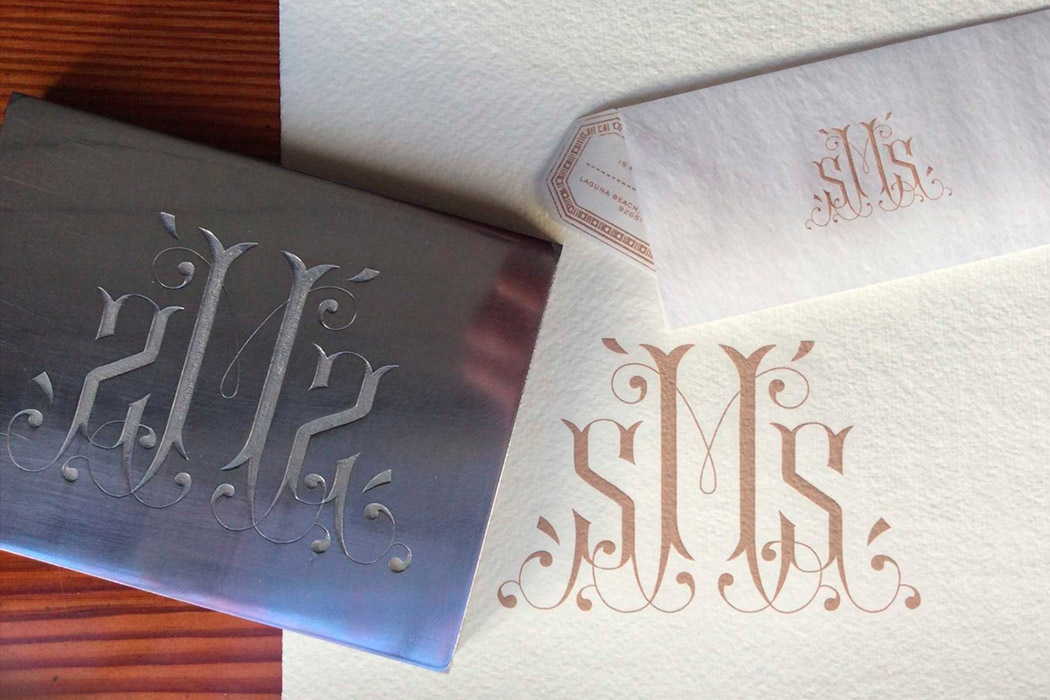
Nancy Sharon Collins has forged a path as a stationer. She has been a
proponent of proper letterhead since the early 1970s, when she
purchased a large quantity of onionskin on a whim. Today, she sells this
same collection in her online store,
along with artisanal notepads and bespoke stationery. “I didn’t know
that the simple purchase I made then would create such a wonderful
business opportunity for me,” Nancy says.
Onionskin, being lighter than most paper, was once widely used for
its portability. However, because it is not compatible with printers, it
fell out of fashion. Its recent resurgence could be attributed to the
fact that it takes ink wonderfully, encouraging the writing of beautiful
longhand. The experience of writing on it might be called ethereal. (Read more.)
But once she gets her rations, Mar said, she'll go back to the swamps. Her home county, Leer, has been one of the worst affected areas since
South Sudan's civil war broke out three years ago. To add to the
hardships, the United Nations and South Sudan's government last month
declared a famine in Leer and Mayendit counties. Authorities say about
100,000 people there face starvation, with 15,300 of them in Padeah town
alone. Yet even though people are starving, many from Padeah still prefer live in the bush for their safety.
"The government soldiers come and they kill us and steal our food,"
said John Chol, who lives just outside of Padeah. He said people would
rather live in the swamps than risk being attacked or raped.
Lulu Yurdio's family escaped to the river several months ago. A
ripped shirt hung over the 12-year-old's tiny frame. It had been five
days since he last ate. "I'm hungry," he said, his eyes full of pain. "I never have food and
I'm always hungry." Tasked with picking up rations for his two siblings
and parents, he had walked two-and half hours to reach WFP's food
distribution site. He said his family was afraid to come out. (Read more.)
A new 900-seat chapel for a Jesuit prep school in Florida draws on the
great tradition of Jesuit architecture and will be a new focal point of
the school’s expanding masterplan. The brick exterior has a limestone
portico and is topped with an octagonal cupola. The centralized interior
includes four shrines dedicated to Jesuit martyrs and an altarpiece
above the main altar depicting the vision of Saint Ignatius at La
Storta. The chapel will be completed in 2018. (Read more.)
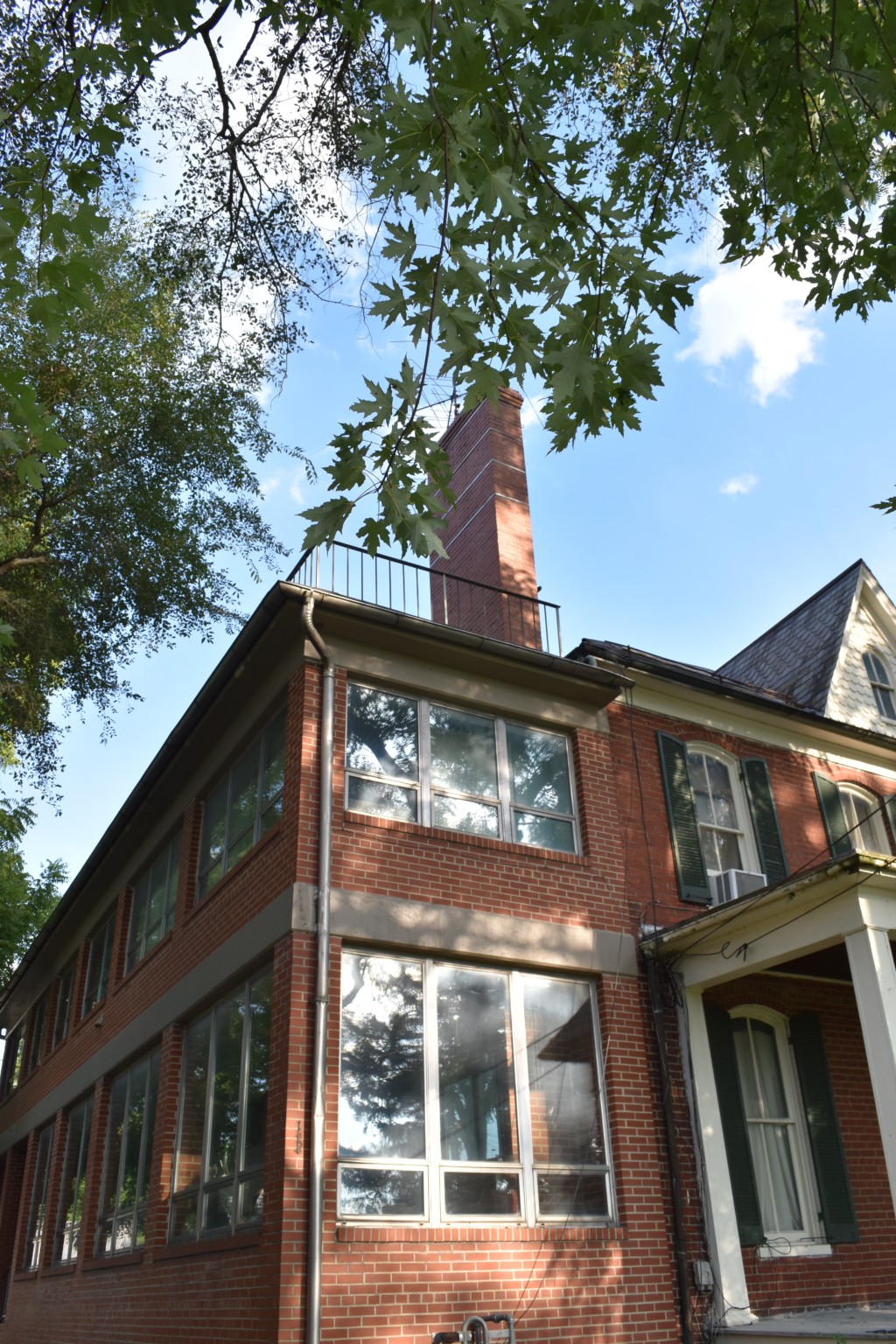
Some live in vintage homes. Others live in modern ones. We live in both.
At the same time.
You see, our house has a long architectural history, added to (quite
dramatically, I might add) by my grandfather in 1968. The story of The
Glass Room is one of family and architecture and dubious compromises.
In 1968, my grandparents,
then in the their 50s, found themselves in the classic tweener
generation. With their sons grown, with children of their own, my
grandparents recognized that my grandfather’s parents were in need of
assistance. My great-grandfather, George Leicester Thomas, Sr. was
ailing, and my great-grandmother could no longer take care of him
herself. So it was decided they should move in with my grandparents,
here at Clifton (our farm’s name is Clifton on the Monocacy). As
great-granddaddy was in a wheelchair, the house, which sits a half-story
above ground level, needed to be made accessible. And additional
bathrooms (the house had only one and a half baths) were needed. I
don’t know all the details of the search for the architect, or any of
the discussions involved, but somehow the addition you see here was
conceived. (Read more.)
Marie-Antoinette "en gaulle" by Elisabeth Vigée-Lebrun
Generalissima: A Novel of Henrietta Maria
Book Two in the "Henrietta of France Trilogy"
#1 in Kindle Biographies of Royalty!
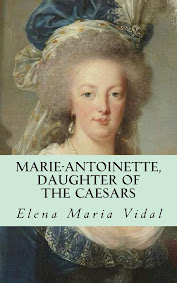
Marie-Antoinette, Daughter of the Caesars: Her Life, Her Times, Her Legacy
An Audible Bestseller
Marie-Antoinette, Daughter of the Caesars: Her Life, Her Times, Her Legacy
An Amazon Bestseller
Trianon: A Novel of Royal France
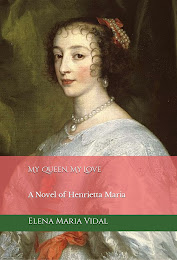
My Queen, My Love: A Novel of Henrietta Maria
Available from Amazon
The Saga of Marie-Antoinette's daughter, Marie-Thérèse of France
A Novel of the Restoration
In Kirkus Top 20 for 2014! And #1 in Kindle Historical Mystery, Thriller & Suspense Fiction
"In every Eden, there dwells a serpent . . . ."
#1 in Kindle History of France!
The Night's Dark Shade: A Novel of the Cathars
Join me on Facebook!
Elena Maria Vidal Author Page
Join me on X!
@emvidal
Visit My Tumblr!
East of the Sun, West of the Moon
St. Teresa of Avila, pray for us!
"...Bud forth as the rose planted by the brooks of waters. Give ye a sweet odor as frankincense. Send forth flowers, as the lily...and bring forth leaves in grace, and praise with canticles, and bless the Lord in his works." —Ecclesiasticus 39:17-19
The fact that a link is provided here in no way constitutes an endorsement of everything on the other end of the link.
Comments Policy
Comments are moderated. If a comment is not published, it may be due to a technical error. At any rate, do not take offense; it is nothing personal. Slanderous comments will not be published. Anonymity may be tolerated, but politeness is required.
I would like to respond to every comment but my schedule renders it impossible to do so. Please know that I appreciate those who take the time to share their thoughts.