


Thomas Merton on Noise
1 day ago


This perverse view has been carefully prepared by a so called “education,” aiming at convincing us that there are no absolute moral truths: they are all relative and depend upon the time and the culture that one happens to live it. It was declared to be “high time” to liberate ourselves from paralyzing taboos which have kept us in bondage. This view also justifies “same sex marriage” – a moral abomination that threatens the very fabric of society and that a no- nonsense Italian peasant would condemn on the ground that “no door can be opened if lock and key are identical.” From time immemorial – starting with Genesis – marriage has been declared to be the union of a man and a woman – whose spiritual, intellectual, affective and biological structures are so admirably complementary. (Read more.)Share
As well as sewerage, another “waste removal” problem plagued London in the 19th century: the disposal of the dead. There was little dispute about the means. Burial was the norm; cremation a peculiar foreign custom. The difficulty lay in finding room for an ever-increasing number of corpses. The capital’s burgeoning population, upon their decease, were filling up its small churchyards, burial grounds and vaults...Clearance of long-buried bones had always taken place; but the growing demand for burials in crowded grounds meant the work became ever more grisly.Share
Moreover, by the 1840s London’s overcrowded churchyards (and the older, small commercial grounds in the centre of the capital) were not only seen as posing a logistical challenge, but damned as a source of “miasma”. Sanitary reformers quite mistakenly believed that the stench from poorly interred decaying bodies was poisoning the metropolis. The practice of urban burial was touted as a profound menace to public health. (Read more.)

Beehive huts can be found in great numbers in County Kerry, Ireland. The most well known examples are to be found at the monastic settlement on Skellig Michael (Sceilig Mhichíl). A UNESCO World Heritage Site, this early Christian monastery clings to the steep cliffs of an isolated rocky island situated to the west of the mainland of the Iveragh Peninsula. A visitors centre on Valentia Island (Dairbhre) gives some excellent background on the monastic settlement, its structures, and the men that dwelt in them. From Valentia, the more intrepid explorer may travel by boat to the Skellig Isles and explore Skellig Michael by foot if they dare tackle the hundreds of steep steps leading to the monastery which was believed to have been founded between the 6th and 8th Centuries. (Read more.)Share
ShareToday [April 6] is the anniversary of the passing of what J. N. Figgis, the early twentieth century historian of political ideas, and an Anglican priest, termed " [p]robably the most revolutionary official document in the history of the world."
What is this revolutionary text? The American Declaration of Independence? The Declaration of the Rights of Man? THe Communist Manifesto? The Ninety Five Theses? Magna Carta? The Edict of Milan?No, none of the above. What Figgis had in mind when he wrote Political Thought from Gerson to Grotius: 1414-1625: Seven Studies (1907) which had been originally delivered as the Birkbeck Lectures at Trinity College in 1900, was the Decree Haec Sancta voted on by the Council of Constance in its Fifth Session, on this day in 1415. (Read more.)
What most historians agree on is that Richard was walking the chateau's perimeter without wearing his chain mail and he was shot by a castle defender using a crossbow. The wound in his left shoulder turned gangrenous. It steadily grew worse over the next 10 days. Some wrote that while dying Richard asked that the bowman be brought to him. He then forgave the man, who was named Peter Basil, and instructed that he should not be harmed. Richard died in the arms of his mother on April 6th. Later, defying Richard's orders, Peter Basil was flayed alive and hanged.Share
Why did Richard I, a seasoned and expert warrior, expose himself to a bowman's shot? Did the king and crusader put his life at risk to claim some grubby treasure dug up from the ground--why?(Read more.)
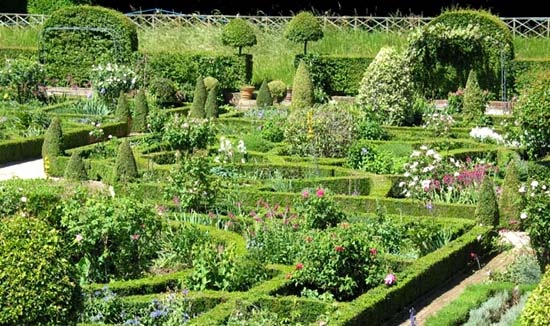
On November 17, 1558, Lady Elizabeth Tudor was sitting beneath an oak tree at her Hatfield estate -- either reading or eating an apple -- when she received the news that she was Queen of England. We're told that as the courtiers who came bearing the news bowed before their new queen, Elizabeth got on her knees and said in Latin, "This is the Lord's doing, and it is marvelous in our eyes." Within hours, Queen Elizabeth I's councilors had gathered around her for her first Council of State, held in the Great Hall of The Royal Palace of Hatfield. One of those councilors was William Cecil, Elizabeth's trusted friend and chief advisor whose family name would eventually become closely tied to Hatfield. For several days, Hatfield played host to the influx of courtiers and the Great Hall was the forum for the many meetings, appointments and confirmations vital to a new reign. Elizabeth officially addressed her councilors and courtiers for the first time as Queen in the Great Hall, seated on her throne under the canopy of estate. On November 23, barely a week after she sat unknowing under that tree, Elizabeth left Hatfield, accompanied by her entourage of more than 1000, for London, returning to her childhood home only rarely. (Read more.)Share

ShareSo it is of particular irony to admit that Jefferson was as remarkable a man as America has produced. "Spent the evening with Mr. Jefferson," John Quincy Adams wrote in his diary in 1785, "whom I love to be with....You can never be an hour in the man’s company without something of the marvelous." And even Abigail Adams wrote of him, "He is one of the choice ones of the earth."
Jefferson was born rich and became well educated. He was a man of principle (except for slaves, Indians, and women). His civic duty was paramount to him. He read, deeply and widely, more than any other president of the United States except, possibly, Theodore Roosevelt. He wrote well and with more productivity and skill than any other president except, perhaps, Theodore Roosevelt. Wherever Jefferson sat was the head of the table. Those few who got to dine with him around a small table always recalled his charm, wit, insights, queries, explanations, gossip, curiosity, and above all else his laughter.
Jefferson’s range of knowledge was astonishing. Science in general. Flora and fauna specifically. Geography. Fossils. The classics and modern literature. Languages. Politicians of all types. Politics, state by state, county by county. International affairs. He was an intense partisan. He loved music and playing the violin. He wrote countless letters about his philosophy, observations of people and places. In his official correspondence, Jefferson maintained a level of eloquence not since equaled. I’ve spent much of my professional life studying presidents and generals, reading their letters, examining their orders to subordinates, making an attempt to judge them. None match Jefferson. (Read more.)