



Thomas Merton on Noise
1 day ago


His two legitimate sons, James Stewart and Robert Stewart, were born about a year apart and died about a month apart, just after Robert was born, about mid-year in 1541 and just about a year before King James himself died, leaving Mary Queen at the age of six days.Share
King James no doubt had never expected succession to come down to an infant girl, for although he had only three legitimate heirs, he fathered at least nine children out of wedlock, three of those before he was twenty. Seven of those children were sons.
It is these illegitimate children I write about today.
As with so many Scottish kings, James was crowned while still an infant, at the age of one, just after the death of his father, James IV, in 1513. The tale is told that young James V was encouraged in his debauchery by one of his regents, but to be fair, illegitimate children had long been a royal prerogative, in England and Scotland. Young James came by it honestly. His own father had seven children out of wedlock by four different mistresses.
But James, who became king in his own right at age 16, was able to best his father. And although the identities of some of the mothers of his children are lost to history, some of his mistresses were the daughters of Scottish nobles. Their children were treated accordingly. This meant that several of them played prominent roles in Scottish history and proved problematic to their half sister, Queen Mary.
Five of the illegitimate sons of King James V were named “Priors” as children. This meant they held the five richest livings in the Scottish Church—Holyrood, Kelso, Melrose, Coldingham, and St Andrews. (This did not happen, of course, without the approval of the Pope. James apparently wrote asking his permission for three of his illegitimate sons to receive ecclesiastical positions before 1532, when the boys were still babes.)
I’ve listed the children below. Don’t worry if you get confused. Three are named James, their father’s name; two are named Robert. (Read more.)
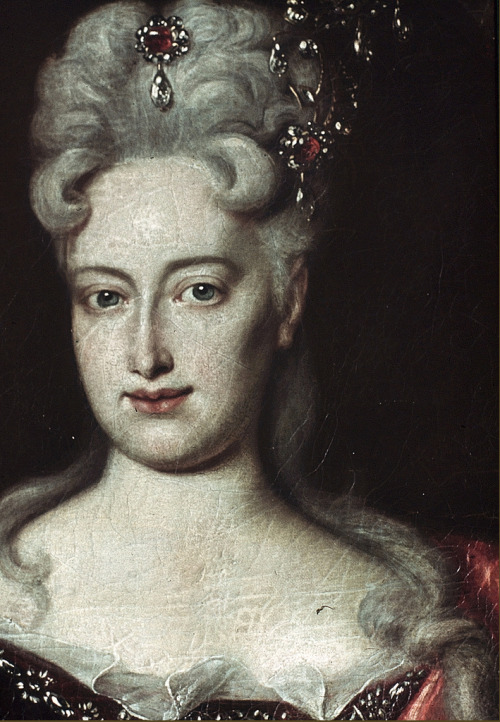
Francis II became King of France in 1559, when he was just 15 years old. Trying to take advantage of his weak position, the Guises and two other families battled to control the throne, and the Guises won through - they were also fanatical Catholics.Share
When Francis II died just a year later, his even younger brother (Charles IX) took the throne, but because of his young age it was his mother, Catherine de Medici, who controlled the kingdom. Catherine de Medici, seeing the threat posed by the Guise family, gave support to the two other leading noble families, the Bourbons and the Montmorency-Chatillons. But supporting these two families meant she had to support the Huguenots, and in 1562 the right was granted to Huguenots to worship outside towns, and to hold church assemblies. But Catherine de Medici herself remained a Catholic.
In March 1562, all this religious freedom had become too much for the Guise family, and the Duke of Guise led an army against a protestant church in Champagne. The entire congregation, unarmed men, women and children were slaughtered (see picture: the Massacre of Wassy)
This was to be the start of almost 40 years of war. During the first three civil wars (1562–63, 1567–68, 1568–70) Catherine de Medici struggled to find a balance between the Catholic and Protestant sides, with some success, and a temporary peace was found in 1570.
But this was not too last. Catherine plotted with the Guise family to assassinate a member of the Montmorency-Chatillons family, but the plot failed and the truth of the attempt soon emerged. A Protestant uprising seemed likely, and to pre-empt this Catherine persuaded Charles IX to act first. The most infamous period of the wars was about to start. (Read more.)
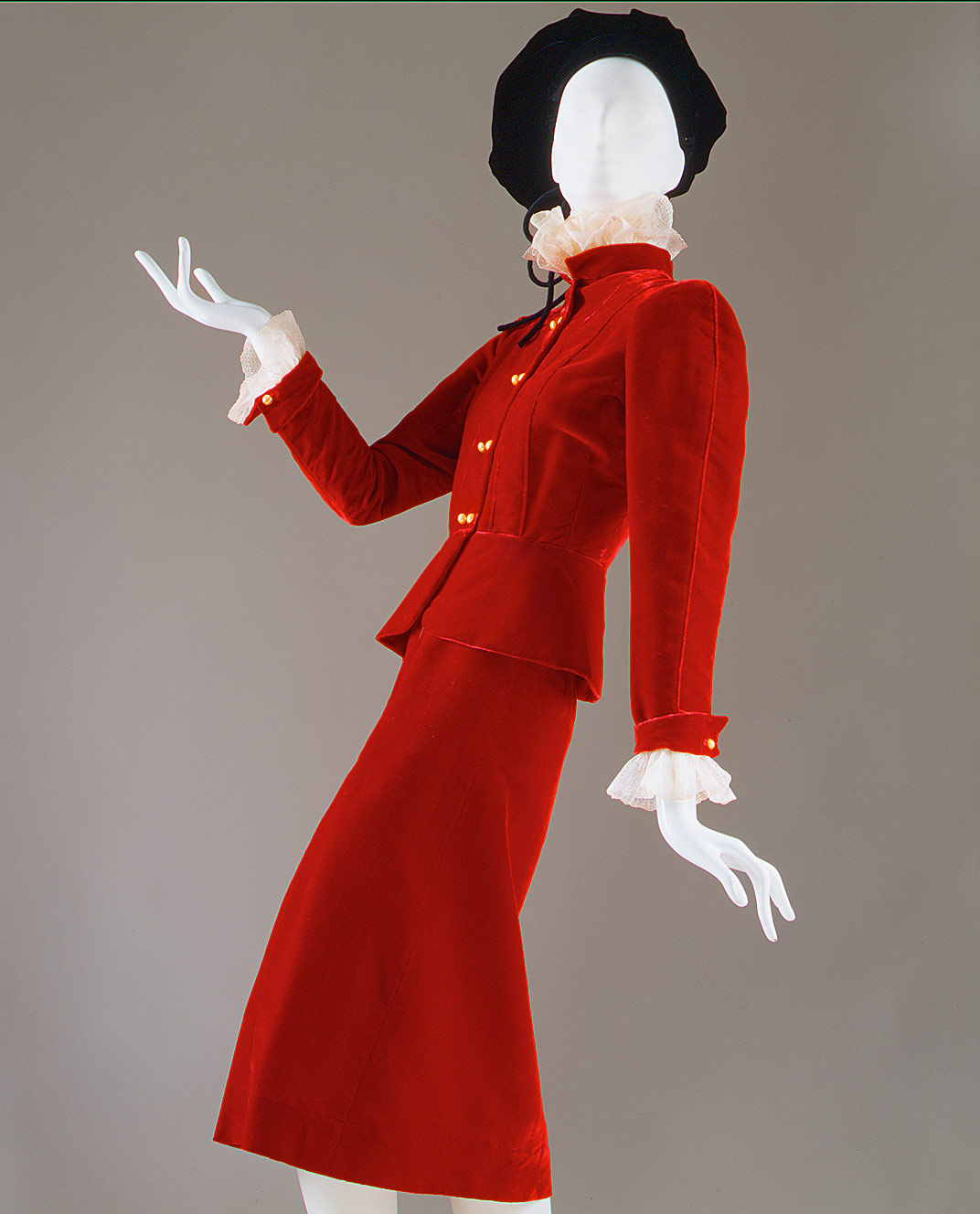
This suit made of ruby red silk velvet was inspired by a costume worn to a masquerade party in 1938. Called 'Watteau" and modeled after the dress of the male figure in a painting by Jean-Antoine Watteau (1684–1721), the suit represents a successful melding of contemporary and historical styles. The suit was intended to be worn with a flared floor-length skirt; the original owner, Diana Vreeland (1903–1989), shortened the skirt when the garment was in her personal wardrobe. Chanel herself wore a version of this suit executed in black velvet. (Read more.)Share
Upon returning to Scotland, James had no fewer than seventy of his subjects rounded up on suspicion of bewitching his fleet and that of his new wife. He personally superintended the interrogation of many of the suspects, including the ringleader – a 'wise woman' named Agnes Sampson. Taking 'great delight' in her torture, he was dismayed when she suddenly called a halt to the proceedings and beckoned the king to her. She then whispered something in his ear that made him go as white as a sheet. It transpired that she had repeated the very words that had passed between James and Anne on their wedding night – words that no other mortal soul could possibly have known. If James needed any further proof that witches existed, this was it. He sent Agnes straight to the flames. Thousands more of his subjects – both in Scotland and (after 1603) in England would perish for the same crime. (Read more.)Share
 |
| Lafayette in 1824 |
In 1797, the Directory instructed then General Napoleon Bonaparte to negotiate the release of the prisoners at Olmütz as part of the Treaty of Campo Formio. This Napoleon did, earning Lafayette’s gratitude. Lafayette’s view of Napoleon was not entirely rosy, however. In October 1799, not long before Napoleon’s coup d’état of 18 Brumaire, Lafayette wrote to a friend:Share
Bonaparte thinks only of his own ambition, and until now has not found glory in serving liberty…. He will risk no personal advantage for the sake of liberty; he has proved that his soul could quite happily watch and even cooperate in its violation. If, however, his fame and his ambition demand that he put himself forward in defence of the cause, he will do so. His wish must be to establish the Republic on a solid foundation of liberty and justice. (1)Lafayette and Napoleon met several times when Napoleon was First Consul. They had an extended conversation at Joseph Bonaparte’s estate on October 2, 1800, during a party to celebrate the signing of the Treaty of Mortefontaine between France and the United States. Part of the discussion reportedly went as follows:
Napoleon: ‘You must have found the French looking very coldly upon liberty.’By now you will have gathered that liberty was a bit of sticking point between Napoleon and Lafayette. Still, they remained on friendly terms. As Napoleon gradually began to admit exiles back into France, Lafayette asked for the names of his friends and relatives to be removed from the list of proscribed persons, a request that Napoleon granted. Napoleon also (through intermediaries) invited Lafayette to join the Senate and offered him the position of ambassador to the United States, but Lafayette refused. (Read more.)
Lafayette: ‘Yes, but they are in a condition to receive it.’
Napoleon: ‘They are much disgusted, the Parisians, for example. The shopkeepers want no more of it.’
Lafayette: ‘It’s not lightly, General, that I’ve used this expression. I do not ignore the effect of the crimes and follies which have profaned the name of liberty; but the French are, perhaps, more than ever in a state to receive it. It is for you to give it; it is from you that it is expected.’ (2)
Thomas Gallagher points out in Paddy’s Lament, that during the first winter of famine, 1846-47, as perhaps 400,000 Irish peasants starved, landlords exported 17 million pounds sterling worth of grain, cattle, pigs, flour, eggs, and poultry—food that could have prevented those deaths. Throughout the famine, as Gallagher notes, there was an abundance of food produced in Ireland, yet the landlords exported it to markets abroad.
The school curriculum could and should ask students to reflect on the contradiction of starvation amidst plenty, on the ethics of food exports amidst famine. And it should ask why these patterns persist into our own time.
More than a century and a half after the “Great Famine,” we live with similar, perhaps even more glaring contradictions. Raj Patel opens his book, Stuffed and Starved: Markets, Power and the Hidden Battle for the World’s Food System: “Today, when we produce more food than ever before, more than one in ten people on Earth are hungry. The hunger of 800 million happens at the same time as another historical first: that they are outnumbered by the one billion people on this planet who are overweight.”
Patel’s book sets out to account for “the rot at the core of the modern food system.” This is a curricular journey that our students should also be on — reflecting on patterns of poverty, power, and inequality that stretch from 19th century Ireland to 21st century Africa, India, Appalachia, and Oakland; that explore what happens when food and land are regarded purely as commodities in a global system of profit. (Read more.)











