


A Prayer for America on Election Day
1 week ago


Recent claims that the Catholic Church disregards women fail to acknowledge the Church’s critical work to support women and families around the world, say leaders in medicine, academia and global relief work.
Share
“Anyone who thinks that the Catholic Church doesn’t support women doesn’t know much about the Church, its mission and its presence around the world,” said Joan Rosenhauer, executive vice president of U.S. operations for Catholic Relief Services.
“Every day, the Catholic community supports women with opportunities to strengthen their families, become better educated and build their economic and food security. Our presence across the globe, including in some of the most remote places on earth, allows us to help many women the rest of the world has left behind,” she told CNA Aug. 27.
A recent “Poverty Matters” blog post in the British daily The Guardian criticized the Church as being anti-woman. Entitled “Pope Francis has done little to improve women’s lives,” the blog post argued particularly against the Church’s stance on human sexuality.
Rosenhauer pointed to several initiatives Catholic Relief Services has started to help alleviate poverty, particularly for women and their families.
For example, the Savings and Internal Lending Communities program has provided loans to more than 1 million people — more than 80% of them women — to help start small family businesses or help women to become financially independent. Additionally, Rosenhauer said, “Thousands of girls and women are being helped around the world every day through Church-run programs focusing on maternal and child nutrition, girls’ education and livelihoods for women, to name just a few.”
CRS runs programs that both distribute food in times of need and teach farming techniques that aid with food production and nutrition.
The Catholic Church, she continued, also provides programming, such as The Faithful House in sub-Saharan Africa, that helps strengthen families and relationships between spouses in order to help families find their basis in loving, respectful relationships.
Participants in the Faithful House, she said, “report decreased alcohol use, better management of household finances, improved budgeting and savings and the ability to pay for essential items such as school fees, household repairs and transportation.” One participant commented, “By the time our children have their own families, society will be better than it is now, because children learn from watching their parents in a loving and respectful relationship.”
The Church’s sexual teachings also help support women and families, Rosenhauer said. Catholic Relief Services’ work to teach natural family planning methods help “women adopt life-affirming ways to space births in order to reduce the risk of the mothers dying during labor and improve the chances that babies will be born healthy and thrive.”
Other organizations corroborate the Church’s emphasis on providing life-affirming development policies. In 2009, Dr. Donna Harrison, president of the American Association of Pro-Life Obstetricians and Gynecologists, briefed the U.N. commissioner on human rights on the risks of promoting abortion as part of attempts to aid international development or address maternal mortality.
The provision of abortion in developing countries, Harrison wrote, “increases, not decreases, maternal mortality and morbidity in resource poor nations,” increasing the “risk of hemorrhage, infection and incomplete abortion” in such areas.
The promotion of abortion as a development policy, she continued, also diverts funds and attention from interventions that have been proven to help reduce maternal mortality and increase overall health, such as “prenatal care, skilled birth attendants, antibiotics and oxytocics.” (Read more.)

With her royal pedigree and wealthy background Anne received an education befitting her status. Along with her brother Thomas and sister Elizabeth, Anne was educated at home in Guernsey by the controversial, uncompromising, Puritan preacher, William Bradshaw. The girls also received instruction in the skills required for running their own establishments.
The association between the Leighton and St. John families was a long standing one. The John St John and his siblings were orphaned in childhood. After their father’s death in 1594, their mother Lucy married her cousin Sir Anthony Hungerford of Black Bourton. Following her death in 1598 the heir to the St John estates was made a ward of the monarch.
Queen Elizabeth granted Sir Thomas Leighton the wardship of the young John St. John and the lease of his lands after an appeal from Lady Elizabeth Leighton who stated that she and her husband were ‘minded to match him to their daughter.’
Sadly, whilst on holiday with Sir Thomas in 1597 John’s elder brother Walter got into difficulties bathing off the Island of Herm with a group of fellow young guests. His tutor Isaac Daubney went to his aid, but both were drowned. John subsequently succeeded to the family estate, aged just 11 years old.
Anne duly married John at St. John’s Church, Hackney on July 9, 1604. Still a ward of court, John was 19 years old. With no legal age for marriage, Anne was just 13.
It is not known when the young couple first set up home together, although the daughter of Sir John’s sister Lucy St John suggests it was soon after their marriage.
“The rest of my aunts, my mother’s sisters, were dispersed to several places, when they grew up till my uncle, Sir John St. John, being married to the daughter of Sir Thomas Laten, they were all again brought home to their brother’s house,” Lucy Hutchinson writes in her Memoirs of Colonel Hutchinson.
Lucy also writes of the kindness shown by Anne to her mother, the youngest of six sisters among whom there was considerable rivalry in the matrimonial stakes – “my uncle’s wife, who had a mother’s kindnesse for her, persuaded her to remove herselfe from her sister’s envie, by going along with her to the Isle of Jernsey where her father was governor.”Share
The St. John family was the largest landowners in the 17th century parish of Lydiard Tregoze with the medieval deer park, numerous farms including Windmill Leaze and Wick, plus others at Shaw and parcels of land in the neighbouring parish of Lydiard Millicent.
In 1604 the medieval mansion house to which the newly married couple returned consisted of two wings linked by a central hall block. This was a period when a number of titled families were renovating their ancestral homes and in many instances it was the lady of the house who was in charge of building operations. Perhaps Anne was the driving force behind the modernisation of Lydiard House, dragging it out of the past and into the 17th century. The remodelled Palladian house as seen today was the work of her great grandson John, 2nd Viscount St. John. (Read more.)
Richard Topcliffe, that infamous hater of priests, that torturer of many historical figures known and lesser known such as Jesuit Robert Southwell, John Gerard and Henry Garnet, Swithun Wells, Edmund Gennings and Polydore Plasden. Richard Topcliffe features in many films about the lives of the English Martyrs especially 28 year old priest Plasden who was tortured and eventually hanged at the infamous triple Tyburn tree despite the attempted intervention of Sir Walter Raleigh. (Read more.)Share
 |
| The Erebus and the Terror |
 |
| Sir John Franklin |
For hundreds of years, the British Admiralty had been dispatching expeditions to search for a geographic chimera, the Northwest Passage linking Europe and the Pacific by a navigable route over the top of North America. Some voyages were more successful than others, but none was able to push through hundreds of square miles of pack ice from Baffin Bay to the Bering Strait. Despite having almost nothing to show for the expeditions except nautical charts revealing where the Northwest Passage was not, the Admiralty kept the dream alive. Claiming the Northwest Passage became a matter of national pride for Victorian England.
From The National Post:In 1845, the Admiralty outfitted its most sophisticated expedition to date. It chose naval officer Sir John Franklin to command the voyage, even though some criticized Franklin’s age (59) and physical fitness (lacking). The ships HMS Erebus and HMS Terror, freshly returned from a four-year mission to Antarctica, had proven their ice-worthiness. They were fitted with locomotive steam engines and screw propellers to breeze across open water. Every modern technology was provided for the expedition’s crew of 134: a library of at least 1,200 books, a daguerreotype camera, one mechanical hand-organ per ship, three years’ worth of canned food (a recent invention), steam-heating systems to keep both vessels toasty, and even a pet monkey.
Their mission: Chart the last unexplored area of the Canadian archipelago for a likely route to the Bering Strait. They were to voyage via Lancaster Sound and Barrow Strait, filling in the final blank space on the Arctic map. What could possibly go wrong?
After leaving London, Franklin’s party stopped at a Greenland whaling post to collect supplies and discharge five sick crew members before heading into Baffin Bay. Two passing whalers hailed them on July 26, 1845. Then the Erebus and Terror vanished.
It wasn’t uncommon for Arctic voyages to last two or three years without communication home, but by 1847, the Admiralty was getting worried. The government sent a series of search-and-rescue operations, but no trace of the Franklin expedition was found until 1854. That’s when the world learned the horrifying truth. (Read more.)
The two ships of the Franklin Expedition and their crews disappeared during an 1845 quest for the Northwest Passage.From The Guardian:
They were the subject of many searches throughout the 19th century, but the mystery of exactly what happened to Franklin and his men has never been solved.
The expedition has been the subject of songs, poems and novels ever since.
“We’ve got half the story here,” said John Geiger, president of the Royal Canadian Geographical Society.
“It’s very exciting. It’s a big break.”
Since 2008, Parks Canada has led six major searches for the lost Franklin ships. Four vessels — the Canadian Coast Guard ship Sir Wilfrid Laurier, the Royal Canadian Navy’s HMCS Kingston and vessels from the Arctic Research Foundation and the One Ocean Expedition — led the search this summer. (Read more.)
It remains one of the greatest mysteries of polar exploration. In 1845, a well-provisioned Royal Navy expedition commanded by Sir John Franklin embarked to find the North-West Passage between the North Atlantic and Pacific Oceans. A total of 129 officers and men set sail on Franklin's two ships, the Erebus and Terror. None returned.
The disaster was the greatest single loss of life inflicted upon any polar expedition. Only a few scattered remains – papers and bones – have since been found of Franklin's men on north Canada's frozen islands. These testify that at some point, some crewmen resorted to cannibalism in a bid to survive, a revelation that horrified Victorian Britain. As Andrew Lambert states in his biography, Franklin: Tragic Hero of Polar Navigation, the story is "a unique, unquiet compound of mystery, horror and magic".
In the intervening years, there have been many attempts to explain why Franklin's well-provisioned expedition failed, with one recent idea finding particular popularity. According to Owen Beattie and John Geiger, in their book Frozen in Time: The Fate of the Franklin Expedition, analyses of the skeletons of three Franklin crew members, whose graves were found on Beechey Island in northern Canada, showed they had suffered from severe lead poisoning that would have had "catastrophic" consequences for themselves and for their fellow crewmen.
Lead poisoning causes abdominal pain, confusion, headache, anaemia and, in severe cases, seizures, coma and death. And, according to Beattie and Geiger, it could be traced to their ships' canned food. (The expedition carried provisions for three years.) Poorly soldered, the authors argued, the tins' food contents would have been contaminated with lead and would have poisoned the crewmen, an idea that has since achieved widespread acceptance.
Not every scientist agrees, however, and several studies have since argued that the support for the idea is poor, culminating in a paper, written by Keith Millar, Adrian Bowman and William Battersby, that is published in the current issue of the journal Polar Record. It argues that the evidence for widespread lead poisoning in the crew is questionable. "We looked at two key pieces of evidence," says Millar, of the Institute of Health and Wellbeing at Glasgow University. "The analyses of the bones of the three crew men – John Torrington, John Hartnell and William Braine – who died in 1846 and who were buried on Beechey Island and a statistical study of how lead might have affected the entire crew." Beattie and Geiger found very high levels of lead in the body of Torrington, a stoker on the expedition: 226 parts per million (ppm), which was 10 times higher than samples taken from Inuit skeletons found in the area. The discovery formed a key part of Beattie and Geiger's theory.
But as Millar points out, high levels of lead were common in men and women in Victorian times. "Drinking water and food were often contaminated and some medicines also contained lead. The lead found in the men's bones could easily have been acquired at home. More to the point, there was wide variation in lead levels between the three men. It is not at all clear that it killed them, certainly not all of them"
A similar analysis of seven other skeletons of men from the Franklin expedition who died a couple of years later also found wide variations in lead in their bones. In some cases, these were well above standards that are now considered safe. Others were not, however. "There is not enough evidence to support the idea the Franklin expedition was solely wiped out by lead-contaminated food," adds Millar.
As to the real cause of the loss of the expedition, that remains open to speculation. "However, it was probably ice, not lead, that killed them," he argues. Extreme cold trapped the expedition for two winters near King William Island in northern Canada. "By the following year, provisions would have been running short.
By then, Franklin and 23 others had died. We don't know why. The surviving men had no option but to desert the ships and trek south to the mainland. But they were ill-equipped, and probably in poor health, so escape was beyond them. Their plight was desperate and all died in the attempt." (Read more.)
 |
| Death of Sir John Franklin |
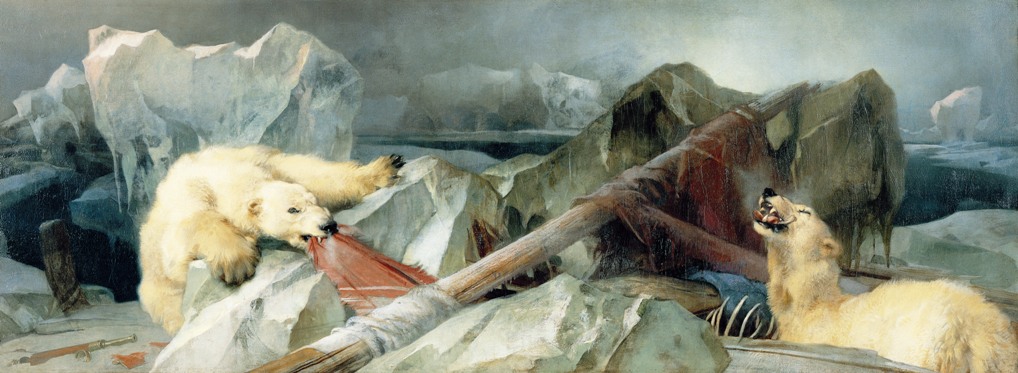 |
| "Man Proposes, God Disposes" by Edwin Henry Landseer |
ShareThe new store will be at 1133 Broadway—that's between 25th and 26th streets—on the ground floor of the St. James Building, an 1896 Beaux-Arts structure. Rizzoli executives looked at more than 150 locations, including Brooklyn, whittled the list down to six, and then to two before choosing the space in the Nomad neighborhood. They also used focus groups to identify the best location for a high-end destination bookstore in the city. Indeed, one executive—for some reason, apparently steeped in Italian corporate tradition, he declined to be quoted by name—went on for several minutes about the delights of the area. He provided a virtual walking tour to bolster the company's belief that this is a part of town as receptive to books as Fifth Avenue was when Angelo Rizzoli opened his original shop in 1964 at Fifth Avenue and 55th Street.
At that time, Rizzoli joined as many as a half-dozen other bookstores on the avenue. The shop moved to 57th Street in 1985. The executive mentioned the nearby Nomad and Ace boutique hotels, as well as Madison Square Park; and he seemed to attribute almost talismanic importance to the fact that Rizzoli will be only two blocks from an institution that has successfully managed to bottle the essence of Italy, or at least a supercharged, Americanized version of it—Eataly, the destination food store, espresso bar and multiple dining establishment. He also cited the trend of artists, galleries and bookstores moving into an area, making it desirable, boosting real-estate prices and eventually becoming victims of their own success. Apparently the hope is that Rizzoli will add a touch of class to this stretch of Broadway, which—despite its good bones—also has its share of tacky storefronts.Rizzoli's 57th Street store covered three slightly cramped floors. But that was part of its charm. It was as if you were entering Henry Higgins's private library. Simply by setting foot in the emporium you felt patted on the back for your erudition and good taste. The new store will be approximately the same size—5,000 square feet—but on a single level. (Read more.)

The image of Mary which comes down to us through the biased lens of Protestant history is a classic case of ‘blaming the victim.’ The Whig historians of the British Empire depicted her as weak-willed and excessively romantic – so hopeless, in fact, that she ‘deserved’ her fate.Share
The real Mary Stuart, however, appears to unbiased eyes as guileless and forthright, clearly possessed of intelligence and character sufficient to survive a life rife with calamity – and still to keep her wits and charm about her.
Daughter of King James V of Scotland and Mary of Guise of France, Mary Stuart became Queen of Scotland at her father’s death. She was six days old. What followed were certainly her happiest years – her youth spent in the French court, educated by devoted French religious.
She was then married to the sickly Francis, son of Henry II and Catherine de Medici, whom she treated with kindness. His death two years later followed that of her own mother; she was eighteen years old.
Grieving her losses, Mary nevertheless stalwartly acknowledged her royal obligations, and left her merry France for dismal Scotland. It was a country engulfed in religious turmoil, with significant political opposition entrenched against her. The stern Puritans who followed John Knox made much of her elegant French wardrobe; she was said to have arrived with more than 20 lavish black gowns, the height of French fashion.
Regardless of their politics, however, the Scots were inevitably struck by Mary’s beauty, charm, sweetness of character and gentleness of spirit. An eyewitness relates that “In one of the … processions Mary was moving along with the rest, through a crowd of spectators, and the light from her torch fell upon her features and upon her hair in such a manner as to make her appear more beautiful than usual. A woman, standing there, pressed up nearer to her to view her more closely, and, seeing how beautiful she was, asked her if she was not an ‘angel’.”
Wishing to avoid further discord and bloodshed, Mary allowed the Scots their religious freedom. (Read more.)
In the legends of Robin Hood, Richard is a benevolent ruler, who after being freed forgives his brother John and returns to the task of governing England. But Richard had little interest in England his whole life–he is rumored to have said, “If I could have found a buyer, I would have sold London itself”–and was passionate about going on Crusades or fighting for more French territory than he already possessed as the ruler of the Aquitaine.Share
Richard decided what he needed was an impregnable castle from which to defend Normandy and then retake critical French land. The vast one that he built required two years of punishing around-the-clock labor and cost an estimated £20,000, more than had been spent on any English castle in the last decade. Legend has it that while building the Chateau-Gaillard, Richard and his men were drenched with “rain of blood,” but he refused to take it as an evil omen. (Read more.)











