Wednesday, April 16, 2014

A Hermit in the Garden

In eighteenth century Europe it became a popular romantic sentiment to have an ornamental hermit living in  one's garden. Some were genuine hermits. To quote from Atlas Obscura:
While some gardeners might now throw in a gnome statue among their flowers and shrubberies, back in the 18th century wealthy estate owners were hiring real people to dress as druids, grow their hair long, and not wash for years. These hired hermits would lodge in shacks, caves, and other hermitages constructed in a rustic manner in rambling gardens. It was a practice mostly found in England, although it made it up to Scotland and over to Ireland as well.

Gordon Campbell, a Professor of Renaissance Studies at the University of Leicester, recently published The Hermit in the Garden: From Imperial Rome to Ornamental Gnome with Oxford University Press. It's the first book to delve into the history of the ornamental hermit in Georgian England. As Campbell explains in this video for the book:

"Recruiting a hermit wasn't always easy. Sometimes they were agricultural workers, and they were dressed in a costume, often in a druid's costume. There was no agreement on how druids dressed, but in some cases they wore what we would call a dunce's cap. It's a most peculiar phenomenon, and understanding it is one of the reasons why I have written this book."

How the live-in hermit came to be a fashionable touch to a splendid garden goes back to the Roman emperor Hadrian with his villa at Tivoli, which included a small lake with a structure in it built for one person to retreat. When the ruins of this early hermitage were unearthed in the 16th century, it was suggested that Pope Pius IV build one for himself, which he did at the Casina Pio IV. Yet from here it gradually verged away from religious devotees isolating themselves for spiritual reflection to hermitting being an 18th century profession for those willing to put up with the stipulations.

As Campbell cites from an advertisement referenced in Sir William Gell's A Tour in the Lakes Made in 1797, "the hermit is never to leave the place, or hold conversation with anyone for seven years during which he is neither to wash himself or cleanse himself in any way whatever, but is to let his hair and nails both on hands and feet, grow as long as nature will permit them." (Read more.)
 More on ornamental hermits, HERE. Share

Five Ways Women Cheapen Themselves

From James Sama:
They call themselves a “bad bitch.”
I can’t stand this term. I even hate writing it. Worse, I hate women referring to themselves in this way. Why does anyone actually want to be a bitch, let alone a “bad bitch?” If the girls of our generation think that this makes them sound more authoritative and respectable, well, it doesn’t.
A true gentleman will choose a good woman over a bad bitch, any day.

They have truck driver mouth.
Sure, when you’re in the comfort of your own home or around friends, the gloves come off in terms of language (though there are still some words I’d never say), but when typing tweets or status updates, even I get taken aback by some of the words that girls use these days.

The irony of it is that I was raised to do my best not to swear around women, and now they do it more than I do.

They talk about fighting other girls (and do it).
What? When did women become the new high school boys? With so much talk about drama and fights at clubs all over Facebook, if I blocked out the person’s name I probably couldn’t tell if the post was coming from a guy or a girl.

Keep it classy, ladies – no need to fight. (Read more.)
Share

Tuesday, April 15, 2014

Charles X: the Man, the King, and the Reactionary

From author Shannon Selin:
Artois was said to be handsome, charming, generous and impulsive. He was a horseman, a gambler and a playboy – the “Don Juan” of Versailles. (1) Artois was a close friend of Louis XVI’s wife, Marie Antoinette. The two of them indulged in expensive frivolities, like the construction of the Château de Bagatelle. Their activities highlighted the gulf between the royal family and ordinary French people, and added to the unrest that sparked the French Revolution.

In November 1773 Artois married Marie Thérèse of Savoy (the sister of Louis XVIII’s wife), with whom he had two sons: Louis Antoine, the Duke of Angoulême and Charles Ferdinand, the Duke of Berry. The marriage was a dynastic alliance rather than a love match. You can read about Artois’s true love for the married Louise de Polastron on Elena Maria Vidal’s Tea at Trianon blog.

After the storming of the Bastille in July 1789, Artois and his family left France. He lived briefly in Italy and in Germany before settling in England in 1792. The Prince Regent (later George IV) gave him a generous allowance. Artois lived in London and Edinburgh with Louise, while his wife remained on the continent (she died in Austria in 1805). When Louise died of tuberculosis in 1804, Artois reportedly swore a vow of perpetual chastity and became devoted to religion. He must have retained some of his earlier spirit, though; in October 1811 Countess Harriet (Harryo) Granville wrote from her estate of Trentham in Staffordshire:
Monsieur forgets we are all beyond our teens and plays at bo-peep, etc. with Lady Stafford and me. (2)
(Read more.)

Share

The Art of Justice

From the Intercollegiate Review:
Justice understood as the virtue corresponding to Pieper’s robust “right” resists the modern leveling mindset. If rights are possessed and invoked by persons, and what is due to the rights-bearer is rendered by persons, and if, as Kirk points out, the traditional concept of justice provides for the variety of things a person may be due well beyond material return,[6] then the judgment that determines the proper recompense, given the diversity of the human person, is only possible at the personal level, face to face. Thus we need to keep in mind Pieper’s observation that “justice can be discussed meaningfully and fruitfully only if it is regarded in the context of a complete moral doctrine. It is one feature in the sevenfold image of man; the part becomes fully intelligible only within the whole” (italics original).[7] The liberal notion of justice tolerates no such constraints—and for that reason it is in theory meaningless, and in practice crushing. (Read more.)
Share

Monday, April 14, 2014

Description of Madame Elisabeth

From the Memoirs of Madame Vigée Lebrun (Via Tiny-Librarian): 
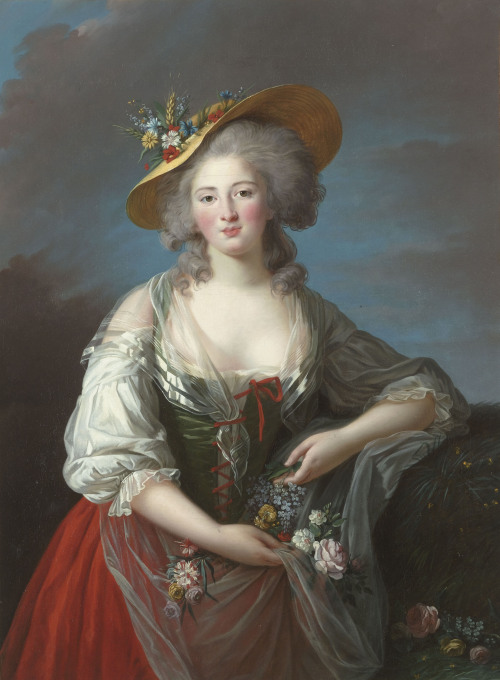
The features of this last named Princess were not regular, but her face expressed gentle affability, and the freshness of her complexion was remarkable; altogether, she had the charm of a pretty shepherdess. She was an angel of goodness. Many a time have I been a witness to her deeds of charity on behalf of the poor. All the virtues were in her heart: she was indulgent, modest, compassionate, devoted. In the Revolution she displayed heroic courage; she was seen going forward to meet the cannibals who had come to murder the Queen, saying, “They will mistake me for her!”
Share

What is Feminism?

From Kamilla Ludwig:
Feminism It seems there are as many definitions of feminism as there are feminists. However, foundational to all feminisms is a common anthropology clearly illustrated in the oft repeated mantra, “feminism is the radical notion that women are people”. This plays out to varying degrees in the belief that women should receive equal pay for equal work (a notion thoroughly misused in the main), that they should be allowed to compete on an equal basis for jobs and places in schools and sports teams. At the extremes, feminists view all sexual encounters between a man and a woman as rape and all apparent differences (other than crude biology) as the result of social conditioning.

In history, feminism has come in various waves – from the Suffragettes of the 19th and early 20th Centuries (although it is something of an historical anachronism to call them feminists, a contention I will expand upon in future) the so-called 2nd wave sparked by Betty Friedan’s “The Feminine Mystique” and on into 3rd and 4th wave feminisms. Then, too there are different schools of feminism – equity, gender, radical, etc. However different these feminisms all are, they have in common a view of the human person (anthropology) that departs from the historic or traditional one.

Religious Feminism is feminism carried into the religious sphere. Simple enough. In particular, the term will here refer to the importing of feminist principles into Christianity and the attempt to blend the two belief systems.

Egalitarian is the term preferred by religious feminists who say they are Evangelical Christians, also known as Evangelical Egalitarian. While this term is sometimes used as a courtesy here, the proper generic term, religious feminist, will be the normal use. Egalitarians generally hold that the priesthood of all believers is a controlling belief and often point to Galatians 3:28 as a key verse. They hold that there is no difference in ways authority are exercised in the home and the church and that church office is open to those who claim a gift and a calling, regardless of maleness or femaleness. In addition, Egalitarians hold that all patriarchy is abusive by definition.

Complementarian is the term preferred by neoTraditionalists to describe the form of soft patriarchy to which they hold. Rather than set down a clear definition and practice of authority, Complementarians coined their new term to avoid the negative connotations patriarchy has in the culture at large as well as its abuse. While the Complementarians came together to respond to feminism within Evangelicalism, they view “Egals” as colleagues with whom there are (generally) no first order theological differences. Complementarians believe the husband is the head of the wife means there is a differential in authority between husband and wife and that only men are eligible for the presiding office (pastor), although some Complementarians will hold that women may hold a sort of associate pastoral office as long as they are under the authority of a male senior pastor. Complementarians are deeply divided on the matter of authority in the culture and government, as the recent candidacy of Sarah Palin for VP illustrated. A primary weakness of Complementarianism has been their failure to articulate a theology of sex and authority that stems from creation but yet does not seem to apply in all of creation. (Read more.)


Share

Sunday, April 13, 2014

The Last Days of Jesus: His Life and Times

Let us go forth therefore to him without the camp, bearing his reproach. For we have not here a lasting city, but we seek one that is to come. ~Hebrews 13:13-14
 The Last Days of Jesus by Bill O'Reilly explores the historical background of the life of Jesus, building an authentic portrait of the world He lived in. With genuine respect for his subject, O'Reilly writes of the politics, culture, beliefs and balance of power among the different groups in first century Palestine as if he were reporting from the scene. Written in simple and direct language, the author clearly and succinctly depicts the year by year, day by day journey of Christ to His Cross on Calvary. While showing the forces which plotted His ruin, O'Reilly makes it clear that Jesus Christ was highly aware of what the end of His earthly life held for Him and yet He would not turn back.

The childhood of Jesus is described in light of Scripture, archaeology, and Jewish tradition. The problems faced by Mary and Joseph are brought to life in the context of their culture and the Law. Many Jewish customs and expressions are explained in a manner which can only deepen one's understanding of the Gospels. The book provides many illustrations and charts which enhance the verbal portrait of the most fascinating Man Who ever walked the earth. The author shows the gamut of emotions experienced by the Apostles, who believed in Jesus and yet were continually mystified by His words and  His actions. The Last Days of Jesus emphasizes how the ritual slaughter of the lambs in the Temple was going on while Jesus was dying on the Cross as the Lamb of God

The Last Days presents the economic realities of the Roman system of taxation: the taxes were high and many people were forced into destitution because of them. What is worse is that the Jewish leaders were richer than ever, having figured out how to work the Roman system, and thus they cheated their own people. The author points out what should be obvious: how the love of money was intrinsic in bringing about the death of Our Lord. Judas wanted money; Pilate and the chief priests did not want the flow of money interrupted by anyone, even if He was the Son of God. The priests, of course, saw Jesus as a threat to their power and were determined to get rid of Him. As the author emphasizes at the end, they had no way of knowing beforehand that the Jesus they tried to destroy would conquer in the end.

The Last Days of Jesus would be excellent for youth Bible study groups, and is helpful Lenten reading for adults as well.

(*NOTE: This book was sent to me by the author's representative in exchange for my honest opinion.) Share

The Queen's Toys

From The Guardian:
An exhibition brings together toys and belongings of royal children dating back more than 250 years, as well as previously unseen photographs and film footage. The show, called Royal Childhood, is part the summer opening of the state rooms at Buckingham Palace from 26 July to 28 September. (Read more.)
Share

What Will Happen?

Clyde Wilson on the American political scene. From Chronicles:
Nobody can predict the future, least of all a mere historian. There are often long-term changes under way that nobody notices until they suddenly emerge. And the course of our poor human race through time takes place in the mind of God, Who may disregard the plans and expectations of men. Allowing for such, we can make some projections based upon recent history. I will venture a few predictions. Anybody who likes can remember and call me to account at a later time.

The Democratic presidential nomination will be contested between the minorities, who want to maintain their prominence, and party regulars who want a practical chance to push their agenda, though of course the true nature of the struggle will not be admitted.    How this will turn out is unpredictable. The ideal candidate, who can hope to capture the Obama enthusiasm, will  be a minority woman with Establishment credentials.  Let’s keep in mind always that no matter who is the candidate, the leadership of both parties is owned body and soul by the financiers and the neo-conservatives.

The Republican nomination will be hotly contested because it will be expected that it is the GOP’s turn for the top spot, especially since the Obama bubble has burst for many people. The Republican money men and the professional politicians who serve them while serving themselves almost always pick the candidate. Whether you know it or not, that is exactly what we mean when we say “the party of Lincoln.” If a maverick somehow gets the nomination, he will either be torpedoed like Goldwater or co-opted like Reagan. So we can expect to see a field of Romney-like wannabes, the usual  photogenic and respectable Deep North corporate types, which could include a carpetbag governor of Florida. It will be mildly amusing.

It is true that there is considerable unrest, unfocused and futile, at the Republic grassroots, and that the old appeal of the lesser evil is getting somewhat threadbare.   But doubtless there are still plenty of Republicans out there who still have not figured out that by voting for the lesser evil they are accomplices in turning their country over to evil. And sometimes it is not even the lesser. And there are still the sad types who prattle about restoring a Constitution that ceased to exist long ago.

A maverick candidate, who is wise, brave, and  somehow able to communicate with the people over massive jamming by the  media, could perhaps get a message across about the real dangers to the commonwealth (debt, imperial over-extension, the ongoing  proletarianisation of the middle class, to mention just a few). We can be certain that the two parties will never touch a real issue, which might upset their cozy relations with each other and the media. For such an outsider to succeed would require extraordinary circumstances indeed. However, he might accomplish the wrecking of the Republican party, which would be a great service to the restoration of good government. (Read more.)
Share