Wednesday, March 5, 2014

Canadian Slaves

From The Montreal Gazette:
Slavery existed in the Great White North. Art historian Charmaine Nelson says it’s a part of history most Canadians would prefer to sweep under the carpet, and there are few public artifacts by which to remember it. But one work of a young woman posing with a plate of tropical fruit — bearing the innocuous title Portrait of a Haitian Woman — offers a glimpse into a forgotten era, said Nelson, who is one of the laureates for this year’s Black History Month events in Montreal.

“If Canadians know about slavery at all, we’re usually patting ourselves on the back and saying we were so much better than those nasty people in the tropical colonies,” said Nelson, an associate professor at McGill University and author of five books. In fact, slavery was a fact of life in Canada under the French and British regimes, Nelson said. New France, and later Quebec, had an estimated 4,000 slaves from 1628 to 1800. About two-thirds were First Nations captives while a third were blacks, mostly from southern slave colonies.

Slavery was less widespread in Canada than in the tropics because northern agriculture did not require vast numbers of manual labourers, unlike southern sugar or cotton plantations, Nelson said. “It’s not that we were more benevolent. We still believed that some people were inhuman and worthy of enslavement. So the difference was that the uses of a slave were not as abundant, so we had a smaller population (of slaves),” she said. Unlike the southern United States, where slave quarters and other artifacts recount the ugly history of slavery, Canada has few visual reminders of human bondage. (Read more.)
Share

Tuesday, March 4, 2014

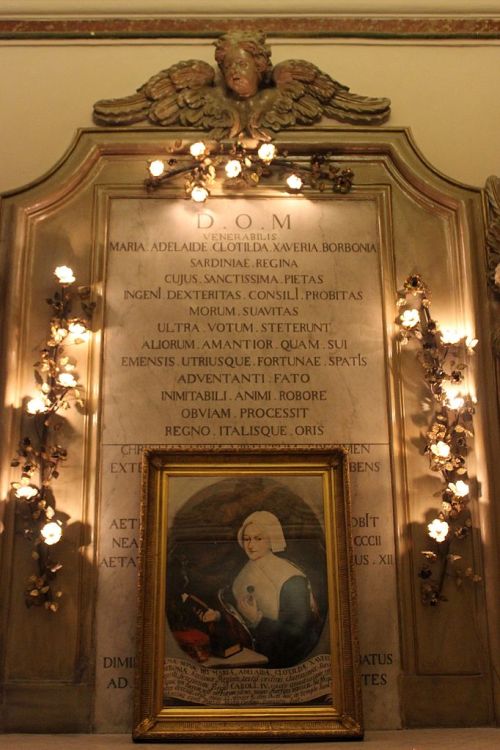
Tomb of Venerable Clotilde de France

From Tiny-Librarian:
The tomb of Marie Clotilde of France, Queen of Sardinia, inside the Church of Santa Caterina a Chiaia in Naples. She was declared venerable by Pope Pius VII after her death, which is two steps away from being declared a Saint in the Catholic Church.
Share

Darwin and Intelligent Design

From The Atlantic:
The ferocity of the debate makes it difficult to remember that, at one point not so long ago in geological time, religion and science weren't all that distinct. In the late 1600s and early 1700s, intelligent design — the belief that you could find God's hand by examining creation — was seen as a way to glorify both God and the ordered laws of physics revealed by Newton....

Intelligent design wasn't something invented after Darwin to oppose him; rather, it was the context for, and a building block of, his work. Intelligent design, then, is not some sort of anti-science, know-nothing idiocy. It's an important part of the history of science, and a necessary link in the development of Darwin's elegant theory of evolution. If birds are dinosaurs, Bill Nye is an intelligent design theologian. (Read more.)
Share

Monday, March 3, 2014

The Return of the Tiara

From Jewels du Jour:
Downton Abbey’s sumptuous Season 4 Finale was a dazzling display of the much-celebrated “London Season” of decades past. Centering on Rose’s debutante presentation to King George V, the Crawley’s find themselves in London at Grantham House with all the pomp and circumstance that go with the “social event of the season.”

Throughout the episode, I couldn’t help but notice the superfluous sparkle at each evening soirée. All of Britain’s 'fictional' landed gentry decided to display the vestiges of their wealth by wearing their finest diamond jewels throughout the final episode, most notably tiaras and head ornaments. No diamonds were spared during the lavish and visually opulent grand finale, which left me thinking about the dear old tiara. (Read more.)
Share

The Myth of Religious Violence

Setting the record straight. To quote:
First, as William Cavanaugh so powerfully argues in his Myth of Religious Violence, when we take a closer look at the 16th and 17th century wars of religion we find that differences between Catholics and Protestants, and Protestants and other Protestants, were secondary to the aims of the emerging nation-states and various political and dynastic intrigues. Simply put, the main cause of these wars was political, not religious.
How can that be?  If religious differences were the main cause of these bloody conflicts, Cavanaugh maintains, then we would expect to find that they were invariably fought along neat denominational lines.  What we actually find is Catholic emperors attacking popes, Catholic French kings attacking Catholic emperors, Protestant kings and princes siding with Catholic kings against other Protestants, Lutheran and Catholic kings uniting against Catholic emperors, Protestant Huguenot nobles and Catholic nobles in France uniting against both Catholic and Protestant Huguenot commoners who likewise united against the nobles, Protestant and Catholic nobles in France uniting against their Catholic king, Protestants rejecting the Protestant Union (the coalition of German Protestant states) even while some Catholics were siding with it, Lutheran princes adamantly supporting the rights of a Catholic emperor, Catholic France supporting Protestant princes in Germany, the Dutch Calvinists helping the Catholic king to repress uprisings of French Calvinists, a Lutheran leading the Catholic imperial army, and mercenaries of every religious stripe selling themselves to the highest Catholic or Protestant bidder.

And that is only a very quick overview of the examples provided, at great length, by Cavanaugh.  A careful, unbiased study of the so-called religious wars yields the rather surprising result that they were not religious wars.  They were political wars that both ignored religious differences when the more important political aims demanded either cooperation with religious opponents or antagonism to those sharing the same religious beliefs, and used religious differences when they would serve political purposes. (Read more.)
Share

Sunday, March 2, 2014

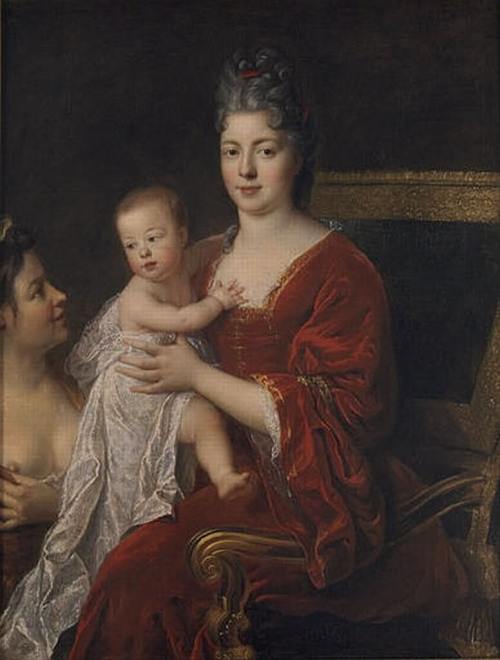
Madame de Ventadour and Her Charge

The Duc d'Anjou, later Louis XV, is shown in the arms of his governess, the Duchesse de Ventadour. At his left is the royal wet nurse. Madame de Ventadour saved the future king's life by locking him away from the doctors during a measles epidemic at Versailles. His older brother, the Duc de Bretagne, had died because the doctors bled him too much. (Via Tiny-Librarian.) Share

The Red Ensign

The old Canadian flag. Some prefer it to the maple leaf. To quote:
The adoption of the new flag was part of a larger project, undertaken by the Liberal Party, bureaucrats and public intellectuals, to remove historical symbols from public life and invent a new Canadian identity. There were various reasons why they did this. One was the rise of Quebec separatism.  

‘The British connection’ had always been central to English Canadian identity. The Loyalists and the Founding Fathers had rejected revolution in favour of British institutions. That was why we were a parliamentary democracy, why our history had been more orderly and why we were more moderate and polite—so we believed—than our neighbours to the south.

The Red Ensign, which bears the Union Jack in its corner and the shield from Canada’s coat of arms in the fly, reflected this identity. However, Liberals such as then-prime minister Lester Pearson believed that by discarding British symbols and creating a “distinctly Canadian” identity, they could appease the separatists. But here’s the problem: Canada’s history was bound up with the British Empire, so the new identity would have to bear no relation to the history of the country.

So what would fill in the void? Aha. Here we get to a second reason why the Liberals were vandalizing Canada's traditional culture: ideology. (Read more.)
Share

Saturday, March 1, 2014

Hercules: The President's Cook

The story of Hercules, our first president's cook. To quote:
General George Washington (1732-1799), first president of the new United States of America, was well aware of the importance of his cook. He brought his own cook from his home at Mt. Vernon to run the kitchen of the presidential residence in Philadelphia in 1790. Known by the single name of Hercules, he was reputed to be the very best cook in America, one who could not only produce the most elaborate dishes, but also insist on perfect order among his large staff and spotless cleanliness in his kitchen. Washington spoke proudly of the "labors of Hercules" when the first exquisite dishes were set on his table each night. Even on his days off, Hercules set himself apart, dressing with such impeccable style that he was recognized and saluted by name as he sauntered down the Philadelphia streets.

Only one thing set Hercules apart from his lofty counterparts in the great houses of Berkeley Square in London: Hercules was a slave, and President Washington owned him. (Read more.)
Share

The Ukrainian Revolution

Some thoughts from A Conservative Blog for Peace:
So a mob has overthrown the elected government in the Ukraine, a move at least passively supported by the U.S., whose media talking heads are cheering for the rebels. The U.S. wants to weaken Russia by taking the Ukraine away from it and putting it in the EU. As LRC's Michael Rozeff says, neither Russia nor the Ukraine are threats to America; they're not Communist anymore, remember? Anyway, as happens with American-driven coups, the results might not be what the U.S. government wants. Good. It seems these are anti-Soviet right-wing nationalists, culturally conservative Slavs like the Russians.

American opinion from those who care seems to be that liberals, neocons, and well-meaning conservative Catholics support the rebels, remembering the Cold War and the heroic Ukrainian Catholic Church surviving underground for 40 years. Real conservatives like Putin's Russia, non-Communist and anti-liberal. I like Russia too for those reasons, but really this calls for common sense. The eastern and southern Ukraine are historic parts of the Russian heartland; let them go back. I would have counted Kiev as Russian too but apparently they want independence. That's their business. I fear for the Ukrainian Catholic Church, whose home is the far west that Stalin stole during World War II, as they're outnumbered in a secular country with a big Orthodox minority; not sure if they'd fare best in one independent Ukraine or in their own country with Lvov as the capital. (Read more.)
 UPDATE: Putin declares war. To quote:
Why is Putin doing this? Because he can. That's it, that's all you need to know. The situation in Kiev—in which people representing one half of the country (the Ukrainian-speaking west) took power to some extent at the expense of the Russian-speaking east—created the perfect opportunity for Moscow to divide and conquer. As soon as the revolution in Kiev happened, there was an unhappy rumbling in the Crimea, which has a large Russian population and is home to the Russian Black Sea Fleet. It was a small rumbling, but just big enough for Russia to exploit. And when such an opportunity presents itself, one would be foolish not to take it, especially if one's name is Vladimir Putin.

We didn't think Putin would do this. Why, exactly? This has often puzzled me about Western analysis of Russia. It is often predicated on wholly Western logic: surely, Russia won't invade [Georgia, Ukraine, whoever's next] because war is costly and the Russian economy isn't doing well and surely Putin doesn't want another hit to an already weak ruble; because Russia doesn't need to conquer Crimea if Crimea is going to secede on its own; Russia will not want to risk the geopolitical isolation, and "what's really in it for Russia?"—stop. Russia, or, more accurately, Putin, sees the world according to his own logic, and the logic goes like this: it is better to be feared than loved, it is better to be overly strong than to risk appearing weak, and Russia was, is, and will be an empire with an eternal appetite for expansion. And it will gather whatever spurious reasons it needs to insulate itself territorially from what it still perceives to be a large and growing NATO threat. Trying to harness Russia with our own logic just makes us miss Putin's next steps. (Read more.)
Share