Wednesday, January 11, 2012

Writing History in a Digital Age

A history professor reflects:
From one point of view, the new digital libraries represent an immense democratization of knowledge, since any student in any high school or community college can now access as many books online as students and professors at the most elite institutions were once uniquely privileged to possess on their campuses. One can now search and read books online that even a decade ago weren’t nearly as accessible even at institutions lucky enough to own them—and no institution owned them all.
From another point of view, though, there is much to worry about in this picture. Longstanding legal and intellectual traditions of fair use and public domain access that have been absolutely essential to scholarship are being eroded in ways that few anticipated. Even the ability of historians to quote from primary documents is more at risk today than ever before, with the possibility that significant swathes of the historical record may essentially become privatized at the very moment when open access seemed about to triumph.
More worrisome still, the very act of reading is undergoing such subtle and sweeping changes that it’s hard to know what it will look like 10 or 20 years from now. Not only are readers gaining more and more of their “content” via screens rather than paper; they are doing so in ever smaller and more fragmented bites that undermine the richly contextualized interpretations and narratives of traditional history writing. When I reflect on how little time my students now spend reading books—indeed, how much less time I devote to such reading than when I was younger—I worry that the human ability to navigate book-length texts may be diminishing in ways that could have worrisome consequences for the long-form prose we historians cherish.
(Read entire post.) Share

Tuesday, January 10, 2012

The Expert Cook in Enlightenment France

A book review. To quote:
Cooks, as Takats explains, held a unique place in 18th century society. Both men and women worked as  cooks, and unlike other occupations which were primarily male or female, cooking was seen as neither masculine or feminine.  The occupation of a cook was not entirely domestic, like a house servant, or entirely professional, like an architect. This in-between occupation created a greater degree of autonomy and freedom for cooks when it came to looking for employment. They often bargained with employers for wages and other benefits, and had much more freedom when working in the home than a typical domestic house servant. Cooks also published cookbooks, recipes and other instruction manuals, which was not common outside of 'behavior' manuals written with domestic servants in mind.

However, their role in society was at times contradictory. Although employers gave cooks much freer 'reign' than a typical house servant, cooks were greatly mistrusted. Satirical prints and stories about dirty, evil, and sexually promiscuous cooks abounded in 18th century France. Cooks intended to improve their status by reforming methods of cooking, recipes, and the kitchen itself, however these reforms only inspired greater suspicion of cooks and cooking. When 'modern cuisine' was developed, it was intended to showcase the power that cooking and food could have on the body and establish cooking as a legitimate science. These attempts to establish the importance of cooking only caused greater problems - after all, reason followed that if food could be used to improve health, it could cause destruction and death as well. The poor reputation of cooks at the time only helped to strengthen the stereotype of the cook as a dangerous, secretive person. Unfortunately, efforts by cooks to improve their reputation in society generally fueled the suspicion and derision he general populace held for them. However, despite this setback, cooks played an important role with 18th century society and used the Enlightenment to help pave the way for French cooking as we know it today. (Read entire review.)
Share

An Era of Perpetual Revision

Some reflections from The Wall Street Journal. E-books are open to constant revision and updating.
An e-book, I realized, is far different from an old-fashioned printed one. The words in the latter stay put. In the former, the words can keep changing, at the whim of the author or anyone else with access to the source file. The endless malleability of digital writing promises to overturn a whole lot of our assumptions about publishing.

When Johannes Gutenberg invented movable type a half-millennium ago, he also gave us immovable text. Before Gutenberg, books were handwritten by scribes, and no two copies were exactly the same. Scribes weren't machines; they made mistakes. With the arrival of the letterpress, thousands of identical copies could enter the marketplace simultaneously. The publication of a book, once a nebulous process, became an event.

A new set of literary workers coalesced in publishing houses, collaborating with writers to perfect texts before they went on press. The verb "to finalize" became common in literary circles, expressing the permanence of printed words. Different editions still had textual variations, introduced either intentionally as revisions or inadvertently through sloppy editing or typesetting, but books still came to be viewed, by writer and reader alike, as immutable objects. They were written for posterity.

Beyond giving writers a spur to eloquence, what the historian Elizabeth Eisenstein calls "typographical fixity" served as a cultural preservative. It helped to protect original documents from corruption, providing a more solid foundation for the writing of history. It established a reliable record of knowledge, aiding the spread of science. It accelerated the standardization of everything from language to law. The preservative qualities of printed books, Ms. Eisenstein argues, may be the most important legacy of Gutenberg's invention.

Once digitized, a page of words loses its fixity. It can change every time it's refreshed on a screen. A book page turns into something like a Web page, able to be revised endlessly after its initial uploading. There's no technological constraint on perpetual editing, and the cost of altering digital text is basically zero. As electronic books push paper ones aside, movable type seems fated to be replaced by movable text. (Read entire article.)
Share

Monday, January 9, 2012

The Catholic Briefcase

It is an error, or rather a heresy, to try to banish the devout life from the regiment of soldiers, the shop of the mechanic, the court of princes, or the home of married folk. ~St. Francis de Sales, Introduction to the Devout Life 
But he that shall deny me before men, shall be denied before the angels of God. ~Luke 12:9

Holiness in the workplace is the theme of Randy Hain's new book The Catholic Briefcase: Tools for Integrating Faith and Work. A convert to Catholicism since 2005, Mr. Hain, co-founder of the site The Integrated Catholic Life, shares the methods which have helped him to combine faith and work in the business world. He demonstrates how our Christian beliefs must be just as alive at the office as they are at home or at church. We do not know when we may have been chosen to be the sole instrument of grace to persons in a certain venue, therefore with prudence and charity we must always be ready to speak of our love of Christ and His Church. As the author explains:
In the Pastoral Constitution on the Church in the Modern World (Gaudium et Spes), the Second Vatican Council weighed in on this particular struggle, saying that we have grown to become erroneous in our ways by creating this dichotomy between a so-called professed faith and the practice of daily life. One of the main points was to emphasize that a Christian who shirks his temporal duties does so to his neighbor, neglecting God and endangering his eternal salvation. (p.xviii)
The necessity of cultivating an integrated life rather than a compartmentalized life is illustrated throughout the book by means of the Mr. Hain's anecdotes as well by the personal testimonies of his friends. The importance of self-surrender to God is shown as being one of the initial steps in the journey. Establishing a daily routine which balances prayer with action is emphasized; it is vital for every soul to find a few minutes a day for solitary prayer. The author gives many practical tips on how to find quiet time in the midst of a busy schedule. Prayer is not something we can compromise without severe repercussions to our spiritual lives, for it puts the present in its proper perspective.

One sentence in the The Catholic Briefcase which I would like to reflect upon is this: "We must trust that in return for our trustful surrender, Jesus will provide us with the strength we need to be successful in business and life and overcome the obstacles of pride, fear and excuses." (p.16) In light of the bad economic times, which Mr. Hain mentions later in the book, it is important to acknowledge that our ideas of success, particularly of success in business, may or may not coincide with God's plans for us. In some cases a failure may be better for our souls. We have to trust that God knows what He is doing. As St. Teresa of Calcutta said: "We are not called to be successful, but faithful." Perseverance counts more than any material success.

An aspect of The Catholic Briefcase which is particularly timely is Mr. Hain's discussion of networking and social media. Catholics in the business world need to support each other more and networking on and off the internet is a way to reach out. To those who say they do not have enough time to network, the author responds: 
This is simply a scheduling and commitment issue. Most people I have met in my professional life think this way but later regret their lack of attention to networking....You will be more likely to 'have time' if you schedule it. Take a client out to lunch, invite coworkers out after work, or just send correspondence to somebody daily. (p.78)
The Catholic Briefcase is helpful on many levels. While intended for those who are commercially or professionally engaged, the advice on prayer offers guidance to anyone seeking to deepen their relationship with God, especially those new to Catholic spirituality. Written in a direct and simple style, Mr. Hain takes a topic which many find formidable and presents it with both clarity and warmth. Holiness is within the grasp of each of us; we need only to be open to grace.

(*NOTE: The Catholic Briefcase was sent to me by the publisher in exchange for my honest opinion.)

Share

Carmelite Monastery Assaulted

Pray for the nuns in the Congo. It sounds like a terrible time.
 A group of youths assaulted the Carmelite Monastery of Kananga on November 28th. Political elections were ongoing in the Democratic Republic of the Congo at the time.

Taking advantage of election day, the hoodlums decided to assault all the monasteries in the area. They first went to the community of sisters of the Immaculate Heart of Mary where they were stopped by police guarding the convent.

After that, they approached the Carmelite Monastery (Saint Enfant Jésus). Police stationed at the door called two other policemen that were guarding the Theological Seminary of Kananga, which is near the monastery, but despite the four-man guard, the police were not able to stop the bandits from entering the monastery. (Read entire post.)
Share

Franz Liszt, God and Civilization

A piece from The Brussels Journal.
Liszt lacked the propagandistic inclination of his son-in-law Wagner, so he wrote no grand theoretical statements explaining his music. Liszt’s inveterate reading and constant humble submission to tutors rendered him, however, a massively literate man whose philosophical identity defined itself as carefully and with as much conviction as Wagner’s. Liszt’s conviction differed from Wagner’s especially in their view of the Christian religion. (Read entire article.)
Share

Sunday, January 8, 2012

Happy Epiphany!

Here are some photos sent to me by my friends the Discalced Carmelite nuns in Rochester, NY.

High altar. Notice the choir grate over on the left.

High altar.

Choir altar and creche.

Choir creche

Creche inside the monastic quarters

Lovely Hummels, a gift to the monastery from a generous benefactor
Share

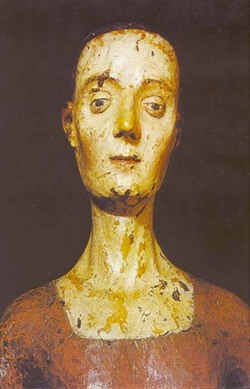
Catherine of Valois

Henry V's Queen.
She was Queen consort and then Queen mother or dowager in the lifetime of Bishop Richard Fleming, who attended her coronation at Westminster on February 23 1421, and who took part in King Henry V's funeral in the autumn of 1422. (Read entire post.)
Share

The Coming Year of Faith

Author Teresa Tomeo encourages us to prepare.
Pope Benedict XVI is giving us a great opportunity in this New Year to make a big difference.  In October he announced the “Year of Faith” which according to Vatican statements is designed to help Catholics around the world deepen their relationship with God, better appreciate the gift of our Catholic faith, and strengthen our commitment to sharing the Catholic faith with others.

The observance is set to begin October 11th, 2012 which also happens to be the 50th anniversary of the Second Vatican Council. The “Year of Faith” will then conclude on November 24th, 2013, the feast of Christ the King.

We have ten months to prepare for this important celebration but are we or will we be ready when October 11th rolls around? What can I do better or differently to enhance not only my own relationship with Jesus but to help spread the good news?  These are questions I’ve been asking myself since the announcement was made.  Actually these are questions I ask myself quite often. Because of my work in Catholic media, I am blessed to be surrounded by some pretty amazing evangelizers.  It seems like at least once or twice a week I say “I want to be more like him or her. Why can’t I be that strong of a public witness?” (Read entire article.)
Share