Friday, December 21, 2007

Learning to Love the French

Charles A. Coulombe has an engaging article about his French ancestry.
The France whose language and religion I hold died in stages between 1789 and 1905. Just as Quebec is no longer the land of the voyageurs and Frontenac, Montcalm and Mgr. Laval, so too with la belle France et douce. She is not today the nation founded by the crowning and baptism of Clovis, the realm of Saints and Kings, the land where Ss. Mary Magdalene, Martha, and Lazarus arrived by boat; where Charlemagne and St. Louis ruled, and St. Joan of Arc fought; where the Knights of the Table Round prowled Breton forests, and the country was consecrated to Our Lady of the Assumption and the Sacred Heart of Jesus. She is not even the land of the Sun King or the heroes of the Vendee.

Were one to be honest, even that France made some real howlers, from which we all suffer today (in my humble opinion, though most, perhaps all, will differ). Certainly, the siding of Francis I with the Turks and Louis XIII with the Protestants against the Habsburgs was a huge error. Not backing a Stuart restoration wholeheartedly led to future woes. Backing the American Revolutionaries was a huge blunder, both in the immediate and later (the bankruptcy that victory cost the Crown directly led to the guillotine). Napoleon III’s reluctance to recognize the Confederacy and break the blockade led directly to the failure of Maximilian’s Mexico. Even so, until the breaking of the Concordat, it was still possible to speak, at least in some sense, of the gesta Dei per Francorum. One cannot now.

Share

Madame Royale and the Substitution Theory

There is a new biography about Marie-Thérèse-Charlotte coming out in 2008. It is called Marie-Thérèse, Child of the Terror: The Fate of Marie-Antoinette's Daughter by Susan Nagel. According to Harper Collins:

Susan Nagel is the author of a critically acclaimed book on the novels of Jean Giraudoux. She has written for the stage, the screen, scholarly journals, the Gannett newspaper chain, and Town & Country. She is also the author of "Mistress of the Elgin Marbles", a biography of Mary Nisbet, Countess of Elgin. A professor in the humanities department of Marymount Manhattan College, she lives in New York City.
I have long been hoping for a new biography of Madame Royale, the Duchesse d' Angouleme, based on solid sch
olarship. I hope this will be the one. Dr. Nagel sounds like a reputable scholar.

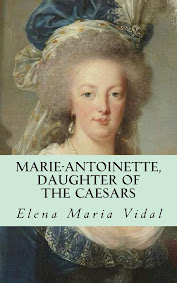
People always ask me why I chose to write novels instead of biographies, since to write a good historical novel demands about as much research as a biography. I chose to write novels about Marie-Antoinette and
Marie-Thérèse because I wanted to explore the deeper themes of suffering, martyrdom, perseverance, and the mystical role of women, which is easier to do in a novel. One can study the psychological complexities of the various characters and come to an understanding of their issues in art based on true historical events.

The historical novelist has a serious obligation to be faithful to the integrity of the characters and events. Some artistic license and creative interpretation may be necessary for the flow of the story. However, to make the personages do and say things that in reality they would never have done or said is to make an unjust and irresponsible portrayal. For instance, for Carrolly Erickson in her Hidden Diary of Marie Antoinette to show the queen having a long term liaison with Count Fersen contradicts what we know about her regular practice of her religion. As biographer Jean Chalon points out, if the queen had been having an affair with Fersen, a confessor would have made her send him away. As it was, he kept coming around and was a friend of her husband's as well. There was nothing to hide. (Erickson also has the queen traveling to Sweden with the count, which makes her novel one of fantasy rather than historical fiction.)

What I have less patience for than novels which take untoward liberties, are biographies which, while purporting to be based on facts and a careful sifting of research, reduce themselves to novelization by indulging in sheer romanticism. One such biography is the highly popular Marie-Antoinette: The Journey by Antonia Fraser, which I reviewed last spring. It is well-written and highly readable, like most of Lady Fraser's extensive body of work. Therefore, I was appalled to see Fraser make the claim that the queen and Fersen slept together because "the idea of a great pure love, which is never consummated...does not seem to fit the facts of human nature." (Fraser, The Journey, p.203) Oh, really? I read on the Lew Rockwell report about the love letters of Ernest Hemingway to Marlene Dietrich. Apparently, the two were in love with each other for many years but had a platonic relationship. So you see, dear Lady Antonia, such restraint is possible, even among the morally lax.

Anyway, I heard through the Marie-Antoinette grapevine that Susan Nagel's biography of Madame Royale includes an exploration of the old "substitution" theory. The substitution theory, which keeps flaring up like wild fire on internet discussion forums, claims that Louis XVI had an "operation" and was encouraged by his wicked brother Provence to test his prowess upon a serving maid. The maid, who was a married woman, gave birth to a daughter named Marie-Philippine Lambriquet
. Marie-Antoinette eventually adopted the girl and renamed her "Ernestine" after a character in one of her favorite novels. Ernestine and Madame Royale were educated together.

Later, the legend claims, while Madame Royale was in prison, she was raped and impregnated. She was sent off to Germany to a small town where she was made to wear a green veil and given the name of "Sophie Batta," also known as "The Dark Countess." Meanwhile, her wicked uncle Louis XVIII replaced her with her alleged "half-sister" Ernestine, who became the Duchesse d' Angouleme. The "Dark Countess" rumor was perpetuated by
Marie-Thérèse's moroseness and lack of beauty. How could she be the daughter of the beautiful lively Marie-Antoinette? So they assumed that she was someone else.

Here are some glaring points as to why this story is untenable:


1) Louis XVI had no illegitimate children. There is no proof that he had an operation. He was known for his devotion to his wife, fidelity to his marriage vows and his religious scrupulosity. He did not have an affair with a chambermaid and beget Ernestine. There was an Ernestine, a child of servants, whom Marie-Antoinette adopted. (She adopted two other children as well. The queen came from a large family and liked having lots of children around.) There is no evidence that Ernestine was the secret daughter of Louis XVI or of any of the other princes.

2) Louis XVIII would have had to pay off a huge amount of people to buy their silence, and he really did not have all that much money - not enough for that kind of blackmail. He had been an impoverished exile for over 20 years. When he did get hold of some cash, he immediately deposited it in an English bank. The Bourbon family lived on his savings the next time they were all exiled.

3)Louis XVIII may have been clever and devious enough to carry off that kind of a hoax, but the other members of the family were not. His brother Artois (Charles X) was notorious for his lack of discretion. His nephew the Duc d'Angouleme, Madame Royale's husband and cousin, was deeply pious and scrupulously honest, in spite of other innumerable short-comings. He would never have been able to live that kind of a lie - the lie he had to live, that of having a marriage in name only, was difficult enough. The other nephew, the Duc de Berry, was like his father Artois, completely unable to be devious, no matter how hard he tried.

4) Many faithful retainers and childhood friends of Madame Royale, such as Pauline de Bearn and her mother the royal governess Madame de Tourzel, were close to
Marie-Thérèse before and after the Revolution. Both mother and daughter were known as women of honor and to insinuate that they would participate in such a hoax is outrageous to say the least. There were many, many others, who had lost fortunes through being faithful to the royal family and were not the type to sacrifice their principles over such a charade that really served no purpose.

I do hope that the forthcoming biography does not subscribe to this wild theory, or it will cease to be non-fiction. It is a shame that so many people cannot accept the broken woman that Madame Royale became after all she endured, and instead have to pretend that she was an imposter.
Share

Thursday, December 20, 2007

O Clavis David

O Key of David and scepter of the House of Israel! who opens and no man shuts, who shuts and no man opens; come, lead the captive from prison, sitting in the darkness and the shadow of death. Share

The Sufferings of the Infant Jesus


Anyone who has ever visited our house knows that we have a special devotion to the Child Jesus. The Infant of Prague statue by the door is a dead give away, I guess. Once a business associate of my husband's was coming by and a friend suggested that we temporarily move the statue so as not to appear to be fanatics. My mother, however, said: "Never be ashamed of Jesus," and so the statue stayed. It turns out the associate was a gentleman of Italian descent and the Infant reminded him of his home and his beloved mama. "The more you honor Me, the more I will bless you," as Little Jesus told the Carmelite Father Cyril.

Saints and mystics who have pondered the Divine Infancy tell us that it was not all sweetness and light. From the first moment of His earthly existence, the Incarnate God began atoning for the sins of the world. The Child Jesus had to suffer from poverty, cold, and exile. According to the English Oratorian priest Father Frederick Faber in his book Bethlehem, Our Lord's awareness of the sins of the world caused Him a "spiritual agony," in addition to the foreknowledge of His coming Passion.
As He was the Lamb slain from the foundation of the world, so, in the eyes of the Father and in the terrible realities of His own heart, He was the Crucified Jesus even from the days of Bethlehem. His sufferings exceeded all martyrdoms, even in each single hour of His infant life. (Father Faber)
Share

Wrapping Gifts

For those who have not yet wrapped any presents, Martha Stuart has some great ideas. Share

Latin for Everybody

Far from being outdated, studying Latin is becoming popular. (Via LRC)
...Culture is never independent of language. If you want to understand ancient Greece and Rome in more depth than you can get from 300, you need, ideally, to learn Latin and Greek. Although these languages are hard to learn well, it's fairly easy to get a smattering of Latin, especially if you already know Spanish or Italian. And to know even a little bit of Latin helps you understand how European vernacular languages emerged from the language of the Romans—and hence, how the societies of modern Europe and America emerged from antiquity. Linguistics specialist Nicholas Ostler, author of Empires of the Word, provides an impressively detailed account of how Latin has dominated later cultures and languages. His book, called Ad Infinitum: A Biography of Latin, does not aim to teach Latin, as Mount's does, but instead traces the whole history of Latin from its origins down to the present day—imparting some vocabulary along the way.
Share

Wednesday, December 19, 2007

The Nutcracker


In the hundred years or so since its debut, Tchaikovsky's The Nutcracker has become a delightful aspect of modern Christmas celebrations. Composed during the "Silver Age" of Russian ballet, The Nutcracker is based upon a fairy tale by the German romantic writer E.T.A. Hoffman, whose stories also inspired Delibes' Coppelia and Offenbach's Tales of Hoffman. It is one of the few ballets that is not a love story, although later stagings have tried to make it into one.

The music, however, is powerful enough for any story of a great romance. In college, I helped my sister Andrea, who was still in high school, with a project; we were listening to the "Pas de Deux" of the Sugar Plum Fairy and her cavalier. Andrea said, "That must be from a really great love story."

"No, it's just from The Nutcracker," I replied.

It is a simple story, full of childhood's innocent, but very real, hopes and fears. To watch or listen to The Nutcracker is to enter into a dream, a dream which comes to life even after so many years, and all wars and revolutions which have tormented the world. Share

Food Bank Shortage

America's food bank supplies are dwindling. Not good. How easy it is for us, when caught up in so many other things, to forget the poor. Share

O Radix Jesse

O Root of Jesse, who stands as the ensign of the people; before whom kings shall fall silent; to whom the nations shall pray: come and deliver us, do not delay.

Here is a quote from the ancient Ambrosian liturgy:
Blessed is the womb of the Virgin Mary, which bore the invisible God.
There did he deign to dwell, whom seven thrones cannot hold
And she bore him as a light weight in her womb.

(from Dom Gueranger's The Liturgical Year, Vol I)
Yesterday was the feast of the Expectation of the Virgin. To quote from Vultus Christi:
Even in the minds of many of the faithful, enfeebled by a forty year dearth of popular orthodox catechesis, a tragic confusion holds sway concerning the privileges of the Blessed Virgin Mary and, in particular, her virginity before, during, and after childbirth. There are many, alas, who, affected by various mutations of creeping Nestorianism and Arianism, have no grasp of what it means to call the Blessed Virgin Mary, Mother of God. Those who do not confess the privileges of the Blessed Virgin Mary, honouring them and celebrating them, fall inevitably into one or another of the classic Christological heresies.
Share