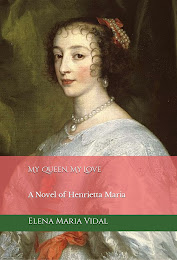
From
The Catholic Herald:
Throughout the 1630s, Queen Henrietta Maria’s mission to re-establish
the Catholic faith in England looked increasingly successful. The
decade saw numerous high-profile conversions, growing crowds around the
new centres of legal Catholic worship in London, and a relaxing of
penalties against Catholics.
But none of this activity went unnoticed by Puritan detractors. By
the end of the decade, parliamentarian unrest increasingly targeted the
queen’s influence on the king.
To help Charles I prepare for the possibility of war, Henrietta Maria
sailed to the Continent to raise funds and gather an army. Her letters
to Charles during this period confirm parliamentary suspicions: the
queen was her husband’s most hardline counsellor. She repeatedly urged
him to defend his Crown, his family and his people against the rebels,
threatening that if he did not take stronger action she would retreat to
a nunnery. Such strong terms were necessary. Charles’s military
decisions during the first years of the 1640s were halting and
uncertain, and he sometimes appeared ready to submit to his opponents’
demands.
In early 1643 Henrietta Maria returned to England, landing in the
small port of Bridlington, midway between the parliamentary strongholds
of Hull and Scarborough. She had with her an army of 1,000 men and 300
officers, 1,000 saddles, £80,000 in cash and suits of armour for 20,000
men. Royalist hopes surged with her arrival and a series of victories
against the rebels followed. The queen herself came under fire shortly
after her return. Waking in the night to the sound of shot circling the
house where she slept, she ran outside and hid in a ditch until morning.
While she was dodging cannonballs in the north, her houses in London
were being ransacked. One of the Capuchin friars attending Henrietta
Maria reported that John Clotworthy MP entered the chapel at Somerset
House, where he climbed on top of the altar table and looked at Rubens’s
The Crucifixion in its gilt frame. “Calling for a halberd, he struck
Christ’s face in contempt with such offensive words it would be shocking
to repeat them. His second blow was at the Virgin’s face, with more
hateful blasphemies, and then, thrusting the hook of his halbert under
the feet of the Crucified Christ, he ripped the painting to pieces.”
Clotworthy and his men then smashed sculptures of the Virgin and
Child, cut up the remaining paintings, set the books alight and took off
with the vestments. The Capuchins were arrested and deported. All this
was done because Parliament “was greatly incensed against [the queen] …
without [whose] encouragement and aid the king would never have put
himself in a position to resist”.
After a slow and perilous journey south to Oxford, the queen was
reunited with Charles in 1643 and was soon pregnant with their ninth and
final child. Shortly after the baby girl was born, the ailing and
disconsolate queen returned to France to gather more money and soldiers.
But by the middle of the decade, Cromwell’s New Model Army was
frustrating Cavalier military endeavours and the royalists suffered a
series of defeats.
When the king was finally captured his letters from the queen were
seized and published widely. Here, finally, the rebels could claim proof
of their suspicions that the queen had seduced the king “under the
royal curtains … to advance the plots of the Catholics”. Under her
influence, the king had begun to “pray unto the Lady Mary and be ruled
by his little Queen Mary”, who had convinced him that to do so was not
“idolatry, but the way to increase his Royal Off-spring”.
Too ill to return to England, Henrietta Maria instead worked for the
royalist cause from France; but in 1649 Charles was executed. The queen
never recovered from the loss. Aged 39, she retreated with her youngest
child to the Carmelite convent of her youth. A number of sources attest
that, were it not for her children, she would have remained in enclosed
prayer for the rest of her life. (Read more.)
From the great Leanda de Lisle at Historia:
Puritans came to see the deep love of the royal couple as a threat.
They disliked the ceremonial style of Protestantism that Charles
preferred over their stripped-down Calvinism, and they blamed the
influence of the Queen. Yet this was quite untrue; for Charles, the
Protestant Church of England was “the best in the world”.
When Charles’s religious reforms triggered rebellion in Presbyterian
Scotland, the Scots’ allies in England used Henrietta Maria’s Catholic
faith as a means of attacking the King. She was trolled from the pulpits
as a “Popish brat of France” and, as hatred against Catholics fanned to
new heights, so mobs were sent to attack her house.
The following October, a Catholic rebellion broke out in Ireland.
News of massacres of Protestant settlers were used by Charles’s enemies
to recruit to their cause, and the finger of blame was pointed at the
innocent Queen. In February 1642, on the eve of the English Civil War,
Henrietta Maria left for Holland. This was not to save her own skin,
however, but to act as Charles’s chief diplomat and party leader in
Europe, as well as his arms buyer.
She returned to England in February 1643 with men, money and arms.
After a dangerous landing in Yorkshire, she spent months raising
royalist morale in the north, eating in sight of the soldiers and
recruiting men.
The royalists had gained superiority in Yorkshire by late June, when
Charles called for her to join him in his wartime capital at Oxford.
Parliament sent cavalry to intercept the Queen and her men, but she
escaped again and, still en route to meet her husband, the
“generalissima” (as she called herself) captured Burton-on-Trent in a
“bloody” and “desperate” battle. (Read more.)
My novels about Queen Henrietta Maria available HERE and HERE.
Share