Saturday, July 7, 2012

Too Busy

Has "busy" become a four letter word?
It’s also true that saying “I’m crazy busy” in response to the typical “how’s it going?” question has become a major cliché. Let’s face it: Everyone is busy to some extent or another, particularly in a big city like New York. Talking about how busy you are is idle banter about one intimacy grade above talking about the weather, and probably less useful. But it’s also a convenient, non-personal topic that everyone can relate to, a sort of verbal tic that people can spew when they’re bored, tired, or not interested in telling the truth about how it is really going. Because, when it’s not going well, “busy” is beautifully unassailable. (Read entire article.)
Share

Friday, July 6, 2012

Berglar's More

Stephanie Mann reviews Peter Berglar's Thomas More: A Lonely Voice Against the Power of the State, saying:
This is an effective overview of More's life and works, with an interesting organizing pattern, and the reminder, especially highlighted in the epilogue, of the integrity of St. Thomas More's life. He thoroughly integrated his spiritual and professional life, his religious and personal life, so that there is no division or compartmentalization. Berglar notes when More may have failed in this effort (as when he followed Wolsey too closely) and does not ignore the difficulties and balance More had to work to achieve.

This book was translated from the German and the author notes in the epilogue the scarcity of German translations of More's works. Even though it is meant for a German audience, to bring St. Thomas More's example of responding to the crisis of the State attacking the Church, it's a good reminder for English and American audiences too, especially when discussing the distinctions between More and St. John Fisher:
The difference between them was the difference between layman and priest. Fisher was obliged to resist the regime's aberrations directly. In this sense, his position was easier than More's. Priests who come into conflict with the state and wish to remain faithful to the Church will invoke St. John Fisher as their patron; whereas perplexed Christians entangled in the complexities and intrigues of the social apparatus and in need of an example and intercessor, will turn to St. Thomas More. (Read entire post.)
Share

Farewell to Mayberry

From Tom Piatak:
Yesterday brought the news of Andy Griffith's death at 86. Unfortunately, the type of television exemplified by The Andy Griffith Show died long before its star did. Long gone are the days when the networks aired prime time series that parents could safely allow their children to watch, much less a prime time in which such shows actually dominated the competition. Indeed, it is hard to imagine a network even making a show like The Andy Griffith Show today. After all, The Andy Griffith Show was wholesome and innocent and completely devoid of vulgarity or sexual immorality or even any topical references to current events, much less propaganda for favored Hollywood causes. There hasn't been a show like that on prime time network television in many years. (Read entire post.)
Share

Thursday, July 5, 2012

The Divorce of Henry VIII: The Untold Story from Inside the Vatican

The Divorce of Henry VIII  (UK title: Our Man in Rome) by Professor Catherine Fletcher of Durham University is an indispensable addition to the library of any serious scholar of Tudor history. I say "serious" scholar because, while the book is not overlong, it is not light reading. It might be challenging for some to keep track of all the various players and intertwining events unless one is already deeply immersed in the politics of the King's Great Matter. However, after glancing at the author's extensive bibliography, I must commend her for being able to concentrate so much detailed research into one volume. It includes material rarely covered by other works about Henry VIII, shedding light on the fascinating world of sixteenth century ambassadors.

The narrative centers on the adventures of the Casali family of Rome whose sons made a living by working as diplomats for various princes, both local and foreign. The complicated inner workings of Renaissance Italian politics are beyond modern imagination; compared to those Renaissance rascals most Americans do not know the meaning of intrigue. Growing up in a diplomatic and political scenario was helpful for those who wished to have a career in statecraft; it all depended on whom you knew and how well. Gregorio Casali was employed by Henry VIII to represent his case before the Pope. Now getting in to see the Pope, even for the ambassador of a king, was not always an easy matter. Bribes were usually necessary and what made the difference between a good ambassador and a sloppy one was knowing whom to bribe.

Furthermore, it was necessary for an ambassador to be dressed in a manner worthy of the ruler he was representing. For an ambassador of Henry VIII, this meant having an extremely elaborate wardrobe. The duties  also involved having to travel long distances as quickly as possible, risking storms, natural disasters, wars, robbers, and enemy agents. An ambassador also had to be able to entertain in style and purchase the appropriate gifts to gain support for his master's cause. This all sounds extremely cynical but it is how business was transacted and deals were made. It makes the courageous stands of martyrs such as of Saints Thomas More and John Fisher, who could not be won over by any human persuasions, all the more admirable.

The stipend from one's patron was often not sufficient to cover all the expenses which being an ambassador entailed so diplomats such as Gregorio Casali had to make certain they had some kind of additional income. Signor Gregorio tries to make ends meet by marrying an heiress. Family connections, which were strengthened or weakened by making the right or wrong alliance, had everything to do with one's success in life. When a person rose or fell, their family went with them.

My copy of The Divorce is an uncorrected proof. There are a few errors I noticed which hopefully have been corrected in the final edition. For instance, Charles VIII of France was the cousin of Louis XII, not his brother. Also, Fra Filippo Lippi was a Carmelite, not a Dominican. As for the title, although the word "divorce" is used for the benefit of the general public, we must remember that Henry VIII did not believe in divorce. He was seeking from the Pope not a divorce as we understand it but a decree of nullity, meaning that he wanted to prove that he and Queen Katherine had never been truly married in the eyes of God. With all the bribes that passed from hand to hand, and with the help of such a character as Gregorio Casali, working his magic in the courts and universities of Europe, it was hoped to be an easy annulment. However, there were other factors, such as Queen Katherine's contestation of the King's claim, a contestation which she had every right to make, according to canon law. Then Henry VIII, in his impatience, saw fit to take matters into his own hands. Even the most clever diplomacy can fail in the face of human passions.

(*NOTE: This book was sent to me by the author's representative in exchange for my honest opinion.)

Share

Isabella of Castile: History and Character

 Two interviews with author C.W. Gortner.

From Reading the Past:
Isabella requested that this Council investigate corruption in the church, as it was deemed, as well as reports of non-conformity among conversos – Jews who’d converted to Christianity, most of them under duress during an intense period of persecution in the medieval era. She was troubled by ongoing rumors that many conversos were practicing Christianity at face-value or combining Judaism with Christian practices. Some, it was said, hadn’t really converted at all. To Isabella, this would have been gravely disturbing. The souls of her subjects, the very spiritual health of her kingdom, were at risk. Yet again, at first caution overrode even her piety. It took her almost four years to implement the papal bull that granted her permission to authorize the Inquisition’s revival. She instituted a program of spiritual education, dispatching trained priests to guide her subjects back to the ‘proper’ way of worship; it failed, but I did not make this up. If I hadn’t seen those reports in Spanish, I wouldn’t have understood the complexity of what she faced. I’m not condoning her role in the Inquisition, of course; I think she made a horrifying mistake that unleashed a monstrous wave of terror and suffering, but I do believe she agonized over her decision. I think she believed she had done everything she could to avoid persecution. (Read entire post.)
From A Bloody Good Read:
Some people apparently are determined to see her as this ruthless fanatic without redeeming qualities. I even got an e-mail recently from someone accusing me of glorifying a mass murderer. They blame her for things she had no control over, such as the rapine of the Americas. However, if you read her testament, you’ll see that she never wanted the New World destroyed as it was; that occurred under her grandson, Charles V, and his son, Philip II. She was human and extremely fallible; I do not seek to excuse her mistakes, which were grave and caused much suffering, but to assume she was a monster because of them is simply misguided. Her outer strength concealed inner conflict; anyone who researches her in depth will see that while she could be obdurate, she was not innately cruel. I think she hid her vulnerability because she was a woman, ruling a kingdom; and that she privately worried over some of her more controversial deeds. Her hesitation of years in authorizing the Inquisition indicates as much. But Isabella wasn’t prone to displays of emotion; she comes across, especially in her later years— the years we’re most familiar with—as remote, extremely pious, cold. She suffered the losses of her children, of her health, and the fear of her leaving her kingdom without a capable ruler with stoicism; you never hear her complain. This paints a picture of someone detached, when in fact she was deeply engaged. (Read entire post.)
Share

Wednesday, July 4, 2012

Thoughts on Independence Day

From Scott Richert:
On Independence Day, it is common to invoke God's blessing on our country, and rightly so. Sometimes, however, we might begin to regard the United States as uniquely blessed, in a way that other countries aren't. "God bless America" can become a command, and not a request. And if it does, then we lose sight of the reason why God blesses any nation: because of that nation's fidelity to Him.
John Carroll, archbishop of Baltimore and the first bishop appointed in the United States, truly understood that. In 1791, he wrote a Prayer for Government that puts the relationship between God, country, and the civic order in the proper perspective. The truth taught by the Church is the guarantee of political order, and so Archbishop Carroll begins by praying for Church, then for the guidance of the Holy Spirit for all the leaders of our country, at every level. He prays then for the living, that they may live lives worthy of eternal life, and finally for the dead, that they may have eternal rest. (Read entire post.)
Share

Moral Relativism

To quote Judie Brown of the American Life League:
Pope Benedict XVI has addressed the problematic nature of moral relativism (MoRe) on several occasions, including the effect that such thinking, which he calls a “dictatorship of relativism,” has had on young people across the world.

This argument is mirrored by a recent Knights of Columbus/Marist poll. Speaking of that survey while in Rome, Supreme Knight Carl Anderson said, “Catholic Millennials support Church teaching in a wide variety of areas, including contentious issues like abortion and euthanasia. In other areas, the cultural relativism that Pope Benedict XVI has spoken so much about is very evident, and it confirms the wisdom of his attention to this question as central to the New Evangelization.”

Such comments remind me of a Celebrate Life magazine article published in the year 2000 and written by then ALL executive director Andrew Daub. In his article, “No MoRe Lies,” Daub spelled it out very clearly when he said, “A better way to describe moral relativism is moral apathy—the absence of truth, interest, emotion, feeling or concern in regard to morals. It’s feeling blah about right or wrong—too lazy or uninterested to make a decision.” (Read entire post.)
Share

Tuesday, July 3, 2012

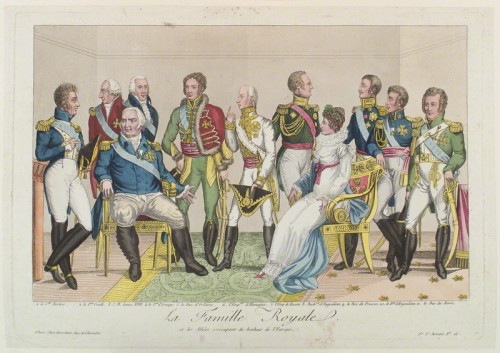
La Famille Royale

The principle survivors of the Bourbon clan, circa 1814. Louis XVIII and his niece  Marie-Thérèse-Charlotte de France are seated. To the left of Louis XVIII is Artois (Charles X). To the right of Marie-Therese are her husband Louis-Antoine, Duc d'Angoulême, and his brother Charles-Ferdinand, Duc de Berry. In the center are the various cousins, such as the Ducs d'Enghien and de Bourbon.

Share

Stonewall Jackson's Arm

A forgotten story from the War Between the States. (Via @BurtonReview.)
About an hour outside Washington, near Chancellorsville, Va., lies one of Gen. Thomas "Stonewall" Jackson's graves. A major Civil War battle was fought here in 1863. That's when Jackson was accidentally shot by his own Confederate troops. As Park Ranger Chuck Young tells a group of visitors, Jackson didn't die here — but his left arm was amputated. "Both of these doctors had performed that procedure literally hundreds, if not thousands of times by this point in the war," Young says. (Read entire article.)
Share