skip to main |
skip to sidebar
From
The Catholic Herald:
Congo’s bishops have said Catholics are facing a new wave of violence
following the collapse of a Church mediation plan, and in some places
Church leaders have fled to the forest. In late March, the bishops abandoned attempts to arrange a
government-opposition power-sharing settlement and, within days,
violence erupted in eastern Congo. “The militias are continuing their macabre operations – each passing
day sees new killings and burning of religious buildings,” said a
statement on the bishops’ conference website.
“The worst affected is the Diocese of Luebo, where the bishop’s
house, library, sisters’ convent and vehicles have been burned, and
priests and religious have fled to the forest with other inhabitants. The situation is harsh and unbearable.”
The statement followed attacks on church personnel and property in Congo’s Kasai and Kivu regions. Bishop Sebastien Muyengo Mulombe of Uvira said the situation in Kivu
had been exacerbated by the arrival of 15,000 refugees from neighbouring
Burundi, adding that he had been forced to suspend wages to teachers at
local church schools after a delivery driver was killed in a robbery. (Read more.)
Share
From
The Imaginative Conservative:
Rossini’s setting of the scene of the Stabat Mater—whose text
comes from a thrirteenth-century hymn possibly written by Pope Innocent
III—comes a century and a quarter after the realization by his
compatriot Vivaldi, and it is worlds apart in style as well as time.
Drawing on the tradition of bel canto (“beautiful singing”)
that he helped to make famous, Rossini’s effort is operatic in many
sections, never more so than in the second movement, “Cuius animam
gementem” (“Through her weeping soul”), in which the tenor sings, to a
breezy tune, words of the utmost pathos. (Read more.)
Share
From
Jane Friedman:
I often see manuscripts where the writer has invented a
detailed and dramatic back story for a character, but the main story
events lack impact and substance. There is no meat left for the book’s
real-time plot and so the novel seems empty and static. Of course, the
story may be precisely that; the character might be coming to terms with
past mistakes. The focus might be the finer detail of living with a
burden, or leaving behind a golden period that is gone forever. But just
as often, this approach is not deliberate and the writer is scrabbling
around, trying to find stuff for the characters to do. They don’t
realize they’ve already got fantastic ideas, but hidden them in the back
story. Could that back story be used as a fully
fleshed flashback so the reader could participate? Or, more radically,
could those same ideas be extracted from the past and reworked as a
forward-moving plot? Consider whether your back story ideas should be front story. (Read more.)
Share
From
Southern Lady:
Spring’s garden harvest shines in this tableau and its accompanying
menu, full of bright flavors that celebrate the season. Cap off the
feast with a glorious lemon cake topped by a cloud of limoncello-kissed frosting—a slice of sunshine on a plate.
Menu Selections
Honey Apricot Glazed Ham
Roasted Spring Vegetables
Arugula Potato Salad
Dilly Rolls
Dreamy Lemon Cake with Limoncello Frosting (Read more.)
Share
From
The Catholic Gentleman:
As the smoke cleared, the devastation became apparent. Blood and body
parts covered the floor, pews, and walls. Palm branches that were
moments ago held aloft in joyful celebration were now scattered on the
ground. Wails and cries erupted as survivors identified the dead as
their loved ones and friends. Passion week had truly begun for these
Egyptian Christians, entered into and sealed with sorrow.
I shed tears with a broken heart for these dear Christian brothers and
sisters in Egypt. They have suffered so much for being faithful to the
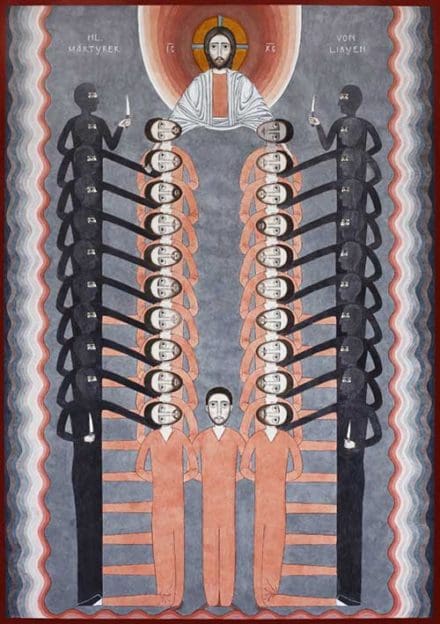
name of Jesus. In my home, I have a copy of the original icon created by
a Coptic Christian after 21 Copts were kidnapped and beheaded on a
beach in Libya. They died repeating the name of Jesus. “The people of
the Cross,” their killers called them with spite and hatred in their
voice. And so they were, though their killers knew not that it was the
sign of their triumph and not their defeat.
The word martyr comes from the Greek word meaning witness. In the early church, the martyrs were the most cherished treasures of the ekklesia.
Their mangled bodies were recovered from the places of their executions
and buried with great love and honor. Prayers were offered at their
graves and many of their names are still remembered and venerated today. (Read more.)
More
HERE.
Share
From
The Creative Penn:
As a reader or a movie goer, how frustrating is it when a character
doesn’t turn out to be more than they seem? It means the writer didn’t
have any insight into the inner life of this person or their world. When a character has depth, we want to spend time with them –
regardless of whether they’re good or evil, sympathetic or not – we’re
drawn to their story and compelled to find out more. One effective way to make sure your character is rich and multi-dimensional is to write their backstory. This backstory is written outside your novel, and it should tell the
character’s individual story—where they come from, what drives them and
why—along with details about their life. You can think of it as a mini history, and ask yourself what you
might write if you were doing it for a family member or friend. You
might include details about where they were born and who their relatives
are, along with defining moments in their life, and tidbits about what
they like or dislike. In other words, you would include the big things, along with quirks that make them unique. You might scratch your head and wonder why this is necessary. It’s not going to be in the book after all. Who cares about their backstory? (Read more.)
Share
From
Victoria:
As diminutive as they are exquisitely detailed, these shapely
collectibles garner appreciation that exceeds their dainty proportions.
Beyond cradling soft-cooked eggs served at brunch, they can be used in
myriad ways. Companies began offering eggcups in their most beloved china patterns
during Victorian times, but these charming serving dishes were first
noted among culinary traditions generations before. (Read more.)
Share
From
Live Action:
Society tells us that abortion empowers women. Media personalities,
Hollywood celebrities, and pro-choice activists call an act that
destroys a living human being a “woman’s right.” We’re told abortion is a
personal choice, a private matter, a decision which can bring the
promise of a better life. The language of abortion being ‘safe, legal
and rare’ has been replaced with the language of ‘abortion positivity’ and ‘reproductive justice.’ While some may assert that no one is ‘pro-abortion,’ abortion is labeled as a ‘social good,’ — and even the sale of various types of pro-abortion paraphernalia is becoming more common.
As a woman in America, I’m often told supporting women
includes accepting their right to legal abortion. In order to belong to
the ‘sisterhood,’ I should toe the line and support abortion on demand.
Women are fed the message that regardless of morality, the law permits
us to decide the fate of children growing inside of us. We either agree
with the “my body, my choice” rhetoric or face accusations of hating
those who share our gender. If we dare believe in women’s empowerment or
feminism without support of abortion, we’re mocked or pressured into silence. (Read more.)
Share
From
The Creative Penn:
What danger is to a cop, rejection is to a writer–always hanging in
the air dripping with possibility. And drip it does, onto the talented
and untalented in almost equal measure. Actually it doesn’t just drip; it pours. Rejection has a 360-degree aim — from literary agents who don’t want
you as a client, editors who don’t want your manuscript, publishers who
give you an insulting advance, bad reviews from literary critics, hate
speeches on Amazon, and of course the ultimate rejection—poor sales. Somebody, somewhere at just about every stage of your writing life gives you the finger, a hand and sometimes the whole arm. Success makes it worse because now you have more to lose. Who do you
think suffers more—the newbie who can’t get her first manuscript
accepted or the best seller who can’t get his last published because his
prior two books tanked? Success, as any best-selling author knows,
doesn’t protect you from rejection. (Read more.)
Share