


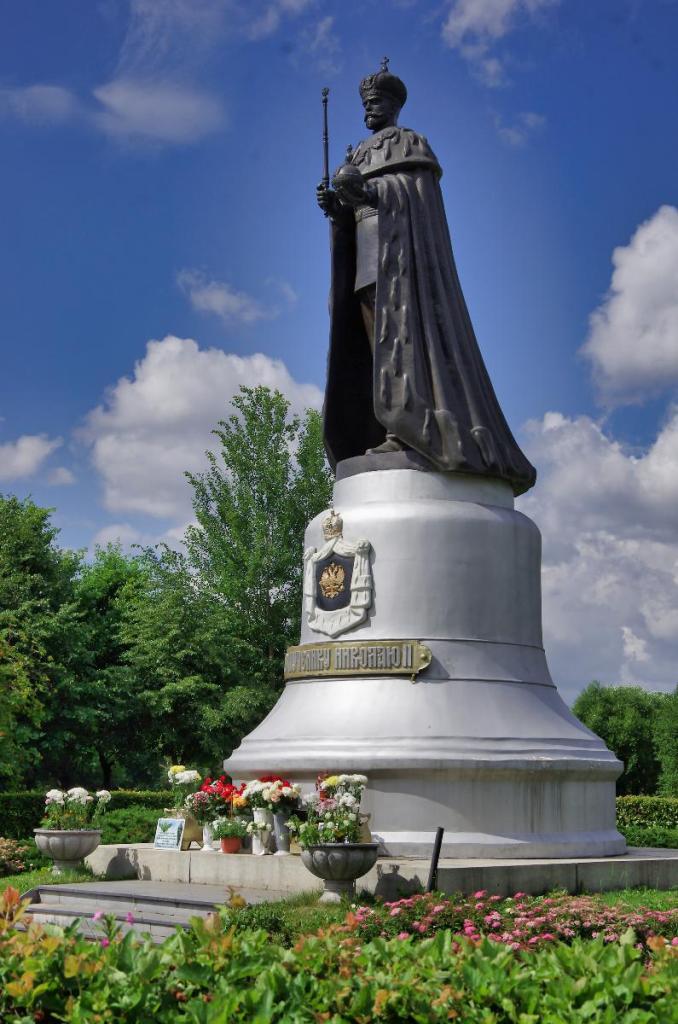
From Nicholas II:
The finest and most impressive full-scale monument to Nicholas II has to be the one erected in the former village of Taininskoye [the village was incorporated in the Mytishchi district of the Moscow region in 1961], situated 19 km northeast of Moscow. Like the fate of the Sovereign, the monument has a tragic history, having been the target of extremists in 1997. However, the monuments’ sculptor Vyacheslav Mikhailovich Klykov (1938-2006) replaced it in 2000.
According to the sculptor’s son Andrey Klykov, the monument was supposed to be erected on Borovitsky Hill in central Moscow. The project had the support of Yuri Luzhkov, who served as mayor at the time. Members of the city’s Communist party were outraged at the idea, so the project was pulled.
Klykov was offered another site in Mytishchi, near the site of a former royal traveling palace [built in 1749 for Empress Elizabeth Petrovna, it was destroyed by fire in 1823]. The site was situated near the 11th century Church of the Annunciation of the Holy Mother of God [built in 1675-1677]. As it turned out, due to the smaller number of approvals and red tape, the monument was easier to install on the church grounds, and had the support of the diocese. (Read more.)
From First Things:
Like many cultural trends, the fashion for spiritualism and esoteric practices came to Russia from the West. By the mid-nineteenth century, the Russian aristocracy was deeply westernized: Knowledge of French, German, and English was widespread, and travel abroad was popular. Science and philosophy deferred to Western authorities; the nobility and the urban elite readily adopted European trends in clothing and leisure. Trust in the official Church had weakened by the beginning of the twentieth century, fueling interest in new forms of spirituality.
The Decadent movement exerted a tremendous influence on the cultural life of fin de siècle Russia. Decadent literature, which began in France, emphasized the pursuit of sensual knowledge and spirituality over against positivism. For the intellectual elite, particularly artists, esotericism and mysticism were not merely a creative method but also a lifestyle.
At the same time, spiritism became popular in the United States and was quickly taken up in Europe. The first modern spiritist practices are associated with sisters Catherine and Margaretta Fox, who became famous in 1848 by claiming they made contact with the deceased previous owner of their New York house. The sisters took their spiritist talents on the road and toured the country performing lucrative séances. The Theosophical movement of Russian-born Helena Blavatsky drew tens of thousands of followers in the West who embraced Blavatsky’s ideas about the inseparability of spirit and matter, the secret knowledge of the ancients, and karma and reincarnation.
The works of French Decadents and symbolists inspired many poets and novelists—such as Valery Bryusov, Konstantin Balmont, and later Nikolai Gumilev, Boris Pasternak, and others—of the “Silver Age” of Russian literature. Charles Baudelaire and Arthur Rimbaud were especially popular, as were Arthur Schopenhauer and other German philosophers. Literary salons were major cultural hubs. One of the most famous was the St. Petersburg salon of the writer couple Dmitry Merezhkovsky and Zinaida Gippius, the latter also known as the Russian Decadent Madonna. The city’s elite gathered at their four-room apartment, located in the heart of Petersburg in a building of exquisite neo-Moorish style. Writer Andrei Bely, poet Alexander Blok, and many other leading figures in the arts were among the regular guests.
Groups with a more pronounced occult orientation spread across the Russian Empire. Theosophical societies sprang up in St. Petersburg, Kyiv, and Warsaw, some running extensive educational programs and participating in international Theosophical conferences. Beginning in the 1880s, St. Petersburg became home to the weekly journal Rebus, a voice for spiritism and mediumship. The journal offered instructions for conducting séances and translated articles on various esoteric practices from European periodicals. It also regularly reported on so-called “spontaneous phenomena” attributed to supernatural forces—doorbells that rang without human help and empty houses where moans of the long-dead could be heard. (Read more.)











No comments:
Post a Comment