Thursday, November 16, 2017

Give Communism a Chance

What? From The Washington Times:
The majority of millennials would prefer to live in a socialist, communist or fascist nation rather than a capitalistic one, according to a new poll. In the Victims of Communism Memorial Foundation’s “Annual Report on U.S. Attitudes Toward Socialism,” 58 percent of the up-and-coming generation opted for one of the three systems, compared to 42 percent who said they were in favor of capitalism.
The most popular socioeconomic order was socialism, with 44 percent support. Communism and fascism received 7 percent support each.

Marion Smith, executive director of the Victims of Communism Memorial Foundation, said the report shows millennials are “increasingly turning away from capitalism and toward socialism and even communism as a viable alternative.”

“This troubling turn highlights widespread historical illiteracy in American society regarding socialism and the systemic failure of our education system to teach students about the genocide, destruction, and misery caused by communism since the Bolshevik Revolution one hundred years ago,” Mr. Smith said in a statement. (Read more.)
Share

Wednesday, November 15, 2017

Olympe de Gouges: Feminist and Revolutionary

It is interesting how so many of the early feminists experienced abuse and hardship in their youth. From Haaretz:
From a young age, de Gouges believed she was destined to be a distinguished playwright. But fate cast her instead in the lead role in the widespread tragedy of the 18th century: life as a woman. She was born Marie Gouze in 1748, in the town of Montauban, southern France, and grew up in a bourgeois family that was not well-off. Officially, her father was a butcher, but very early on she learned that her real, biological father was actually her mother’s lover, Jean-Jacques Lefranc, the Marquis de Pompignan.

Lefranc, whom Marie got to know as a child, was an educated man and a successful playwright-poet. His occupations and social status left a deep impression on her, but their relationship did not last long: The marquis’ ties with Marie were abruptly severed when he married a rich Paris widow. Marie was 9 at the time, no longer had the right to be with him and, of course, had no legitimate claim to his fortune. Far from fading with the years, that early affront only intensified and became a major driving force in her later writing.

De Gouges’ education and place of birth were also not likely to land her in Parisian intellectual circles. The language spoken in southern France at the time was Occitan, not French; she did not learn the latter until she was older. Moreover, her education was quite basic. “Fate left me in total darkness, in the most enlightened century. I know few things, only a few ideas that have not become confused in my memory,” she wrote later, though she was intellectually superior to the girls around her, most of whom were illiterate. (Read more.)
Share

Statistics We Refuse to Collect

From Dr. Esolen at Crisis:
What is the median number of pornographic images that a boy will have seen before his fifteenth birthday? I specify “median” rather than “average,” because the median will give the more conservative number; an average would be much higher, as the minimum is bounded by zero, and there is no maximum. We can call this the Male Index of Moral and Intellectual Rot.

What is the percentage of people between 20 and 30 who have never fallen into regular fornication, but who are either married now, or who have been in a normal relationship of at least six months’ length, whether by dating or by courtship? That would have been almost everybody, in my parents’ time, and very few people now. We can call this the Index of Pre-Marital Health.

What is the percentage of people between 15 and 30 who have had sexual relations with someone who was a stranger—that is, someone whose name they did not know, or with whom they had not, before that day, exchanged more than fifteen minutes of conversation? We will call this the Index of Lonely Whoredom. (Read more.)
Share

Urban Southern

From Southern Lady:
While fashion trends come and go as fleetingly as winter in the South, there are some accessories that remain steadfast in every woman’s wardrobe: a strand of pearls, a flattering black dress, a crisp white blouse, and a leather handbag. Recognizing this abiding niche, Regina Bauman, owner and designer of Urban Southern, sought to make her mark with accessories that would showcase the timeless beauty and versatility of naturally tanned cowhide. With the encouragement and expertise of her husband, a third-generation leather craftsman, Regina’s vision not only for a collection of everyday style essentials, but also for a lifestyle brand with a unifying message, began to take shape.

As Urban Southern attracted growing support, Regina recruited her cousin and best friend, Meg Delagrange, to help her articulate the company’s mantra: “Urban Southern is for everyone.” Intrigued by the clean lines and elegant restraint of her designs, customers expressed their desire for a bag that would complement all facets of their day-today routine. It was this idea that inspired Regina and Meg to parlay their products into a sense of community for women from all walks of life. “To me, the everyday woman can really be anybody,” says Regina, “no matter what her everyday looks like: a career woman, a stay-at-home mom, a single woman, or an older woman with grown children.” (Read more.)
Share

Tuesday, November 14, 2017

"Slavery was Never Abolished"

Instead of obsessing about the slavery of a century and a half ago, people need to focus on abolishing the slavery which exists in the world now. From Crux:
“I’m the one. Put a face to it. I had a mother and father who loved me. Remember me when fighting human trafficking.” Those words belong to Rani Hong, who was born in India. She was stolen from her parents at the age of seven, and sold to a slave master, who kept her in a cage to be “seasoned into submission.” When she was eight, due to her physical condition and emotional state, she was near death.

According to United Nations statistics, 40 million people are trapped in slavery today. “They thought I would die, and that I had no value,” Hong said on Monday. “But they wanted one more [source of] profit from me, so my captor sold me into international adoption in Canada.”

Today, Hong is a leading voice in the fight against modern-day slavery. Together with her husband Trong, a Vietnamese refugee who fled his country at the age of nine to avoid being recruited as a child soldier, she runs the Tronie Foundation, a non-profit organization dedicated to providing freedom to those who are enslaved and to help eliminate the root causes of slavery. Rani Hong was at the Vatican this weekend, participating in a Nov. 4-6 workshop titled “Assisting Victims in Human Trafficking - Best Practice in Resettlement, Legal Aid and Compensation,” organized by the Vatican’s Pontifical Academy of Social Sciences (PASS). (Read more.)
Share

The Problems of “Privilege”

From Quillette:
The suggestion that French society should be transformed through the elimination of privilege might have remained only a daring idea aired in philosophical debates, had the debt-ridden French monarchy not stumbled into a desperate crisis in the late 1780s. Previous attempts by the monarchy to push through reforms of the French judicial and economic systems had been stymied by traditional institutions representing the interests of the nobility. Now, as reform seemed more urgent than ever, many were ready for radical solutions. In 1789, as crowds stormed the Bastille, and as non-noble elites proclaimed themselves to be a ‘national assembly,’ the previously obscure cleric Emmanuel-Joseph Sieyès placed himself in the center of French politics with an essay singling out privilege as the cause of France’s woes.

This essay, What is the Third Estate?, came to be seen by many revolutionary politicians as a justification and elucidation of their own inchoate demands. Sieyès himself became one of the most prominent figures of the revolutionary decade of the 1790s, and saw many of his ideas put into action. In What is the Third Estate?, Sieyès condemned France’s ‘Estates system,’ by which people were identified as clergy (First Estate), nobles (Second Estate), or the rest: the vast majority of the population (Third Estate). He called for a new kind of society in which elites would be chosen not on the basis of their bloodline, but on the basis of ability and merit. People like himself—smart, ambitious men from comfortable but non-aristocratic backgrounds—should make the decisions that mattered. (Read more.)
Share

Monday, November 13, 2017

The Most Beautiful Portrait

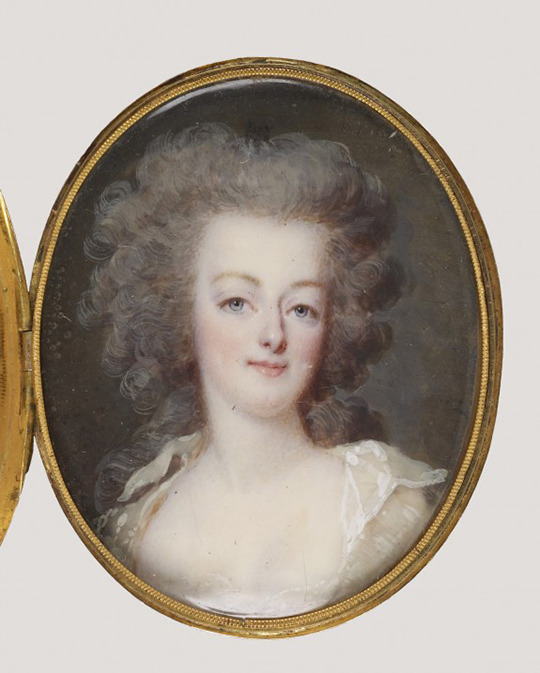
I think that this miniature at the Walters Museum in Baltimore, by an unknown artist, possibly Pierre Adolf Hall, is the most beautiful portrait of Marie-Antoinette. Just my opinion. Share

An Elite Form of Dumbing Down

From Reid's Reader:
Recently, I came across the following quotations from the philosopher and cultural critic Hannah Arendt. They appeared in her essay “The Crisis in Culture”,  first published in 1961 in her collection of essays Between Past and Future. At this point in her essay, Arendt was distinguishing between “culture” (basically great and challenging works which have come to us from the past) and “entertainment” (what is ephemeral, undemanding and basically intended to fill up our spare time).
She wrote: “those who produce for the mass media ransack the entire range of past and present culture in the hope of finding suitable material. This material, moreover, cannot be offered as it is; it must be altered in order to become entertaining; it must be prepared to be easily consumed.”
Of real works of art, she goes on to say: “their nature is affected when these objects themselves are changed – rewritten, condensed, reduced to kitsch in reproduction, or in preparation for the movies. This does not mean that culture is spread to the masses, but that culture is being destroyed in order to yield entertainment. The result of this is not disintegration but decay, and those who promote it are not the Tin Pan Alley composers but a special kind of intellectual, often well read and well informed, whose sole function is to organise, disseminate, and change cultural objects in order to persuade the masses that Hamlet can be as entertaining as My Fair Lady, and perhaps as educational as well. There are many great authors of the past who have survived centuries of oblivion and neglect, but it is still an open question whether they will survive an entertaining version of what they have to say.” [Underlinings added for emphasis.]
Of course, after most of 60 years, there are some things here that now sound a little dated. Perhaps we could substitute something like Mamma Mia! for My Fair Lady and we might say “the music industry” rather than “Tin Pan Alley”, a phrase which means little nowadays. We might remark that it would be television and the internet rather than “the movies” which now do most of this cultural simplification, although the movies are still part of the process. If we read only these quotations, we might also think that Arendt is attacking pop culture and the mass media per se, and in therefore (to use the easy insult word) an “elitist”. In fact she isn’t. The essay as a whole makes it clear that she understands the legitimate functions of the mass media and also the necessity for “entertainment”. Then we might consider how, over the past half century, television and film have been more readily recognised as media capable of rising to the status of real art. (Read more.)
Share

Growing Rice in the South

From Southern Lady:
Ninth-generation farmer Mike Wagner thought he knew all there was to know about growing rice. But when he noticed a change in his soil after ducks and geese had flocked to the area, a realization struck him: he might not need conventional fertilizers or chemicals to raise a healthy crop. “I started experimenting on my own,” he says. “I would cut the fertilizer every year, to no detriment. Now, we farm with nature’s rhythm, and we’ve been farming the land this way for 20 years.

With the help of a tenth generation of Wagner farmers, son Lawrence and daughter Abbey, Mike’s environmentally sustainable long-grain rice has become the basis for Two Brooks Farm, which offers a line of 14 products that include grits and flour as well as rice. Flavor profiles range from the buttery, sweet Delta Belle Long Grain White Rice to the fragrant, earthy Missimati Bayou Bouquet, a Basmati brown rice.

The grits from Two Brooks Farm are nearly as diverse in taste. One of Mike’s favorites is the Original Mississippi Midlands Brown Rice Grits. “They feel like little champagne bubbles in your mouth,” he says. Four rice flours were added to the line after a mechanic at the farm told Mike about his granddaughter’s gluten allergy. Mike dusted off a vintage grist stone and started grinding the byproducts of his rice. With the addition of the flour, Mike says, nothing goes to waste. “We’re trying to get everything out of the hog,” he says, “including the squeal.”

Mike is pleased that the changes he instilled decades ago allow him not only to produce rice rich in nutrients, but also to create positive change in the natural surroundings. He likens his Mississippi Delta farm to a nature reserve that has helped to rebuild the waterfowl habitat, increasing the variety and the population of migrating birds in the area. (Read more.)
Share