Tuesday, December 8, 2015

Statue of Virginia Dare

In the Elizabeth Gardens. To quote:
History remembers Virginia Dare as the first child born of English parents in the New World. In August, 1585, twenty-two years before Jamestown, 108 Englishmen under the far-reaching hand of Sir Walter Raleigh, managed to sail into what is now called Roanoke Sound and came ashore on an island called Roanoke in what is now Dare County, North Carolina. Having found a safe harbor between the mainland and the Outer Banks, they chose an area covered with live oaks on Roanoke Island overlooking the Roanoke Sound as the site for the first English colony in North America. Later this group returned to England.

Two years later, Raleigh sent a second ship of colonists, this time including women and families. Several weeks after their arrival in July of 1587, Eleanor Dare gave birth August 18, 1587, to a baby girl who was named Virginia after Elizabeth I, England’s Virgin Queen. It was also a name befitting the first English child born in the wilderness of the New World.

Ten days after the birth of his grandchild Virginia Dare, John White, governor of the colony, returned with the ship to England to secure additional supplies. The colonists were left to fend for themselves without the unifying strength of their governor, without the additional supplies and adequate skills in how to deal with the wilderness of a strange and alien land; the various Indian tribes and the whims of nature in this area which vacillated from drought to hurricanes. Because England was at war with Spain and involved in the defeat of the Spanish Armada, Governor John White could not return immediately with his ship of supplies. When he finally was able to return three years later in 1590, there was no trace of the colonists and no visible evidence of a struggle. On a post near the entrance to the settlement the bark had been peeled off and a single enigmatic word carved into the wood – CROATOAN. Possibly this referred to a nearby island of that name or the Croatan Indians who were considered friendly. There was no sight of a cross which had been the prearranged signal of distress. No trace has ever been found of these colonists in subsequent years. (Read more.)
Via Pittsford Perennialist. Share

Jubilee Of Mercy

"The Immaculate Conception" by Bartolomeo Altomonte
The Jubilee of Mercy begins today, the Solemnity of the Immaculate Conception, and will end on the Solemnity of Christ the King on November 20, 2016. Any Jubilee Year is a time when the Church opens the coffers of her graces to the faithful and penitent. Our Holy Father Pope Francis has placed a special emphasis on the Mercy of Our Savior, which brings to mind the devotions of the Sacred Heart of Jesus and the Divine Mercy. There is also special relation of today's feast with the Mercy of God. To quote from Our Holy Father's Bull of the Extraordinary Jubilee of Mercy:
This liturgical feast day recalls God’s action from the very beginning of the history of mankind. After the sin of Adam and Eve, God did not wish to leave humanity alone in the throes of evil. And so he turned his gaze to Mary, holy and immaculate in love (cf. Eph 1:4), choosing her to be the Mother of man’s Redeemer. When faced with the gravity of sin, God responds with the fullness of mercy. Mercy will always be greater than any sin, and no one can place limits on the love of God who is ever ready to forgive. I will have the joy of opening the Holy Door on the Solemnity of the Immaculate Conception. On that day, the Holy Door will become a Door of Mercy through which anyone who enters will experience the love of God who consoles, pardons, and instills hope.

On the following Sunday, the Third Sunday of Advent, the Holy Door of the Cathedral of Rome – that is, the Basilica of Saint John Lateran – will be opened. In the following weeks, the Holy Doors of the other Papal Basilicas will be opened. On the same Sunday, I will announce that in every local church, at the cathedral – the mother church of the faithful in any particular area – or, alternatively, at the co-cathedral or another church of special significance, a Door of Mercy will be opened for the duration of the Holy Year. At the discretion of the local ordinary, a similar door may be opened at any shrine frequented by large groups of pilgrims, since visits to these holy sites are so often grace-filled moments, as people discover a path to conversion. Every Particular Church, therefore, will be directly involved in living out this Holy Year as an extraordinary moment of grace and spiritual renewal. Thus the Jubilee will be celebrated both in Rome and in the Particular Churches as a visible sign of the Church’s universal communion. (Read more.)
Share

Trump and the Fourth Estate

From PJB:
In the feudal era there were the “three estates” — the clergy, the nobility and the commons. The first and second were eradicated in Robespierre’s Revolution. But in the 18th and 19th century, Edmund Burke and Thomas Carlyle identified what the latter called a “stupendous Fourth Estate.” Wrote William Thackeray: “Of the Corporation of the Goosequill — of the Press … of the fourth estate. … There she is — the great engine — she never sleeps. She has her ambassadors in every quarter of the world — her courtiers upon every road. Her officers march along with armies, and her envoys walk into statesmen’s cabinets.”

The fourth estate, the press, the disciples of Voltaire, had replaced the clergy it had dethroned as the new arbiters of morality and rectitude. Today the press decides what words are permissible and what thoughts are acceptable. The press conducts the inquisitions where heretics are blacklisted and excommunicated from the company of decent men, while others are forgiven if they recant their heresies.

With the rise of network television and its vast audience, the fourth estate reached apogee in the 1960s and 1970s, playing lead roles in elevating JFK and breaking Lyndon Johnson and Richard Nixon. Yet before he went down, Nixon inflicted deep and enduring wounds upon the fourth estate. When the national press and its auxiliaries sought to break his Vietnam War policy in 1969, Nixon called on the “great silent majority” to stand by him and dispatched Vice President Spiro Agnew to launch a counter-strike on network prejudice and power. A huge majority rallied to Nixon and Agnew, exposing how far out of touch with America our Lords Spiritual and Lords Temporal had become. Nixon, the man most hated by the elites in the postwar era, save Joe McCarthy, who also detested and battled the press, then ran up a 49-state landslide against the candidate of the media and counter-culture, George McGovern. Media bitterness knew no bounds. (Read more.)
Share

Monday, December 7, 2015

Glastonbury: Lies and Legends

"The Tomb of King Arthur"
An excellent post about the monks of Glastonbury and King Arthur's tomb from A Clerk at Oxford:
In the twelfth century, the legend of King Arthur absolutely took off in England, and became hugely popular almost overnight. (Here's a fairly compact overview, and see also this and this page.) This coincided with an explosion in the volume and variety of historical texts being written in England, in Latin, French, and English, and in many of these texts Arthurian legend became incorporated into the narrative of the pre-Saxon history of Britain; from a strictly historical point of view this was largely spurious, but it was a moment of immense literary vitality and creativity. Not everybody was swept along with the fashion; there are some skeptical and scathing comments from twelfth-century historians about this apparently brand-new history. But these stories had huge appeal, and part of that appeal, we might speculate, was that they occupied an enchanting borderland between history and fantasy: they can be imagined taking place not in some faraway magical kingdom but in this country, on the very ground we walk on, yet so far in the past that they provide space for all kinds of invention.

Whatever the exact details of Glastonbury’s origins, there’s no doubt it really is ancient, and people go there, even today, in part because of the charm of antiquity, the sense of origins lost in the mists of time. The vagueness and the mistiness and the ‘maybe real, maybe not’ are part of its appeal to the imagination. Deliberately designing a church to look older than it is might well be a scam, but it might equally be an attempt at conveying an aura of ancientness, creating an atmosphere which helps your visitors to feel that this is a special, holy, and ancient place. (Note the difference between 'helps your visitors to feel' and 'tricks your visitors into thinking'.) It’s an entirely natural move to associate that specialness with the most popular historical legend of the day, one which was especially beloved by the aristocracy and the educated elite – the social world from which some monks came, and which most monks had to learn to negotiate to some degree. In that world, Arthurian legends were everywhere - and understanding them as legends, as literature, is key.

Legends are not lies. Fiction is not fraud. At root, these are stories, and the most important thing about a story – even a story about events which happened in the past – is not always whether it is true, as in, it actually happened. We all know this, don’t we? Telling a story which you know not to be true is not necessarily lying; whether we call an untrue story a 'lie' depends on all kinds of other factors, which we are quite capable of understanding in our everyday lives. It depends on your intention in telling it, the manner in which you tell it, the way you want your audience to receive it, and the way they actually receive it. If you invent a story which you know is not true, and you want your audience to believe it’s true, that might be what we would call a lie. (But even so, there are circumstances in which we would not consider it lying; when parents tell their children stories about Father Christmas, children believe them, but most people don’t call that 'lying'.) And if you invent a story which the audience won’t believe, which they will recognise as exactly that – a story – that’s not a lie. That’s fiction. It’s fiction even if it deals with history; it is quite possible to tell a story about history because you think it’s a good and powerful story, and not because you think every word of it actually happened. (Read more.)
More HERE from Stephanie Mann. Share

The War Novels of Robin Hyde

From Reid's Reader:
Passport to Hell by Robin Hyde is a book I have been languidly circling for years, always biting my knuckle to read but never quite grasping the nettle and actually reading. Now I have, prompted amongst other things by the hoop-la surrounding a new reprint in June 2015. I acquired my copy about fifteen years ago from a long-vanished second-hand bookshop as a dog-eared 1986 Auckland University Press reprint of the Revised Edition published in 1937. I stuck it on a bookshelf and it gradually disappeared from sight beneath a teetering, avalanche-imminent cairn of other impulse acquisitions.
 
            The full title of the book is Passport to Hell, the Story of James Douglas Stark, Bomber, Fifth Reinforcement, New Zealand Expeditionary Force, and is about the early life and times of a World War One soldier, and it was first published in Britain in 1936 to considerable acclaim —recognised by reviewers as an exceptional chronicle — so much so that that edition sold out almost immediately, with only a few arriving in New Zealand.
 
            Actually, the story of James Stark — or 'Starkie' — is told by Robin Hyde in two books. The sequel, Nor the Years Condemn, was published in 1938 and deals with the long aftermath to World War One, the period after Starkie returned to New Zealand, up to and including the Great Depression of the 1930s. I consequently fished out a copy of that book from the waters of Lethe, where it had lain undisturbed these many years, and devoured it whole.
 
            Starkie is an epic figure by any measure, a man alone, amongst men alone, when that was a dominant trope in New Zealand writing. John Mulgan, Frank Sargeson, John A. Lee were busy producing  'man alone' novels in the Thirties; but arguably Hyde's version was more emblematic than any of them: a mythic New Zealand narrative closely based on a true story. Robin Hyde (Iris Wilkinson) herself was a kind of honorary 'man alone': a 'woman alone' in a very masculinist, conformist society. Certainly she was a marginalised figure — a disabled, drug-addicted, solo mother of piercing verbal eloquence and stunning literary virtuosity. John A. Lee wrote in his diary at the time, that she was: 'A girl without a sanctified contract to breed. Poor girl, worth a dozen corpulent priests or parsons to New Zealand. Within five years she'll be in a madhouse or dead.' (Read more.)
Share

A Call for Intellectual Humility

From Public Discourse:
We should want to be questioned by others, the way Socrates and his compatriots questioned one another repeatedly—about the strength of our arguments, about the ways in which we are using our words, and about our presuppositions. There is no doubt that “such waltzing is not easy,” to borrow a line from the poet Theodore Roethke. It can only be achieved by instilling in our students a love of the truth and the intellectual humility necessary for fruitful argument.

We are all limited. We all have presuppositions, many of them unexamined. And we can rarely predict the full scope of the consequences any of our proposals will have. This is why engaging with others is not only helpful, it is essential. And yet, to engage with others fruitfully, we cannot begin by dismissing them as unworthy of our rational attention. (Read more.)
Share
Sunday, December 6, 2015

First Book of Fashion

From The Guardian:
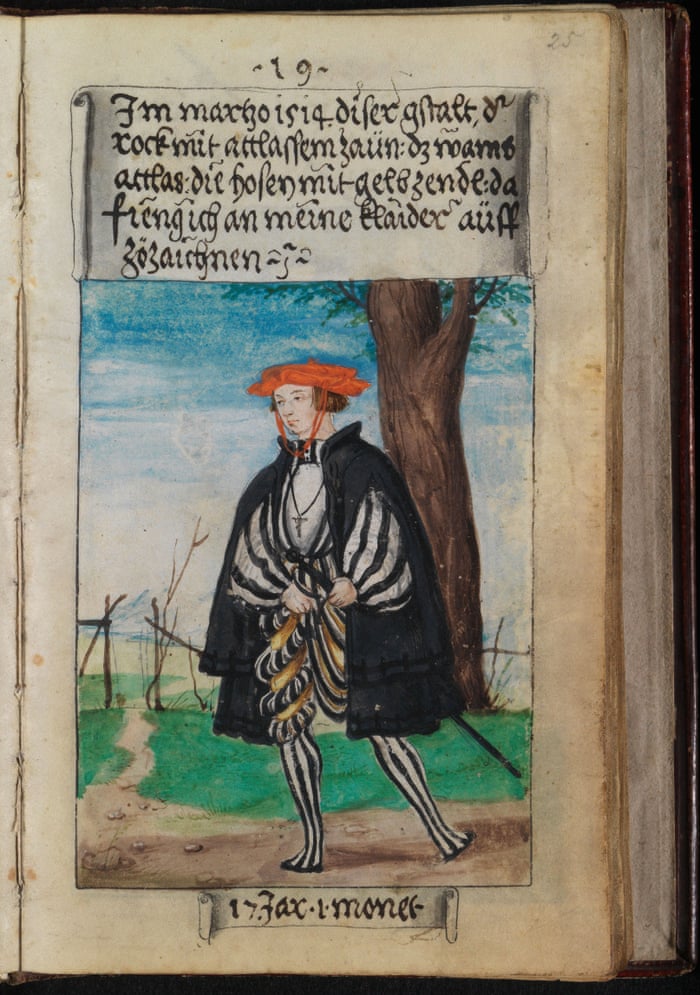
Five hundred years ago, two boys grew up in the city of Augsburg in south Germany: Hans Holbein the Younger and his exact contemporary Matthäus Schwarz. Holbein’s father even painted Schwarz in 1508, when he was 11 years old, as part of a family portrait. Here we see him in that same year, playing in the streets after school.

Matthäus started making notes about what he was wearing when he was 17, and also asked older people about the clothes they had worn. For him, changes in fashion registered changes in culture. In 1523, he began commissioning artists to paint watercolours of him and his outfits, a project that became the world’s first continuous record of a lifetime’s worth of clothes. (Read more.)
Share

Saturday, December 5, 2015

Queen Isabel at Granada

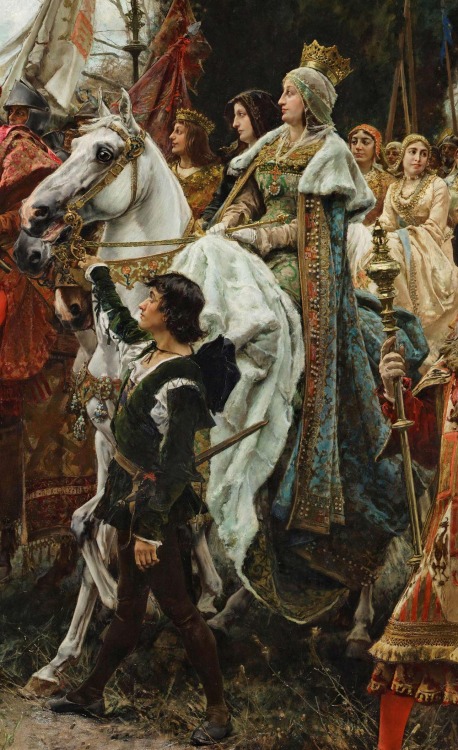
A detail of the "Capitulation of Granada" by Francisco Pradilla Ortiz, showing Isabel I of Castile on horseback. Share

To Begin Again

It is Advent. It's time to begin again, trying to be a disciple of Christ. Here are some words to ponder from Fr. Mark in Ireland:
So many people, brought low by life’s hardships, by their own weaknesses and sins, by tragedies, illness, losses, and betrayals, come very near to despairing of so much as the possibility of beginning again. The devil himself slithers like a venomous snake through our psyches, hissing, “Why begin again? You know that you will fall again? Why begin again? It’s all wasted effort. Why begin again? You shall only fail. Why begin again? It will change nothing. Why begin again? You are fatally flawed; your hopes are illusions. You will never emerge from the wreckage you have made of your life. Why begin again? Just relax. Take it easy. Go with the flow. You’re grand just as you are. Why begin again? You’ve tried it all before. Has prayer made a difference? Why begin again?” This is devil’s tired, old discourse. He may vary the words, but he never changes his message.

Pope Saint Leo the Great has an altogether different message. He speaks in the name of Christ. He speaks in the power of the Holy Ghost. He speaks with the authority of a Truth that can neither deceive or be deceived, a Truth that is invincible and incorruptible, a Truth that is utterly reliable, a Truth upon which one can build and rebuild one’s life, though it be altogether in ruins. Saint Leo says, “If in this life, it is difficult to persevere, it is possible, nevertheless, oftentimes to begin again”. The state in which you find yourself at present matters little; what matters is the state to which Christ is calling you: the state of grace, of holiness, of communion with the Father in the consolation of the Holy Ghost.
“You”, says Saint Peter, “are a chosen race, a royal priesthood, a consecrated nation, a people God means to have for himself; it is yours to proclaim the exploits of the God who has called you out of darkness into his marvellous light. Time was when you were not a people at all, now you are God’s people; once you were unpitied, and now his pity is yours”. (1 Peter 2:9–10)
Pope Saint Leo the Great also speaks to us of the necessity of moderation, of using created goods in a measured way, with restraint, avoiding all excess. Saint Leo speaks specifically of moderation in eating and drinking because for him, back in the 5th century, Advent was a season marked by fasting and abstinence, even as it ought to be for us today. Pope Saint Leo says:
By daily experience, beloved, it is proved that the mind’s edge is blunted by over-indulgence of the flesh, and the heart’s vigour is dulled by excess of food, so that the delights of eating are even opposed to the health of the body, unless reasonable moderation withstand the temptation and the consideration of future discomfort keep from the pleasure. (Sermon IX, On the December Fast)
What are some concrete examples of this? If I eat too much, I will feel heavy and bloated. Prayer, exercise, and study will be difficult. If I drink too much, I will find it hard to get out of bed the next day; my emotions will go from being abnormally intense to being altogether dull; my reason will be impaired. If I watch too much television, I will be disinclined to read things that require mental exertion. If I spend too much time in front of the computer, I will put myself at risk for mental fatigue which, in turn, can lead to general gloominess. Saint Leo was preaching a very practical Christian wisdom in his Advent sermon. He goes on to say:
It is the function of the soul to deny things to the body which is subject to it, and acting on its interior conviction, to keep back the outer man from things unseemly. Then will the soul, more often free from bodily lusts, sit at leisure in the inner temple of the mind, meditating on Divine Wisdom. There, away from all the noise of earthly cares, it may in silence enjoy holy thoughts and eternal delights. (Sermon IX, On the December Fast)
Moderation in food, drink, sleep, talking, and use of the social media are necessary for any man who desires to give himself over to watchfulness in prayer. Drunkenness, heaviness, and indigestion are impediments to prayer. So too are an unrestrained use of technology, an immoderate use of the social media, or any other compulsion, addiction or excess. (Read more.)
Share