Friday, June 8, 2012

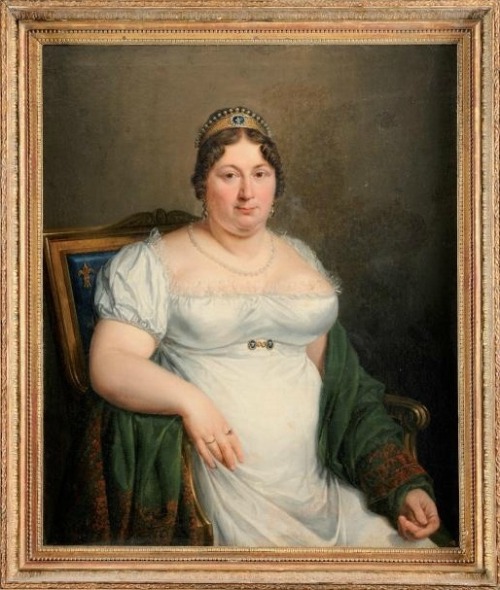
La Baronne de Crussol

From author Leah Marie Brown:
This portrait was painted by the incomparable Madame Elisabeth Vigee Lebrun who, incidentally, was Marie Antoinette's official portraitist.  The subject is the Baroness Crussol, wife of Henri-Charles-Emmanuel de Crussol-Florensac, lieutenant general of the armies of the King of France. 

The Baroness holds a book of opera music, opened to a score by Christoph Willibald Gluck who, incidentally, was Marie Antoinette's preferred composer. (Read entire post.)
I believe this is the same Madame de Crussol who accompanied Madame Elisabeth to the guillotine. (More HERE.)
.
Share

Is it Too Late?

On the state of the nation.
Now, we are assured that this generation of Republicans has come home to the church and confessed its sins, and is prepared to face martyrdom in the name of fiscal responsibility. Well, perhaps. 
Yet, if it is difficult to see how the GOP advances toward a balanced budget, it is impossible to see how President Obama does. Would the party of Nancy Pelosi and Harry Reid, triumphant, scale back programs that are the pride of their party – Social Security, Medicare, Medicaid? Would Pelosi, Reid and Obama cut the number of bureaucrats and beneficiaries of federal programs, thereby demobilizing the unionized armies on which they depend at election time? 
When FDR came to power in 1933, after his running mate, "Cactus Jack" Garner, accused Herbert Hoover of taking us "down the road to socialism," the Federal government was spending 4 percent of GDP. Today, it spends 24 percent. Under both parties, under every president since FDR, domestic spending has moved in one direction. 
Ann Romney's question remains relevant. 
Is the trend inexorable? Is there any turning back? Is it too late? (Read entire article.)
Share

Thursday, June 7, 2012

Queen Marie-Josephine

A rare portrait of Marie-Antoinette's sister-on-law, the Comtesse de Provence, wife of Louis XVIII, during the royal exile. Share

Stoning Christians at Mass

In the South of France. To quote
No one will take much note of this. It is just one story among the thousands that together tell the tale of France’s decline and Islamization. Eurabia Update: Here is my translation of “Carcassonne Des fidèles caillassés pendant la messe à Saint-Joseph,”:

Carcassonne: The faithful stoned during Mass at St. Joseph
Yesterday at 6:20PM, as Fr. Roger Barthes began to celebrate mass, four youths, aged 14 to 18, broke into the Church of St. Joseph, before launching handfuls of pebbles at 150 faithful present at the service. Immediately, men began pursuing the young troublemakers, but in vain. They managed to vanish into thin air, heading towards the city La Conte.

Interrupted by regrettable unexpected event, Mass was finally able to proceed as planned. Although no one was injured and nothing was broken in the church, located along the Avenue Jean Moulin, the parishioners, many of whom are elderly, were greatly shocked by the disrespectful act of the youths of North African origin….
Share

Wednesday, June 6, 2012

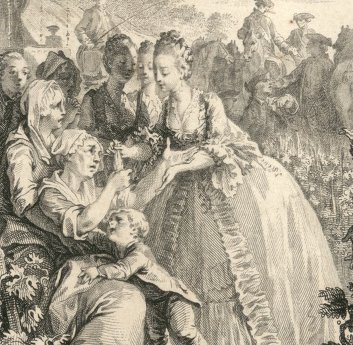
A Merciful Dauphine

Marie-Antoinette giving alms to a family in need. Read more at Vive la Reine. Share

The Age of Inattention

And how to end it.
Linda Friedlaender, the curator of education at the Yale Center for British Art, and Irwin Braverman, at Yale's medical school, created the program a decade ago and guide groups through the New Haven museum. Each student is assigned a painting—"Mrs. James Guthrie," say, by Lord Frederic Leighton—which they examine for 15 minutes, recording all they see. Then the group discusses its observations.

There is no redness, no apparent pressure, in Mrs. Guthrie's fingers as she holds a flower. Does that mean she's putting it into the vase—or taking it out? The conclusion matters less than the collection of detail. "We are trying to slow down the students," Ms. Friedlaender told me. "They have an urge to come up with a diagnosis immediately and get the right answer."

Many have been taught that schooling is a race to the finish. Others learned early that equations beat etchings (picture book writers, once considered the "academicians of the nursery," have been trampled on the fast track to pre-K). Ms. Friedlander is realistic: "This is not an aesthetic experience we're providing. The artwork is a means to an end. (Read entire post.)
Share

Tuesday, June 5, 2012

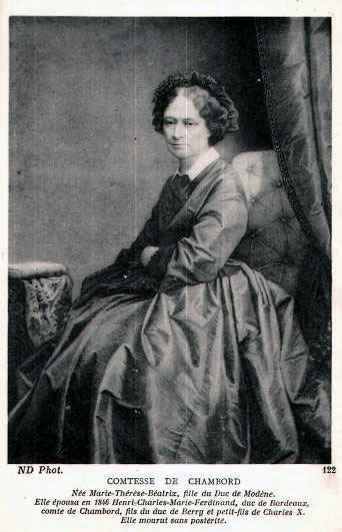
Maria Theresa of Austria-Este

The Comtesse de Chambord, wife of  the French pretender, Henri V. Some say she was chosen by Henri's aunt Marie-Thérèse-Charlotte of France, daughter of Louis XVI and Marie-Antoinette, for her plainness as  well as her religious devotion. The Comte and Comtesse were childless.  For more about the daughter of Marie-Antoinette and her family read the novel Madame Royale.

Share

Dystopia

Some thoughts from Fr. Blake:
I watched the film of Ray Bradbury's 1953 "Fahrenheit 451" a classic from 1966, in it firemen rather than putting out fires, start them, they burn books, in an attempt to introduce equality within "modern" society. Thought and ideas are considered dangerous, the state does everything it can to remove it. It is part of the genre of dystopia books and films, most written in the light of the rise and fall of twentieth century dictators.

At their heart is the redefinition or subjugation of language, actually making language meaningless, it is a "Babel effect", in most of those novels it tends to reduce communication to the superficial and leads to a dis-ease within society that is "cured" by drugs, sex, violence and superficial entertainment. The message of most of these novels that the centre cannot hold, mainly because communication breaks down, words no longer serve a purpose in expressing thought.

It is the manipulation of language, the control of thought that these novelists find most worrying.

Mr Cameron's redefinition of marriage seems to fit into this mould. I asked when he first announced his cunning plan what term we are going to use to define the loving, lifelong, exclusive relationship between members of the opposite sex, in which they hope to procreate and raise children. We need a new term, now "marriage" is to be redefined as a "loving commitment between two people" irrespective of gender, irrespective of place of children. We need a new term because "marriage" now will no longer define what the majority of human beings aspire to. (Read entire post.)
Share

Monday, June 4, 2012

Bloodletting

A brief history. To quote:
Considered one of medicine’s oldest practices, bloodletting is thought to have originated in ancient Egypt. It then spread to Greece, where physicians such as Erasistratus, who lived in the third century B.C., believed that all illnesses stemmed from an overabundance of blood, or plethora. (Erasistratus also thought arteries transported air rather than blood, so at least some of his patients’ blood vessels were spared his eager blade.) In the second century A.D., the influential Galen of Pergamum expanded on Hippocrates’ earlier theory that good health required a perfect balance of the four “humors”—blood, phlegm, yellow bile and black bile. His writings and teachings made bloodletting a common technique throughout the Roman empire. Before long it flourished in India and the Arab world as well.

In medieval Europe, bloodletting became the standard treatment for various conditions, from plague and smallpox to epilepsy and gout. Practitioners typically nicked veins or arteries in the forearm or neck, sometimes using a special tool featuring a fixed blade and known as a fleam. In 1163 a church edict prohibited monks and priests, who often stood in as doctors, from performing bloodletting, stating that the church “abhorred” the procedure. Partly in response to this injunction, barbers began offering a range of services that included bloodletting, cupping, tooth extractions, lancing and even amputations—along with, of course, trims and shaves. The modern striped barber’s pole harkens back to the bloodstained towels that would hang outside the offices of these “barber-surgeons.”

As hairdressers lanced veins in an attempt to cure Europeans’ ailments, in pre-Columbian Mesoamerica bloodletting was believed to serve a very different purpose. Maya priests and rulers used stone implements to pierce their tongues, lips, genitals and other soft body parts, offering their blood in sacrifice to their gods. Blood loss also allowed individuals to enter trance-like states in which they reportedly experienced visions of deities or their ancestors.

Bloodletting as a medical procedure became slightly less agonizing with the advent in the 18th century of spring-loaded lancets and the scarificator, a device featuring multiple blades that delivered a uniform set of parallel cuts. Respected physicians and surgeons extolled the practice, generously prescribing it to their most esteemed patients. Marie-Antoinette, for instance, seemed to benefit from a healthy dose of bloodletting while giving birth to her first child, Marie-Thérèse, in 1778, 14 years before the guillotine would shed more of the queen’s blood. As an excited crowd thronged her bedchamber, hoping to witness a dauphin’s arrival, the mother-to-be fainted, prompting her surgeon to wield his lancet. Marie-Antoinette immediately revived after the bloodletting—perhaps because the windows were simultaneously opened to let in fresh air.

America’s first president was less fortunate than France’s most infamous queen. On December 13, 1799, George Washington awoke with a bad sore throat and began to decline rapidly. A proponent of bloodletting, he asked to be bled the next day, and physicians drained an estimated 5 to 7 pints in less than 16 hours. Despite their best efforts, Washington died on December 17, leading to speculation that excessive blood loss contributed to his demise. Bloodletting has also been implicated in the death of Charles II, who was bled from the arm and neck after suffering a seizure in 1685. (Read entire post.)
Share