Tuesday, April 3, 2012

Women and the Sexual Revolution

Are we happier? The Wall Street Journal offers a powerful article by Mary Eberstadt.
Granted, happiness is a personal, imponderable thing. But if the sexual revolution has really made women as happy as feminists say, a few elementary questions beg to be answered. Why do the pages of our tonier magazines brim with mournful titles like "The Case for Settling" and "The End of Men"? Why do websites run by and for women focus so much on men who won't grow up, and ooze such despair about relations between the sexes? 

Why do so many accomplished women simply give up these days and decide to have children on their own, sometimes using anonymous sperm donors, thus creating the world's first purposely fatherless children? What of the fact, widely reported earlier this week, that 26% of American women are on some kind of mental-health medication for anxiety and depression and related problems?

Or how about what is known in sociology as "the paradox of declining female happiness"? Using 35 years of data from the General Social Survey, two Wharton School economists, Betsey Stevenson and Justin Wolfers, made the case in 2009 that women's happiness appeared to be declining over time despite their advances in the work force and education.

The authors noted that women (and men) showed declining happiness during the years studied. Though they were careful not to draw conclusions from their data, is it not reasonable to think that at least some of that discontent comes from the feeling that the grass is greener elsewhere—a feeling made plausible by the sexual revolution? However one looks at the situation, it seems difficult to argue that the results of the revolution have been a slam-dunk for happiness. (Read entire post.)
Share

Monday, April 2, 2012

Marie-Antoinette's Generosity

From History and Other Thoughts:
Marie Antoinette was a very generous and compassionate woman who did what she could to help the poor and needy. One of her good deeds, which are sadly often forgotten these days, was to give a dowry to 100 poor girls so that they could get married. In addition, she promised to pay for the nursing of their first born children and further benefits to the mothers who chose to breastfeed them...(Read entire post.)
Share

Making Time for Yourself

Are wives and mothers being selfish when we take time for ourselves? I am always struck by the fact that in an airplane parents are told to put the oxygen masks on themselves first before putting them on the children. It is so we will be able to save our children. If we want to be the best we can be for our families than we can't let our health fall through the cracks, and that means our mental, emotional and spiritual health. An elderly lady in the Carmelite order once confided to me that she felt selfish when she took time to put everything aside and pray. I asked her if she felt the same way about eating and she said "no." I  told her that as food was necessary to the body so was prayer necessary to the soul. Every person needs to take some quiet time to regroup, to meditate, to reflect on life and where God is leading them. This can be done best in a quiet place like church but it can also be done while soaking in a tub, taking a brisk walk, working out at the gym, sitting under the hair dryer or blissfully ensconced in one's special corner at home. Making time for yourself can also entail, on a more mundane level, giving yourself a manicure and a facial, writing a letter to an old friend, or working on that novel you promised yourself you would write someday. I do all of the above to re-energize; I especially love to take long walks in the country. When the batteries are recharged then the task at hand goes smoother.

More HERE.

Read about the latest BlogHer sweepstakes, HERE.
Share

Sunday, April 1, 2012

Breakfast

From Under the Gables:
A leisurely and quiet breakfast in beautiful surroundings would seem to be a luxury in today's world, except for some on Sundays. I hazard a guess that in the long run it pays to make breakfast each day as lovely and inviting as possible...(Read entire post.)
Share

St. Nuno: Constable and Carmelite

From Nobility.org:
The military capabilities of Nuno were, nevertheless, tempered by a deep spirituality, a profound love of the Eucharist and of the Blessed Virgin, the main foundations of his interior life. Totally dedicated to Marian prayer, he fasted in Mary’s honour on Wednesdays, Fridays and Saturdays and on the vigil of her feasts. The banner he chose as his personal standard bore the image of the cross, of Mary and of the saintly knights James and George. At his own expense he built numerous churches and monasteries, among which was the Carmelite church in Lisbon and the church of Our Lady of Victories at Batalha.

Following the death of his wife in 1387, Nuno did not wish to marry again and became a model of celibate life. When peace finally came, he gave the bulk of his wealth to the veterans, the rest he would dispose of in 1423 when he decided to enter the convent of the Carmelites which he himself had founded, taking the name of Brother Nuno of Saint Mary. Animated by love he abandoned power to serve the poor: it was a radical choice for a life, bringing as it did to a high point, the authentic path of faith which he had always followed. With this choice, he left behind the weapons of war and power in order to be vested in spiritual armor as the Rule of Carmel recommends. He would have wanted to withdraw to a community far away from Portugal, but the son of the king, Don Duarte, prevented it. No power could stop him from dedicating himself to the convent and above all to the poor, whom he continued to help and serve in every possible way. For them he organized a daily distribution of food and never hesitated in responding to their needs. The Commander of the King of Portugal, chief officer of the army and victorious leader, founder and benefactor of the Carmelite community, when entering the convent did not want any privileges but chose the humblest rank of a lay brother, putting himself at the service of the Lord, of Mary his ever venerated Patron, and of the poor in whom he recognized the face of Jesus himself.

Of significance too was the day of the death of Brother Nuno of Saint Mary: it was Easter Sunday, the 1st April 1431, and what following it was that he was immediately acclaimed a saint by the people who called him “O Santo Condestavel” [Holy Constable]. (Read entire post.)
Share

Saturday, March 31, 2012

Dining in Old Virginia

From Under the Gables:
When I visited Mount Vernon about more than a decade ago, I was thunderstruck by the color that the small dining room was painted--a deep, very vibrant green. In previous years the dining room had been painted a calmer, more neutral color, but research on the walls showed that the Washingtons had the walls painted the far more attention-getting green that is there now. (Read entire post.)
Share

Walsingham and Anti-Catholicism

A book review by R.J. Stove.
This grand confusion can readily be observed, in any period, among those who spend too much time in secret police work. In a sense, it redounds perversely to Walsingham’s credit that even as his tactics involved recruiting agents, suborning double-agents, and if need be hiring the occasional triple-agent, his strategy remained clear: keeping Elizabeth alive and the “Whore of Babylon” at bay. He defended in theological terms not only the common-or-garden pursuit of recusant priests, but also the celebrated forgeries by which he destroyed Mary Queen of Scots: “I see the wicked creature,” he assured the Earl of Leicester, “ordained of God to punish us for our sins and unthankfulness.” (Read entire review.)
Share

Friday, March 30, 2012

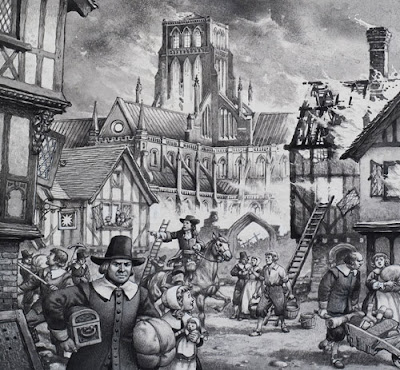
The Great Fire of London

King Charles II rose to the occasion.
The King straight away ordered to tear down the houses to contain the fire (something the Lord Mayor had hesitated to do until then because he was worried of the high rebuilding costs), but the wind was blowing so strongly that it was difficult to create a clear zone. The King also sent his guards to help, and later he too, together with his brother, went to the site of the fire. The royal brothers traveled by royal barge all the way to Queenshithe, stopping once to watch the fire from the roof of a tall building. The Duke took charge of the fire-fighting operation while Charles too gave orders, imperiling his life in the effort. But the fire wasn't quenched. The flames, now headed to Cheapside. The smoke could be seen from Oxford and Londoners had begun to flee to the open spaces of Moorfields and Finsbury Hill. (Read entire post.)
Share

Communism Comes To America

Let's go back eighty years. From LRC:
Enough has been written elsewhere about this idea of communists in the Roosevelt administration. I can add nothing to this. I will only comment that I can find no satisfactory explanation as to why the U.S. sided with Stalin as opposed to Hitler – to say nothing of why side with either. In 1938, writing of Roosevelt and the New Deal, Garet Garrett wrote in The Revolution Was:
There are those who still think they are holding the pass against a revolution that may be coming up the road. But they are gazing in the wrong direction. The revolution is behind them. It went by in the Night of Depression, singing songs to freedom.
At the end of the first year, in his annual message to the Congress, January 4, 1934, President Roosevelt said: "It is to the eternal credit of the American people that this tremendous readjustment of our national life is being accomplished peacefully."
(Read entire article.)
(Via Serge.)
Share