Sunday, June 29, 2025

Cult of the Supreme Being


 Many Catholics, particularly priests, monks and nuns, were murdered by the revolutionary government for refusing to renounce the papal sovereignty. From World History:

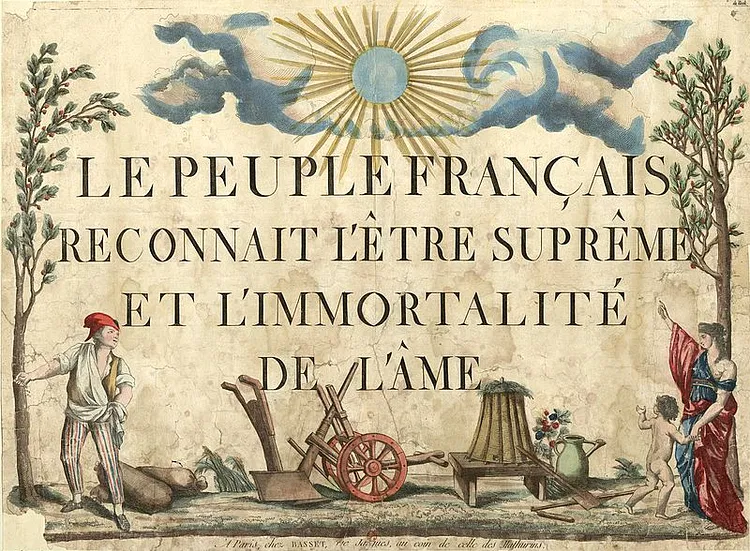
The Cult of the Supreme Being was a deistic cult established by Maximilien Robespierre (1758-1794) during the French Revolution (1789-1799). Its purpose was to replace Roman Catholicism as the state religion of France and to undermine the atheistic Cult of Reason which had recently gained popularity. It represented the peak of Robespierre's power and went unsupported after his downfall.

In establishing the Cult of the Supreme Being, Robespierre intended to shepherd the French Republic toward a state of absolute virtue, or moral excellence. He meant to use the idea of an abstract godhead, or Supreme Being, to educate the French people on the relationship between virtue and republican government, thereby creating a perfectly just society. According to the decree of 18 Floréal (7 May), the cult acknowledged the existence of a Supreme Being as well as the immortality of the human soul. Worship of the Supreme Being was to be done through acts of civic duty.

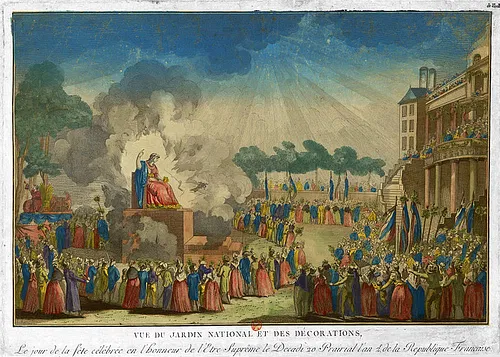
On 8 June 1794, a Festival of the Supreme Being was held on the Champ de Mars. Robespierre, who was then at the apex of his dictatorial powers, took on a central role in the festivities, giving him the appearance of pontiff to the new religion. It is thought that distaste for the cult, and for Robespierre's central position in it, helped lead to his downfall a little over a month later. According to historian Mona Ozouf, the Festival represented a certain revolutionary stiffness that foreshadowed the "sclerosis of the Revolution" (Ozouf, 24).

The French Revolution had been at odds with the Catholic Church since its beginning. A fundamental pillar of the oppressive Ancien Régime, the institution of the Church seemed to stand for corruption, superstition, and backwardness, all contrary to revolutionary values. In November 1789, Church lands were seized and nationalized to bolster France's withering economy, while the Civil Constitution of the Clergy forced all practicing clergymen to swear oaths to the new constitution and pledge that their loyalty to the French state would supersede their loyalty to the Pope in Rome.  
Yet in this early phase of the Revolution, it was the institution of the church that was under attack rather than Christianity itself. Many citizens would still consider themselves Catholic, and many even sought to reconcile the Gallican Church with the Revolution; most early revolutionary festivals included sermons from constitutional priests, who made sure to draw parallels between revolutionary values and the Gospels and to refer to Jesus Christ as the ideal sans-culotte. Infants would be baptized with a tri-color cockade pinned to their diapers, being simultaneously given over to both Christ and the fatherland. 
But before long, the differences between the Church and the Revolution became too vast to ignore. The Pope condemned the Revolution and excommunicated certain clergymen who had supported the new constitution. King Louis XVI of France (r. 1774-1792), after his failed flight to Varennes, made clear his disgust at the Revolution's treatment of the Church, further helping to associate it with corrupt aristocracy. In late 1791, the French Legislative Assembly declared that all clergymen who had not yet sworn oaths to the constitution were guilty of conspiracy and sentenced to deportation. The Assembly also legalized divorce and declared that all records of births, deaths, and marriages would henceforth be handled by secular officials only, removing an important function from the Church. (Read more.)

Share

Iran: Necessity and Opportunity

 From The Reactionary:

The cease-fire between Israel and Iran holds, for now. Both sides got their final shots – Iran with a few missiles and an Israeli retaliation against an Iranian radar system – but it holds. The “12 Day War” is potentially over. At least the first stage of it.

It’s tough to disagree with the success of the Israeli strikes, even if you are opposed to the strikes themselves. (Not that we’re opposed.) After years of planning and months of covert operations inside Iran, Israeli drones – launched from within Iran with the support of Israeli forces on the ground – struck surface-to-air missile launchers and Iranian air defenses, allowing Israeli aircraft to strike more than 100 military and infrastructure targets, including Iran’s “main nuclear [uranium enrichment] facility in Natanz,” damaging its underground structures, enrichment capabilities (allegedly), and overall infrastructure.

There is an interesting question of whether Iran’s imminent development of nuclear weapons served as the basis for the strikes. After the campaign commenced, Prime Minister Benjamin Netanyahu justified the actions in stating “Iran could produce a nuclear weapon in a very short time” – which he explained “could be a year. It could be within a few months.”

Now, that may be true. But given warnings and predictions about Iran’s nuclear trajectory over the years – they’ve been months away from nuclear weapons for years – it’s hard to assume that’s true. In 2012, Netanyahu warned that “Iran would reach the brink of being able to build a nuclear bomb in just six or seven months.” Others have made similar statements. The Washington-based Institute for Science and International Security (or ISIS, the group that picked what would become the most unfortunate acronym) issued a report in 2013 that Iran had “significantly shortened the time needed” to develop a nuclear bomb and could “enrich enough weapons-grade uranium for a single nuclear bomb in about a month.” And those are just a couple examples of many. (Read more.)

Share

Hunting and the English Civil War

 From H-net Online:

This tantalizing study engages with the English Forest Laws, the distinct law code covering the royal forests and primarily designed to protect the king’s deer, in the twenty years before 1642. Why did these jurisdictions prompt so many riots as the nation divided between Royalists and Parliamentarians? Daniel C. Beaver has trawled through the files of the Forest Courts to present four case studies where he fills out the courts’ procedural records with depositions generated in suits before the Court of Star Chamber or participants’ family papers. This approach generates plenty of detail demonstrating the local impacts of forest law, a medieval institution that weighed hard on territory under its jurisdiction.

These studies engage with the prestige that surrounded hunting and venison, while disputes that simmered in the 1630s and exploded in 1642 highlight royal interference in a core strand in gentry culture. Investigating the questions of honor invoked in a succession of local quarrels offers a fresh perspective on local communities’ decisions to attack royal forests as King Charles I’s Personal Rule crumbled into civil war. Some of the book’s most tantalizing references sample later royalist critiques of postwar societies that demeaned the honor of hunting. Newmarket Heath, a pamphlet play from 1649, jeered at the misadventures of some London merchants on a hunting trip who mangled the archaic jargon of the hunt before getting their come-uppances, with an alderman breaking his neck and the Lord Mayor hanged in a tree. In this royalist fantasy, the humor centers on the snob appeal of deer hunts whose rituals provided shibboleths for gentry and aristocratic culture. A further pamphlet from the 1660s, “The Court and Kitchen of Elizabeth, Commonly Called Joan Cromwell,” grumbled that the civil wars had cheapened the aristocratic monopoly of venison, as a prestigious dish became just another meat.

It is clear that the king’s deer were difficult neighbors. This had been so through the Middle Ages. In the 1630s, the royal forests continued to protect deer for the king’s “princely recreation and delight of hunting and chasing,” which imposed additional constraints on farming such areas (p. 62). Livestock that grazed in the woods were to be removed for the “fence month” or “forbidden month” of the fifteen days on either side of Midsummer’s Day to leave the deer undisturbed after their fawns were born (p. 70). Under forest jurisdiction, gathering firewood, felling timber, keeping dogs whose front toes had not been amputated, or erecting fences that blocked wandering herds of deer were all offences. Clashes were inevitable, even without factoring in poaching, itself feeding a wider appetite for venison--and here a book on the forests that does not index “Robin Hood” only addresses some of the cultural resonances of hunting in English culture. Beaver highlights local consequences of the revived enforcement of the Forest Laws during the 1630s. Showing that as King Charles limited new peerages or knighthoods, alternative strategies for social display became sought after, with aspiring aristocrats and gentry securing grants making their estates deer parks, which delivered prestige but imposed new regulations onto their neighbors. Novel applications of ancient privileges provoked squabbles and skirmishes. (Read more.)

Share

Saturday, June 28, 2025

An Irresistible Canvas

The Art with Glass doorway informs the Moroccaninspired entryway a showcase for Natasha's intricate ceiling design... 

 From House and Garden:

Inspired by artists who also used their homes as a stage for their work like David Parr, Peggy Angus and Vanessa Bell and Duncan Grant’s work at Charleston, her approach is at once scholarly and playful. ‘I enjoy living in a house that is my own creation and is not constrained by any particular style or fashion.’

In the entrance a tricky L-shaped biomorphic frieze cascades overhead, each detail radiant with 24-carat gold leaf. On the sitting room wall hangs a hand-drawn geometric design from a collection Natasha produced while studying at the Prince’s School. One of the pieces, was selected by Prince Charles for the ‘Prince and Patron’ exhibition that marked his 70th birthday. A border painted by Natasha, reminiscent of the Art Nouveau period, wraps the room. (Read more.)

 The artist Natasha Mann has used her Edwardian home as a canvas for her handpainted designs


Share

Chaos Creeps in on Little Cat's Feet

 From James Howard Kunstler:

The Democratic Party put another bullet in its head this week with the election of the charming, affable jihadi communist Zohran Mamdani. Is “communist” too harsh a label? (He styles himself, softly, a “socialist.”) Yet his campaign platform looks like a template from the venerable Soviet Council of Ministers circa 1957: Free Everything: housing, buses and subways, college, child-care, government food stores. . . with a cherry-on-top of replacing police with social workers in high crime areas — because rapists and car-jackers would quit their rowdy ways if only they could talk about their feelings.

If you believe the news reports emanating from Woke Central, Zohran received major support from the folks who predominate the Upper West Side, where he was raised-up by his Columbia prof Dad and film-maker Mom. That is, voted in by the same high-income demographic that flocks to Zabar’s Deli on Sunday mornings for smoked sturgeon and babka — a curious alliance. I guess this solves the old riddle of why Europe’s Jews walked so placidly into Auschwitz.

“Life imitates art,” old Oscar Wilde liked to say, and with so many self-administered bullets in its head now, the Democratic Party looks more and more like The Walking Dead, a necromantic tribute to its erstwhile mascot, “Joe Biden,” the Phantom of the White House. Fortunately, the Latinx bombshell, AOC, America’s answer to Eva Peron, has stepped up to the leadership role, flanked by the foxy Jasmine Crockett, with their mentor, Bernie Sanders close at hand (on a leash, really) barking validation for the Party’s death trip. (Read more.)

Share

Ireland’s Oldest Book Shrine

 From ArtNet News:

In 1986, divers fished a series of ancient fragments out of a lake in a Longford County village in Ireland. The pieces were well-preserved, thanks to sediments in the lake—but they were no humble find. When researchers eventually fitted the wood, metal, and decorative components together, what emerged was nothing less than Ireland’s largest and oldest book shrine.

 Nearly four decades after its discovery, the Lough Kinale Book Shrine, so named for its find site, is now on view at the National Museum of Ireland (NMI), where it was conserved.

And it’s quite a sight: the 9th-century book shrine, an elaborate container for a manuscript associated with a saint, is an oak box overlaid with bronze plates, measuring more than 13 by 11 inches, with a thickness of almost five inches. On its face is florid metalwork with four circular medallions and a large cross, encircled by ornately embellished openwork panels. Its hinges are in the shape of snake heads, built to hold a thick leather strap for transportation of the book shrine to ecclesiastical ceremonies.

Otherwise, Paul Mullarkey, a conservator at the museum, told the Irish Times: “The box was permanently sealed, with no direct access to the contents.” (Read more.)


Share

Friday, June 27, 2025

The Sacred Heart, Our Lady, and General de Sonis

The following is the little known story of a great battle was fought over the fate of France. General de Sonis was a devout Catholic husband and the father of a large family, as well as being a lay Carmelite. To quote:
Back on the battlefield, a strange thing happened. The Virgin Mary appeared to the wounded General Sonis, assuring him that all was not lost and that France would survive. A scattering of soldiers milled around the former battle; only the Zouaves and a very few other units retained their order and discipline. The remnant of the 17th Corps retreated to Poitiers. When the surviving Zouaves reached this refuge, they were welcomed deliriously by the townspeople. Deeply saddened by the plight of his former paladins, Pius IX sent a message to them: “Tell Charette and his heroic sons as speedily as possible that my wishes, prayers, and remembrances constantly follow them wherever they go; that as they were, and still are, present with me, I am also with them in heart and soul, ever entreating the God of all mercy to protect and save both them and their unhappy country, and to bless them as fully and as specially as I do this day, in His name and with the warmest effusion of my heart.” (Read entire post.)
Share

Can the Senate Be Saved from Its Democrat Parliamentarian?

 From Amuse on X:

Let us begin with a matter of fact, not speculation. The Parliamentarian's rulings are advisory. They are not law. The idea that she is the final arbiter of what may or may not appear in a reconciliation bill is a legal fiction, propped up by political timidity and institutional inertia. There is precedent, and not ancient, musty precedent, but recent, muscular precedent, for the Vice President to exercise the authority that the Constitution vests in him. In 1975, Vice President Nelson Rockefeller overruled the Parliamentarian in a matter involving the filibuster. In 1969, Hubert Humphrey attempted the same. The office of the Vice President, when acting as President of the Senate, is not a rubber stamp.

Consider the bill in question. The One Big Beautiful Bill Act, passed by the House in May by the narrowest of margins, is not merely another legislative vehicle for routine policy tinkering. It is the centerpiece of Trump’s second-term agenda, and its key provisions are deeply rooted in the fiscal and moral expectations of the American electorate. The bill eliminates funding for the Consumer Financial Protection Bureau, a bureaucratic stronghold created by Dodd-Frank, long insulated from congressional accountability. It restricts Medicaid and CHIP funds from being used for what is euphemistically called "gender-affirming care" for minors, and it bars the disbursement of public health funds to those unlawfully present in the country. Each of these provisions carries both moral clarity and budgetary consequence. Yet MacDonough has ruled them impermissible under the Byrd Rule.

Here we must pause and ask, what precisely is the Byrd Rule? Enacted in 1985 and named after Senator Robert Byrd, the rule prohibits the inclusion of "extraneous" material in reconciliation bills. What counts as extraneous? Anything that does not primarily affect federal revenues or outlays. The Parliamentarian’s job is to interpret this language. But interpreting is not the same as ruling. And even if it were, the text of the rule allows far more discretion than MacDonough appears willing to concede. (Read more.)


Share

Why Camelot May Have Been a Real Place

 From The Collector:

Therefore, the fact that Camelot was first mentioned in the 12th century does not mean that it was not based directly on a real location. Chretien may well have been thinking of a real place, but given it a fictional name. Similarly, Jane Austen gave the fictional name “Sanditon” to her version of the perfectly real town of Bognor Regis.

While this is all well and good in theory, is there any evidence that the medieval romance writers were actually describing a specific, real location when they referred to Camelot? As it happens, we find such evidence in the preface of Sir Thomas Malory’s Le Morte d’Arthur, written in the 15th century. This preface was written by William Caxton, the publisher. He refers to the fact that the grand stone walls of Camelot were still visible in Wales and were regularly visited by many people.

This does not necessarily tell us anything about any potential historical connection between Arthur and Camelot. It does, however, tell us that William Caxton evidently had a specific place in mind when he referred to Camelot. The Camelot that Caxton mentioned was, therefore, by definition, a real place. Of course, this does not necessarily mean that all the other writers who mentioned Camelot were thinking of the same location. What do Thomas Malory’s own words indicate regarding this? (Read more.)


Share