A place for friends to meet... with reflections on politics, history, art, music, books, morals, manners, and matters of faith.
A blog by Elena Maria Vidal.
"She was not a guilty woman, neither was she a saint; she was an upright, charming woman, a little frivolous, somewhat impulsive, but always pure; she was a queen, at times ardent in her fancies for her favourites and thoughtless in her policy, but proud and full of energy; a thorough woman in her winsome ways and tenderness of heart, until she became a martyr."
"We have followed the history of Marie Antoinette with the greatest diligence and scrupulosity. We have lived in those times. We have talked with some of her friends and some of her enemies; we have read, certainly not all, but hundreds of the libels written against her; and we have, in short, examined her life with– if we may be allowed to say so of ourselves– something of the accuracy of contemporaries, the diligence of inquirers, and the impartiality of historians, all combined; and we feel it our duty to declare, in as a solemn a manner as literature admits of, our well-matured opinion that every reproach against the morals of the queen was a gross calumny– that she was, as we have said, one of the purest of human beings."
"It is now sixteen or seventeen years since I saw the queen of France, then dauphiness, at Versailles; and surely there never lighted on this orb, which she hardly seemed to touch, a more delightful vision. I saw her just above the horizon, decorating and cheering the elevated sphere she had just begun to move in, glittering like a morning star full of life and splendor and joy. Oh, what a revolution....Little did I dream that I should have lived to see such disasters fall upon her, in a nation of gallant men, in a nation of men of honor and of cavaliers! I thought ten thousand swords must have leaped from their scabbards, to avenge even a look which threatened her with insult. But the age of chivalry is gone; that of sophisters, economists, and calculators has succeeded...."
~Edmund Burke, October 1790
A Note on Reviews
Unless otherwise noted, any books I review on this blog I have either purchased or borrowed from the library, and I do not receive any compensation (monetary or in-kind) for the reviews.
I’ve also
been aware for some time of the increasingly symbiotic relationship
between younger children and YouTube. I see kids engrossed in screens
all the time, in pushchairs and in restaurants, and there’s always a bit
of a Luddite twinge there, but I am not a parent, and I’m not making
parental judgments for or on anyone else. I’ve seen family members and
friend’s children plugged into Peppa Pig and nursery rhyme videos, and
it makes them happy and gives everyone a break, so OK. But I don’t even have kids and right now I just want to burn the whole thing down.
Someone
or something or some combination of people and things is using YouTube
to systematically frighten, traumatise, and abuse children,
automatically and at scale, and it forces me to question my own beliefs
about the internet, at every level. Much of what I am going to
describe next has been covered elsewhere, although none of the
mainstream coverage I’ve seen has really grasped the implications of
what seems to be occurring. (Read more.)
Sarah Josepha Buell Hale, nineteenth-century author and magazine editor,
campaigned for more than three decades to have Thanksgiving recognized
nationwide. She wrote a letter to President Abraham Lincoln in 1863,
urging him to secure the “permanency and unity” of its commemoration.
When the final Thursday of November was officially declared a time of
gratitude for our country’s bounty, its intermittent regional observance
was already cultivating a rich culinary tradition. (Read more.)
Although the turkey often gets the most attention
during holiday-menu planning, the trimmings can bring just as much
harvest flavor to your celebration. Fresh and delicious, these
unforgettable sides might just steal the spotlight on your Thanksgiving
table. From the hearty Winter Squash-and-Mushroom Medley to warm Brown
Butter Rosemary Yeast Rolls, these delectable dishes are certain to have
guests asking for more. (Read more.)
The truth is, though, that the feminist zealots determined to wage
this dialectical male-privilege gender struggle are but a small group of
privileged women. They occupy positions of extraordinary power and
influence and, under the gaze of the media, pretend to speak for all
women.
Nothing could be further from the truth. Just as the majority of MPs
are grossly out of touch with the people on Brexit, these ‘feminist’ MPs
and Parliamentary staff are grossly out of touch with the majority of
British women, only 7 per cent of whom would describe themselves as feminists.
Many of the rest are horrified by the apparently self-serving obsession
of some of the privileged women to have found their way to the top of
the Parliamentary tree.
The danger now is that those in charge of Parliamentary discipline
will capitulate to knee-jerk solutions. Engulfed by the media storm,
they feel they have to do something – anything – to signal to the
baying, illiberal progressive media that they are not dinosaurs. Under
pressure to say that they are ‘taking steps to ensure this will never
happen again’, they appear too afraid to tell the truth: that the
reaction has been hysterical, out of proportion; that conflating
flirtation and behavioural lapses with serious harassment and assault
risks trivialising the latter. (Read more.)
In
reading The Old Patagonian Express,
it is wise to remember that it was written 40 years ago, and some of the
political situations to which it refers have passed away. (For example, Theroux
conspicuously avoids visiting Nicaragua, because a civil war was then raging
there, and the Argentina he visits was still the Argentina of the junta).
So
what are the pleasures of reading (or listening to) this book?
Much is the simple pleasure of decription as the various trains pass through
barren deserts, or have Theroux gasping in the thin air as they cross the
Andes, or allow him to see the wide reaches of the pampas. Much is the pleasure
or surprise of the unexpected spectacular event, such as the football match in
El Salvador which turns into a full-scale riot. In terms of human habitation,
it is not always a pretty world that Theroux observes. From Mexico to
Patagonia, there are many descriptions of urban slums, sprawling squatter camps
outside the cities, naked and unwashed children begging and an indifferent (but
much smaller) affluent class often living in what amount to gated communities.
Nor does Theroux stint on recording the run-down quality of most Latin American
trains and their discomfort, or the type of accommodation provided by
rat-infested or flea-infested hotels. In short, there is much human squalor in
this book. (Read more.)
Although it is fairly well-known that Marie-Antoinette loved music, studying under both Gluck and the famous Chevalier de Saint-Georges,
many people are surprised to learn that she composed her own tunes.
This is at odds with the typical image of the Queen as being a
thoughtless playgirl. She also wrote poetry and spoke Italian. She was
not an intellectual, but she was very bright, contrary to the myths. She composed several songs, the most famous being "C'est mon ami" ("My
Friend"). Here are the lyrics of "C'est mon ami" by Jean Pierre Claris de Florian:
"C'est mon ami"
Ah s'il est dans votre village Un berger sensible et charmant Qu'on chérisse au premier moment Qu'on aime ensuite davantage
C'est mon ami Rendez-le moi J'ai son amour Il a ma foi
Si par sa voix douce et plaintive Il charme l'écho de vos bois Si les accents de son hautbois Rendent la bergère pensive
C'est encore lui Rendez-le-moi J'ai son amour Il a ma foi
Si même n'osant rien vous dire Son seul regard sait attendrir Si sans jamais faire rougir Sa gaité fait toujours sourire
C'est encore lui Rendez-le-moi J'ai son amour Il a ma foi
Si passant près de sa chaumière Le pauvre en voyant son troupeau Ose demander un agneau Et qu'il obtienne encore la mère
Oh c'est bien lui Rendez-le moi J'ai son amour Il a ma foi.
Translation :
Ah,
if there is in your village, a sensitive and charming shepherd, whom we
cherish at the first moment, and whom we later love more, he is my
friend, give him back to me, I have his love, he has my faith.
If
with his sweet and plaintive voice, he charms your forests' echoes, if
the accents of his oboe makes the shepherdess thinking, it's him
again...
If even not daring to tell you anything, his look only
can move you, if never making you blush, his cheerfulness makes you
always smile, it's him again...
If passing by next to his
cottage, the poor seeing his flock, dares to ask for a lamb,a nd that he
obtains the mother also, Oh yes it's him...
Marie Antoinette completely composed "Portrait Charmant", music and
lyrics, probably in honor of the Princesse de Lamballe. It is an example of the extremely florid and gushing language
she used with her close friends and family. This is also typical of her
era, and we cannot impose the same meanings to the words as they might
have for us today. The song was written when she was barely out of her teens and still missing her family in Austria, most of whom she would never see again.
"Portrait Charmant" Portait charmant, portait de mon amie Gage d'amour par l'amour obtenu Ah viens m'offrir le bien que j'ai perdu Te voir encore me rappelle à la vie. Oui les voilà ses traits, ses traits que j'aime Son doux regard, son maintien, sa candeur Lorsque ma main te presse sur mon coeur Je crois encore la presser elle-même Non tu n'as pas pour moi les mêmes charmes Muet témoin de nos tendres soupirs En retraçant nos fugitifs plaisirs Cruel portrait, tu fais couler mes larmes Pardonne-moi mon injuste langage Pardonne aux cris de ma vive douleur Portait charmant, tu n'es pas le bonheur Mais bien souvent tu m'en offres l'image.
Translation:
Charming portrait, portait of my friend
Token of love, by love obtained
Ah come and give me back the good I have lost
To see you again brings me back to life
Yes here they are, her features, her features I love
Her sweet looks, her bearing, her ingenuousness
When I press you to my heart
I think I still embrace her herself.
No you don't have to me the same charms
Silent witness of our tender sighs
By recounting our fleeting pleasures
Cruel portrait, you make my tears fall.
Forgive me for my unfair language
Forgive the cries of my bitter woe
Charming portait, you are not happiness
But so often you give me the image of it.
The word “communism” needs to be used now, but it is misleading, and
Bloch is partly responsible. Up until the late fifties, he was a
supporter of both the Soviet regime and the German Democratic Republic
(he fled East Germany for Tübingen in 1961, just as the Berlin Wall was
being built). He called the Soviet Union of the 1930s “an achievement
about which one can say with all one’s heart, yes, yes, yes,” and his
defense of the show trials is obscene. Yet he never joined the Communist
Party, and his writings placed him under its constant suspicion and
occasional surveillance.
It was the religious dimension of Bloch’s thought that did so. It was apparent from his first book, The Spirit of Utopia, and
led to the straining of friendships with Walter Benjamin, Theodor
Adorno, and Louis Althusser, mandarins of what would be known as Western
Marxism. Bloch’s use of Marx was selective and unorthodox. When he drew
directly from Marx, it was not from the late “scientific” works of
political economy like Capital,
but from early letters that spoke romantically of humanity’s “dream”
for a better life. This was Marx’s translation of Feuerbach’s projection
theory of religion. Where the earlier thinker saw the Christian idea of
God as the screen onto which we projected our intuition about human
fulfillment, Marx cast that projection forward as the end of history.
Bloch’s communism, if it should be called that, therefore verges on the
mystical. He envisions a “communism of love” as the eschatological
completion of our spiritual, not economic, development. (Read more.)
Anxiety isthe most common mental-health disorder in the United States, affecting nearly one-third of both adolescents and adults,
according to the National Institute of Mental Health. But unlike
depression, with which it routinely occurs, anxiety is often seen as a
less serious problem. “Anxiety is easy to dismiss
or overlook, partially because everyone has it to some degree,”
explained Philip Kendall, director of the Child and Adolescent Anxiety
Disorders Clinic at Temple University in Philadelphia. It has an
evolutionary purpose, after all; it helps us detect and avoid
potentially dangerous situations. Highly anxious people, though, have an
overactive fight-or-flight response that perceives threats where there
often are none.
But sometimes there are good
reasons to feel anxious. For many young people, particularly those
raised in abusive families or who live in neighborhoods besieged by
poverty or violence, anxiety is a rational reaction to unstable,
dangerous circumstances. At the Youth Anxiety Center’s clinic in the
Washington Heights neighborhood of Manhattan, which serves mostly poor
and working-class Hispanic youth, teenagers would object to the
definition of anxiety I heard often at Mountain Valley: “The
overestimation of danger and the underestimation of our ability to
cope.” (Read more.)
I use avocado oil in the Morning Bouquet Facial Treatment
for the special protection it gives the skin during the day. I have
also begun using it as an astringent and as a make-up remover. I just
put a few drops on a damp cotton ball and it wipes away the eye make-up
without irritation. Indeed, avocado oil is a soothing way to both end
and begin the day. (Read more.)
The marriage rate is “sinking” among lower and middle-class American
adults; it’s now down to 48%. It has, however, remained stable among the
wealthy. And it’s “the proliferation of single-parent households” that
“accounts for virtually all of the increase in child poverty since the
early 1970s,” as Stanton quotes Jonathan Rauch.
In the early 1990s, sociologist Bill Galston said that to stay out,
or climb out, of poverty, Americans needed to do only three things:
graduate from high school, marry before having a child, and have that
first child after the age of 20. Only 8% of Americans who follow these
rules will be poor, Galston claimed, whereas 79% who fail in all three
respects will certainly live in poverty.
This “success sequence”--high school, marriage, and only then baby
carriage--still holds true today, and “working-class” women are three
times more likely to have babies out of wedlock than wealthy women. Poor
women are five times more likely than wealth women to have babies
outside marriage. Both poor and working class women are twice as likely
to be cohabiting than their richer sisters.
Marriage has a “extraordinary economic power,” Stanton wrote. “It
boosts every important measure of well-being for women, children and
men.” That includes income, health, savings, employment, educational
success, happiness, recovery from serious illness--even a healthy diet.
“Marriage is an essential active ingredient in improving one’s
overall life prospects, regardless of class race, or educational
status,” Stanton observed. Astonishing as it may seem, the poverty rate
for children living with two unmarried, cohabiting parents is similar to
that of single-mother led households. Even so-called “shotgun”
marriages, contracted when the bride was pregnant, help keep women and
children out of poverty.
But doubters have asked if this is putting the cart before the horse.
Does marriage really generate wealth, or does wealth generate marriage?
“That’s the criticism some scholars have had--the liberal scholars,”
Stanton told LifeSiteNews. “But marriage itself is a wealth creating
institution. That’s what the research is finding.”
Marriage creates wealth because marriage encourages men to become
better, more committed workers, providers and savers. Married men are
less likely to fall into substance abuse, they are less likely either to
commit or fall victim to crime, they have better health and they’re
even less accident-prone. “A married man is a far different kind of man
than the single or cohabiting man,” Stanton told Lifesitenews. (Read more.)
Marie-Antoinette "en gaulle" by Elisabeth Vigée-Lebrun
Generalissima: A Novel of Henrietta Maria
Book Two in the "Henrietta of France Trilogy"
#1 in Kindle Biographies of Royalty!
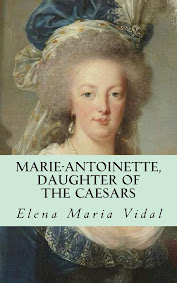
Marie-Antoinette, Daughter of the Caesars: Her Life, Her Times, Her Legacy
An Audible Bestseller
Marie-Antoinette, Daughter of the Caesars: Her Life, Her Times, Her Legacy
An Amazon Bestseller
Trianon: A Novel of Royal France
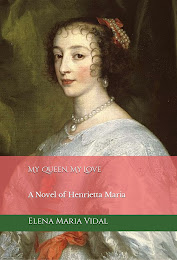
My Queen, My Love: A Novel of Henrietta Maria
Available from Amazon
The Saga of Marie-Antoinette's daughter, Marie-Thérèse of France
A Novel of the Restoration
In Kirkus Top 20 for 2014! And #1 in Kindle Historical Mystery, Thriller & Suspense Fiction
"In every Eden, there dwells a serpent . . . ."
#1 in Kindle History of France!
The Night's Dark Shade: A Novel of the Cathars
Join me on Facebook!
Elena Maria Vidal Author Page
Join me on X!
@emvidal
Visit My Tumblr!
East of the Sun, West of the Moon
St. Teresa of Avila, pray for us!
"...Bud forth as the rose planted by the brooks of waters. Give ye a sweet odor as frankincense. Send forth flowers, as the lily...and bring forth leaves in grace, and praise with canticles, and bless the Lord in his works." —Ecclesiasticus 39:17-19
The fact that a link is provided here in no way constitutes an endorsement of everything on the other end of the link.
Comments Policy
Comments are moderated. If a comment is not published, it may be due to a technical error. At any rate, do not take offense; it is nothing personal. Slanderous comments will not be published. Anonymity may be tolerated, but politeness is required.
I would like to respond to every comment but my schedule renders it impossible to do so. Please know that I appreciate those who take the time to share their thoughts.