Friday, November 20, 2015

Gwenllian, the Warrior Princess

A Welsh tragedy. From English Historical Fiction Writers:
What the Lord of Gwynedd said to his son and wife when he returned from England to find that Gwenllian was now married to the Prince of Deheubardd is not recorded but the alliance changed Welsh politics. The word ‘alliance’ still means ‘wedding ring’ in modern French and medieval marriages were as important as battles in shaping events. But Gwenllian was no mere trade object. Her soubriquet of ‘warrior princess’ was earned by living rough and fighting alongside her husband.

When Henri I died in 1135 and England was unstable, combined Welsh forces from north and south rose up against the Anglo-Norman castles in a more organised way. At one point in these skirmishes and sieges, Gruffydd won Kidwelly Castle, and Gwenllian lived there for a few months, pregnant, and enjoying the life of a lady. However, Deheubardd was not strong enough to hold Kidwelly. Soon Gwenllian was once more living with her people in the wooded hills, the traditional Welsh tactic to protect women and children in times of war. The nomadic way of life allowed lightning strikes and withdrawals, so the marcher lords were never secure. One consequence of this period was to convince Maurice de Londres, Lord of Kidwelly Castle, that Gruffydd and Gwenllian were a serious threat to Kidwelly.

In 1136 Gruffydd was in North Wales, seeking help from his father-in-law and Gwenllian was Lord of Deheubardd in Gruffydd’s absence. She received word that a Norman army was on its way from England to meet up with Maurice de Londres, intending to wipe out Gruffydd, Gwenllian and their troublesome family. (Read more.)
Share

Thursday, November 19, 2015

Sunset on the Autumn Porch

From Victoria:
I cannot say why autumn is my favorite time of year. Perhaps it’s all the vibrant shades of yellow—the goldenrods that begin blooming into their full color just as August is ending, the black-eyed Susans by the side of the road, the beautiful elms with their burnished foliage. The garden delights and inspires me as much in fall as it does when it is born in the spring.

The little poplar in the middle of the yard is majestic, even though it was planted only a few months ago. Its leaves are a buttery gold now, demanding to be not just admired, but captured eternally in a painting, an illustration, or a poem. Wind chimes announce the arrival of a sharp hint of autumn air, as do the orange mums that sway like awkward children beside licorice-scented marigolds and winterberry holly leaves that sift to the ground in each lifted breeze. (Read more.)
Share

The Firmness of Faith in the Cataclysm of Time

From Fr. Angelo:
“But in those days, after that tribulation, the sun will be darkened, and the moon will not give its light, and the stars will be falling from heaven, and the powers in the heavens will be shaken. And then they will see the Son of man coming in clouds with great power and glory” (Mk 13:14-26).
In today’s gospel, Our Lord portends the signs that will accompany the end of the world. The heavens will be shaken to their foundation. The universe will literally come apart, constituting the dissolution of all things of time and the advent of eternity. The sun, moon and stars along with the firmament in which they are set will collapse and fall, and, thus, so shall we.
This is the exact opposite of the way it is all began. The Holy Spirit says in Isaiah:
My hand laid the foundation of the earth, and my right hand spread out the heavens; when I call to them, they stand forth together (48:13).

And in the Book of Daniel, which is the first reading in today’s Mass, the prophet likens the wise among men with the stability of the heavens:
And those who are wise shall shine like the brightness of the firmament; and those who turn many to righteousness, like the stars forever and ever (12:3).
In the Collations on the Six Days of Creation (8, 1-2), St. Bonaventure comments on this verse from Daniel as representative of the firmness of faith. The context is the second day of creation when God stretches out the firmament of heaven and separates the waters below the firmament from those above (cf., Gen 1:6-8). The firmament of heaven is literally a barrier between the two waters, and in it is fixed the heavenly bodies: the sun, moon and stars. Bonaventure says that etymologically caelum, or heaven, is related to the act of engraving, so that we can say that the heavens are engraved with heavenly lights. They are fixed firmly in the heavens.

All light comes from the heavens. Faith is a light that comes from heaven. Thus, faith, according to Bonaventure, is not only lofty and deep, but is also firm like the firmament of the heavens. It is something that cannot and will not pass away until the end of the world, when only charity will remain. Our Lord says in today’s gospel: Heaven and earth will pass away, but my words will not pass away (Mk 13:31). (Read more.)
Share

A Theology of Women

From The Catholic World Report:
German philosopher and Catholic convert Edith Stein (later St. Teresa Benedicta of the Cross) explained that women have a deep desire to bring wholeness to themselves and then share their gifts with others. Of course, sin and abuse can affect this desire, but in a healthy woman, this is the general hallmark of the genius of woman. It epitomizes motherhood, both spiritual and physical. Maria Montessori is a great example of this feminine genius; by using her gifts as a doctor, she was able to teach the unteachable—young, impoverished, mentally-challenged boys. Not only did they flourish in remarkable ways, but she revolutionized the way children around the world are now taught. Of course, the best example, which Stein uses over and over again when speaking of the genius of woman, is of Mary at the Wedding Feast of Cana. Quietly, before any of the guests know there is no more wine, she remedies the situation. No fuss, without drawing any attention to herself, she takes care of the problem. These are examples of women using their gifts and sharing them with others in their attention to detail and compassion. 

There is also a connection between motherhood (spiritual and physical) and how our souls relate to God: the feminine spiritual vocation mimics the physical model of motherhood. Over and over again in Scripture and the lives of female saints there is an initial sense of mission that comes before the mission happens; a seed is planted. And then, over time, slowly, God reveals the full truth of the work he planted in the heart of the woman years, or even decades, before. Certainly, we see this in spades in Mary, the perfect woman, both in the Annunciation and Simeon’s prophesy: “A sword shall pierce your heart” (Luke 2:35). Mother Teresa had the sense decades before moving to India that God had a particular mission for her that would eventually blossom. This “seed planting” requires that a woman has the heart to hear God and then the time and patience to let it fully come to life—much like pregnancy. This very different than, say, the insights St. Joseph received through dreams, which required immediate action and not a long period of gestation. Of course, every person is different, but a theology of woman could look more deeply into these sorts of patterns. 

Rather than shun these gifts, these uniquely feminine ways of relating to God and the world, women need to come to understand them and find specific ways to apply them in their own lives. (Read more.)
Via The New Beginning. Share

Wednesday, November 18, 2015

Inbal Segev, Cellist

From InsideChic:
The Bach Cello Suites are the cellist’s Bible. They are six pieces which amount to a little bit more than two hours of music. They are the pinnacle; the most important work for cello solo. Everybody knows them. Everybody plays them. Everybody has a very strong opinion about them. Recording them puts you on the line. Your recording shows, “This is who I am as a cellist. This is how smart… or not so smart… I am.” It’s a little bit like being naked. They are full of complex ideas. Bach tried to put three voices into one instrument. You have to think of how to bring out those voices. How to make them clear. How to make the music feel free, but also how to keep it structured. What’s fascinating about them is that everybody plays them differently and they can be musically convincing within different interpretations. (Read more.)
Share

Political Correctnesss: More Dangerous Than ISIS

From Mark O'Malley:
The left in their hypocrisy are now more more concerned about non existent racism on college campuses, while advocating punishing people that basically disagree with their sick fascist ideology but the terrorists who kill liberals and conservatives without mercy are ignored, and worse, the left blames the West for the behavior of terrorists and always try to acknowledge their grievances, and especially after every major terror attack. Just to reiterate the Muslim terrorist has no grievance but has a desire to enslave “the unbelievers” until they submit to Allah, it just that simple. It is the same goal of Hitler, that all should bow to the Fuhrer or you will die, or Stalin, Mao or any other tyrannical regime. The left who espouse justice are sick with their tyrannical desire to silence their opposition, declare “the right” as enemies, instead of viewing themselves as the loyal opposition, that most conservatives do when one is in a political disagreement. (Read more.)
Share

Holocaust Survivors Speak of Pius XII

From Aleteia:
During the Holocaust wrought by Nazi Germany, an estimated six million European Jews and almost as many other victims were killed by the Nazis.

During this dark hour, Venerable Pope Pius XII proved himself to be an untiring foe against the Nazis, determined to save as many Jewish lives as he could. Yet today Pius XII has received little credit, despite the fact of having saved the lives of at least 8,000 Jews, protecting them inside the Vatican.

In this video, watch Roman Jews tell their story of being rescued from the Holocaust by Venerable Pope Pius XII and the Roman Catholic Church. (Read more.)
Share

Tuesday, November 17, 2015

Charles Martel

From Nobility:
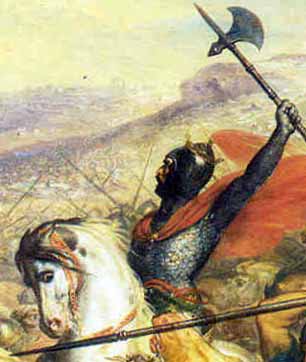
In 732 Abd-er-Rahman, Governor of Spain, crossed the Pyrenees at the head of an immense army, overcame Duke Eudes, and advanced as far as the Loire, pillaging and burning as he went. In October, 732, Charles met Abd-er-Rahman outside of Tours and defeated and slew him in a battle (the Battle of Poitiers) which must ever remain one of the great events in the history of the world, as upon its issue depended whether Christian Civilization should continue or Islam prevail throughout Europe. It was this battle, it is said, that gave Charles his name, Martel (Tudites) “The Hammer”, because of the merciless way in which he smote the enemy.
 
The remainder of Charles Martel’s reign was an uninterrupted series of triumphant combats. In 733-734 he suppressed the rebellion instigated by the Frisian duke, Bobo, who was slain in battle, and definitively subdued Friesland, which finally adopted Christianity. In 735, after the death of Eudes, Charles entered Aquitaine, quelled the revolt of Hatto and Hunold, sons of the deceased duke, and left the duchy to Hunold, to be held in fief (736). He then banished the Moslems from Arles and Avignon, defeated their army on the River Berre near Narbonne, and in 739 checked an uprising in Provence, the rebels being under the leadership of Maurontus. (Read more.)

Share

On the Relevance of Romano Guardini

From VIS News:
Vatican City, 13 November 2015 (VIS) – This morning in the Clementine Hall the Pope received in audience members of the Romano Guardini Foundation attending the Congress promoted by the Pontifical Gregorian University to commemorate the 150th anniversary of the birth of the Italian-born German priest, theologian and writer. During the audience the president of the foundation, Professor Ludwig von Pufendorf, announced the imminent publication of a previously unpublished text by Guardini who, as the Holy Father affirmed, “has much to say to the people of our time, and not only Christians”.
Francis recalled that Guardini, in his book “The Religious World of Dostoevsky”, cites the episode in “The Brothers Karamazov” in which a peasant confesses to the starec (the spiritual guide of orthodox monasteries) that she had killed her sick husband who had mistreated her throughout his life. The starec notes that the woman, desperately aware of her guilt, is entirely closed in on herself and that any reflection, comfort or counsel would meet this wall. The woman is convinced she is condemned; however, the priest shows her the way out. Her life has meaning, because God will receive her at the moment of repentance. He urges her not to be afraid since there is not, and there cannot be, a sin on earth that God cannot forgive to those who repent sincerely, nor can there be a sin so great that it exhausts God's infinite love. In confession the woman is transformed and receives new hope.
“The simplest people understand what this is about”, said the Pope. “They perceive the greatness that shines in the starec's wisdom and the strength of his love. They understand what holiness means, that is, an existence lived in faith, able to see that God is close to man, that He holds their life in His hands. In this respect, Guardini says, that by accepting with simplicity existence in the hand of God, personal will transforms into divine will and in this way, without the creature ceasing to be only a creature and God truly God, their living unity is brought about”.
For Guardini, this “living unity” with God consists of the concrete relationship of people with the world and with others around them. “The individual feels a part of the fabric of the population, that is, in an original union of men that by type, country and historical evolution in life and destinies are a single entity”. The author of “The Meaning of the Church” considered the concept of “population” as the “compendium of what in man is genuine, profound and substantial. We are able to recognise in the population, as in a mirror, “field of the force of divine action”.
“Perhaps we can apply Guardini's reflections to our own time, seeking to uncover the hand of God in current events”, observed the Holy Father. “In this way we will perhaps be able to recognise that God, in His wisdom, sent us, in rich Europe, the hungry to be fed, the thirsty to slake their thirst, the stranger to be welcomed and the naked to be clothed. History then shows this: if we are a population, we will certainly welcome these as our brothers; if we are merely a group of individuals, we will be tempted only to save our own skins, but we will have no continuity”.(Read more.)
Share