Share


ShareTell some historians that "Lincoln freed the slaves" and one can virtually see the smoke come out of their ears."Please don't get me started," Dunbar says after hearing that phrase."There's this perception that good old Lincoln and a few others gave freedom to black people. The real story is that black people and people like Douglass wrestled their freedom away," Dunbar says.Historians still argue over Lincoln's racial attitudes. The historian Henry Louis Gates Jr. once called him a "recovering racist" who used the N-word and liked black minstrel shows.Others point to the public comments Lincoln made during one of his famed senatorial debates with Stephen Douglas in 1858 when he said, "There is a physical difference between the white and black races which I believe will forever forbid the two races living together on terms of social and political equality."There must be the position of superior and inferior, and I as much as any other man am in favor of having the superior position assigned to the white race," Lincoln said in the speech.Spielberg's film depicts Lincoln as a resolute opponent of slavery, willing to deploy all the powers of his office to destroy it.Yet "The Abolitionists" paints another portrait of Lincoln. It recounts how he supported colonization plans to ship willing slaves back to Africa. It says that Lincoln once floated a peace treaty offer to the Confederates that would allow them to keep slaves until 1900 if they surrendered. At one White House meeting with black ministers, Lincoln virtually blamed slaves for starting the war, the film's narrator says. (Read entire article.)
SharePeople often sail or motor into St. Michaels for dinner or a weekend to enjoy the charm of the small Eastern Shore boating town. Landlubbers come by car or bike, traversing the streets on a hunt for historic landmarks or unique souvenirs, while enjoying the sails and hulls in the background. No matter how they arrive, visitors to this tourist mecca will be happy to find St. Michaels Winery, a peaceful oasis of oaken barrels and copper-topped tables that welcomes wine lovers.St. Michaels Winery is located in the front of the Old Sewing Factory Building on Talbot Street. A neighbor to Eastern Shore Brewing, the winery offers daily wine tastings that need no reservation and cater to groups wishing to have a genuine local experience. Talbot County’s only winery, St. Michaels Winery boasts a wine list of twenty, handily broken down into three categories—dry whites, dry reds, and sweet wines. (Read entire post.)

For more than a century, couture has been emblematic of the triumph of costume and fashion. It represents the fusion of fashion—the modern entity that combines novelty and synergy with personal and social needs—and costume—the arts of dressmaking, tailoring, and crafts constituent to apparel and accessories. Founded in the crucible of modernism's invention in the middle years of the nineteenth century in Paris, with the expanded patronage cultivated by the House of Worth, but still dependent upon the considerable support of Empress Eugénie, couture has long stood as the modern equilibrium between the garment as exquisite aggregate and the burgeoning notions of fashion as a system. (Read entire article.)Share
Married to this poor theological background is even poorer historical knowledge. Every Orthodox priest I have ever contended with has brought up the sack of Constantinople by Western Crusaders in 1203; almost to a man, however, they have been ignorant of the subsequent excommunication of the leaders of that expedition by Innocent III. No Catholic will deny the grievances suffered by Easterners at the hands of Latins; but amnesia engulfs the Orthodox mind with regard to the reverse. None, for example, seems to remember the kidnapping and abuse of two popes by Emperor Justinian I (a saint in their calendar); by the same token, they do not remember that monarch's seeking forgiveness and subscribing to papal primacy. Equally glossed over is the bloody, forced incorporation of Byzantine Catholics into the Orthodox Church by Tsar Nicholas I and Stalin (the Orthodox, despite their professed hatred of the latter, have been extremely reluctant to return the churches Stalin stole). Nor (although they have canonized him) do they recall the acceptance of that primacy by Constantine XII, last Emperor of the East, or the part papal opponents played in weakening Constantine's position, in the face of the Turkish menace. One recalls the Grand Admiral of the Empire, Lukas Notaras, who declared that he "preferred the turban of the Sultan to the tiara of the Pope." He must have recalled his words bitterly when the conquering Sultan Mohammed ordered him to present his sons as concubines; refusing, Notaras was forced to watch their execution before being put to death himself. One cannot resist contrasting this with the action of Paul VI, who, in hopes of safeguarding Greek lives and property in Turkey during the 1965 Cyprus crisis, returned the banners captured from the Sultan's fleet at Lepanto. For that matter, the same Pontiff gave the head of St. Andrew back to the Orthodox Diocese of Patras.Share
That same Turkish Sultan, anxious to break the union with Rome, appointed Gennadios II as Patriarch. From that time until 1922, the patriarchs were appointed by the sultans. Our current schism dates not from 1054, but from 1456; it owes its origin not to Pope St. Leo IX and Michael Caerularius, but to the Turks. (Read entire post.)
 |
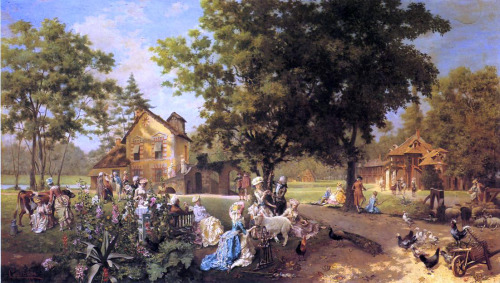
| 'Chesapeake Sunset" by Stephen J. Griffin |
 |
| "Near Oxford: by Jill Basham |
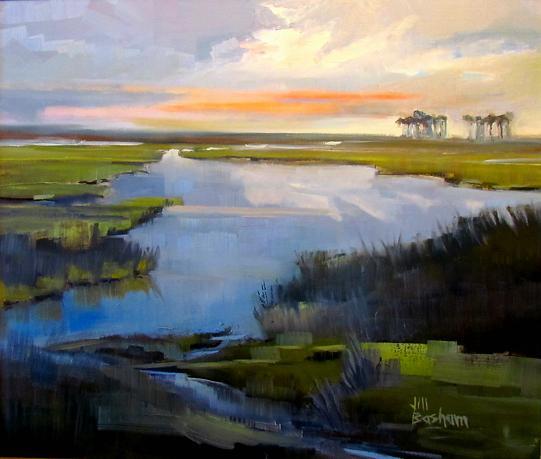 |
| "Blackwater Dawn" by Jill Basham |
Jill is drawn to the landscape and prefers to paint "en plein air" (outdoors, not from photographs). "The immediacy of painting the surroundings in which you are immersed is captivating to me. There is nothing better then feeling the scene and putting the energy and emotion down on canvas with color and brushstrokes." The Eastern Shore of Maryland is inspiring to the artist. Jill is also interested in urban scenes as well as any location in the world that provides inspiration. Jill comes from a family with a multi-generational history of artists.For more of Jill's paintings, please visit HERE.
 | |
| "Before the Rain" by Margot Miller |
Monasteries in those past centuries had to have their own gardens: they needed vegetables for the daily food of their inmates, and fruit was grown in a special area. Flowers and aromatic herbs were raised for decoration of the church. But the smaller herbularies or physic garden was of high importance, too, particularly since the Rule of Benedict of Nursia – who founded the monastery of Monte Cassino, the cradle of the Benedictine Order, in 529 A.D. – stated solemnly: “Before all things, and above all things, especial care must be taken of the sick.”Share
The Benedictine monasteries, J. J. Walsh says, became the repository of important traditions in medicine and surgery, and their scriptorium or writing-rooms preserved many of the old Greek medical writings from perishing from the face of the earth in the midst of contemporary neglect of the intellectual life during the invasion of the barbarians in the early Middle Ages. Their gardens supplied the herbs which were considered to be so precious for the treatment of the various human ills even down to our own day. The beginnings of modern medical education can be connected with monastic influence. (Read entire article.)
They build a strong social fabric. Happy people stay connected to their families, neighbors, places of worship, and communities. These strong connections act as a buffer to depression and create strong, meaningful connections. The rate of depression has increased dramatically in the last 50 to 75 years. The World Health Organization predicts that by 2020, depression will be the second leading cause of mortality in the world, impacting nearly one-third of all adults. While several forces are likely behind this increase, one of the most important factors may be the disconnection from people and their families and communities.Share
They engage in activities that fit their strengths, values and lifestyle. One size does not fit all when it comes to happiness strategies. You tailor your workout to your specific fitness goals -- happy people do the same thing with their emotional goals. Some strategies that are known to promote happiness are just too corny for me, but the ones that work best allow me to practice acts of kindness, express gratitude, and become fully engaged. Dr. Sonja Lyubomirsky offers a wonderful "Person-Activity Fit Diagnostic" in her book The How of Happiness.
They practice gratitude. Gratitude does the body good. It helps you cope with trauma and stress, increases self-worth and self-esteem when you realize how much you've accomplished, and often helps dissolve negative emotions. Research also suggests that the character strength of gratitude is a fairly strong correlate with life satisfaction.[1]
They have an optimistic thinking style. Happy people reign in their pessimistic thinking in three ways. First, they focus their time and energy on where they have control. They know when to move on if certain strategies aren't working or if they don't have control in a specific area. Second, they know that "this too shall pass." Happy people "embrace the suck" and understand that while the ride might be bumpy at times, it won't last forever. Finally, happy people are good at compartmentalizing. They don't let an adversity in one area of their life seep over into other areas of their life.
They know it's good to do good. Happy people help others by volunteering their time. Research shows a strong association between helping behavior and well-being, health, and longevity. Acts of kindness help you feel good about yourself and others, and the resulting positive emotions enhance your psychological and physical resilience. One study followed five women who had multiple sclerosis over a three-year period of time.[2] These women volunteered as peer supporters for 67 other MS patients. The results showed that the five peer support volunteers experienced positive changes that were larger than the benefits shown by the patients they supported.
They know that material wealth is only a very small part of the equation. Happy people have a healthy perspective about how much joy material possessions will bring. In The How of Happiness, Lyubomirsky explains that in 1940, Americans reported being "very happy" with an average score of 7.5 out of 10.[3] Fast forward to today, and with all of our iPods, color TVs, computers, fast cars, and an income that has more than doubled, what do you think our average happiness score is today? It's 7.2. Not only does materialism not bring happiness, it's a strong predictor of unhappiness. One study examined the attitudes of 12,000 freshman when they were eighteen, then measured their life satisfaction at age 37. Those who had expressed materialistic aspirations as freshmen were less satisfied with their lives two decades later.[4]
They develop healthy coping strategies.. Happy people encounter stressful life adversities, but they have developed successful coping strategies. Post-traumatic growth is the positive personal changes that result from an individual's struggle to deal with highly challenging life events, and it occurs in a wide range of people facing a wide variety of challenging circumstances. According to researchers Tedeschi and Calhoun, there are five factors or areas of growth after a challenging event: renewed appreciation for life, recognizing new paths for your life, enhanced personal strength, improved relationships with others, and spiritual growth. Happy people become skilled at seeing the good that might come from challenging times.
They focus on health. Happy people take care of their mind and body and manage their stress. Focusing on your health, though, doesn't just mean exercising. Happy people actually act like happy people. They smile, are engaged, and bring an optimal level of energy and enthusiasm to what they do.
They cultivate spiritual emotions. According to Lyubomirsky, there is a growing body of science suggesting that religious people are happier, healthier, and recover more quickly from trauma than nonreligious people.[5] In addition, authors Ed Diener and Robert Biswas-Diener explain in their book Happiness: Unlocking the Mysteries of Psychological Wealth that spiritual emotions are essential to psychological wealth and happiness because they help us connect to something larger than ourselves. (Read entire article.)