Saturday, February 11, 2017

The Song of Bernadette (1943)

The Song of Bernadette is one of my favorite films. The bleak poverty, the depth of winter, the chilling remoteness of the Pyrenean village are captured magnificently, so that it appears as the most unlikely spot for miracles that would shake the world. There are few more majestic moments in cinema than when the dying baby is plunged into the newly dug spring at the grotto of Massabielle, to come forth with a hearty, healthy cry. (Such a miracle did happen at Lourdes. I always cry at that scene.) Jennifer Jones becomes St. Bernadette; she resembles her a great deal, other than the divergence in height. The tall Jennifer communicates quite masterfully the littleness of the petite Bernadette, as well as her purity and simplicity. Charles Bickford's portrayal of the crusty, skeptical Abbé Peyramale, who becomes Bernadette's indefatigable champion, inspired me to visit the Abbé's tomb in the crypt of the parish church of Lourdes. The Abbé died two years before Bernadette, and so was not at her deathbed as shown in the movie.

The film was based upon the novel by Franz Werfel, one of the greatest Catholic novels written by a non-Catholic. When Werfel, who was Jewish, was escaping the Nazis, he and his wife (the notorious Alma Mahler) stopped in Lourdes on their way to Spain. Werfel found a great deal of spiritual consolation in Lourdes, and promised the long dead Bernadette that he would write down her story. The novel and film romanticize some aspects of Bernadette's life; a few historical liberties are taken. But the portrayals of Bernadette and her family, particularly her horrified parents, already overwhelmed by trials, are fairly accurate, as is the recounting of the amazing events at the grotto.

Remarkably, both the book and film emphasize that it was not the apparitions that made Bernadette into a saint. Rather, it was how she accepted the trials sent by God, from the humiliations in the convent to the debilitating and agonizing health problems that killed her. In the final scene, the faith of a dying nun illuminates a darkening world. I rejoice that her moment of light is artistically captured on film for posterity. Share

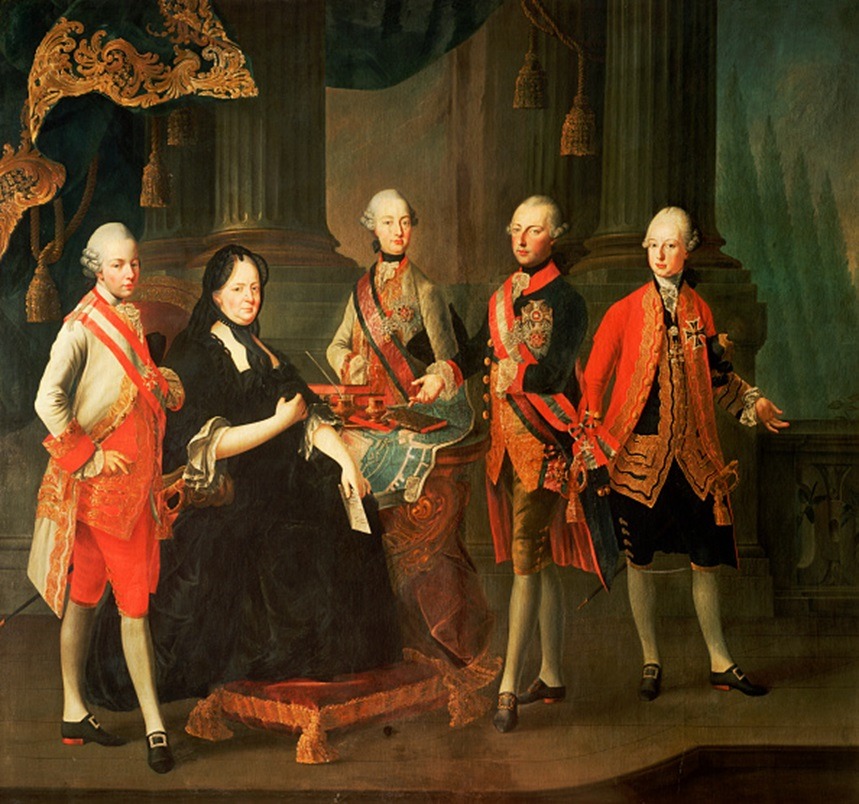
Empress Maria Theresa and Sons

A portrait of Maria Theresa with her four sons that survived to adulthood. Share

Philippines Trip

Dear Friends and Family,
I want to thank everyone who prayed for me during my travels in the Philippines and let you know that your prayers were answered. I had a truly wonderful and rewarding time. I have never been welcomed with such warmth and kindness as I have been by my Filipino cousins. I have never been treated so generously. Getting to know my relatives was the most special part of the journey. Plus I discovered a great deal about my Spanish-Chinese-Filipino heritage and about the life of my grandmother Maria Magdalena Vidal Crosby Strong. I am grateful to my cousins Drs. Jaime and Carol Almora for making it all possible.

 
On the long flight to the Far East,  I took Qatar airlines, which offered delicious meals, wines, movies, and clean facilities. There were signs which asked people to pray seated rather than prostrate in the aisles! I changed planes in Qatar. I have never seen so many  Muslims, in various costumes. There were pilgrimage groups heading towards Mecca, the men and women sitting on the floor in separate groups. There were sheiks that look like they stepped right out of the desert, followed by groups of women in burkhas. The airport is huge, modern and high tech. The entire scenario was like a combination of Star Wars and Lawrence of Arabia. Everyone was cordial but they charge a lot for a cup of coffee. I could see the Persian gulf from the airport, pale blue and serene.

I thought the airport in Manila was clean and nice. My cousins met me there and immediately began to treat me like a queen! I spent the first night at the Manila Hotel where General MacArthur once stayed. All I could say was: "Grandma, I am here at last!" In the morning I had the most delicious breakfast at the hotel. It was Chinese New Year, with red lanterns everywhere. A few Christmas trees too.

That day I toured Manila with my cousin Jaime and his assistant Abe. I saw my grandparents' old neighborhood and the park where my mother played as a child, right near the beautiful Manila Bay. After lunch we visited Santo Tomas University where my grandfather was a prisoner of war of the Japanese.


We found his name on the list of prisoners. Later, we did research at St. Luke's hospital which was run by the same Anglican missionaries who brought up my grandmother. In the evening we had a big family feast with my cousins! All of them are fascinating people! My cousin Eddie remembers his father talking about visiting my Grandma's house during the Japanese occupation, and especially about a certain "little blonde girl" who charmed everyone. She was none other than my mother!


The next day I went to a medical mission in a small town with my cousin Dr Jaime where he and his daughter Dr. Adalyn provided medical care for poor people in need. There were other doctors present as well. Hundreds of people were there seeking medical help. It was in a gymnasium. The crowd was positively festive. I chatted with some women who were waiting for dental treatment. There was a magnificent old Spanish church next door where I prayed.  I think there is a power in praying in a place where many poor people have prayed. They have nothing but faith and their faith is strong and gives glory to God.


That night we arrived in the mountains of Baguio at my cousin Jaime's house there, where Cousins David and Tatet Almora lived with their children and grandchildren. The little ones were darling and called me "Grandma." It was cold outside but lovely and the Pacific Ocean could be seen far in the distance. We had a feast with the extended family to celebrate the Chinese New Year. The food was fabulous. They were all amazed at my willingness to try the various Filipino dishes. The next day I visited the hospital where my mother was born; later we went  driving over steep one lane roads to the mining camp where my Granddad worked as an accountant and where my Aunt Floy was born. We had lunch at the former officers' club at Camp John Hay.  I saw Baguio Cathedral as well as the Baguio Country Club to which my grandparents had belonged. There was also a giant mall.


That night we drove six hours through the mountains to Kalinga province in the northern highlands of Luzon where my Grandma's brother Frank had his plantation. It is still in the family and is now owned and operated by Cousin Jaime and they grow rice there. I stayed at their family home in Tabuk which is next to the hospital built and operated by my cousin so that the poor can receive the best medical care. When someone is sick in the Philippines they are accompanied to the hospital by many family members, especially if the sick person is a child. Jaime and Carol feed about a hundred people a day from their own kitchen. In the garden there are many pets, including ostriches, which danced for me!


In the morning I watched the Miss Universe pageant with everyone else in the Philippines. In the evening we had supper at the family farm, and visited graves of all the grandparents and other cousins where we prayed and lit candles. The men chopped up some coconuts and we had fresh coconut scrapings with mango ice cream and never was there anything more delicious!


I later had a more extensive tour of Cousin Jaime's lands by truck. We drove through acres of rice paddies and I got a good look at how farming is done. I also saw plenty of carabao, a deer, and all kinds of flora and fauna, especially chickens. Then we went to see an older lady named Amelia who lived near my grandparents in Manila during the war. Her stories about the war were helpful for the book I plan to write. I also was able to talk to Carol's father Grandpa Jerry who had been a guerilla fighter against the Japanese during the war. He told me many amazing things and gave me a copy of his memoirs.


One night my cousins Jaime and Carol had a wonderful party for me in their courtyard. Jaime was dressed as a local chieftain. The hospital staff was there and many family members. My lovely niece Blessie was Mistress of Ceremonies. The local high school students dressed in traditional Kalinga garb and danced the most incredible courtship dance. Jaime and Carol danced too. They invited me to join them and we all danced. Then they dressed me in their beautiful traditional costume, handwoven. And we danced some more, even faster. Then we had a feast of local cuisine, prepared by their cook who is a former cook of Imelda Marcos. What a magical time! The youngsters radiated such charm and innocence!


The following day we caught a plane to Manila and then we flew to Leyte island to the town of Maasin where another medical mission was being held. We saw the spot where General MacArthur landed.


Then I went with my cousin Cely and niece Blessie on a special excursion to the isle of Limosawa where Magellan erected a cross and the first Mass in the Philippines was offered. We traveled on an extremely rustic boat surrounded by crates of eggs. The gangplank was rickety and narrow and several souls were delivered from purgatory each time I traversed it. Several of the crew formed a chain to help us ladies disembark on the beach of Limosawa. We walked across the beach to our hotel.


After the boat ride I felt the need for a drink but the hotel bar only sold liquor by the bottle. So we bought a bottle of Napoleon brandy. Later we climbed into a pick up truck owned by the vice-mayor of Limosawa and toured the island where there were mostly bamboo huts. The bamboo huts are so much nicer looking than the metal shacks that have replaced them in other parts of the country. We saw the lush tropical forest and the memorial to the first Mass in the Philippines. While Cely and Blessie hiked up the mountain to see Magellan's cross, I lingered below in the lovely garden while listening to the carabao call to each other.


The next day we crossed back to main land Leyte in a better boat but the ocean was rough and the boat pitched and waves crashed over us. I sat with a Polish lady (there seemed to be a great many Poles touring the Philippines) and at first we were annoyed when the crew covered us with canvas but when the waves started crashing we understood why. That evening I had a lovely time with my cousin Cely and my nieces Blessie and Ada. We talked and talked in the lovely open dining room of the hotel overlooking the Pacific. I spiked my mango shake with the brandy we bought in Limosawa.

The following day we took a boat to Cebu. There was a typhoon warning but nothing came of it and the weather was lovely. We stayed in a lovely condo in Cebu City lent to us by one of Carol's relatives. There I met Uncle Oscar Binoya, a son of my grandmother's half-sister Julia. Julia was incredibly beautiful but I never saw any pictures of her until recently. We talked about the rift between my grandmother and Julia and Uncle Oscar said that my grandfather forbade Julia from coming to the house because of her dark skin. I was quite shaken to hear it. Similarly, my grandmother had been sent away from her family as a small child because of her white skin; her stepfather did not like her. She was brought up and later adopted by an American missionary, Frances Crosby Bartter.


We went with Uncle Oscar to the island where Magellan was killed by the chief Lapu Lapu. At the spot where two fearless, hard-headed men faced each other there was a lovely garden where students were recreating, a cheerful irony.


The following morning we drove over the mountains to the village of Balamban where my grandmother was born. It was a new road for in the olden days, people would have journeyed along the shoreline or taken a boat to get to another side of the island of Cebu. As we arrived in Balamban there was a fiesta in progress with all the local children in their finest array. They processed and danced in honor of the Holy Infant Jesus. It was the First Saturday of the month and when we went into the magnificent old church of St. Francis, where my grandmother and her brother Frank had been baptized, there was a First Communion Mass going on. The parish office was opened and I had a look at the parish registry. It was all written in the same hand for over twenty years of entries which I thought odd. I figured that there had been damage from a storm or fire to the older registries so what was left was copied into one volume. As it was, the entry concerning the my grandmother's baptism was missing. But then I remembered her telling me that her records were lost in a storm which is why the Episcopalians gave her a conditional baptism. Sometimes we learn more from what we do not find than from what we do find.


In the afternoon we visited one of the great shrines of the world, the shrine of the Santo Nino of Cebu. Magellan had bequeathed a statue of the Child Jesus to the Queen of Cebu and when the Spanish returned years later they found the statue was still being venerated by the natives. Many miracles have surrounded it through the years. One of the Augustinian friars gave us a tour of the shrine and the  monastery. The next morning, I had the privilege of assisting at Mass at the shrine with thousands of devotees. A little Child who is King and God won the hearts of a people and continues to win hearts today. There is so much reverence in all the churches I visited in the Philippines.

On my last day in the Philippines I enjoyed a spa day at the elegant salon of my beautiful niece Dr. Ada Almora. I had a facial, a makeover, a massage, and several other procedures, which combine the skills and insights of both the East and West. I came away feeling invigorated and looking great. I also had my hair done at the salon of Sandy Gee where my sweet niece Dr. Christine Almora took me. I had so many lovely conversations during the course of the trip.

Then it was time to pack and go to the airport. I was sad to leave the Philippines.
It is a country where family and faith truly are everything. Divorce and abortion are against the law. The Sunday masses are overflowing. Although there are social problems due to poverty, one has the sense that for the most part, purity and virtue are cherished. The people are hard-working, resilient and resourceful; the great poverty is due mainly to government corruption and mismanagement that occurred during past regimes.
 
Once again I passed through Qatar. The security was much tighter when heading towards America. I was patted down and had to take off my shoes and everything. I was x-rayed several times.

The flight to JFK from Qatar was quite long but I had some good books to read and they had some good movies. Plus I saw Russia for the first time, from the air, in the daylight: a vast country covered with snow and great forests. Oh but JFK was a nightmare! I had to claim all my baggage and then recheck it for the flight to BWI. How I missed the Philippines where I always had someone to help me! I had so much trouble understanding the people who worked at JFK because of their accents! No one bothers to enunciate. I also had one of my bags split open, then I left my passport and boarding pass at the baggage check-in and they would not let me back in to get it. One of the airport workers was kind enough to get it for me though. And I almost missed my connecting flight because of the long lines at security. I had to run across the airport to catch my plane.

Once at home, I went to Mass to thank God for the fantastic trip to the Philippines and for the safe return journey. My dearest cousins, Carol and Jaime Almora, I cannot thank you and Ada, Blessie, Christine, and Abraham and Celenia enough for all that you did to make my trip to the Philippines so wonderful and totally unforgettable. And all the other Almora and Binoya relatives that did so much to welcome me! My family here rejoices in the connections that have been forged with our relatives on the other side of the world. I have returned to my home basking in the happiness of my trip to the Philippines. My mother loves the gifts you sent and the rest of the family as well. She sends her gratitude for the love and care that you all showered upon me.

Now it is time to write the book about my grandmother's life; I am still trying to think of a title. Any ideas?
Share

Friday, February 10, 2017

Where Were the Protestors When Christians Were Being Murdered?

From Theodore Shoebat:
Major leader of the Catholic Church, Catholic Archbishop of Erbil, has declared to all those protestors against Donald Trump: Where were you when ISIS was terrorizing and persecuting Christians in Iraq? He made this question in a recent interview, as we read in one report:
The Catholic Archbishop of Erbil has denounced the hypocrisy of those protesting President Trump’s recent executive order on immigration, wondering aloud where all of the demonstrators were when Islamic State fighters were slaughtering Christians and other minorities in the Middle East.

In an interview with the online journal Crux, Archbishop Bashar Warda said that from his perspective in Iraq, he couldn’t help but ask “why all of these protesters were not protesting in the streets when ISIS came to kill Christians and Yazidis and other minority groups.”
Warda also criticized the policies of the Obama administration, which offered no financial assistance to displaced Christians in Islamic State territory and instead favored Syrian Muslims when it came to accepting refugees into the United States.

“They were not protesting when the tens of thousands of displaced Christians my archdiocese has cared for since 2014 received no financial assistance from the U.S. government or the U.N.,” he said. “There were no protests when Syrian Christians were only let in at a rate that was 20 times less than the percentage of their population in Syria.”

“I do not understand why some Americans are now upset that the many minority communities that faced a horrible genocide will finally get a degree of priority in some manner,” Warda added. The archbishop also suggested that the inconvenience posed by a three-month moratorium on visas is nothing compared to the suffering of minorities in Iraq and Syria during the past several years, and yet no one seemed to think that was worthy of a protest.

“Most Americans have no concept of what it was like to live as a Yazidi or Christian or other minority as ISIS invaded,” he said. “Our people had the option to flee, to convert, or to be killed, and many were killed in the most brutal ways imaginable.”

“But there were none of these protests then of ISIS’s religious test,” he said.

In his lengthy interview, Warda underscored the hypocrisy of protesters who are willing to side with Muslims but won’t lift a finger to aid Christians facing genocide in the Middle East. “Our people lost everything because of their faith—they were targeted for their faith, just like the Yazidis and others too,” he said. “Now these protesters are saying that religion should not matter at all, even though someone was persecuted for their faith, even though persecution based on religion is one of the grounds for refugee status in the UN treaty on refugees.”

“From here I have to say, it is really unbelievable,” he said. (Read more.)
Share

God's Universe

Science helps us to grow in knowledge and awe of God's magnificent creation. From Monsignor Charles Pope:
As we look out on God’s universe, we cannot even fathom how huge and magnificent it is; we cannot comprehend its immensity. If one were to make a scale model of the Milky Way galaxy and reduce each star in it to the size of a grain of sugar, the model would have to be about 2000 miles wide and 1000 miles high—and that’s just one galaxy! There are billions of galaxies in the universe, which is ever expanding. Even the nearest star in our galaxy is about 25 trillion miles away from us.

And we are whirling around and outward! Earth rotates at a speed of about 1000 miles per hour (at the equator) while itself revolving at roughly 67,000 miles per hour around the sun. And our entire solar system is rotating around the center of the Milky Way galaxy at more than 500,000 miles per hour. And the Milky Way galaxy is flying outward and away (according to Doppler shift) at 1.3 million miles per hour! All creatures great … praise the Lord, for He has made them all!

Inner Space: What is equally amazing is the universe that exists, hidden from the naked eye, in what we might call “inner space”: that tiny, almost invisible world of microbiology. In just a drop of pond water there may be hundreds of thousands of bacteria and microorganisms, a veritable universe unto itself. Indeed, in every human body there are trillions of microorganisms in a kind of microbial fauna. About 80 different types of microorganisms live in the mouth alone. Every square centimeter of the human bowel contains as many as 10 billion organisms. Every square centimeter of our skin contains about 10 million individual bacteria. Even on our eyelashes are colonies of helpful bacteria and microorganisms that help keep the harmful ones away. These massively numbered civilizations—universes, really—of microorganisms are only recently known to us, thanks to the invention of powerful microscopes. To those in this “micro-world,” our bodies must seem as massive as outer space seems to us. If a microorganism could think, it would consider our bodies a universe too large to comprehend. Just as there are trillions of stars, there are trillions of microorganisms. To a microbe on our eyelash, a bacterium on our toe seems light-years away. (Read more.)
Share

Thursday, February 9, 2017

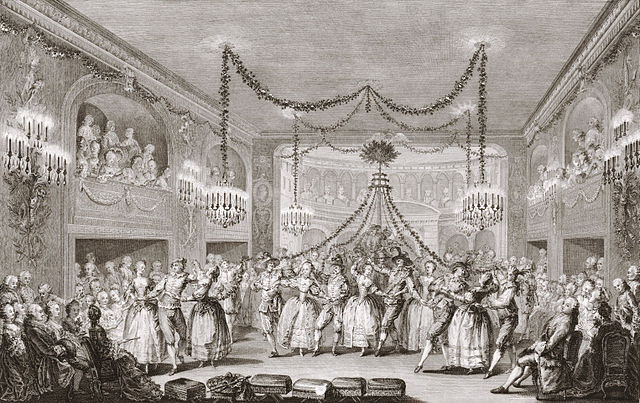
Carnival at Versailles

Carnival is the season that proceeds Lent and it was celebrated with many festivities in Catholic countries. Via Vive la Reine. Share

The Chinese in the Philippines

As many of you know, I just returned from a marvelous trip to the Philippines to visit relatives and gather information for a book. Here is an article about the Chinese Christians in Cebu, from whom I am descended. To quote:
In the case of the Chinese who settled in the Philippines to take advantage of the galleon trade, the formation of ghettos (where the infidels could be proselytized to Roman Catholicism), known as the parian, also became a reality. The Spanish Crown later recognized the leaders of the Chinese Christians as also part of the principalia, and like their native equivalent, could carry the Hidalgo titles of don or doña, were permanently exempted from tribute and labor services, and exercised the right to hold public office and participate in elections. In office, they were granted such emblems of authority as canes, hats and a retinue of deputies. (Read more.)
Share

Mary Ward and the Institute of Mary

From Nobility:
Her idea was to enable women to do for the Church in their proper field, what men had done for it in the Society of Jesus. The idea has been realized over and over again in modern times, but in the seventeenth century it met with little encouragement. Uncloistered nuns were an innovation repugnant to long- standing principles and traditions then prevalent. The work of religious women was then confined to prayer, and such good offices for their neighbour as could be carried on within the walls of a convent. There were other startling differences between the new institute and existing congregations of women, such as freedom from enclosure, from the obligation of choir, from wearing a religious habit, and from the jurisdiction of the diocesan. (Read more.)
Share

Wednesday, February 8, 2017

Madame de Genlis and Napoleon

From Shannon Selin:
In 1802, Napoleon provided Madame de Genlis with an apartment in the Arsenal Library. After becoming Emperor in 1804, he granted her a pension of 6,000 francs a year. In return, Napoleon required that Madame de Genlis write him regular letters. Some thought this was a pretext for her to act as Napoleon’s spy among partisans of the ancien régime. French Foreign Minister Talleyrand (not always a reliable source) recounted how, on the evening of the Battle of Austerlitz, he read to Napoleon the “report” of Madame de Genlis.
It was long, and written entirely in her own hand. She spoke of the spirit of Paris, and quoted a few offensive conversations held, she said, in those houses which were then called Faubourg Saint-Germain; she named five or six families, which, never, she added, would rally to the government of the emperor. Some rather biting expressions which Mme. de Genlis reported set Napoleon in an inconceivable state of fury; he swore and stormed against the Faubourg Saint-Germain. (3)
However, according to Napoleon’s private secretary Baron Méneval, the letters were simply intended to make Madame de Genlis feel that she was not living on imperial charity. (Read more.)
Share