Friday, September 13, 2013

Praying to St. Anne

From the Tea at Trianon Forum. Thank you, Tiny-Librarian! To quote:
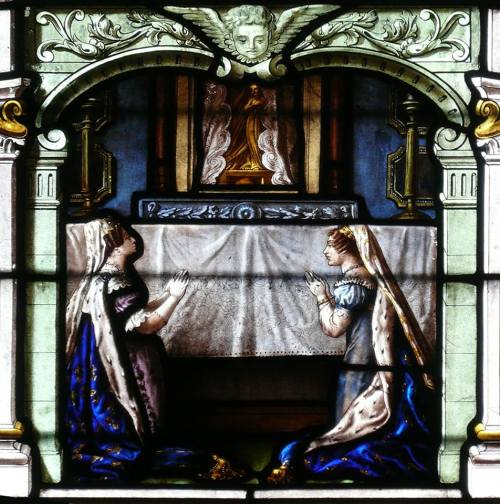
A large stained glass window in the Basilica of Sainte-Anne d’Auray. It was given to the church by Henri, the Comte de Chambord.

It portrays his mother, the Duchesse de Berry, and his aunt, the Duchesse d’Angoulême, kneeling in prayer before a statue of Saint Anne, the patron saint of Brittany.
Source Share

A Plea for Caution from Russia

This piece by Russian President Putin is interesting on many levels. Our Lady at Fatima asked everyone to pray for the conversion of Russia, saying that it would lead to peace. Let us keep praying. To quote:
No one doubts that poison gas was used in Syria. But there is every reason to believe it was used not by the Syrian Army, but by opposition forces, to provoke intervention by their powerful foreign patrons, who would be siding with the fundamentalists. Reports that militants are preparing another attack — this time against Israel — cannot be ignored.
It is alarming that military intervention in internal conflicts in foreign countries has become commonplace for the United States. Is it in America’s long-term interest? I doubt it. Millions around the world increasingly see America not as a model of democracy but as relying solely on brute force, cobbling coalitions together under the slogan “you’re either with us or against us.”
But force has proved ineffective and pointless. Afghanistan is reeling, and no one can say what will happen after international forces withdraw. Libya is divided into tribes and clans. In Iraq the civil war continues, with dozens killed each day. In the United States, many draw an analogy between Iraq and Syria, and ask why their government would want to repeat recent mistakes.
No matter how targeted the strikes or how sophisticated the weapons, civilian casualties are inevitable, including the elderly and children, whom the strikes are meant to protect.
The world reacts by asking: if you cannot count on international law, then you must find other ways to ensure your security. Thus a growing number of countries seek to acquire weapons of mass destruction. This is logical: if you have the bomb, no one will touch you. We are left with talk of the need to strengthen nonproliferation, when in reality this is being eroded.
We must stop using the language of force and return to the path of civilized diplomatic and political settlement. (Read more.)
Share

Iran: A New Direction

Some people are optimistic. To quote:
In 2013, nearly a quarter century after Rafsanjani's first election to the presidency—literally a lifetime in a country where two-thirds of the population is below the age of 30—the possibility of his return to the office loomed large as the latest ballot approached. He had already served two terms, from 1989 to 1997, and had sought a third in 2005, in a tight race against Mahmoud Ahmadinejad, then mayor of Tehran. He lost that contest in a run-off, a defeat that stung the establishment and catapulted the little-known Ahmadinejad into the limelight. Ahmadinejad's presidency reversed the trajectory of Iran's post-war path of moderation, and put the revolution back on a collision course with the international community.

This time around, after months of public vacillation, Rafsanjani arrived to register his candidacy at the last possible moment, creating a perfectly orchestrated election surprise. His dramatic bid captivated an Iranian political establishment that had been in a state of suspended animation for four years, ever since the massive street protests that erupted after Ahmadinejad's dubious 2009 reelection. Not that Rafsanjani's candidacy was universally welcomed. Over the years, the disappointments of his tenure and his reputation for opportunism and corruption had eroded public support, perhaps accounting for the failure of his last two campaigns (a 2000 bid for the parliament as well as the 2005 presidential race). But he remains a heavyweight. And after the havoc wrought by Ahmadinejad, the prospective candidacy of a politician still considered a man of action and substance buoyed hopes for a better future.
 
Iranian elections adhere to an idiosyncratic set of procedures. While anyone can toss a hat into the ring, a clerical oversight body—the Council of Guardians—determines who is permitted to run. The eligibility criteria are vague enough to enable the regime to cull all but a few hand-picked insiders. In a bizarre turn of events, the Guardians rejected Rafsanjani's bid for another go at the office he had held for eight years. However absurd the Islamic Republic's vetting process has been in the past—and more than two dozen elections over the course of 34 years have provided abundant fodder for ridicule—the ruling that one of the regime's founders was unfit to run for the presidency carried the farce to a new level. (Read more.)
Share

Thursday, September 12, 2013

Louis XVI, Marie-Antoinette and the Dauphin Louis-Charles

Conjugem sequerer meum, Nisi hic teneret.~ Seneca's Troades

According to the Waddesdon Rothschild Collection:
In the medallion, Marie-Antoinette is placed on the left, Louis XVI on the right and Louis-Charles between them in the front. Marie-Antoinette has a tall hairstyle decorated with feathers and flowers. She wears an ermine cape decorated with fleur-de-lis. Louis XVI wears a lace collar and an ermine cape also decorated with fleur-de-lis. Louis-Charles wears an open collar and a sash.....

The print quotes from Seneca's Troades, a passage where Andromache states that she'd follow her husband (Hektor) into death if her son (Astyanax) did not bind her to life. Using a classical tragedy in this context serves to highlight the tragedy of the royal family. The interpretation could change depending on whether this was created before or after Louis-Charles' death on 8 June 1795. Paul thinks it is more likely to date after Louis-Charles' death. (Read more.)
Share

Why I Love the Stuarts

Author Andrea Zuvich explains her fascination with the Stuart dynasty, as follows:
As Louis XIV was enjoying his autocratic powers in France, across the Channel there was an equally fascinating royal line in England - the Stuarts. This tragic dynasty has fascinated me for years, but I never thought that my passion for their history would lead to my writing historical fiction. At first, writing evolved out sheer frustration. I had been working at a palace in London, and visitors would come up to me and ask questions about the history of the palace and the people who had once inhabited it. They were constantly getting Mary, Queen of Scots completely confused with Mary II, or trying to relate a room’s history to a Tudor, so that is what spurred me to write. I figured that more people want to read a fictionalised depiction rather than an academic study. That being said, I try to keep my work as historically accurate as possible, without bashing people on the head with historic details. But then I ran into the hurdle of the market…

I still find it really sad to get rejections from publishers with the line, “though your story seems very interesting, we cannot be sure we can successfully market a book set in the 17th-century or about the Stuarts” (!) What is it about the 17th-century that makes both readers and publishers go cold? I have asked, and it’s usually the following:

        “The 17th-century is boring. Nothing cool ever happened in it.”

        “I’m happy with the Tudors, nothing else can come close to them.”

Elizabeth I died in 1603, ending the Tudor dynasty and causing the Stuart dynasty in England to begin. No fewer than seventeen of Shakespeare’s plays debuted during the Seventeenth Century, and throughout the period there were massively important political changes. Some of the biggest consequences of the English Civil War were the beheading of King Charles I, the abolition of the monarchy and the Interregnum and Commonwealth under Oliver Cromwell. Indeed, it is lamentable that the joy in life seems to have been sucked out of England during Cromwell’s time, and this decade of Puritanism has tainted the public’s perception of the whole century. For after Cromwell’s death, everything changed again during the Restoration of the monarchy: this period is full of colour, seduction, the arts flourished once again, and it’s just amazing to learn and write about. Boring? Nothing could be further from the truth! (Read more.)
Share

Wednesday, September 11, 2013

Guichette

Anna Gibson posts on the eldest child and only daughter of the Royal Governess Madame de Polignac. She was Aglaé de Polignac, the Duchesse de Guiche, whom Marie-Antoinette nicknamed "Guichette." To quote:
Aglaé Louise Françoise Gabrielle de Polignac (7 May 1768 - 30 March 1803) was the first child and only daughter of Yolande Martine Gabrielle de Polastron and Jules de Polignac. In 1780, she was married to the Antoine Louis Marie de Gramont, duc de Guiche. They had three children.

In 1784, the talented Elisabeth Vigee-Lebrun painted the 16 year old Aglaé in a simple, pastoral dress that was popularized in the 1780s by the rise of country and hamlet inspired fashions. (Read more.)
Share

Saxon Healing Herbs

From English Historical Fiction Authors:
Bald’s Leechbook  is the only document whose content appears to reflect a fairly pure English tradition and is free of much influence from the Mediterranean world. The plant names are given in English for example. The surviving manuscript which is held at the British Museum was probably compiled in the 9th century, possibly around 850 AD. The books title is from an inscription which reads Bald habet hunc librum Cild quem conscribere iussit, meaning “Bald owns this book which he ordered Cild to compile.” Who Bald and Cild are we have no idea.
Saxon Traditions and the Christian Faith
What is interesting is that although this book was written during the mid Anglo-Saxon period when Christianity was well established, it is clear that many beliefs from the earlier pagan religions were still held as well as the new faith. This is shown by these examples of illness caused by dark-elves whom the Saxons believed attacked people during the night or by relations with the devil.
For elf sickness, a leechdom…one must sing over the plants before one takes them and one must place them under an altar. (Read more.)
Share

Tuesday, September 10, 2013

Dance Cards

Via Tiny-Librarian. To quote:
Vintage Dance Cards of the 19th Century
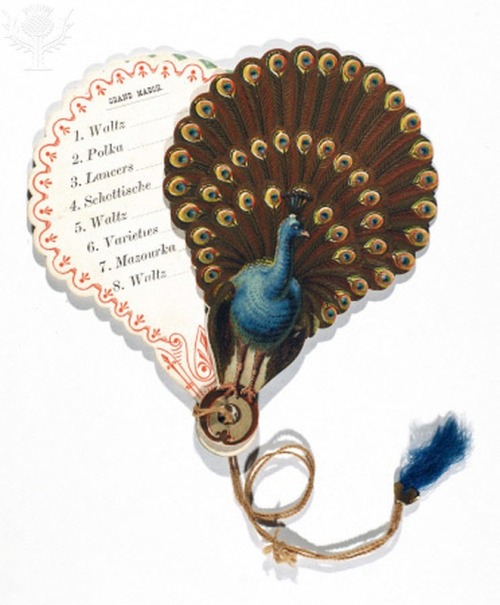
The dance card was a courtly tradition in which women had preassigned dance partners for each dance at the event. The tradition was convenient and inclusive. No wall-flowers allowed at these events. When you consider today’s jr. high dances (and even some weaker high school ones) in the auditorium or cafeteria with boys swaying nervously on one side staring at the girl’s busily chatting away on the other, the dance card is a far more social, viable alternative....

All are from the 19th century with the earliest dating to 1850 (the peacock cover). They represent beautiful visions of the past and remind us of a time when leaving a woman standing alone was not considered “good taste”. (Read more.)
Share

Cardinal Maury

From Madeleine Doak:
Jean-Sifrein Maury was born in Valréas in 1747 and died in Rome in 1817.  He successfully, for the most part, navigated the churning water that was France during the transition from ancien régime to the Bourbon Restoration, seemingly by jumping from life raft to life raft and supporting whomever was at the helm.  During those years, he went from Abbé to Cardinal and received honors and recognition for his speaking and writing.  He was especially known for his dry wit.

During the early years of the Revolution, the abbé was a member of the Académie Française and the Estates General.  In the National Constituent Assembly, he was a defender of the monarchy known for his oratory contests with Mirabeau in which he was "though always defeated on the vote, was not seldom the conquerer in the debate," according to New Advent online Catholic Encyclopedia.  In 1792, he joined the French émigrés in Coblenz where he was hailed by Louis XVIII as a defender of the Church and of the monarchy.  As the tides turned, he supported Napoleon and his pursuit of divorce from Josephine which resulted, later, in suspension and imprisonment by the Pope.   Cardinal Maury's health suffered as a result of his months in prison and he died in May 1817, rosary in hand.  Despite his steadfast support of the monarchy years earlier, Louis XVIII never forgave Maury's association with Napoleon and refused to allow him to be buried in his titular church. (Read more.)
Share