St. Dominic and the Triumph of Grace
5 days ago


As queen, Matilda used her newfound wealth to continue financing and expanding the Holy Trinity Abbey back in Caen, although with her customary dedication to Christianity she enthusiastically supported the reforms of the English Church which her husband and Archbishop Lanfranc were introducing, including forbidding priestly marriage and the corrupt selling of church offices. Under his wife's influence, William became more and more religious as he grew older and the Queen's household was noted for its regular attendance of Mass and its exemplary morality. The Queen was certainly not above throwing a tantrum when her husband took a mistress and faced with his diminutive wife's rages, William eventually ceased his adulteries altogether.Share
Farewell, an engrossing French spy movie in which Ronald Reagan is one of the heroes, is perhaps the finest film of this year. Veteran character actor Fred Ward (astronaut Gus Grissom in The Right Stuff) plays Reagan in a supporting role, while Willem Dafoe (the Green Goblin in the first Spider-Man film) portrays his CIA director William Casey.
Farewell makes the audacious claim that our Cold War victory was substantially hastened by a lone KGB colonel codenamed “Farewell.” In 1981, Vladimir Vetrov, a fed-up Russian engineer, began copying KGB technology documents and delivering them to the French equivalent of the FBI. Socialist François Mitterrand, who had been elected president that year with the help of the Moscow-controlled French Communist Party, demonstrated his anti-Communist bona fides by personally passing along the “Farewell Dossier” to Reagan on July 19, 1981.Share
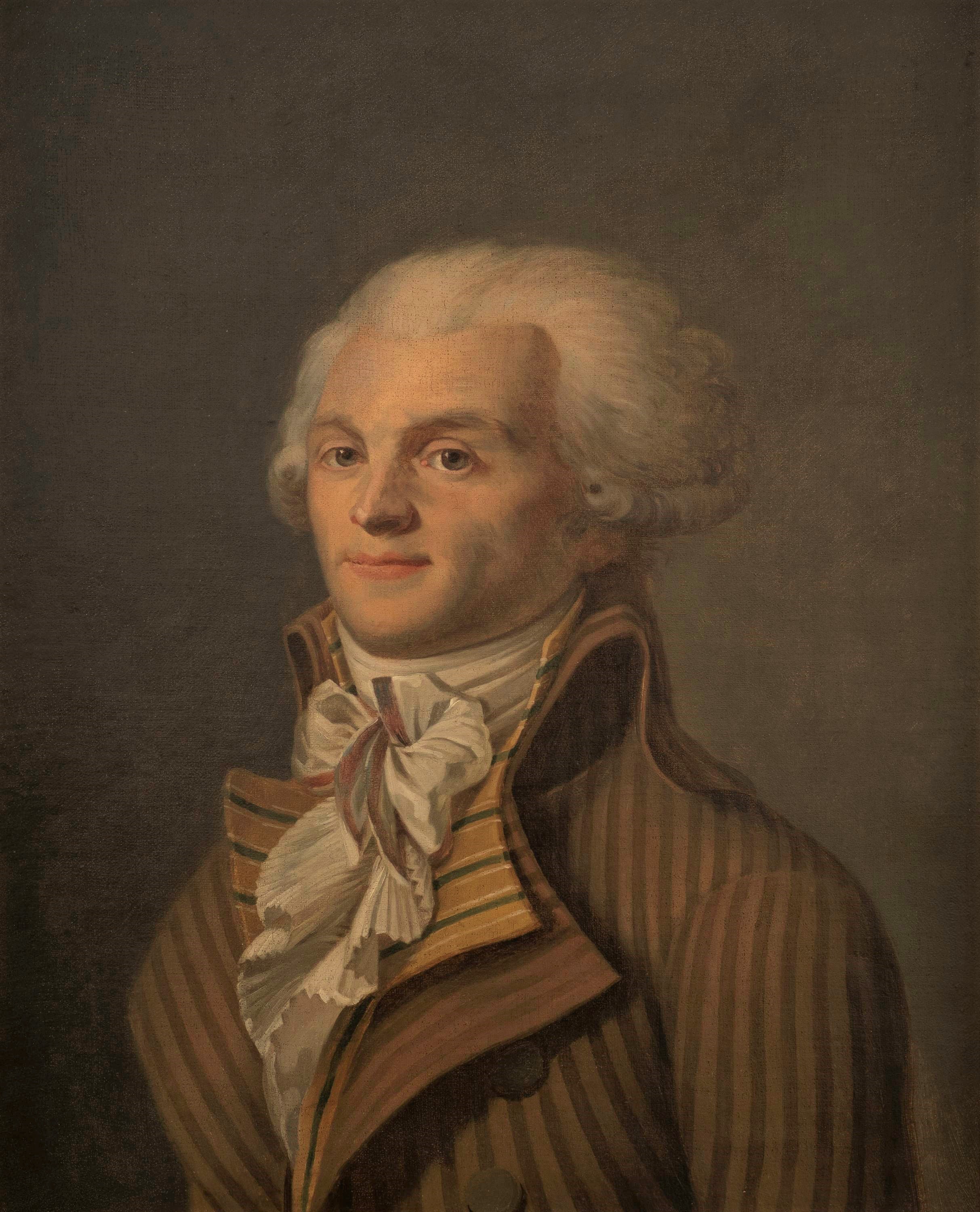
Born as Maximilien François Marie Isidore de Robespierre in 1758 in Arras, France, out of wedlock (his parents later married), after his mother’s death when he was six years old he was raised by his maternal grandmother and aunts. In October of 1769, on the recommendation of the bishop, he obtained a scholarship at the Lycée Louis-le-Grand in Paris. At the age of seventeen he was chosen from five hundred pupils to deliver a speech to welcome King Louis XVI to the school, shortly after the king’s coronation. On the day of the speech, Robespierre and the crowd waited for the king and queen for several hours in the rain. Upon arrival, the royal couple remained in their coach for the ceremony and immediately left thereafter. After having completed his law studies, Robespierre was admitted to the Arras bar. The Bishop of Arras appointed him criminal judge in the Diocese of Arras in March 1782. This appointment, which he soon resigned to avoid pronouncing a sentence of death, did not prevent his practicing at the bar. He quickly became a successful advocate and chose in principle to represent the poor. During court hearings he was known to often advocate the ideals of the Enlightenment and argue for the rights of man: i.e. his clients. Later in his career he read widely and also became interested in society in general and became regarded as one of the best writers and most popular young men of Arras. In December 1783 he was elected a member of the academy of Arras, the meetings of which he attended regularly. In 1784, he obtained a medal from the academy of Metz for his essay on the question of whether the relatives of a condemned criminal should share his disgrace. He and Pierre Louis de Lacretelle, an advocate and journalist in Paris, divided the prize. Many of his subsequent essays were less successful, but Robespierre was compensated for these failures by his popularity in the literary and musical society at Arras. In 1788 he took part in a discussion of how the French provincial government should be elected, showing clearly and forcefully in his Addresse à la nation artésienne that if the former mode of election by the members of the provincial estates were again adopted, the new Estates-General would not represent the people of France. It is possible he addressed this issue so that he could have a chance to take part in the proceedings and thus change the policies of the monarchy. King Louis XVI later announced new elections for all provinces; although only thirty, comparatively poor and lacking patronage, Robespierre was elected fifth deputy of the Third Estate of Artois to the Estates-General.Share
The heinous crimes of which Anne Boleyn was sentenced to death are liable for the myriad interpretations as to the character of, and the ensuing countenance toward Henry VIII’s second Queen Consort. The brevity of Anne’s arrest, arraignment and condemnation is striking and the scarce remnants of these measures have further muddied the scholarly analysis of Anne’s reign and demise. Perceptions of Anne are undoubtedly shaped through the popularisation of her legend, from Shakespeare’s compassionately naive ‘Bullen’ to Hirst’s enigmatic, sensual and headstrong suggestion. To unpick the truth behind the multi-layered and often tarnished veneer that Anne has been coated in, an acute analysis of the limited primary material available is essential in establishing a coherent picture. It is a treacherous path, one paved with ancient judgment, contemporary misrepresentation and crude propaganda. To navigate it, the historian must assume not simply the role of judge, but of the judicial process in its entirety. Anne’s ‘case’ is essentially a re-trial, having been condemned in her own lifetime; however the rigid process of examination remains firm. Through meticulous analysis of all available evidence, they must assume both prosecution and defence roles. Evidence is heard from contemporary voices long departed, and considered by the historian as a solitary jury. There is a unique element to the historian’s court which, as judge, they must examine: the previous ‘trials’ completed by other historians. Their verdict must answer not only their own judgement of the case, but must convincingly question and challenge their predecessors' attempts. With over 400 years of analysis, it is no small task, and with a ‘definitive’ analysis by Eric Ives, Bernard’s task is an ambitious one.Share

 One of the Revolutionary leaders and greatest adversaries of Marie-Antoinette was Philippe d'Orléans. Although Philippe Égalité, as he came to be called during the Revolution, liked to portray himself as a man of the people, he was not averse to creating his own stately gardens. The Parc Monceau was in the English style, like the gardens of Trianon. According to A View on Cities:
In 1769, the Duke of Chartres (later the Duke of Orleans) purchased a small parcel of land on which he hoped to build a garden. A pavilion was built in the center and the Duke planned to expand the area throughout the next decade.
The Duke hired Louis Carrogis Carmontelle to design the gardens in an English style. Such gardens are much less formal than the traditional French garden, which is what distinguished it from many other parks in Paris. Carmontelle added random sculpture of famous Frenchmen as well as small-scale architectural features such as a windmill, pyramid, and some Corinthian pillars.There are said to be many masonic references in the designs of the park, which is not surprising since Philippe was a dedicated adept. The Parc Monceau is featured in the novel Madame Royale as the setting of the picnic to which Louis-Philippe invites Thérèse.

 (Photos)
Share
(Photos)
Share
Cecily was indeed buried at Fotheringhay. On a visit there, Elizabeth I, distressed at the neglect of the graves of her ancestors, ordered that the bodies be moved into the present church and that monuments be erected over them. Cecily's coffin was opened for the removal, revealing that she had been buried with a papal indulgence tied around her neck with a silver ribbon. The handwriting on the indulgence was "as fair and fresh as if it had been written yesterday."Share

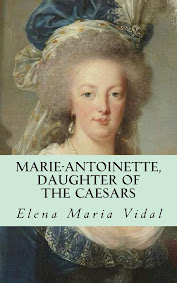
 , a novel about the turbulent life of Marie-Antoinette's daughter, Marie-Thérèse, is now available as an ebook from Amazon and also in softcover. The period which follows the fall of Napoleon Bonaparte, called by historians "the Bourbon restoration" (1814-1830), was outwardly one of rest and peace for France. Yet beneath the surface, the forces of revolution were engaged in a ruthless duel for power with those of the reaction. At the center of the drama one woman, consumed by a quest for love and restoration, must struggle to survive amid deception and betrayal. A tale of murder, mystery and secret romance, the novel searches the conflicted heart of the orphaned princess who from childhood had been called "Madame Royale." To quote from the back cover of the second edition:
They say that the greatest story in History is the Truth and in Madame Royale, Elena Maria Vidal certainly proves that’s the case. The sights, sounds and smells of 19th-century Europe are all brilliantly captured in this immaculately researched and exquisite novel, which recalls the great writers and memoirists of the 1800's. It is an unforgettable portrait of a royal life torn between religion, politics, revolution, mystery, heartache and intrigue and Madame Royale is a fantastic tribute to one of Europe’s most tragic, but courageous princesses.Signed copies of Madame Royale and my other novels are available HERE.
- Gareth Russell, author of The Audacity of Ideas and Popular
..The Bedouins dwell neither in towns nor cities nor castles, but lie always in the open fields; and in the evening their servants, wives and children creep for the night, or by day when the weather is bad into a sort of shelter that they make out of the hoops of casks lashed to poles; just like the [Sedan] chairs of these ladies here; and over these hoops they throw sheepskins, called "Damascus hides," cured with alum. The Bedouins themselves have great pelisses of these skins, which cover their whole body, legs and feet and all. When the evening is rainy or the weather bad at night, they wrap themselves up inside their pelisses, and take off their horses' bridles and let them graze beside them; and when morning comes, they spread out their pelisses again in the sun, and dress them, and there is not a trace to be seen of their night's wetting...Share
...The Bedouins' creed is this: That no man can die, save on his appointed day; and for this reason they will not wear armour; and when they curse their children they say: " Mayst thou be accurst, even as the Frank who arms himself for fear of Death!" In battle they carry nothing but sword and spear. Nearly all of them are clad in surplices, like priests. They wear napkins twisted round their heads and passing under their chins, so that they are loathly people and hideous to behold, for the hair of their heads and beards is all black. They live on the milk of their flocks and herds, and purchase from the wealthy men the grazing of the prairies, which feeds their beasts...
...Their number is past reckoning, for one finds them in the realm of Egypt, and in the realm of Jerusalem, and in all other countries that belong to the Saracens and Infidels, to whom they pay heavy tributes every year...
...I have seen in our own country, since I returned from beyond seas, certain disloyal Christians, who held the faith of the Bedouins, and said that no man could die, save at his appointed hour. Their belief is so disloyal, that it is as much as saying, that God has no power to help us. For we should be mad, who serve God, if we did not believe that He has power to prolong our lives and to keep us from harm and mishap; and in Him we ought to believe, that He has power to do all things....