Thursday, June 26, 2025

The Widow Capet

Above is a posthumous portrait depicting Marie-Antoinette in the Temple prison after the murder of her husband. A bit idealized (I doubt that she had a bust of Louis XVI at hand) it is nevertheless based upon a Vigee-Lebrun portrait. The queen did have her missal with her, because it is recorded that the Revolutionaries later took it away when she was sent to the Conciergerie. Antonia Fraser mentions in Marie-Antoinette: The Journey that the queen would ask her sister-in-law Madame Elisabeth to read the words of the Mass to her from the missal. (In the Temple prison they were forbidden to receive the sacraments.)

Here are the statements of Louis XVI concerning his wife from his Last Will and Testament:
I commend my children to my wife; I have never doubted her maternal tenderness for them. I enjoin her above all to make them good Christians and honest individuals; to make them view the grandeurs of this world (if they are condemned to experience them) as very dangerous and transient goods, and turn their attention towards the one solid and enduring glory, eternity. I beseech my sister to kindly continue her tenderness for my children and to take the place of a mother, should they have the misfortune of losing theirs.

I beg my wife to forgive all the pain which she suffered for me, and the sorrows which I may have caused her in the course of our union; and she may feel sure that I hold nothing against her, if she has anything with which to reproach herself.

Share

How Trump Surprised Hawks and Doves

 From Daniel McCarthy at Compact:

Trump bombed Iranian nuclear facilities on Saturday evening, and by Monday evening was announcing a ceasefire between Iran and Israel. He ended the war almost as soon as he got America into it, a feat that confounds hawks and doves alike. The former wish the war had been longer, the outcome more certain, and the conclusion the end of the ayatollahs’ regime. The latter wish Trump had never allowed the war to happen—assuming he had the power to stop it—or that he’d kept America out of it. Now the raging debate online is over who won the policy battle. Is a two-day war (for us) consisting of one bombing sortie actually a war? It defies the grandiose claims of both interventionists and non-interventionists, who were more alike than not in assuming that regime change was in the offing and the stakes were much the same as those on the table in the 2003 debate over the Iraq War.

“We can’t just bomb Fordow and go home,” was the sentiment of more than one antiwar friend. Any ideology, hawkish or dovish, subsists on extreme scenarios. The idea that some policy either good or bad could be less than apocalyptic, or utopian, is hard to accept. But Trump is not an ideologue, which means he neither feels ideological constraints (which would have kept him out of the war altogether) nor suffers ideological delusions (which would have told him more force achieves more good). 

Once again Trump proves to be ambidextrous, in defiance of conventional political logic. He’s the president who brought about the end of Roe v. Wade and the Republican leader who has moved the party away from pro-life orthodoxy. He loves a grand, seemingly impossible bargain. But can he really reconfigure international relations the way he’s redrawn the boundaries of domestic politics? A realignment in party ideologies and voting blocs is one thing; realigning the Israeli-Iran relations is entirely another. The ceasefire is fragile at best. No matter how successful the U.S. and Israeli strikes on Iran may have been in destroying existing nuclear facilities, Iran can always rebuild what it has built before. Will that mean more Israeli attacks, coupled with further American intervention? If Trump is not careful, the scenario that may emerge over the coming weeks will not look like 2003, but rather like the situation that persisted for more than a decade and led up to the Iraq War. 

In 1991, George H.W. Bush also won a swift victory, ejecting Saddam Hussein’s forces from Kuwait. But then what? The “Marsh Arabs” whom Bush encouraged to rebel against Saddam were massacred. Bush and his successor, Bill Clinton, enforced no-fly zones over parts of Iraq, a form of low-intensity war with no obvious end, other than the one George W. Bush decided upon in 2003. The second Bush’s regime-change war was a dozen years in the making. All the while, America’s foreign-policy establishment was becoming accustomed to thinking of this as a proper and normal exercise of “leadership” and global responsibility. The mental habits acquired by America’s elite in the 1990s—in foreign policy, in cultural politics, and in economics—account for most of the political crises of the early 21st century, as well as for the rise of right-wing populism and Donald Trump in response to them. (Read more.)
Share

Inca String Codes

 From The Conversation:

Five centuries ago, the Incas ruled the western half of South America with the help of a unique form of writing based on coloured and knotted cords. These strings, called khipus, recorded major events, tracked economic matters, and even encoded biographies and poetry, according to the Spanish chroniclers who witnessed their use.

Most khipus have knots that indicate numbers that we can “read”, but we’ve lost the ability to interpret what those numbers mean. Recent discoveries are bringing us closer to deciphering these mysterious strings. In a remote community set high in the Peruvian Andes, my team and I have found khipus that were used by villagers to track climate change.

Last year, I was invited to study the centuries-old khipus preserved in the village of Santa Leonor de Jucul in the Peruvian Andes. The 97 khipus conserved by villagers include the largest khipu in the world, which is over 68 metres long. (Read more.)

Share

Wednesday, June 25, 2025

Marie-Antoinette's Love for Louis XVI


With all the fervid speculations over Marie-Antoinette's relationship with Count Fersen, people forget that she saw herself first and foremost as the wife of Louis XVI, and mother of his children, the Enfants de France. There were many times she was witnessed expressing wifely affection and concern for him. Furthermore, Marie-Antoinette could have escaped without Louis and saved her life, but she refused to desert him. She sacrificed herself to remain with him, and that looks like love to me.

After the storming of the Bastille on July 14, 1789, Louis XVI went to Paris to reconcile with his subjects. Marie-Antoinette dreaded that he would be killed. When he returned safely, a contemporary writer, Lemaire, described her reaction:
This princess, as virtuous as she was amiable, whom monsters later on accused of having never loved her husband, was absolutely in despair. As soon as she heard the King's carriage entering the Cour Royale she ran towards him holding the Dauphin in her arms, then breathless and almost fainting she fell into those of the King who was no less moved than she was. Holding out one hand to his children who covered it with kisses, with the other wiping the tears from the eyes of Marie-Antoinette and Madame Elisabeth, Louis XVI smiled again...he kept on repeating: "Happily no blood was shed, and I swear that not a drop of French blood will ever be shed on my orders."
~ Histoire de la Revolution Francaise (3 vol.) by M.H. Lemaire, 1816
Share

RFK Jr. Shocks Congress With Brutal Message to Top Democrat Rep

 From The Vigilant Fox:

Before you can fix a broken system, you have to acknowledge just how broken it really is.

That was the message from HHS Secretary Robert F. Kennedy Jr. as he opened his testimony before Congress with a sobering diagnosis of America’s healthcare crisis.

“The United States remains the SICKEST developed nation,” he said. “And yet we spend $4.5 trillion annually on healthcare, 2 to 3 times more per capita than comparable nations.”

Kennedy didn’t just point to waste; he warned that the entire system is becoming unsustainable. Healthcare costs are rising faster than the economy, while health outcomes keep sliding. Americans are paying more than ever, and getting sicker in return.

“If we don’t stanch this trend, we will ransom our children to bankruptcy, servitude, and disastrous health consequences.”

More money isn’t the answer, Kennedy argued. It’s about how we spend it. “We won’t solve this problem by throwing more money at it,” he added. “We must spend smarter.”

That means cutting the bureaucracy, fixing misaligned incentives, and making sure dollars actually go toward improving health, not just managing disease. (Read more.)

Share

Tuesday, June 24, 2025

Walking Inside Christian Eschatology


From Hilary White at The Sacred Images Project:

In last week’s post for all subscribers, we talked about the iconographic programmes; the carefully planned cycles of images in fresco or mosaic, that covered all the surfaces of the interiors of Byzantine and western early medieval churches. These cycles structured how sacred images were arranged to tell the story of salvation, that would have been understood by worshippers, transforming the space inside the church into an elevated, sanctified place where those realities were made present.

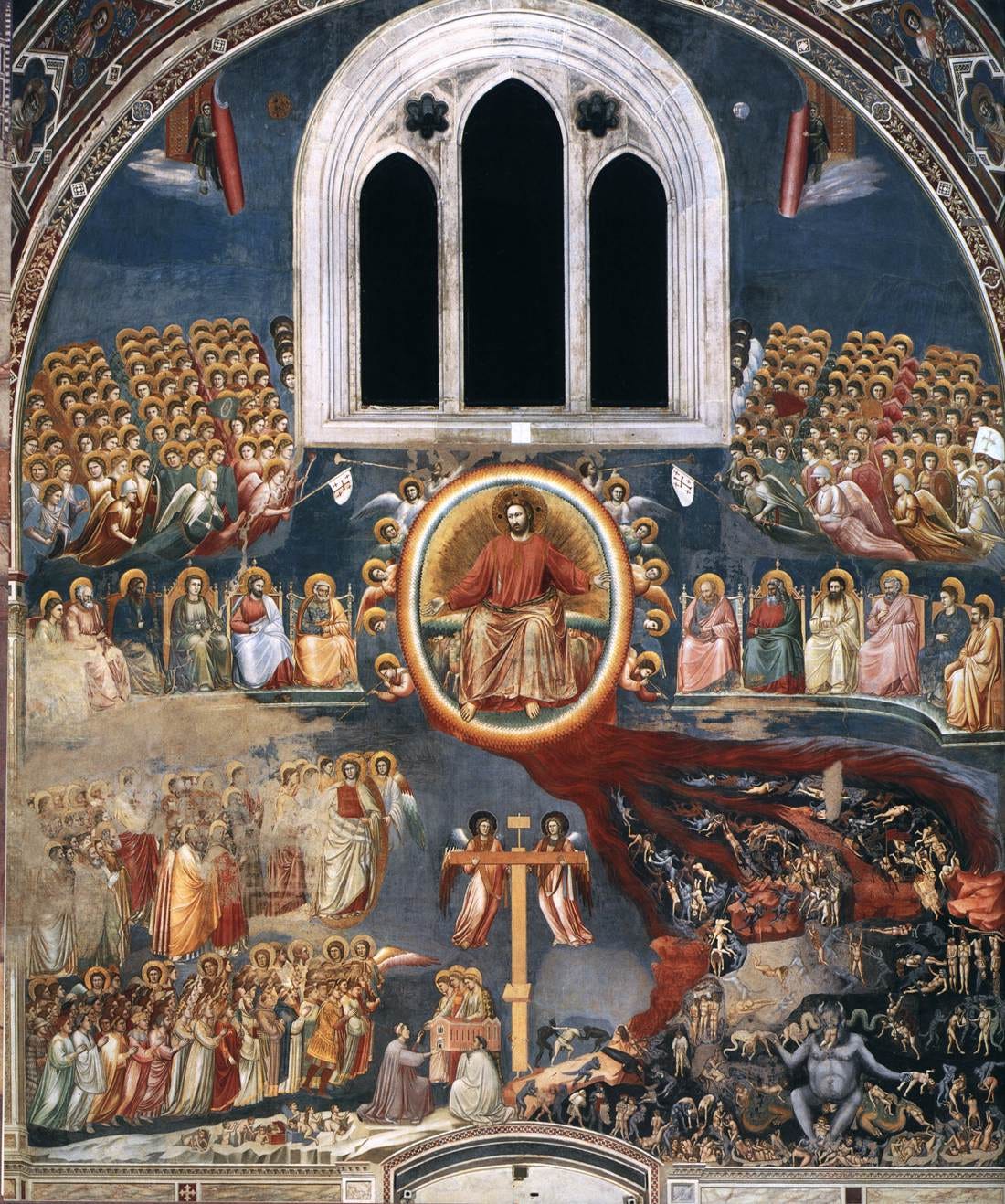
In many churches, all the way up to the late Gothic (or “proto-Renaissance”), a typical feature of these programmes was the back wall of the church - the opposite end of the nave from the sanctuary, or the west wall - being decorated with often shocking and arresting images of the Last Judgment. This was an innovation that came to Western Christendom during the 11th and 12th centuries.

 In today’s post for all subscribers, we’ll look closely at three examples of these commanding scenes, starting in the period when Italo-Byzantine was established throughout the Italian peninsula and was beginning to merge into the Romanesque style. We’ll look at Torcello’s Basilica of Santa Maria Assunta, a mid-11th century grand, multi-tier mosaic cycle and Sant’Angelo in Formis (Capua) early 12th c. where Romanesque style first appeared. We’ll briefly compare these antecedents to the great fresco of the Arena Chapel in Padua, where Giotto took the motif and translated it into his more naturalistic style. (Read more.)

Share

Concrete Proof

 From Tierney's Real News:

We now have concrete proof that Iran intended to build a nuclear weapon and wasn’t just dabbling in nuclear energy. I’ve been waiting to hear this for years. The former president of Russia, Dmitry Medvedev, confirmed that Iran is not just enriching uranium for their civilian energy program - but for nuclear weapons.

Dmitry Medvedev, the deputy chairman of Russia's Security Council, made a statement suggesting that the enrichment of nuclear material by Iran and the "future production of nuclear weapons will continue.” He further claimed that a number of countries are ready to directly supply Iran with their own nuclear warheads.

Medvedev is close to Putin and often speaks for him. You’ll read otherwise - but this is the truth.

Here is his total statement:

MEDVEDEV: What have the Americans accomplished with their nighttime strikes on three nuclear sites in Iran?

1. Critical infrastructure of the nuclear fuel cycle appears to have been unaffected or sustained only minor damage.

2. The enrichment of nuclear material — and, now we can say it outright, the future production of nuclear weapons — will continue.

3. A number of countries are ready to directly supply Iran with their own nuclear warheads.

4. Israel is under attack, explosions are rocking the country, and people are panicking.

5. The US is now entangled in a new conflict, with prospects of a ground operation looming on the horizon.

6. Iran’s political regime has survived — and in all likelihood, has come out even stronger.

7. The people are rallying around the country’s spiritual leadership, including those who were previously indifferent or opposed to it.

8. Donald Trump, once hailed as ‘president of peace,’ has now pushed the US into another war.

9. The vast majority of countries around the world oppose the actions of Israel and the United States.

10. At this rate, Trump can forget about the Nobel Peace Prize — not even with how rigged it has become. What a way to kick things off, Mr. President. Congratulations! (Read more.)


Share

Leo XIV Pays Tribute to Palestrina

 From Aleteia:

Composer Giovanni Pierluigi da Palestrina (1525-1594) is “one of the musicians who contributed most to the promotion of sacred music.” These are the words of Leo XIV on June 18, 2025, during a ceremony organized on the occasion of the 500th anniversary of the birth of the former Vatican choir master.

The pontiff highlighted the importance of the Roman polyphonic tradition, which flourished particularly in the 16th and 17th centuries but which remains a “point of reference” to this day.

On Wednesday afternoon, Leo XIV took part in an event promoted by the Domenico Bartolucci Foundation, named after the cardinal who was head of the Sistine Chapel choir from 1956 to 1997.

Bartolucci played an important role in preserving the sacred music heritage of the Catholic Church after the liturgical reform of the Second Vatican Council. He promoted not only Gregorian chant but also polyphony, particularly that of Palestrina, of whom he was a recognized expert. (Read more.)


Share

Monday, June 23, 2025

Trump's Legal Strike on Iran: A Case Study in Presidential War Powers

 From Amuse on X:

A president sends bombers across an ocean. An adversary’s nuclear infrastructure lies in ruins by sunrise. The political response is predictable. Progressive lawmakers erupt with outrage, while establishment media outlets evoke doomsday analogies and quote scholars feigning constitutional clairvoyance. Yet the core question remains unmoved by headlines: Did President Trump have the legal authority to strike Iran’s nuclear facilities without prior congressional approval? Yes, he did. And if that sentence jars the reader’s sensibilities, one need only recall Barack Obama’s Libya intervention or Joe Biden’s Syria strikes, both executed without congressional authorization and with a fraction of the current outcry. To assert that Trump’s action was unique or impeachable is not only mistaken but deeply hypocritical. The United States has, for decades, operated under a presidency that claims robust authority to initiate limited military actions abroad, particularly when vital national interests are at stake. The 1973 War Powers Resolution, often brandished by critics, has become more of a procedural courtesy than a substantive check. Obama and Biden both used it to justify acts of war after the fact, with little or no prior consultation. No articles of impeachment followed. (Read more.)


From UnHerd:

Natanz, Iran’s primary uranium-enrichment facility, and the complex at Isfahan, where research for the nuclear weapons programme is conducted and weapons-grade fuel is stored, were struck with 30 Tomahawk cruise missiles fired from naval vessels. Meanwhile, a B-2 bomber dropped two “bunker busters” on Natanz. Fordow, the critical Iranian enrichment facility, located deep under a mountain near Qom, was hit with a dozen bunker busters, according to US officials (initial reports said six). At the White House press conference following the strikes, Trump said all the sites had been “obliterated”. It will take some time to know if this is true.

When Israel began its military campaign in Iran 10 days ago, Natanz was one of the first targets, and it was confirmed that power had been cut to the facility and that the 15,000 centrifuges there had been “severely damaged if not destroyed altogether”. After last night’s US attack, it does not seem likely that much functionality remains at Natanz. Isfahan, as an above-ground site, had little hope of surviving a serious American attempt to destroy it, and the complex had already been seriously damaged by Israel. (Read more.)


Share