Thursday, August 24, 2023

Grazing Goats and Sheep Help Uncover Historic Headstones in Ireland

 From Smithsonian:

Uncovering graves buried by centuries of plant growth is hard work—for humans, at least. For sheep, it’s actually a tasty task. That’s why volunteers at a church in Ireland have brought in the herbivores to help with historical conservation work. As BBC News reports, the sheep are clearing an overgrown graveyard by St. Matthew’s Church in the Cork County parish of Templebreedy. They are helping to bring a forgotten history back to the fore,” Cork County Councilor Audrey Buckley tells BBC News.

The Templebreedy Save Our Steeple committee, which aims to preserve the historic site and connect it to the local community today, is spearheading efforts to recover the graves. St. Matthew’s was built in 1788 and has since fallen into ruin. A different church stood at the site before St. Matthew’s, and the grounds’ earliest grave dates back to 1711.

The sheep aren’t the first grazing creatures to help out with the project. Last summer, four goats were recruited to munch on overgrowth around the old headstones. As Buckley told the Irish Times’ Olivia Kelleher last May, she learned about “goatscaping” on a visit to Wales, where goats and sheep often help clear unwanted vegetation from churchyards. The animals can remove weeds in a more environmentally friendly way than power trimmers while presenting less danger to fragile tombstones. (Read more.)

Share

Wednesday, August 23, 2023

Lost Connections


 Between Ancient Ireland and Egypt. From Brehon Academy:

The Stowe Missal is an early Irish liturgical manuscript written in the 8th century. It is one of the most important sources of information about early Irish Christianity. The manuscript contains a number of prayers and hymns, as well as a calendar of saints. One of the most interesting passages in the Stowe Missal is a prayer that mentions the desert monks, and in particular, Anthony of Egypt. The prayer reads:
May God protect us from the dangers of the desert, and may he grant us the grace of following the example of Anthony of Egypt.
Anthony of Egypt was a famous early Christian monk who lived in the 3rd and 4th centuries. He is considered to be the founder of Christian monasticism. Anthony left his home and family to live in the desert, where he devoted himself to prayer and asceticism. He became a popular figure, and many people came to him for guidance and spiritual advice. The teachings of Anthony of Egypt had a profound impact on early Irish Christianity. Irish monks were inspired by his example of asceticism and his commitment to prayer. They also adopted many of his practices, such as solitary living and the use of the desert as a place of spiritual retreat.

The passage above suggests that there was a connection between early Irish Christianity and the desert monastic tradition of Egypt. It is possible that some Irish monks travelled to Egypt to study with the desert fathers, and that they brought back with them the teachings of Anthony of Egypt.

In addition to the Stowe Missal, there are a number of other early Irish sources that mention the desert monks. These sources include the Book of Armagh, the Book of Leinster, and the Annals of the Four Masters. These sources suggest that there was a significant interest in the desert monastic tradition in early Ireland.

The Litany of Irish Saints by Oengus of Tallaght (fl. 800) also mentions the burial of seven Egyptian monks in County Antrim. The passage reads: In Uillaigh, Co. Antrim, seven Egyptian monks (manchaib Egipt) were buried. The passage does not give any further details about the monks, such as their names or the date of their death. However, it does suggest that there was a community of Egyptian monks in County Antrim in the 8th century. The evidence suggests that there was a connection between Ireland and Egypt in the 8th century, and that some Egyptian monks may have travelled to Ireland. Reference to the burial of seven Egyptian monks in County Antrim is a reminder of this connection, and it is a fascinating piece of Irish history. (Read more.)
Share

Congress Subpoenas FBI

 From The Post Millennial:

Members of the House Judiciary and Ways and Means committees are demanding that FBI and IRS agents who sat in on a key meeting that was said to have exposed special treatment for Hunter Biden testify before Congress. According to the Daily Mail, Jim Jordan and Jason Smith say that four agents have knowledge of a meeting that took place on October 7, 2022, in which David Weiss allegedly said he was not the "deciding person" on whether charges would be filed against Hunter Biden, despite being the top prosecutor in the case. Two FBI agents and two IRS agents have been subpoenaed as a result. According to The Hill, those subpoenaed were IRS Director of Field Operations Michael T Batdorf, IRS special agent in charge Darrell J Waldon, FBI special agent in charge Thomas J Sobocinski, and FBI assistant special agent in charge Ryeshia Holley. (Read more.)
Share

Natural Harmony at Stonehenge

 From Ancient Origins:

What appears to be emerging from my mapping research is that during the British Neolithic there once existed a body of knowledge relating to the positioning of  monuments in the landscape. This knowledge seems to have demanded an acknowledgement of the importance of the natural features in the landscape and their corresponding dimensions. Once this “knowledge” was understood, it was then translated into both a monument’s location and its inherent dimensions.

So why would the Proto-Druids behave in such a manner? The answer to this question is difficult, especially as the Neolithic communities were pre-literate. But is there any evidence for such a body of knowledge ever once existing within British pre-history? Maybe so, and the nearest explanation that can be offered here belongs to the late Iron Age druids.

Of course, these druids appeared almost two thousand years after the creation of Stonehenge and its ritual landscape. But we can comfortably place their appearance in British pre-history between 300 BC and 400 AD, when they are directly referred to in classical sources. I cannot find any earlier evidence from these written sources, even though a number of pre-historians are starting to think that the origins of the British Druidry might extend much further back in time than previously thought. For instance,  Iron Age  specialist Barry Cunliffe now considers the possibility that aspects of druidic knowledge could have originated as far back to the start of the  Bronze Age , or 2,500 BC.

Undoubtedly, I believe that we are looking at some kind of specialist surveyor who possessed the ability to accurately measure on a large scale, in a way that would later be observed by the historical  Greek and Roman classical authors. Obviously, for this to happen then the practice of their surveying would have had to continue across many generations (from the Neolithic, through to the Iron Age). (Read more.)


Share

Tuesday, August 22, 2023

Secret Ingredients To Give Fries An Earthy Burst Of Flavor


From Tasting Table:

The leaves of fresh tarragon can be prone to bruising, so you should handle them with care as you strip them from their stems. You can add the leaves whole or roughly chopped to french fries fresh out of the fryer or oven. The hot oils from the french fries will help release fresh tarragon's aromas, giving you an earthy, sweet preview of your herb-upgraded fries. You don't need to use much tarragon on your fries to achieve the desired subtle flavor and aroma. In fact, it's best to start by under-seasoning, because adding too much could overpower the savory flavor of the fries. You can find fresh tarragon sold bundled or packaged in the produce section of most larger grocery stores. That said, fresh tarragon isn't as widely available as other popular herbs, so if you can't find it fresh, dried tarragon is usually available in the spice aisle. (Read more.)

Share

Woke Snow White

From The Daily Wire:

The 22-year-old star has been making headlines recently for her comments regarding the original 1937 film’s storyline, which is based on a German fairy tale. Zegler said she “hated” the classic love story and thought it was “weird,” plus labeled the prince as a “stalker.” As for the new live-action version, the “Snow White” star alluded to some major updates.

“She’s not going to be saved by the prince and she’s not going to be dreaming about true love,” the actress promised. Branding expert Carla Speight predicted Zegler’s highly publicized comments could hurt ticket sales. She told the Daily Mail that even though old Disney movies “hold old values,” taking revisions “to the opposite extreme” in an effort “to inflict strong and loaded messaging on the viewers” is a mistake. (Read more.)

Share

Ancient DNA Sheds Light on Machu Picchu’s Past

 From SciTechDaily:

Who lived at Machu Picchu at its height? New research, recently published in the journal Science Advances, leverages ancient DNA to unveil the origins of workers buried over half a millennium ago within the lost Inca Empire for the first time. A team of researchers, including Jason Nesbitt, an associate professor of archaeology at Tulane University’s School of Liberal Arts, conducted genetic examinations on bodies buried at Machu Picchu. Their objective was to gather more information about the people who lived and worked there.

Machu Picchu is a UNESCO World Heritage Site located in the Cusco region of Peru. It is one of the most well-known archaeological sites in the world and attracts hundreds of thousands of visitors every year. It was once part of a royal estate of the Inca Empire.

Like other royal estates, Machu Picchu was home not only to royalty and other elite members of Inca society, but also to attendants and workers, many of whom lived in the estate year-round. These residents did not necessarily come from the local area, though it is only in this study that researchers have been able to confirm, with DNA evidence, the diversity of their backgrounds. “It’s telling us, not about elites and royalty, but lower status people,” Nesbitt said. “These were burials of the retainer population.”

This DNA analysis works in much the same way that modern genetic ancestry kits work. The researchers compared the DNA of 34 individuals buried at Machu Picchu to that of individuals from other places around the Inca Empire as well as some modern genomes from South America to see how closely related they might be. (Read more.)

Share

Monday, August 21, 2023

Bess of Hardwick’s Tapestries

 From Apollo:

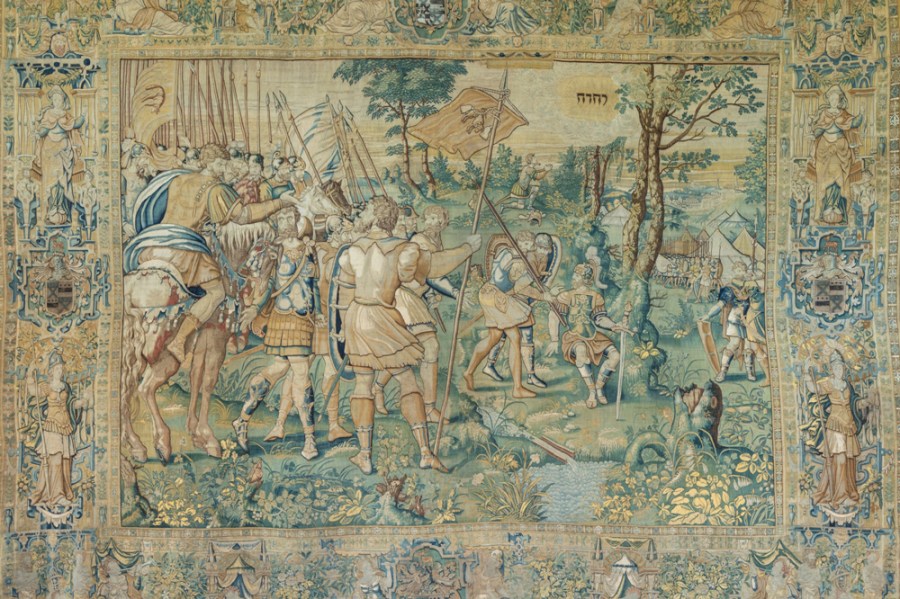
In 1592, Bess of Hardwick was in search of a bargain – and she got one. From the estate of Sir Christopher Hatton, a favourite of Elizabeth I, Bess purchased one of the largest sets of tapestries in existence for the knock-down price of £326 15s 9d, approximately £100,000 in today’s money. The Gideon Tapestries, as they are known, have hung ever since at Hardwick Hall in Derbyshire, where the National Trust has just completed a 20-year conservation programme – at a cost of around £1.7m – to restore them to their former glory.

Many layers of history can be read in these remarkable tapestries. Hatton commissioned them from a Flemish workshop for his own Long Gallery at Holdenby Hall, completed in 1583 in tribute to Elizabeth I. The house was decorated with its political role in mind, and the choice of tapestries may reflect this. The Old Testament story of Gideon tells how he was called by God to save the Israelites from idolatry and win a miraculous victory over the Midianite army. Besides the religious significance of the story for Elizabeth’s Protestant regime, at one point a sheep’s fleece becomes the vehicle for a sign from God.

Elizabeth called Hatton her ‘sheep’ (a weak pun on mutton), so this may explain the choice of subject matter. On the other hand, at 20 feet high, the Gideon tapestries are prodigiously large, and there may have been a limited number of subjects available for weaving at this scale. The designs had originally been woven c. 1560 for the Medici family, but as textile historian Helen Wyld has pointed out, Hatton’s set was almost a third taller again, an effect achieved by extending landscape details and widening borders. Perhaps due to their size, Hatton was forced to compromise on materials. The weaving is relatively crude, with lower grade dyes and less silk thread than is found other examples: the Gideon tapestries aim for a big effect on a budget.

After Hatton’s death, savvy Bess of Hardwick acquired the tapestries at a reduced rate, partly because Hatton’s heir needed to pay off the debts of the ‘dancing Chancellor’, and partly because Bess needed to replace his coats of arms, woven into the borders, with her own. In the event, however, she saved almost £4 (£1,265 in 2023) by having her arms painted on cloths, not woven, and sewn over Hatton’s, with a bit of brown paint and antlers to convert his crest, a golden hind, into the Cavendish stag – alterations that can still be seen today. She installed them at Hardwick New Hall, the house she was then building on her family estate, with money from three previous marriages (and widowhoods). The 13 Gideon tapestries have hung in the Long Gallery ever since their purchase, forming the visual climax for centuries of visitors to Bess’s dream house. (Read more.)


Via Once I Was a Clever Boy.

Share

John Calvin and Gnosticism

Part 1. From Catholic Answers:

For the purpose of this article, I will define an article of faith as “gnostic” if it is imparted to the individual by God directly. This is the opposite of a “public” article of faith, which God imparts to everyone by means of a duly authorized representative—i.e., apostolic (“sent”) authority.

The Christian faith has always been fundamentally public. Christ commissioned the apostles to disciple the nations, and in doing so, he gave them authority to teach, in a public fashion, articles of faith to be believed by all Christians.

Thus, from the beginning, Christians could not claim that God gave them a personal revelation as a means to contradict, add to, or subtract from articles of faith publicly taught by the apostles and their successors as duly authorized representatives of God. If someone claiming to be Christian did make such an assertion, it would be gnostic, as it would amount to the claim that the Christian revelation publicly imparted by authorized representatives had in fact been privately imparted directly to them.

This public nature of the Christian religion is evidenced all over Scripture. Perhaps the most significant example is the Council of Jerusalem, in Acts 15. When a theological controversy was “unsettling [the] minds” of Christians (v. 24), the apostles and elders they had already begun to appoint to succeed them settled the controversy with divine authority, declaring, “For it has seemed good to the Holy Spirit and to us . . .” (v. 28). Of the men who had initiated this controversy, they said, “We gave them no instructions” (v. 24). (Read more.)


Part 2 is HERE

Share