Friday, October 22, 2021

The Yorktown Tragedy

A sad story. From Journal of the American Revolution:

In October 19, 1781, Gen. George Washington attained his apex as a soldier. Straddling a spirited charger at the head of a formidable Franco-American army, Washington watched impassively as 6,000 humiliated British, German, and Loyalist soldiers under the command of Lt. Gen. Charles, Second Earl Cornwallis, emerged from their fortifications to lay down their arms in surrender outside Yorktown, Virginia. The following day, Washington voiced the elation filling his heart in a general order congratulating his subordinates “upon the Glorious events of yesterday.” Ordinarily a stickler for discipline, Washington authorized the release of every American soldier under arrest “In order to Diffuse the general Joy through every breast.”[1]

Five days later, October 25, the Continental Army’s commander-in-chief issued quite a different order. Thousands of Virginia slaves—“Negroes or Molattoes” as Washington called them—had fled to the British in hopes of escaping a lifetime of bondage. Washington directed that these runaways be rounded up and entrusted to guards at two fortified positions on either side of the York River. There they would be held until arrangements could be made to return them to their enslavers. Thus, with the stroke of a pen, Washington converted his faithful Continentals—the men credited with winning American independence—into an army of slave catchers.[2]

This is not the way that Americans choose to remember Yorktown. When President Ronald Reagan attended the festivities marking the battle’s bicentennial in October 1981, a crowd of 60,000 nodded in approval as he described Washington’s crowning triumph as “a victory for the right of self-determination. It was and is the affirmation that freedom will eventually triumph over tyranny.”[3] For the African Americans who constituted one fifth of the young United States’ population in 1781, however, Yorktown did not mark the culmination of a long and grueling struggle for freedom. Rather, it guaranteed the perpetuation of slavery for eight additional decades. (Read more.)

Share

Thursday, October 21, 2021

Majolica


From The Magazine Antiques:

In the late nineteenth century, when the colorful and glossy earthenware called majolica was at the height of its popularity, ceramics factory floors teemed in Britain and America. Entrepreneurial owners made fortunes as staff artisans pummeled, sliced, squeezed, and sculpted slabs of clay. Glazes for multiple kiln firings were concocted from antimony, arsenic, manganese, and lead. Buyers of almost every socioeconomic stratum could afford the results of the gritty, arduous manufacturing process.

 Whimsical and astounding creations emerged from the kilns. Along the rims and handles of teapots and vases, monkeys squabbled, sailors sprouted three legs, and deities performed contortionist backbends. Miniature boots, hats, rowboats, lighthouses, and beehives held matches, ink, ferns, toothpicks, and food. Serving pieces and flowerpots also depicted various organisms in mid-decay. Vessels “disguised the dribbling contents of a game pie in a tureen topped with lifelike duck and hare heads, hid a tangle of roots and soil in a planter seemingly woven from sticks and leaves, or preserved smelly Stilton in a cheese dish besieged by mice,” Jo Briggs, a curator at the Walters Art Museum in Baltimore, writes in a new book, Majolica Mania: Transatlantic Pottery in England and the United States, 1850–1915. (Read more.)


From Pender and Peony:

Today, Majolica mostly refers to the Victorian pottery popularized by the English ceramicist Herbert Minton at the Great Exhibition in 1851. Designed for the Minton Factory by Leon Arnoux, Victorian Majolica advanced fanciful charm, visual pun, exuberant colors, and unique forms.

The pottery technique for producing Majolica dates back to 14th century Spain and was then introduced to Italy via the island Majorca. This style of pottery is known as Maiolica. 18th century French Faience is also a direct pre-curser to Majolica. (Read more.)


From Apollo:

The first time I visited the majolica collection of one of the largest lenders to our upcoming exhibition, I remember feeling a bit bewildered by the concentration of material in front of me – shelves upon shelves of teapots and game-pie dishes, jugs and ornamental figures, garden seats and jardinières – many in the form of moulded animals or embellished with exuberant historicist decoration. I recall thinking, where does one begin to understand this glorious excess? The combination of vibrant colours and sheer diversity of objects was reminiscent of a Victorian interior in its density of display, yet it complemented this sleek Manhattan apartment in a wholly contemporary manner. It was the first of many paradoxes that encounters with majolica would present – and this was just the beginning of an ‘Alice Through the Looking-Glass’ type of visual journey that has culminated in the exhibition and catalogue ‘Majolica Mania: Transatlantic Pottery in England and the United States, 1850–1915’. (Read more.)

More HERE.


Share

The Lion and the Bard

 From The National Review:

While Churchill could thrill or weep (and Churchill was a cryer) at the swirl of Shakespearean drama, his intimate knowledge of the Bard wasn’t simply recreational. It was formative. The wit and the nerve, the agony and the ecstasy of the human experience told in pristine English was woven into the fabric of Churchill himself. To be sure, without the sweeping histories written by Macaulay and Gibbon, Churchill would not have offered the same epic style. But without Shakespeare, Churchill would likely never have galvanized the masses with phrases such as “I have nothing to offer but blood, toil, tears, and sweat,” or “Never in the field of human conflict has so much been owed by so many to so few,” or “Let us therefore brace ourselves to our duties, and so bear ourselves that, if the British Empire and its Commonwealth last for a thousand years, men will still say, ‘This was their finest hour.’” In the wake of the war and pressed by colleagues about how history would treat him, Churchill quipped with a twinkle in his eye, “History will be kind to me, for I intend to write it.” Shortly thereafter, Churchill did just that, penning a magisterial six-volume series on the Second World War. (Read more.)
Share

More Poem Than Proposition

 From The Symbolic World:

Since the 16th century, people have described the regularities of nature with an analogy to “law”, as in “the laws of nature,” which Wittgenstein famously called “The great delusion of modernity,” but we all know a law is a human construct given by a judge to govern society. No one believes a rock is intentionally obeying a legal edict. 7

Naturally, if one uses the analogy of legal fictions to describe the regularities of nature as pre-existing natural “laws”, or if one imagines these regularities more analogous to the creative process of thoughts in some mind, the story we fit these “facts” into will organize our understanding and perception, even as all the fluid poetic ambiguities of reality that escape such scientific categories of definition, determination, and certainty are forgotten in the misty oblivion of modernity’s amnesia.

This is why liturgy is vital. After all, Christ did not come to bring us doctrines, but His body, the Church, which enfolds us into the pattern of its life, the life of Christ. By participating in the rhythms of religious rituals, we order our modes of perception to receive the world as a sacrament. Truth is a habit, a habitat, a pattern that we love, move, and have our being in. (Read more.)


Share

Wednesday, October 20, 2021

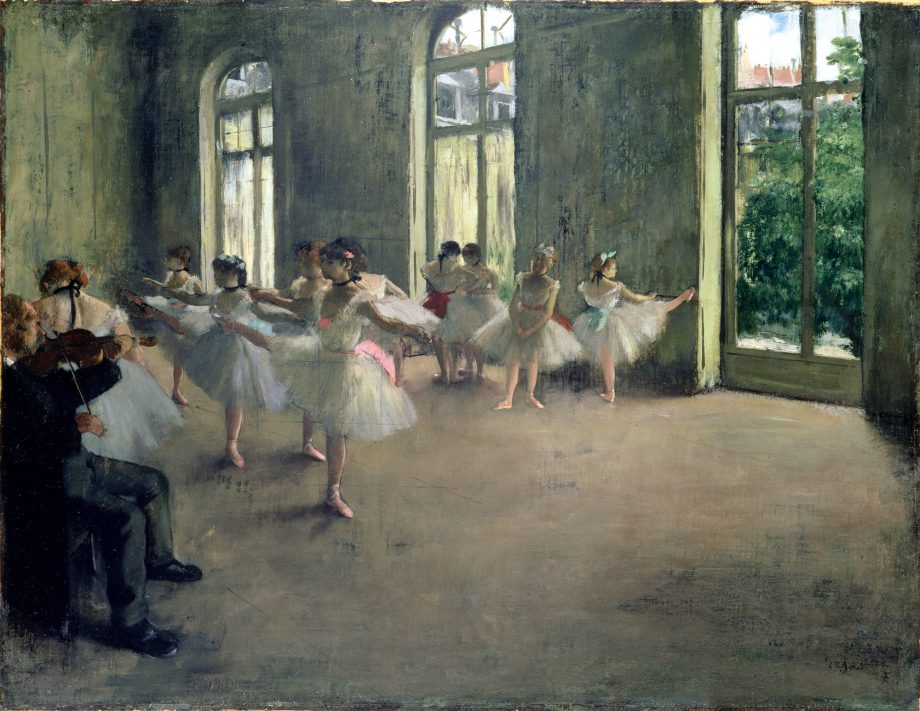
The Rehearsal by Edgar Degas

I love the way Degas perfectly captures the fleeting moment so beautifully, with the grace and elegance of each movement. It is that same movement in dance that has inspired me; you can see a nod to ballet in many of my designs. The close-cropped composition leaves me intrigued. It suggests more is happening outside the frame, in the busy room. The dancers are unaware of the viewer and you can feel their nervous energy. Equally, you can hear the muffled chatter and fine pitter-patter of points. It fascinates me how Degas captures the fabric of the tulle tutus in such a life-like way using oils. The blurred-edge sfumato effect emphasises the sense of realism. Oh, and the contrast of the sashes and the black neckline ties. I could look at his works for hours and hours. (Read more.)

Share

There’s Something About Brandon

 From John Zmirak at American Greatness:

In the spirit of Dave Chapelle cutting through the cant, defying his LGBTQMYNAMEISLEGION critics, Brandon zeroes in on the truth. The phony media spin on that NASCAR chant is exactly, exquisitely our current moment. It nails the vast, yawning gap that separates the Bidenist fantasy world from the real one we’re living in.

As prices shoot up and store shelves empty, half of Haiti somehow appears on the Rio Grande, and China prepares its next war of conquest, our elite fritters and squanders America’s legacy. People who’ve been triple-vaccinated cower in fear of those of us who won’t take it—wait, shouldn’t they be the ones feeling safe? But cower they will, and I say we should pretend to sneeze on such people. Maybe those groundhogs will go back into their homes for another six months.

We’re sick to death of an insanely overhyped pandemic, which blue-state governors turned really deadly by using COVID as euthanasia in nursing homes. We don’t trust big pharma companies that lied to us about using aborted baby parts. Or weird little creepy dictators like Fauci who try telling us in their Bugs Bunny voices whether or not to celebrate Christmas. And about whom Disney makes a fawning biopic, casting Fauci as an epic hero, which 91 percent of “professional” movie critics praise compared to . . . 4 percent of actual audience members. (By the way, that page with viewer comments is now mysteriously down.) (Read more.)
Share

Warped

 The Milky Way. From Science:

To make the map, astronomers looked to its bright, pulsing stars called cepheids. These stars burn up to 10,000 times more brightly than the sun so they are visible from across the galaxy and through interstellar clouds of gas and dust. Crucially, cepheids are "standard candles": Their light waxes and wanes at a rate that corresponds to their inherent brightness. Astronomers can combine their true brightness with their apparent brightness, measured from Earth, to calculate how far away they are. Using a 1.3-meter telescope at Las Campanas Observatory in Chile, astronomers monitored the steady pulses from more than 2400 stars and pinpointed their location on a 3D model of the galaxy.

The research, published today in Science, helps us see the galaxy in a whole new way. From above, the Milky Way can be seen as a spiral-shaped galaxy, but this spiral disk doesn't sit flat on the galactic plane. The cepheid stars cluster along an S-shaped curve, showing that the Milky Way's disk is more warped than previously thought. For many years, astronomers had to rely on measurements from other galaxies to infer the size and shape of the Milky Way. But new data, such as the cepheid map and billions of stars mapped by the European satellite Gaia, are helping astronomers find our place among the stars. (Read more.)


Share

Tuesday, October 19, 2021

The Managed Decline of the Catholic Church

 From Eric Sammons at Crisis:

It’s easy to criticize the plan, and it’s easy to lay blame. It’s also tempting to play “What If?” What if the Spirit of Vatican II were a spirit of faithfulness and orthodoxy, rather than a spirit of chaos and destruction? What if bishops and popes had acted quickly and decisively to stop priestly abuse? What if the liturgical reforms that followed Vatican II actually followed Vatican II? 

These are all interesting questions, but we live in the here and now. We can’t go back and change the past—millions of Catholics have left the Church, we’ve lost tens of thousands of religious vocations, and the Church’s moral standing in the world is in tatters. Decline is a reality we can’t avoid. 

Another temptation is to propose simple solutions to this problem. “Let’s start a new diocese-wide evangelization program!” “We need to return every parish to the traditional Latin Mass!” “Bishops need to stop supporting liberal politicians!” While these ideas might have value, here’s the grim reality: No matter what we do, the Church will continue to decline in the coming years, barring some divine intervention (which we hope and pray for, but cannot presume). (Read more.)


Also from Crisis:

For years now, ordinary Catholics have been barraged with a number of trendy buzzwords and catchy slogans: “A listening Church,” “accompaniment,” “pastoral,” and more. While these words are not necessarily wrong or inappropriate for ecclesial discourse, they often serve as a Trojan horse through which heterodoxy and heteropraxy emerge.

As preparation for the “Synod on Synodality” begins, news regarding the extension of the German Church’s “Synodal Way” into 2023 has ensured that such ordinary Catholics will continue to hear the word “synodality” for the unforeseeable future. In his opening remarks for the synod’s preparatory phase, Pope Francis said, “There is no need to create another church, but to create a different church.” Of course, one wonders where the distinction between the two lies. And furthermore, how can an ordinary, right-believing Catholic survive this era of “synodality”? (Read more.)


From Real Clear Religion:

Continuing his pivot from ancient sources to modern times, Benedict argued that the connection between natural law and justice was well-understood by many Enlightenment thinkers and reflected in documents like the 1948 Universal Declaration of Human Rights. Produced partly in reaction to the horrors unleashed by National Socialism, this text was composed by individuals ranging from a secular French Jew, René Cassin, to the Lebanese Greek Orthodox diplomat, Charles Malik.

The expression “natural law” appears nowhere in the 1948 Declaration. Some of its articles are more evocative of mid-twentieth-century social democracy than Aquinas. Yet the text’s reference to the “inherent dignity and of the equal and inalienable rights of all members of the human family” and its claim that all humans are “born free and equal in dignity and rights” and “endowed with reason and conscience” imitate the language of natural law, albeit one tinged with Enlightenment emphases. The fact, however, that the Declaration was drafted and endorsed by believers and non-believers itself illustrated that some principles are recognizable by all humans as true.

But this confidence in reason’s ability to know truth, Benedict went on, was now in question. The twentieth century’s second half, he said, had witnessed the triumph of “a positivist understanding of nature” throughout the West.

By “positivist,” the pope meant the idea that reason can only know scientific and social facts. Philosophy and religion were subsequently demoted to the sphere of the subjective. The West had consequently cordoned itself off from “the classical sources of knowledge for ethics and law”—and trapped itself in what Benedict called “a concrete bunker with no windows, in which we ourselves provide lighting and atmospheric conditions, being no longer willing to obtain either from God’s wide world.”

How then do we escape this self-imposed prison? “How,” Benedict asked, “do we find our way out into the wide world, into the big picture? How can reason rediscover its true greatness, without being sidetracked into irrationality?” (Read more.)

Share

How Farming Reshaped Our Smiles and Our Speech

 From Science:

Postdocs Damián Blasi and Steven Moran in Bickel's lab set out to test an idea proposed by the late American linguist Charles Hockett. He noted in 1985 that the languages of hunter-gatherers lacked labiodentals, and conjectured that their diet was partly responsible: Chewing gritty, fibrous foods puts force on the growing jaw bone and wears down molars. In response, the lower jaw grows larger, and the molars erupt farther and drift forward on the protruding lower jaw, so that the upper and lower teeth align. That edge-to-edge bite makes it harder to push the upper jaw forward to touch the lower lip, which is required to pronounce labiodentals. But other linguists rejected the idea, and Blasi says he, Moran, and their colleagues "expected to prove Hockett wrong."

First, the six researchers used computer modeling to show that with an overbite, producing labiodentals takes 29% less effort than with an edge-to-edge bite. Then, they scrutinized the world's languages and found that hunter-gatherer languages have only about one-fourth as many labiodentals as languages from farming societies. Finally, they looked at the relationships among languages, and found that labiodentals can spread quickly, so that the sounds could go from being rare to common in the 8000 years since the widespread adoption of agriculture and new food processing methods such as grinding grain into flour. (Read more.)


Share