Saturday, January 24, 2015

Young Maria Theresa as Queen of Hungary

From Tiny-Librarian. To quote:
In this painting, we see Maria Theresa as the queen of Hungary, although not in the Hungarian attire typical in such a depiction. Instead, she wears a white silk, royal gown decorated with embroidery. Draped around her in large billows and folds is a gold brocade cloak with ermine fur lining. Only the Hungarian crown on the pillow and the other regalia indicate she is the ruler of Hungary. This unusual representation can be explained, however, by the outlines of the archducal crown and its more finally executed details discovered under the Hungarian crown during restoration and cleaning. The first version of the portrait was intended to show Maria Theresa as the heir to the throne, with the archducal crown, and may have been made in the years before the coronation in 1741. Her coronation as queen of Hungary provided an opportunity to repaint the work. This magnificent painting by an unknown Viennese painter from the circle of Johann Gottfired Auerbach is not only a superb representative of the art form, but awes us with its natural elegance. (Read more.)
Share

The Secret to Successful Entertaining

From The Catholic Table:
Entertaining isn’t about us; it’s about the people we invite into our homes. Nor is entertaining about impressing people; rather, it’s about loving people.

In other words, the reason we invite friends and coworkers over for dinner isn’t to show off our immaculate baseboards and crystal wine glasses. It’s to laugh with them, tell stories with them, and get to know them better. It’s to strengthen old friendships and forge new ones. It is, ultimately, to show people that they matter, that they’re important, and that they’re worthy of being known and loved.

As Christians, doing that kind of entertaining isn’t optional. It’s called hospitality, and it’s something God expects all His children to do. He expects us to open the doors of our homes and invite people in so that through our love they can experience just a hint of His Love.

Doing that doesn’t demand throwing grand dinner parties in Pinterest inspired homes. In fact, it often demands just the opposite. It demands treating the people who come to us as if they’re part of our family—letting them see the mess, the chaos, and the reality of us.

Hospitality demands that because if we don’t let people see us—who we really are—there can be no real friendship. There can be no real intimacy. Intimacy requires knowledge. It flows from seeing the good, the bad, the beautiful, and the ugly. It goes part and parcel with the dust bunnies, the chipped dishes, and the toddler decorating the dining room with Macaroni & Cheese. (Read more.)
Share

Men and Beauty

From Crisis:
A third reason for beauty’s importance in male formation is that it reveals and brings to life another level of existence beyond mere survival—this being the spiritual domain. Man is not a mere brute. Animals eat, drink, and sleep to live, and pretty much live to eat, drink, and sleep. The caveman of old, on the other hand, though having much of his time consumed with procuring the necessities of life, still found time to produce works of art, such as the stunning cave paintings found in Lascaux, France. It is partly because of this drive for a more fully human life that has led to the emergence of civilizations, economies, and the division of labor. The human person is simply not satisfied with a circular existence of seeking out and procuring the necessities of life in order to merely go on seeking out and procuring the necessities of life.

This being the case, men, as the traditional providers of the family, can easily get caught up in a careerist mindset and become over-immersed in the temporal necessities of life. In addition, modern education has shifted from an emphasis on the liberal arts (a traditional venue for introducing people to the beautiful) to an often exclusive focus on career-oriented education. We are rapidly becoming a society of animals, where serving our needs and our wants is the over-arching narrative of our existence.

It is the role of beauty to shake men out of this mundane existence (or, to borrow a phrase from C.S. Lewis when he was referring to joy, to “administer the shock”) by making them confront a reality above and far more wonderful than a life of simply existing. Ultimately, beauty is a pointer directing us to the reality of the Beatific Vision. This vision will ultimately be an experience of simply taking in the beauty and wonder of the Triune God. In an analogous sense, it is an experience like a couple who from time to time simply want to sit and gaze at each other, taking in the being of the other. Such an experience does not really have a practical or survival purpose. Still, it is experiences like this that are arguably the most fully human, and which remind us that we, as human beings, do not live by bread alone.

The practical question now arises as to how to integrate this exposure to beauty into the formation of men. This task falls partly on the men themselves, and also on those charged with the formation of boys and men (whether this formation be educational, spiritual, liturgical, or cultural). For those involved in education, this means giving the liberal arts a certain pride of place, even while also ensuring that students receive a practical, career-oriented education at the same time. Cultural formation, while acknowledging the importance of popular culture, will also entail exposure to the greatest works of the human spirt. Boys and men should also be encouraged to leave the computer, IPad, and video games behind and go out and experience the greater thrill of nature and the outdoor life. Finally, Catholic men who are preparing to be ordained to the priesthood will see it as their mission to celebrate mass in such a way as to give their congregation a glimpse of the transcendent beauty of God.

Exposure to beauty is a necessary component of the formation of men as men. As the boys and men of today are setting the stage for a disturbing future course of manhood through the proliferation violent video games and movies, pornography, consumerism, and materialism, the time has come to “administer the shock” of beauty by revealing to the world the radiance of truth and goodness. There is an element of truth to Dostoevsky’s famous line that “Beauty will save the world.” (Read more.)
Share

Friday, January 23, 2015

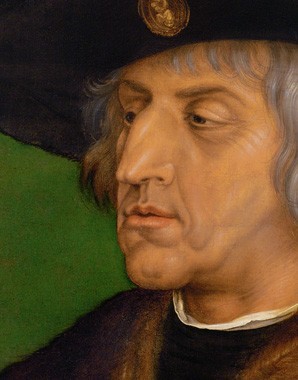
The Habsburg Jaw

Holy Roman Emperor Maximilian I
From Castles and Coffeehouses:
The Habsburgs of Austria ruled a vast empire, the Austro-Hungarian Empire, for about 600 years.  They did not particularly care for fighting. Shrewdly, they built and maintained their empire mostly by judicious marriages.  Very often, a judicious marriage was marriage to a cousin in some other powerful part of Europe, like Spain.

As a result, the succeeding generations of the family very often displayed the famous “Habsburg jaw,” which is seen everywhere in Vienna. Did anyone consider this feature unattractive?  If they did, they may have wisely kept quiet about it. (Read more.)
King Charles II of Spain
Share

The Death of Mrs. Wilde

From The Guardian:
The sudden death of the wife of Oscar Wilde at the tender age of 40 has long been a mystery. In the 116 years since she met her tragic end, speculative theories have ranged from spinal damage following a fall down stairs to syphilis caught from her husband. Now the mystery may have been solved.

Merlin Holland, grandson of the Irish wit and author of The Importance of Being Earnest and Lady Windermere’s Fan, has unearthed medical evidence within private family letters, which has enabled a doctor to determine the likely cause of Constance’s demise.

The letters reveal symptoms nowadays associated with multiple sclerosis but apparently wrongly diagnosed by her two doctors. One resorted to dubious remedies and the other conducted a botched operation that days later claimed her life.

The letters detail symptoms that progressively robbed her of the ability to walk, riddling her body with pain and leaving her with excruciating headaches and extreme fatigue.

Although multiple sclerosis was by then certainly known within the medical profession, the seriousness of her condition went unrecognised. She turned to an unnamed German “nerve doctor”, whose eccentric treatments involved baths and electricity, and to an Italian, Luigi Maria Bossi, who believed that neurological and mental illness could be cured with gynaecological operations.

Days after Bossi undertook a gynaecological procedure – having previously conducted an operation which failed to improve her health – she lapsed into unconsciousness and died. Some 20 years after her death, he faced unrelated accusations of unethical behaviour and professional misconduct, only to be shot dead by a patient’s jealous husband.

Constance’s brother, Otho, contemplated legal action, but realised its futility. She had agreed to go under Bossi’s knife – against the advice of other doctors.

“It cost her her life,” Holland observed. “Ultimately, both Bossi and the hapless Constance met their ends tragically – he by the bullet of an assassin and she by the knife of an irresponsible surgeon.” (Read more.)
Here is an article about Oscar Wilde's conversion. To quote:
 Wilde was baptised into the Catholic Church shortly before he died. L'Osservatore Romano said that the "existential path" which the author trod "can also be seen as a long and difficult path toward that Promised Land which gives us the reason for existence, a path which led him to his conversion to Catholicism, a religion which, as he remarked in one of his more acute and paradoxical aphorisms, was 'for saints and sinners alone – for respectable people, the Anglican Church will do'." (Read more.)
Share

The Future of the Church

From Vultus Christi:
“The future of the Church, once again as always, will be reshaped by saints” — Joseph Ratzinger, 1969.
Forty–six years ago, Father Joseph Ratzinger gave a series of conferences that were later published in book form under the title Faith and the Future (Ignatius Press). What was the future in 1969 has become the present. Joseph Ratzinger’s words are stunningly prophetic. Read them.
The future of the Church can and will issue from those whose roots are deep and who live from the pure fullness of their faith. It will not issue from those who accommodate themselves merely to the passing moment or from those who merely criticize others and assume that they themselves are infallible measuring rods; nor will it issue from those who take the easier road, who sidestep the passion of faith, declaring false and obsolete, tyrannous and legalistic, all that makes demands upon men, that hurts them and compels them to sacrifice themselves.
To put this more positively: The future of the Church, once again as always, will be reshaped by saints, by men, that is, whose minds probe deeper than the slogans of the day, who see more than others see, because their lives embrace a wider reality. Unselfishness, which makes men free, is attained only through the patience of small daily acts of self-denial. By this daily passion, which alone reveals to a man in how many ways he is enslaved by his own ego, by this daily passion and by it alone, a man’s eyes are slowly opened. He sees only to the extent that he has lived and suffered. If today we are scarcely able any longer to become aware of God, that is because we find it so easy to evade ourselves, to flee from the depths of our being by means of the narcotic of some pleasure or other. Thus our own interior depths remain closed to us. If it is true that a man can see only with his heart, then how blind we are!
How does all this affect the problem we are examining? It means that the big talk of those who prophesy a Church without God and without faith is all empty chatter. We have no need of a Church that celebrates the cult of action in political prayers. It is utterly superfluous. Therefore, it will destroy itself. What will remain is the Church of Jesus Christ, the Church that believes in the God who has become man and promises us life beyond death. The kind of priest who is no more than a social worker can be replaced by the psychotherapist and other specialists; but but the priest who is no specialist; who does not stand on the sidelines, watching the game, giving official advice, but in the name of God places himself at the disposal of men, who is beside them in their sorrows, in their joys, in their hope and in their fear, such a priest will certainly be needed in the future.
Let us go a step farther. From the crisis of today the Church of tomorrow will emerge a Church that has lost much She will become small and will have to start afresh more or less from the beginning. She will no longer be able to inhabit many of the edifices she built in prosperity. As the number of her adherents diminishes, so will she loose many of her social privileges. In contrast to an earlier age, she will be seen much more as a voluntary society, entered only by free decision . As a small society, she will make much bigger demands on the initiative of her individual members. Undoubtedly she will discover new forms of ministry and will ordain to the priesthood approved Christians who pursue some profession. In many smaller congregations or in self-contained social groups, pastoral care will normally be provided in this fashion. Along-side this, the full-time ministry of the priesthood will be indispensable as formerly. But in all of the changes at which one might guess, the Church will find her essence afresh and with full conviction in that which was always at her center: faith in the triune God, in Jesus Christ, the Son of God made man, in the presence of the Spirit until the end of the world. In faith and prayer she will again recognize the sacraments as the worship of God and not as a subject for liturgical scholarship.
The Church will be a more spiritual Church, not presuming upon a political mandate, flirting as little with the Left as with the Right. It will be hard-going for the Church, for the process of crystallization and clarification will cost her much valuable energy. It will make her poor and cause her to become the Church of the meek. The process will be all the more arduous, for sectarian narrow-mindedness as well as pompous self-will will have to be shed. One may predict that all of this will take time. The process will be long and wearisome as was the road from the false progressivism on the eve of the French Revolution — when a bishop might be thought smart if he made fun of dogmas and even insinuated that the existence of God was by no means certain — to the renewal of the nineteenth century. But when the trial of this sifting is past, a great power will flow from a more spiritualized and simplified Church. Men in a totally planned world will find themselves unspeakably lonely. If they have completely lost sight of God, they will feel the whole horror of their poverty. Then they will discover the little flock of believers as something wholly new. They will discover it as a hope that is meant for them, an answer for which they have always been searching in secret. (Read more.)
Share

Thursday, January 22, 2015

The Captive Queen

The Captive Queen, an Elegiac Ode.
  Scarce had the night her shadowy curtain spread,
To hide the blush of eve;
Than gloomy Silence cast a solemn dread,
And Nature seem'd to grieve:
But Cynthia soon o'er half the globe
Display'd her star-bespangled robe,
Emitting forth her silver-ray
To cheer the trav'ller's lonely way,
And guide him to the social cot,
Where all his sorrows are forgot--
Oblivious slumber, with Lathaean-pow'r
Snatches the lapse of time, and rules the mid-night hour.

Mute is the warbling concert of the air--
Save the sad minstrel of the night;
Whose trilling-notes, responsive to despair,
Vibrate on Echo's rapid flight!
And, hark, what breathing groans transpierce
the solemn scene!
Ah! 'tis the mourning sorrows of a Captive-Queen!

Borne on Fancy's eagle-height,
I see her pictur'd to the sight
Immur'd within a dungeon's bloom,
Invoking Heav'n to change the doom--
Her rosy-cheeks, of crimson-hue,
Now moisten'd by Affliction's dew,
Fading, have wither'd, by a wintry blight,
And, in despair, the roses red--have chang'd to white.

Via Reading Treasure. Share

The Spirit of Antichrist

From Aleteia:
One of the fundamental principles at the heart of the Johannine Scriptures is that the Word became flesh. Jesus actually came in the flesh; we could touch our God. The true faith is incarnational. In Jesus Christ, God takes up the physical order, Justice … Truth springs up from the earth (cf Ps 85:12). God actually becomes man. The love of God and His salvation are tangible and real, not merely ideals, wishes, or hopes. Faith is about reality. This is John’s and the Holy Spirit’s insistence: that we not let this truth slip from our understanding even for a moment.

There are and have been many Gnostic and Neo-Gnostic tendencies through the centuries that seek to reduce faith to mere intellectualism, to ideas or opinions, and to remove things from the world of reality. Thus St. John and the Church have had to insist over and over again that Jesus is real, that faith is real and is about real, tangible, even material things.

When Jesus came among us, He was not content merely to speak of ideas. He did not simply advance ethical theories or set forth merely philosophical notions. He also addressed actual human behaviors, not merely by speaking of them, but by actually living them and modeling them in the flesh. Jesus demands from His followers not mere intellectual affirmations, but actually walking in His truth using our very bodies and living His teaching. We are to renounce unnecessary possessions, feed the poor, confess Him with our lips, reverence human sexuality through chaste living, accept (and even embrace) suffering—all for the sake of the kingdom.

Yes, faith is about real things, about actual concrete behaviors that involve not only what we think but also how we physically move our body through the created order, how we interact with the physical order and with one another.

Jesus also took up and made use of the physical and created order in His saving mission. Obviously He took it up in the incarnation, but He also referenced creation in many of His parables. He pointed to the lilies of the field and to the sparrow. He made paste with saliva and mud, anointed with oil, changed water to wine, laid hands on the bodies of countless individuals in healing, and took bread and wine and changed it to the Body and Blood. He took up the wood of the cross, laid down His body in suffering and death, and raised it up again on the third day. Then He took His body—His physical body—with Him to Heaven and sat down at the right hand of the Father.

Yet despite this radical physicality seen in the Gospel and in the work of God, there remains a persistent tendency on the part of many to reduce the faith by removing it from the physical and temporal order, rendering it a merely ethical notion, an intellectualism, a set of ideas, or even mere opinion. Faith rooted in daily reality and with measurable parameters is set aside and sophistry takes place. Never mind what a person does; all that seems to matter to many is what they think about it, or what their intentions are. (Read more.)
Share

The Pope on Large Families

From Zenit:
Motherhood and fatherhood are a gift from God, but to receive the gift, to wonder at its beauty and to make it shine in society, that is your task. Each one of your children is a unique creature that will never be repeated again in the history of humanity. When this is understood, that each one has been willed by God, one is amazed at how a child is a great miracle! A child changes life! All of us – men and women – have seen how life changes when a child arrives, it is another thing. A child is a miracle that changes life. You, boys and girls, are precisely this: each one of you is a unique fruit of love, you come from love and grow in love. You are unique, but not alone! And the fact of having brothers and sisters is good for you: the sons and daughters of a large family are more capable of fellowship from early childhood. In a world often marked by selfishness, the large family is a school of solidarity and sharing; and this attitude then becomes a benefit for the whole society. (Read more.)
Terry Nelson has some commentary on some of the Holy Father's controversial remarks. To quote:
If many faithful Catholic couples are in uncomfortable positions because the 'world' doesn't understand what the pope meant or said - what is wrong with that? Isn't the Gospel uncomfortable any way? I hope so.
Did you ever feel funny saying grace in a restaurant? Did you ever get teased for not eating meat on Friday? Haven't people suggested you could skip Mass on Sunday and holy days? Haven't you ever been ridiculed for some Catholic teaching? It goes with the territory. 
I have traditional Catholic friends who are married with lots of kids and consider it a scandal that there is a childless couple who doesn't tell everyone at donuts and coffee that they are either unable to have children or they are practicing NFP - thus, the Inquisitors assume they are contracepting or the husband may be gay. Seriously - I worked with these religious busy bodies.  They can be worse than what we complain about as anti-Catholic bigotry from the world. (Read more.)
Here is the transcript of the Holy Father's interview with reporters on the plane from Manila. It is an amazing conversation. In the following passage they are talking about the third world and the challenges to poor families there. The Pope discusses Paul VI and Humane Vitae. To quote:
 Jan Cristoph Kitzler: I would like to return for a minute to the encounter you had with families. You have spoken of ideological colonization. Would you explain a bit more the concept? You also mentioned Paul VI, speaking of the "particular causes" that are important to the pastoral care for families. Can you give an example of these particular cases and maybe say also if there is need to open the way, to have a corridor, for these particular cases?

Pope Francis: Ideological colonization. I'll give just one example that I saw myself. Twenty years ago, in 1995, a minister of education asked for a large loan to build schools for the poor. They gave it to her on the condition that in the schools there would be a book for the children of a certain level, no? It was a school book, a book prepared well, didactically, in which gender theory was taught.

This woman needed the money but that was the condition. Clever woman, she said yes and did it again and again and it went ahead like this and that's how it was achieved. This is ideological colonization.
They introduce to the people an idea that has nothing nothing to do with the nation. Yes, with groups of people, but not with the nation. And they colonize the people with an idea which changes, or wants to change, a mentality or a structure.

During the synod, the African bishops complained about this. Which was the same story, certain loans in exchange for certain conditions -- I say only these things that I have seen.

Why do I say ideological colonization? Because they take, they really take, they take the need of a people to seize an opportunity to enter and grow strong -- with the children. But it is not new, this. The same was done by the dictatorships of the last century. They entered with their own doctrine -- think of the Balilla (Mussolini’s fascist youth organization -- editor’s note), think of the Hitler Youth.

They colonized the people, but they wanted to do it. But how much suffering -- peoples must not lose their freedom. Each people has its own culture, its own history. Every people has its own culture.
But when conditions come imposed by imperial colonizers, they seek to make these peoples lose their own identity and make a uniformity. This is the globalization of the sphere -- all the points are equidistant from the center. And the true globalization -- I like to say this -- is not the sphere. It is important to globalize, but not like the sphere; rather, like the polyhedron. Namely that each people, every part, conserves its own identity without being ideologically colonized. These are the ideological colonizations.

There is a book, excuse me but I'll make a commercial, there is a book that maybe is a bit heavy at the beginning because it was written in 1903 in London. It is a book that at that time, the writer had seen this drama of ideological colonization and wrote in that book. It is called "The Lord of the Earth," or "The Lord of the World." One of those. The author is Benson, written in 1903. I advise you to read it. Reading it, you'll understand well what I mean by ideological colonization.

This is the first response. The second: What I want to say about Paul VI is that it is true that openness to life is the condition of the sacrament of matrimony. A man cannot give the sacrament to the woman, and the woman give it to him, if they are not in agreement on this point to be open to life. To the point that it can be proven that this or the other did not get married with this intention of being open to life, the matrimony is null. It's a cause of the annulment of the marriage, no? Openness to life, no.

Paul VI studied this, with the commission, how to help the many cases, many problems. They are important problems, that are even about love in the family, right? The everyday problems -- so many of them.

But there was something more. The refusal of Paul VI was not only to the personal problems, for which he will tell the confessors to be merciful and understand the situation and pardon. Being understanding and merciful, no? But he was watching the universal Neo-Malthusianism that was in progress. And, how do you call this Neo-Malthusianism? There is less than one percent of birth rate growth in Italy. The same in Spain. That Neo-Malthusianism that sought to control humanity on the part of the powers.


This doesn't mean that the Christian must make children "in series."


I met a woman some months ago in a parish who was pregnant with her eighth child, who had had seven C-sections. But does she want to leave the seven as orphans? This is to tempt God. I speak of responsible paternity. This is the way, a responsible paternity.


But, what I wanted to say was that Paul VI was not more antiquated, closed minded. No, he was a prophet who with this said to watch out for the Neo-Malthusianism that is coming.
This is what I wanted to say.
[,,,]

Christoph Schmidt: Holy Father, first of all I would like to say: Thank you very much for all the impressive moments of this week. It is the first time I accompany you, and I would like to say thank you very much. My question: you have talked about the many children in the Philippines, about your joy because there are so many children, but according to some polls the majority of Filipinos think that the huge growth of Filipino population is one of the most important reasons for the enormous poverty in the country. A Filipino woman gives birth to an average of three children in her life, and the Catholic position concerning contraception seem to be one of the few question on which a big number of people in the Philippines do not agree with the Church. What do you think about that?

Pope Francis: I think the number of three children per family that you mentioned – it makes me suffer- I think it is the number experts say is important to keep the population going. Three per couple. When this decreases, the other extreme happens, like what is happening in Italy. I have heard, I do not know if it is true, that in 2024 there will be no money to pay pensioners because of the fall in population. Therefore, the key word, to give you an answer, and the one the Church uses all the time, and I do too, is responsible parenthood. How do we do this? With dialogue. Each person with his pastor seeks how to do carry out a responsible parenthood.
That example I mentioned shortly before about that woman who was expecting her eighth child and already had seven who were born with caesareans. That is a an irresponsibility That woman might say 'no, I trust in God.’ But, look, God gives you means to be responsible. Some think that -- excuse the language -- that in order to be good Catholics, we have to be like rabbits. No. Responsible parenthood. This is clear and that is why in the Church there are marriage groups, there are experts in this matter, there are pastors, one can search; and I know so many ways that are licit and that have helped this. You did well to ask me this.
Another curious thing in relation to this is that for the most poor people, a child is a treasure. It is true that you have to be prudent here too, but for them a child is a treasure. Some would say 'God knows how to help me' and perhaps some of them are not prudent, this is true. Responsible paternity, but let us also look at the generosity of that father and mother who see a treasure in every child. (Read more.)

Share