Thursday, July 18, 2013

The Return of the Masked Ball

From The Telegraph:
Who would have predicted that masked balls would become a trend in 2013? Ruby-encrusted eyewear and Marie-Antoinette-inspired dresses are not generally considered a sensitive look during recessions - a point not lost even on the Kardashians.

Cecil Beaton was appalled when he discovered that Truman Capote was planning one in the summer of 1966. "What is Truman trying to prove?" he wrote testily in his tell-all diary. "The foolishness of spending so much time organising the party is something for a younger man or a worthless woman to indulge in, if they have social ambitions."

Beaton, who valiantly overcame his misgivings to attend Capote's party along with most of the elite of the day, may have been right, but not entirely. Capote's party made social history. It's as famous in certain circles as his novels. Mission accomplished.

IN PICS: French Vogue's 90th anniversary masked ball
 
Those masks surely contributed to Capote's lasting mystique. There's something compelling about an invitation that requires disguise - the suggestion of an Eyes Wide Shut moment. Yet it's seven years since the last grand one, hosted by photographer Nick Knight and sponsored by Moët & Chandon at Strawberry Hill, Sir Horace Walpole's giddily Gothic castle in Twickenham. Beaton would have been even more outraged by the sponsorship than the time-wasting that went into some of those masks. Even Pete Doherty remembered to wear one.

Since then, it's been lean pickings on the masked-ball front, sponsored or otherwise. But now, suddenly, two in the same week. Yes, along with sustained British sporting success, the masked ball is a fantastical mirage taking solid shape. First Domenico Dolce and Stefano Gabbana host a spectacular one last Saturday in Palazzo Pisani Moretta, a terracotta-coloured renaissance palace - also with Gothic flourishes - on Venice's Grand Canal. Guests arrived by boat and gondola. Candlelight was the order of the evening, the diamonds real and not borrowed, and the beaded dresses couture. (Read entire post.)
Share

Wednesday, July 17, 2013

French Salon, circa 1780


From Vive la Reine:
Mrs. Thorne’s design was heavily inspired by the private rooms of the Petit Trianon, which were designed in the Marie Antoinette’s preferred style. Of the Petit Trianon, Thorne wrote:

“Nothing could be more chaste, more restrained. This was Marie Antoinette’s favorite retreat and it is here that I always feel her shadow.” (Read more.)
Share

Paris in the Movies

From MessyNessyChic:
Attention Parisphiles! There’s a new smartphone application on the block ready to take you on a cinematic journey through the city you love. Cinemacity is a new website and free application that allows users to rediscover Paris through iconic movie scenes filmed around the city. You can view film clips and screen stills pinpointed by location on the cinemacity map and filter movies by release date, director or the neighbourhood in which they were filmed. (Read more.)
Share

What's in the Burger?

You don't want to know. But here it is anyway:
Hambúrguer chef Jamie Oliver has just won a battle against one of the largest fast food chains in the world. After Oliver showed how McDonald’s hamburgers are made, the franchise announced it will change its recipe. According to Oliver, the fatty parts of beef are “washed” in ammonium hydroxide and used in the filling of the burger. Before this process, according to the presenter, the food is deemed unfit for human consumption.

According to the chef and presenter, Jamie Oliver, who has undertaken a war against the fast food industry: “Basically, we’re taking a product that would be sold in the cheapest way for dogs, and after this process, is being given to human beings.”

Besides the low quality of the meat, the ammonium hydroxide is harmful to health. Oliver calls it “the pink slime process.”

“Why would any sensible human being put meat filled with ammonia in the mouths of their children?” asked the chef, who wages a war against the fast food industry. In one of his initiatives, Oliver demonstrates to children how nuggets are made. After selecting the best parts of the chicken, the remains (fat, skin and internal organs) are processed for these fried foods. The company, Arcos Dorados, the franchise manager in Latin America, said such a procedure is not practiced in the region. The same applies to the product in Ireland and the UK, where they use meat from local suppliers. In the United States, Burger King and Taco Bell had already abandoned the use of ammonia in their products. The food industry uses ammonium hydroxide as an anti-microbial agent in meats, which has allowed McDonald’s to use otherwise “inedible meat.”

Even more disturbing is that because ammonium hydroxide is considered part of the “component in a production procedure” by the USDA, consumers may not know when the chemical is in their food. (Read more.)
Share

Tuesday, July 16, 2013

On the Trail of Annie Oakley

Always a lady. To quote:
There are endless Oakley myths, but it's probable that 15-year-old Annie beat stage marksman, Frank Butler, in a match held on Thanksgiving Day 1875 in a suburb of Cincinnati. By most accounts, Annie married Frank in 1876, but didn't shoot in his act until 1882 -- a period sometimes called Annie's "missing years." When she and Frank joined Buffalo Bill's Wild West in 1885, the seeds of Annie's legend took root, and today she's revered as the greatest marksman our country has ever produced. Paradoxically, the private Annie Oakley Butler was a genteel woman who remained true to her Quaker roots and who reveled in her reputation as "the peerless lady wing-shot," emphasis on lady. (Read entire article.)
Share

Monday, July 15, 2013

A Young Archduchess

The Archduchess Maria Antonia of Austria before her marriage to the Dauphin of France. (I think I found this picture on the Tiny-Librarian blog but cannot find the exact link.) Share

Italian Renaissance Crime Scenes

Eleonora of Toledo
From Smithsonian:
The wealth of biographical information available on Cosimo I allowed Fornaciari to synthesize contemporary testimony and forensic investigation. Documentation concerning Cosimo and his descendants is some of the most extensive in early modern history—the online database of the Medici Archive Project contains descriptions of some 10,000 letters and biographical records on more than 11,000 individuals. Portraits of Cosimo I in museums around the world depict his evolution from a shy, seemingly wary youth in 1538 to a bearded warrior in a polished suit of armor in 1565, and an elderly, corpulent and world-weary figure, gazing absently into space, toward the end of his life in 1574. Reports by court physicians and foreign ambassadors to the Florentine duchy recount Cosimo’s medical history in excruciating detail: He survived smallpox and “catarrhal fever” (likely pneumonia) in youth; suffered in later life from paralysis of his left arm, mental instability and incontinence; and had a painful condition of the joints described by contemporaries as gout.
Fornaciari found that Cosimo’s remains indicated he had been an extremely robust and active man, in whom Fornaciari also noted all of the “knightly markers”—sacro-lumbar arthritis, hypertrophy and erosion of certain parts of the femur, rotation and compression of the upper femur, and other deformations—typical of warriors who rode into battle on horseback. He noted nodes between Cosimo’s vertebrae, signs that as an adolescent, the young duke had worn heavy weights over his thorax, most probably suits of armor. Fornaciari also noticed pervasive arthritis and ossification between the sixth, seventh and eighth thoracic vertebrae, possible signs of diffuse idiopathic skeletal hyperostosis (DISH), a disease of the elderly linked to diabetes. “We see Cosimo getting fatter in his portraits, and the presence of DISH suggests he may have had diabetes, too,” says Fornaciari. “The diet of the Medici and other upper-class families often contained many sweets, which were a sort of status symbol, but often caused health problems.”
Another vivid marker was Cosimo’s poor dental health. The right side of his mandible is marred by an enormous gap, the result of a serious periodontal disease; an abscess had eaten away his first molar and a considerable chunk of bone, leaving a massive crater in his jaw. Fornaciari’s examination of the Medici, the Aragonese and other high-born individuals has revealed appalling abscesses, decay and tooth loss, bringing home just how painful daily life in that period could be, even for the rich and famous.
Cosimo’s wife, Eleanora of Toledo, was the daughter of the Spanish viceroy of Naples and related to the Hapsburg and the Castilian royal families. Her face was immortalized by the Renaissance master Bronzino, who in a series of portraits captures her transformation from a radiant, aloof young bride to a sickly, prematurely aged woman in her late 30s, shortly before her death at age 40. Fornaciari uncovered the maladies that beset her. Dental problems plagued her. Slightly curved legs indicated a case of rickets she had suffered as a child. Childbirth had taken a major toll. “Pelvic skeletal markers show that she had numerous births—in fact, she and Cosimo had 11 children,” Fornaciari says. “She was almost constantly pregnant, which would have leached calcium out of her body.” Further analysis indicated that Eleanora had suffered from leishmaniasis, a parasitic disease spread by biting sand flies that can cause skin lesions, fever and damage to the liver and spleen. DNA testing also revealed the presence of tuberculosis. “She was wealthy, and powerful, but her life was brutally hard,” Fornaciari says.
Share

So Much for Churchill

From the Express:
Labour's Chris Bryant, who represents Rhondda, said his constituents had never forgiven the wartime Prime Minister for sending in the army to support police during a miners strike when Sir Winston was Home Secretary in 1910.

Mr Bryant made the comments in the House of Commons today during a debate on Education Secretary Michael Gove's reforms to the national curriculum.

The plans involve teaching about Sir Winston in English schools, but education in Wales is a devolved responsibility of the Welsh Government.

Mr Bryant told the Commons: "There's only one constituency in the land where Winston Churchill was never ever welcome, including after the Second World War, namely the Rhondda.

"So I am delighted this curriculum, which bizarrely only insists on one politician being studied in the whole of the history of the 20th century, namely Winston Churchill, will not apply in Wales or in the Rhondda." (Read entire article.)
Share

Sunday, July 14, 2013

French Nobles and Bastille Day

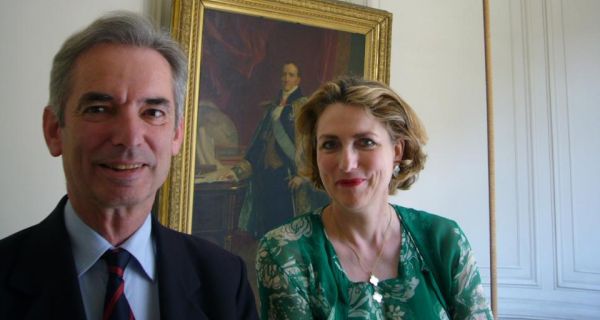
Duc et Duchesse d’Estissac
Yes, some aristocrats escaped the wholesale slaughter and their descendants are still alive today. To quote:
Because he was grand master of the royal wardrobe, the presence of François Alexandre Frédéric de La Rochefoucauld was required when Louis XVI dressed in the Palace at Versailles. One morning 224 years ago – some accounts place it before the storming of the Bastille, others immediately after – the king asked de La Rochefoucauld if it was true there was a revolt in Paris.

“No, majesty. It is not a revolt; it’s a revolution,” de La Rochefoucauld replied. He was the first to define the founding event of modern French history.

De La Rochefoucauld’s grandson, nine generations removed, Pierre-Louis de La Rochefoucauld, duc d’Estissac, lives a block away from the Champs-Élysées, where the French republic will celebrate its revolution tomorrow. This year, as every year, the duke, aged 65, will pay it no notice. “We had to run away, hide or get killed,” he says. “It’s not a date I want to remember.” The family has proof of its lineage for the last 1,000 years, back to Foucaud the 1st in 1019. In the 17th century, François VI, duc de La Rochefoucauld, became a famous writer of maxims and memoirs, whose pithy observations on human folly are still quoted today.

Some 15 de La Rochefoucaulds were guillotined in the revolution. The present-day scion has a special fondness for Pierre-Louis de La Rochefoucauld, Bishop of Saintes. “Because I bear his name, I feel close to him.” The duke never passes the intersection of the rue d’Assas and Vaugirard without thinking of his namesake, who was detained in a Carmelite chapel there with 150 other clergy on September 2nd, 1792.

“They were ordered to recognise the new status of the church under the revolution,” the duke recounts. “All of them said No. One by one, they were shoved into the garden where dozens of ‘patriots’ fell upon them, killing them with hammers and knives.”

Pierre-Louis de La Rochefoucauld was declared a blessed martyr in 1920. He would have been canonised, the duke believes, had the church not been intimidated by the government. “In France, the legal government considers that the revolution was a marvellous thing,” he says bitterly. (Read more.)
Share