Sunday, February 17, 2013

Poufs

From Gio:
Leonard Antid is supposed to have excelled in the art of placing poufs of gauze, which were introduced between the locks, and one day he employed for that purpose about 14 yards of gauze for one hairdress. But all these poufs differed greatly from the pouf aux sentiments owing to their simplicity; they also required no assistance from the milliner. The pouf aux sentiments could contain such various objects as fruit, flowers, vegetables, stuffed birds, dolls, and many other things giving expression to the tastes, the preferences, and the sentiments, of the wearer. (Read entire post.)
Share

Lightning Bolts

Author Emmett O'Regan analyzes the prophecies of Blessed Elizabeth Canori-Mora (1774-1825):
 The prophecies of Bl. Elizabeth Canori-Mora (1774-1825) concerning the future persecution of a pope have some interesting affinities with the rather profound words of Pope Benedict XVI at his inaugural address: "Pray for me, that I may not flee for fear of the wolves". (See the full text of the Holy Father's inaugural address here). These words appear to reference Jesus' prophecy of the persecution of Christians in Matt 10, where Christ depicts the disciples as sheep surrounded by wolves:
Behold, I am sending you out as sheep in the midst of wolves, so be wise as serpents and innocent as doves. Beware of men, for they will deliver you over to courts and flog you in their synagogues, and you will be dragged before governors and kings for my sake, to bear witness before them and the Gentiles. When they deliver you over, do not be anxious how you are to speak or what you are to say, for what you are to say will be given to you in that hour. For it is not you who speak, but the Spirit of your Father speaking through you. Brother will deliver brother over to death, and the father his child, and children will rise against parents and have them put to death, and you will be hated by all for my name's sake. But the one who endures to the end will be saved.
(Matt 10:16-22).
But the Holy Father's words also appear to echo the prophecies of Bl. Elizabeth Canori-Mora (you can find some biographical information on Bl. Elizabeth at Catholic Online here), which are strongly reminiscent of those of Fatima. At the request of her confessor, Bl Elizabeth began to record her revelations, which ended up spanning hundreds of notebooks, and are now stored in the archives of the Trinitarian Fathers at San Carlino, Rome.

On 22nd March, 1814, Bl. Elizabeth was praying for Pope Pius VII, when she suddenly had a vision of the Holy Father being persecuted by a pack of "wolves": During this vision, she saw the pope:
surrounded by wolves who plotted to betray him… I saw the Sanhedrin of wolves which surrounded the Pope, and two angels weeping… when I asked them why they were sad and lamenting, looking upon Rome with eyes full of compassion they responded, ‘Wretched city, ungrateful people, the justice of God will chastise you.’
The two angels in this vision recall the two angels of the Third Secret of Fatima, who gather the blood of the martyrs during the Great Tribulation:
Beneath the two arms of the Cross there were two Angels each with a crystal aspersorium in his hand, in which they gathered up the blood of the Martyrs and with it sprinkled the souls that were making their way to God.
In the earlier posts The Two Witnesses and Prophecies of the Martyr-Pope, we discussed how these two angels appear to represent the two cherubim which adorned the Mercy Seat of the Ark of the Covenant, and that they also may symbolise the Two Witnesses described in the Book of Revelation.

Bl. Elizabeth continued to receive private revelations concerning the plight of the pope, and on 16th Jan 1815, she stated that angels showed her:
'many ecclesiastics who persecute Jesus Crucified and His holy Gospel under the guise of doing good… Like furious wolves they scheme to pull the Church leader down from his throne.' Then she was allowed to see the terrible indignation these wolves aroused in God. 'In terror I saw the blazing lightening bolts of Divine Justice fall about me. I saw buildings collapsing in ruins. Cities, regions and the whole world fell into chaos. One heard nothing but countless weak voices calling out for mercy. Countless people will be killed. [I saw that God was] extremely angry with those who persecute Him. His omnipotent hands were holding bolts of lightening, His face was resplendent with indignation and His gaze alone was enough to incinerate the whole world.'
(Read entire post.)
Share

Saturday, February 16, 2013

The Prophecy of Blessed Tomasuccio de Foligno

Storm on the Sea of Galilee by Rembrandt
I just discovered an interesting blog about Catholic prophecy called Unveiling the Apocalypse. Here is a post about the prophecies of a Franciscan friar, Blessed Tomasuccio, who also singled out the year 2012 as the beginning of a great change for the Church and the world, as did Fr. Thibaut, as I have mentioned previously. This post on Unveiling was written last year, before anyone knew that Pope Benedict would be resigning. To quote:
An interesting prophecy connected to the year 2012 was supposedly made by a Franciscian monk named Bl. Tomasuccio de Foligno, who lived between the years 1319-1377. I'm still in the process of attempting to validate this prophecy, but so far there are several factors pointing to its authenticity. The prophecy is cited in a book called Miscellanea Francescana 1, edited by M. Faloci Pulignani, dating to 1886 - long before the prophetic significance of the year 2012 for the Meso-American cultures was discovered after the decipherment of the Mayan glyphs in the mid-20th century. This book in turn appears to base at least some of its information on a facsimile dating to the late 15th century called Legenda de' Beati del Terzo Ordine Sancto Francisco, (ed L. Temperini, Rome: Editrice Franciscanum, 1996), which contains the Legenda of Bl. Tomasuccio de Foligno - as recorded by his companion and disciple Giusto della Rosa. Although I don't have access to this particular book to confirm that the prophecy is actually included there, so would be grateful if anyone else out there can confirm this. Known as The Worthy Shepherd Prophecy, Bl. Tomasuccio's vision is a variation of the Angelic Pope prophecies, which details how a future pontiff will heal the Church of schism following a time of turmoil:
One from beyond the mountains shall become the Vicar Of God. Religious and clerics shall take part in this change. Outside the true path, there will be only disreputable men; I shrug my shoulders when the Bark of Peter is in danger and there is no one to lend it help... The schismatic shall fall into the scorn of the Italian faithful... By about twelve years shall the millennium have passed when the resplendent mantle of legitimate power shall emerge from the shadows where it was being kept by the schism. And beyond harm from the one who is blocking the door of salvation, for his deceitful schism shall have come to an end. And the mass of the faithful shall attach itself to the worthy Shepherd, who shall extricate each one from error and restore to the Church its beauty. He shall renew it.
Of course the most interesting aspect of this prophecy is the fact that it points to the time of the Second Pentecost to twelve years past the millennium - the year 2012. This would thus correspond with the contention of various commentators on the 2012 phenomenon that the Maya believed that this period would mark a major shift in spiritual thought, rather than being the date of a world-destroying cataclysm.
(Read entire post.)

(See my posts on The Last Pope? and St. Malachy's List.) Share

Coiffures of the Past

A hairdresser recreates ancient hairdos.
In recent years, Ms. Stephens has reconstructed the styles of ancient royals including Faustina the Younger and Empress Plotina—sometimes on live models. Last year she gave a presentation at an Archaeological Institute of America conference in Philadelphia in which she lined up several mannequin heads.

"It was like a bad science-fair project," she says. "I had no idea what I was doing." Also speaking that day: a researcher with new insight into spearheads from the Iron Age in South Italy.

There is one hairstyle that Ms. Stephens says she hasn't been able to find a real, live model to submit to. The style, seen on an ancient Roman sculpture known as the Fonseca Bust, boasts a tall, horseshoe-shaped pile of curls in the front that would involve cutting the model's hair. "It's like a mullet from hell," she says.
At the cavernous, Buddha-filled Baltimore salon where Ms. Stephens is employed, her fellow stylists find her archaeology work a bit mysterious. Nevertheless, they occasionally model for her Roman re-creations. (Read entire article.)
Share

Friday, February 15, 2013

Petrus Romanus: The Last Pope?


It has taken me a few days to absorb the news of the resignation of Pope Benedict XVI. As I continue to process it, I have noticed that the traffic on my blog has risen dramatically from people searching for information on St. Malachy, Fr. René Thibaut, S.J. and the Prophecy of the Popes. My posts on these topics are HERE. This surge in curiosity is due to the last phrase of St. Malachy's Prophecy which says: "In the final persecution of the Holy Roman Church there will reign Peter the Roman, who will feed his flock amid many tribulations, after which the seven-hilled city will be destroyed and the dreadful Judge will judge the people.” Fr. Thibaut, a Belgian Jesuit, believed the Prophecy to be authentic and wrote a work of scholarship about it called La Mystérieuse prophétie des papes. Fr. Thibaut surmised that the prophecy about "Peter the Roman" does not signify a future pope calling himself “Pope Peter II” but rather Petrus Romanus symbolizes all the Roman pontiffs since St. Peter, for the Church has continually undergone persecution of some kind.

For Fr. Thibaut and other scholars, the final pope mentioned on the list is given the mysterious title Gloriae olivae, “The Glory of the Olive.” Fr. Thibaut says that the olive represents the people of God whom His judgment will glorify. It is then, as Fr. Thibaut interprets, that the kingdom of God will be manifested in an extraordinary manner. Benedict XVI is De gloria olivae, the last pope on the list. Fr. Thibaut makes it clear that this does not indicate the end of the world but the end of an era. He also believes there will be other popes to follow. He claims that many factors point to 2012 as being the pivotal year for the start of the unfolding of a new era for the Church. It is cause for hope rather than trepidation, hope which inspires reverence, prayer and vigilance.

As to be expected, all kinds of rumors are flying around the internet. (Please be so kind as to remember that just because I link to something does not mean I agree with everything on the other side of the link. I merely want to share something that others may be interested in reading.) Many people, who have not had the blessing of reading Fr. Thibaut's book, think that the next pope will be the last pope and that he will have the name "Peter." And they are free to have an opinion since it is all speculation anyway. Spirit Daily shares the prophetic pulse, HERE.

In the meantime, Ronald Conte of Improperium Christi has studied prophetic literature for years and believes that Petrus Romanus will indeed be a single individual. Mr. Conte also thinks there will be many more popes after Petrus Romanus and he constructed a list inspired by St. Malachy's, based upon his own research on the subject. Written in 2011, some dates have since been revised, for obvious reasons. I do not think we can ever try to guess the time of the end of the world, since the Gospel makes it clear that it is known only to God. (See the blog post, HERE.)

Last summer, an article by Pat Archbold appeared in the National Catholic Register on Catholic prophecy and in the light of current events it is worth reading.

UPDATE: Terry Nelson on the next pope.

Why did Pope Benedict resign? Of course, there is loads of speculation, along with the Holy Father's assertion that due to his age it is for the good of the Church for him to resign. According to The Catholic Herald:
During his papacy Benedict XVI has rebuked his Curia several times, reminding officials that the Church should not seek power and richness, and that priests should not enter politics. But those who know about the Vatican cannot deny that power is a core business there, and seems to remain so despite Benedict XVI’s struggle. The Pope is, in his own mind, too old now, and passes on the torch to somebody younger, who will have the strength to continue his battle. (Read entire article.)
Pat Buchanan assesses the state of the Church in America:
In 1965, three in four American Catholics attended Sunday mass. Today, it is closer to one in four. The number of priests has fallen by a third, of nuns by two-thirds. Orders like the Christian Brothers have virtually vanished. The Jesuits are down to a fraction of their strength in the 1950s.

Parochial schools teaching 4.5 million children in the early 1960s were teaching a third of that number at the end of the century. Catholic high schools lost half their enrollment. Churches have been put up for sale to pay diocesan debts.

And the predator-priest sex-abuse scandal, with the offenses dating back decades, continues to suppurate and stain her reputation and extract billions from the Sunday collections of the abiding faithful. The highest-ranking Catholic politicians, Vice President Joe Biden and House Minority Leader Nancy Pelosi, support same-sex marriage and belong to a party whose platform calls for funding abortions to the day of birth. Catholic teaching on contraception, divorce, and sexual morality is openly mocked. (Read entire article.)
Fr. Mark Kirby offers words of consolation:
The Holy Father has freely renounced his place on the Chair of Peter. Being on the Chair of Peter gave him a unique perspective on the world and on its transient glories, and on the Church universal and her sufferings. Obedient to the Spirit of God in him, he has chosen to forsake the public eye in order to live now "hid with Christ in God" (Colossians 3:2-3). This is the very essence of the monastic life: to be, like the Host, hidden, silent and, for all of that, intensely present.

Blessed John Paul II, in the public eye until the end, showed the Church and the world the power of suffering, frailty, and old age, assumed in union with the Cross of Jesus. Pope Benedict XVI, by disappearing from the public eye, will show us the inestimable value of silence, of separation from the world, and of remaining hidden with Christ in God.

Pope Benedict XVI will be remembered, I think, as the Pope of the Face of God. He has, from the very beginning of his pontificate until as recently as February 2nd, enjoined the faithful of the Church to fix their gaze upon the Human Face of God, the countenance of our Lord Jesus Christ. (Read entire post.)

 "But of that day and hour no one knoweth, not the angels of heaven, but the Father alone." Matthew 24:26 Share

Chivalry in the Modern World

The Knights of Malta today.
In 1113 Pope Paschal II formally recognised the independence of the Knights with a Papal bull, the original of which is still held in Malta's National Archives. The Knights have had a long history of displacement around the Mediterranean. After being evicted from Jerusalem by Saladin towards the end of the 12th Century, they set up a new headquarters in Cyprus, and subsequently on the island of Rhodes where they created an independent state. During the Middle Ages they were more warriors than hospitallers. For two centuries they were the masters of Malta but they were again evicted, this time by Napoleon who occupied the island on his way to Egypt. They finally settled in Rome in 1834, where they continue to enjoy many of the privileges of statehood, such as the power to appoint and receive ambassadors, print stamps, and issue passports, without actually having a real state to govern. (Read entire article.)

Share

Thursday, February 14, 2013

Royal Entrance

Louis XVI and Marie-Antoinette greet the clergy as they arrive at church. Share

The Battle of the Sexes is Over

And no one won. To quote Suzanne Venker:
Prior to the 1970s, people viewed gender roles as as equally valuable. Many would argue women had the better end of the deal! It’s hard to claim women were oppressed in a nation in which men were expected to stand up when a lady enters the room or to lay down their lives to spare women life. When the Titanic went down in 1912, its sinking took 1,450 lives. Only 103 were women. One-hundred three.

Compare that with last year’s wrecked cruise line, the Costa Concordia. It resulted in fewer deaths, but there was another significant difference. “There was no ‘women and children first’ policy. There were big men, crew members, pushing their way past us to get into the lifeboats. It was disgusting,” said passenger Sandra Rogers, 62.

The captain of the ship agrees. In USA Today, Francesco Schettino was asked about his New Year’s resolution. He responded, “Bone up on the parts about ‘women and children first’ and ‘the captain goes down with his ship.’”

You see, the problem with equality is that it implies two things are interchangeable – meaning one thing can be substituted for the other with no ramifications. That is what feminists would have us believe, and anyone who contradicts this dogma is branded sexist...

The battle of the sexes is over. And guess what? No one won. (Read entire article.)
Share

Wednesday, February 13, 2013

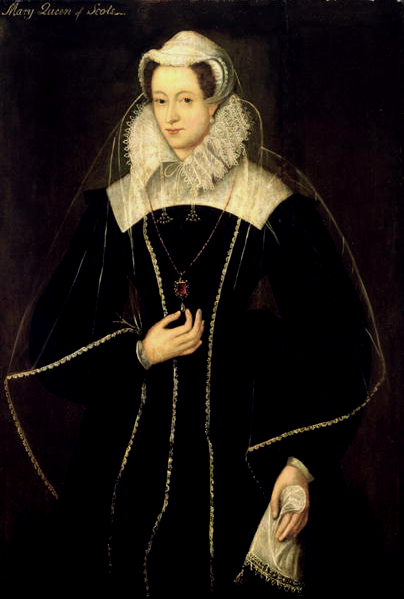
The Rape of Mary Queen of Scots

In spite of the black legend of the frivolous queen, Mary Stuart was a hard-working, business-like ruler. Furthermore, she did not have an affair with Bothwell. He kidnapped and raped her. From History Today:

Negative assessments of Mary’s qualities as ruler have virtually ignored the dispatches of Thomas Randolph, the English ambassador, who, although sometimes misled by Mary’s statements, usually was aware of her whereabouts. It is interesting that the register has no entries concerning her meetings with the council that Randolph witnessed. In 1561 he named five occasions, for example, when she consulted with the council that are not in the register. While absent, she was likely disposing of other business. On 17 February 1566, for instance, she reported to Sir Robert Melville, another ambassador, that she had just pardoned John Johnston for delivering English funds to her rebels and that, as Randolph was then conferring with her council, she immediately ordered him to leave her realm. His dispatches also reveal her interest in the law.

In 1563 she augmented the stipends of the lords of Session and replaced the old ecclesiastical courts with Edinburgh’s Commissary Court and provincial commissariats. Three years later her appointment of James Balfour of Pittendreich and others to revise Scotland’s laws resulted in the publication of the first complete edition of the acts of parliament, known as the Black Acts, a milestone in the history and use of statutory law.

Another measure of success is the willingness of rulers to be seen dispensing law and order throughout the realm. In her short personal reign, she stayed with 82 hosts in many parts of Scotland. She covered 1,200 miles between August 1562 and September 1563 and travelled extensively thereafter. Furthermore, in 1562, she approved a financial settlement for the Kirk. The holders of Catholic benefices retained two-thirds of their income for their lifetimes, and the crown confiscated the other one-third to cover governmental costs and to support Protestant ministers. This settlement accepted the existence of a two-structured church, one reformed, one Catholic, although priests were still forbidden to say mass except at court....


Leaving James in Bothwell’s and Huntly’s custody, Mary went into secluded mourning. Emerging in late March, she transferred her child to the charge of John, earl of Mar, at Stirling. Meanwhile, Lennox demanded that Darnley’s assailants be tried for murder. Scottish justice still relied on private individuals, especially among the nobility, to obtain remedy usually in the form of money compensation for injuries to their relatives. The privy council established a date for Lennox’s accusation of Bothwell in early April, but when Lennox failed to raise as many troops as Bothwell for the purpose of influencing the assize’s decision, the customary noble procedure, he fled to England, leaving Bothwell to be acquitted, since no evidence was introduced against him.

Bothwell took the opportunity his success offered to persuade some members of a recent parliament, while they were at Ainslie’s Tavern, to sign a band validating his acquittal and proposing that he wed Mary. On 24 April, as she was returning from visiting her son, Bothwell approached her with 800 horsemen, grabbed her bridle, and warned her it was dangerous to continue on to Edinburgh. She dispatched an attendant to alert the citizens who guessed that she was in trouble, but they managed only to fire their cannon as Bothwell’s forces sped by to Dunbar. There, after he raped her, she agreed to wed him. Like many other victims, she felt polluted and refused to reveal the violence for fear of being deemed immodest for speaking of such matters. To protect her honour, she was willing to endure religious and political censure.

That her abduction was opportunistic is indicated by the complication that Bothwell still needed to divorce his wife, Jean Gordon. Although Edinburgh’s Commissary Court granted the divorce, John Hamilton, archbishop of St Andrews, by virtue of his position as papal legate a latere, also annulled their union. Even before their Protestant wedding on 15 May, Mary’s subjects began signing bands that led to another rebellion. In early modern Britain, each female monarch or regent who married encountered strong opposition from her subjects.

Some observers believed that Mary colluded in the abduction because she needed a husband to help her rule Scotland; others charged her with aiding Bothwell in killing her husband. Validating these rumours requires disregarding the statements of the French ambassador in Scotland who claimed after the wedding, which he boycotted, that she never ceased weeping and was overheard contemplating suicide. The major evidence for the charge that she was Bothwell’s adulterous accomplice are the documents contained in a silver chest discovered at Edinburgh Castle, the so-called Casket Letters. As their French originals, if they ever existed, are no longer extant, it is impossible to conclude definitively about their authorship, although it borders on the incredible to believe that a woman, who learned in her childhood to cipher all sensitive correspondence, would have so radically rejected that training. As an English captive, she became famous for her use of ciphers. (Read entire post.)


Share