Thursday, December 13, 2012

Sing We Noël!

A history of Christmas carols.
It is from the medieval Church and from her very life, the liturgy, that the custom of singing songs to the Christ child descends. The earliest noëls sprang directly from such chants as the Carolingian anthem Puer natus est and the O antiphons sung before the Magnificat at vespers during the octave leading up to Christmas. The word noël itself derives from the Latin natalis and appears in the form of the salute Noé! in Christmas Masses in the 12th century, meaning approximately “Hail, newborn one.” In the 13th century, the O antiphons emerged from the monastic choirs and took to the streets in the form we still know and love as Veni, veni Emmanuel. Many of the earliest Christmas songs that survive today are similarly bound to the liturgy and its language, often taking the form of what is called macaronic verse, in which Latin lines alternate with vernacular, with Bl. Heinrich Suso’s In Dulci Jubilo and the anonymous Célébrons la Naissance Nostri Salvatoris being particularly fine examples of the type. (Read entire article.)
Share

Wednesday, December 12, 2012

Winter at Trianon

Photos from Marie-Antoinettes's gardens at Versailles. (From Château de Versailles Photos)


Share

Marie-Antoinette's Books

Some brilliant soul put all of the books from Marie-Antoinette's private library on the Library Thing. Even the most cursory look at the titles in the Queen's library should tell us that she was not the feather head that pop history makes her. (She obviously loved drama...and history, too.) Share

Tuesday, December 11, 2012

La Barry

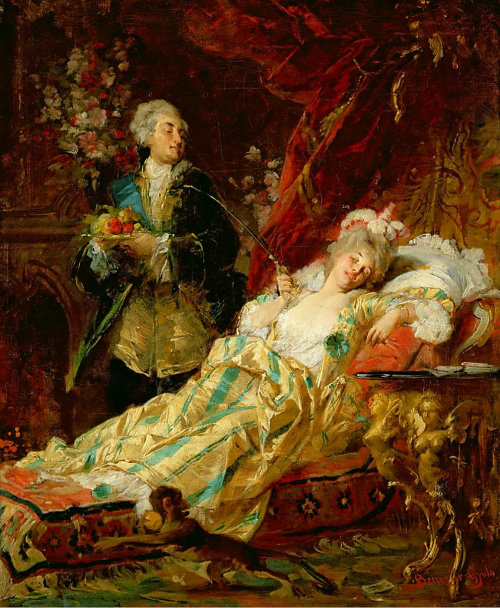
Madame du Barry with Louis XV. The anniversary of her death was on December 8. Pray for her. As Madame LeBrun wrote in her Memoirs:
Being arrested and thrown into prison, Madame du Barry was tried and condemned to death by the Revolutionary Tribunal at the end of 1793. She was the only woman, among all who perished in those dreadful days, unable to face the scaffold with fortitude; she screamed, she begged for forgiveness to the hideous mob surrounding her, and that mob became moved to such a degree that the executioner hastened to finish his task. This has always confirmed my belief that if the victims of that period of execrable memory had not had the noble pride of dying with fortitude the Terror would have ceased long before it did.
Share

Regency Gambling Clubs

The story of Crockford's Club.
Take William Crockford, who began his career as a London fishmonger and ended it, half a century later, as perhaps the wealthiest self-made man in England. Crockford managed this feat thanks to one extraordinary talent—an unmatched skill for gambling—and one simple piece of good fortune: to be alive early in the 19th century, when peace had returned to Europe after four decades of war and a generation of bored young aristocrats, who a few years earlier would have been gainfully employed in fighting Napoleon, found themselves with far too much time on their hands.

The result was a craze for heavy gambling that ran throughout the notoriously dissolute Regency period (c.1815-1838). The craze made Crockford rich and bankrupted a generation of the British aristocracy; at the height of his success, around 1830, the former fishmonger was worth the equivalent of perhaps $160 million today, and practically every cent of it had come straight from the pockets of  the aristocrats whom “Crocky” had lured into the luxurious gambling hell that he had built on London’s fashionable St. James’s Street. So successful was Crockford at his self-appointed task of relieving his victims of their family fortunes that there are, even today, eminent British families that have never properly recovered from their ancestors’ encounters with him. (Read entire article.)
Share

Monday, December 10, 2012

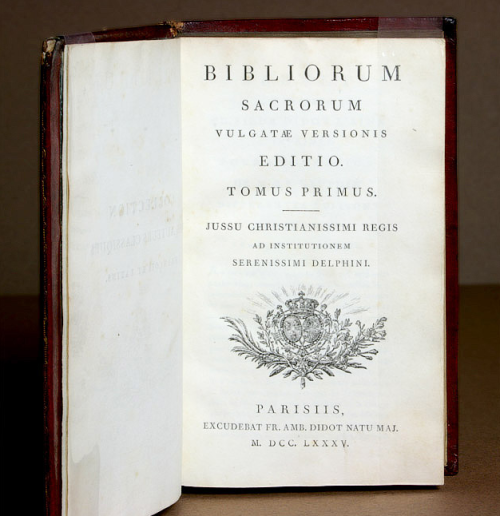
The Dauphin's Bible

Ordered by Louis XVI for his oldest son. Share

How People Use Twitter

A report from the Smithsonian. To quote:
This is just to remind all of us that Twitter was born not as a grand vision, but more an act of desperation. And that it was originally meant as nothing more than a cool way to send reports of your status to all of your friends at once.

Which makes it all the more remarkable that these days Twitter is being hailed as everything from a barometer of the nation’s emotional health to a conduit for the flow of linguistic invention to a tool for urban planners to map travel routes.

Oh, and earlier this week, a young mother reportedly named her newborn daughter “Hashtag.” 

There are those, of course, who think way too much is being made of Twitter’s capacity for capturing the zeitgeist. But there’s no question that it’s gaining status as an analytical tool. (Read entire post.)
Share

Sunday, December 9, 2012

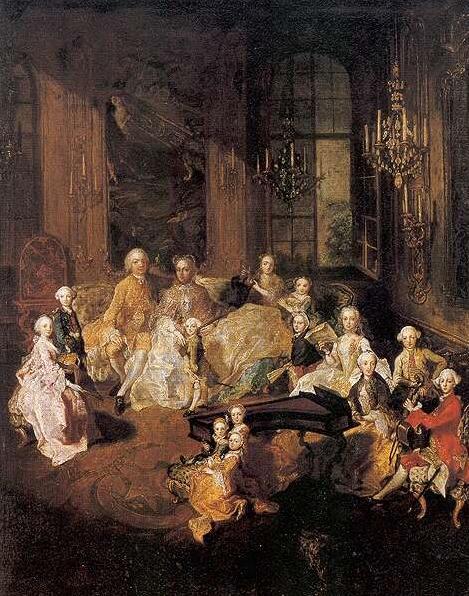
The Imperial Family of Austria

The most complete portrait of the family of Emperor Francis Stephen and Empress Maria Theresa, showing all of the children except for the three who died in infancy. (Via Vive la Reine.) Share

Education and the Revolution

How we got where we are as well as some proposals for reform. To quote:
Babbitt demonstrates that it was Jean-Jacques Rousseau (1712-1778) who first grasped the “liberating” potential of the ethical nihilism implicit in Baconian Science. If Nature (including human nature) is blind and dumb, then each individual being is free to follow its own whims, shrugging off the constraints of conventional morality as nothing more than the heavy hand of a dead past. Science has debunked the moralists of the past as superstitious worshippers of a rational and meaningful order thought to predate the emergence of the individual consciousness. Instead, human beings must be “compelled to be free,” taught to treat every felt impulse within as an unquestionable authority, fully realizing Plato’s nightmarish vision of the “democratic soul” in Book VIII of The Republic.

Rousseau proposed a new “morality” of feeling, to replace the dying morality of reasoned self-discipline. Justice and virtue were to be replaced by an amorphous compassion, which subsequent history has revealed to be almost infinitely malleable, producing holocausts and gulags as easily as free dental plans and kindergartens. As Babbitt puts it, “Rousseau confounds the law for man with his own temperament.” To be clear, let me emphasize that Babbitt was no foe of either science or compassion. As he explains, “The more scientific progress and the more social pity the better. Exception can be taken to these things only when they are set up as absolute and all-sufficient in themselves.”[4] (Read entire article.)
Share