A place for friends to meet... with reflections on politics, history, art, music, books, morals, manners, and matters of faith.
A blog by Elena Maria Vidal.
"She was not a guilty woman, neither was she a saint; she was an upright, charming woman, a little frivolous, somewhat impulsive, but always pure; she was a queen, at times ardent in her fancies for her favourites and thoughtless in her policy, but proud and full of energy; a thorough woman in her winsome ways and tenderness of heart, until she became a martyr."
"We have followed the history of Marie Antoinette with the greatest diligence and scrupulosity. We have lived in those times. We have talked with some of her friends and some of her enemies; we have read, certainly not all, but hundreds of the libels written against her; and we have, in short, examined her life with– if we may be allowed to say so of ourselves– something of the accuracy of contemporaries, the diligence of inquirers, and the impartiality of historians, all combined; and we feel it our duty to declare, in as a solemn a manner as literature admits of, our well-matured opinion that every reproach against the morals of the queen was a gross calumny– that she was, as we have said, one of the purest of human beings."
"It is now sixteen or seventeen years since I saw the queen of France, then dauphiness, at Versailles; and surely there never lighted on this orb, which she hardly seemed to touch, a more delightful vision. I saw her just above the horizon, decorating and cheering the elevated sphere she had just begun to move in, glittering like a morning star full of life and splendor and joy. Oh, what a revolution....Little did I dream that I should have lived to see such disasters fall upon her, in a nation of gallant men, in a nation of men of honor and of cavaliers! I thought ten thousand swords must have leaped from their scabbards, to avenge even a look which threatened her with insult. But the age of chivalry is gone; that of sophisters, economists, and calculators has succeeded...."
~Edmund Burke, October 1790
A Note on Reviews
Unless otherwise noted, any books I review on this blog I have either purchased or borrowed from the library, and I do not receive any compensation (monetary or in-kind) for the reviews.
The manuscript was made at a time when Irish churchmen and scholars not
only travelled extensively but welcomed people from across Europe to
study in its schools. Books also circulated widely at this time, whether
as working texts, diplomatic gifts or exemplars distributed to
scriptoria (monastery rooms where manuscripts were copied) across
Europe.
Writing in the early 20th century, the celebrated author James
Joyce noted that the Book of Kells – an illuminated manuscript depicting
the four gospels of the New Testament in Latin – was “the most purely
Irish thing we have”.
By this time, the unique and intricate designs of the approximately
1,200-year-old manuscript were instantly recognisable, having been
replicated on everything from embroidered clothing to tea sets coveted
by nationalists and the Irish diaspora alike. These designs were deemed
symbolic of “pure” Irish visual identity, created before the coming of
the Vikings and the Anglo-Normans to Irish shores.
For well over a century, debate has raged as to whether the
manuscript was made at Iona on the west coast of Scotland, the northern
English monastery of Lindisfarne or indeed a different Columban
monastery in Ireland. Now, a new contribution to the debate, The Book of Kells Unlocking the Enigma, soon to be published by archaeologist and art historian Victoria Whitworth, adds further food for thought on the topic.
The manuscript known as the Book of Kells
was first referred to as such by the great biblical scholar Bishop
James Ussher (1581-1656) to distinguish between two “gospel books of
[St] Columcill”, one kept at Kells, county Meath, the other at Durrow in
county Offaly.
Land charters transcribed on to the pages of the Kells manuscript
prove that it had been there since at least the 11th century, and is
therefore likely to be the same “great gospel book of Columcille”
recorded as having been stolen and subsequently recovered from the same
monastery in 1007.
Although nobody knows exactly when it was made, art historians and
paleographers (experts in handwriting and manuscripts) agree that the
Book of Kells most likely dates to the late 8th century. And therein
lies a problem. The monastery at Kells was not founded until 807, when
monks fleeing Viking incursions on the Scottish Hebridean island of Iona
were gifted a safer inland site in Ireland to establish a new,
ultimately thriving, monastery. So, while we know the manuscript spent
at least 650 years at Kells, we do not know where it started its life.
Between 1994 and 2007, an archaeological excavation at the Pictish
monastic site of Portmahomack, Easter Ross in the north-east of Scotland
revealed the first-known evidence for the widescale manufacture of
parchment in northern Europe.
This was particularly surprising, as no surviving manuscript has
previously been identified as coming from this area. In addition to
this, Whitworth has identified Pictish stones carved with designs and
writing like that found in the Book of Kells. So, does this mean that
the most purely Irish thing we have is actually Pictish?
The manuscript was made at a time when Irish churchmen and scholars
not only travelled extensively but welcomed people from across Europe to
study in its schools. Books also circulated widely at this time,
whether as working texts, diplomatic gifts or exemplars distributed to
scriptoria (monastery rooms where manuscripts were copied) across
Europe.
This cultural mix is evident in the significant range of artistic
sources drawn on by the Book of Kells artists. Clearly they had access
to designs from contemporary continental gospels, Irish fine metalwork,
Byzantine icons and imagery found on Pictish stones. None of the scribes
or artists recorded their names, and indeed we don’t even know how many
there were, such is the relative consistency of the script.
Non-invasive pigment analysis of the manuscript some years ago
revealed the use of pigments typical to manuscript production in
Scotland and Ireland during the period, some cleverly blended in such a
way as to mimic the precious gold and lapis lazuli that lay beyond their
reach.
An estimated 159 calf skins were used to make its surviving pages,
some of which were of very poor quality. What we don’t know is whether
these animals were reared and processed close to the scriptorium where
the manuscript was made, whether they might have been collected up from
across the territory of a wealthy donor, or whether they were brought in
from a single specialist “processor”, as for example, at Portmahamock.
Ultimately, advances in non-invasive DNA testing may provide scientific
answers to these questions and reveal much regarding the economy of the
period. (Read more.)
Marie-Antoinette "en gaulle" by Elisabeth Vigée-Lebrun
Generalissima: A Novel of Henrietta Maria
Book Two in the "Henrietta of France Trilogy"
#1 in Kindle Biographies of Royalty!
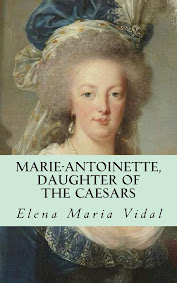
Marie-Antoinette, Daughter of the Caesars: Her Life, Her Times, Her Legacy
An Audible Bestseller
Marie-Antoinette, Daughter of the Caesars: Her Life, Her Times, Her Legacy
An Amazon Bestseller
Trianon: A Novel of Royal France
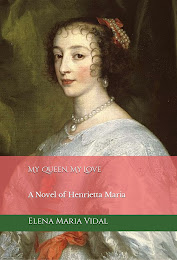
My Queen, My Love: A Novel of Henrietta Maria
Available from Amazon
The Saga of Marie-Antoinette's daughter, Marie-Thérèse of France
A Novel of the Restoration
In Kirkus Top 20 for 2014! And #1 in Kindle Historical Mystery, Thriller & Suspense Fiction
"In every Eden, there dwells a serpent . . . ."
#1 in Kindle History of France!
The Night's Dark Shade: A Novel of the Cathars
Join me on Facebook!
Elena Maria Vidal Author Page
Join me on X!
@emvidal
Visit My Tumblr!
East of the Sun, West of the Moon
St. Teresa of Avila, pray for us!
"...Bud forth as the rose planted by the brooks of waters. Give ye a sweet odor as frankincense. Send forth flowers, as the lily...and bring forth leaves in grace, and praise with canticles, and bless the Lord in his works." —Ecclesiasticus 39:17-19
The fact that a link is provided here in no way constitutes an endorsement of everything on the other end of the link.
Comments Policy
Comments are moderated. If a comment is not published, it may be due to a technical error. At any rate, do not take offense; it is nothing personal. Slanderous comments will not be published. Anonymity may be tolerated, but politeness is required.
I would like to respond to every comment but my schedule renders it impossible to do so. Please know that I appreciate those who take the time to share their thoughts.








No comments:
Post a Comment